Measles Symptoms in Adults: Signs, Risks and When to Get Help
Measles is no longer just a childhood illness: about 4 in 10 US cases in 2026 are in adults. Here is how the symptoms unfold in adults, why they can be more serious, and how to check whether you are protected.
- Written by
- Health Daily Advice
- Published
- Reading time
- 9 minutes
- Sources
- 12 cited
In this guide
Measles symptoms in adults start 7 to 14 days after exposure, with a high fever, cough, runny nose and red, watery eyes. Small white spots may appear in the mouth, then 3 to 5 days later a red rash starts on the face and spreads downward. Adults over 20 face a higher risk of serious complications, so early advice matters.
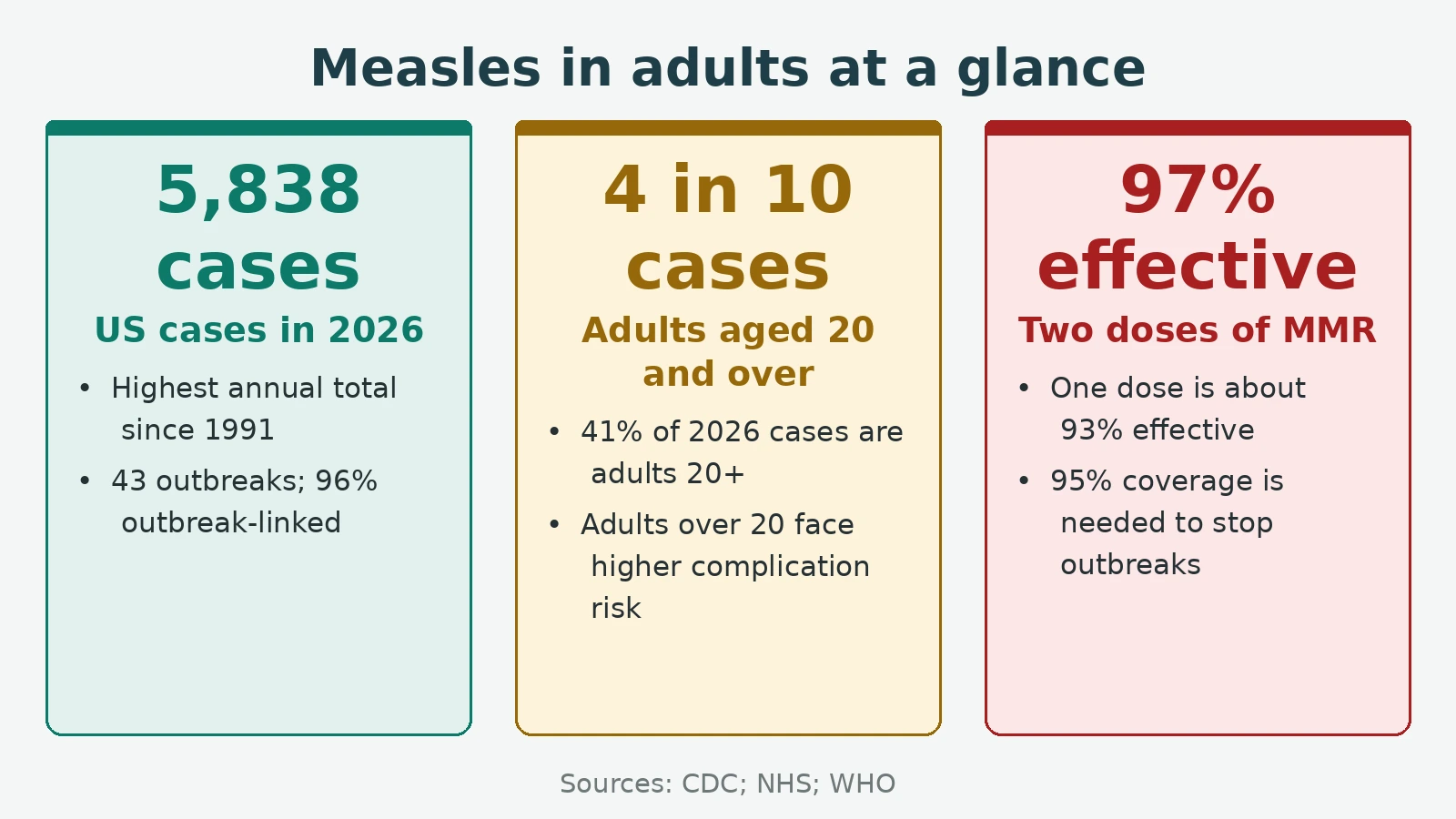
That last point surprises a lot of people. Measles is still talked about as a childhood illness. The 2026 outbreak in the United States has turned that idea on its head. The CDC reported 5,838 confirmed measles cases as of 19 November 2026, the highest annual total since 1991, and about 4 in 10 of those cases are in adults aged 20 and older. Pennsylvania has been hit hardest, with 1,631 confirmed cases there as of 20 November 2026. After 26 years, the United States has also lost the measles elimination status it had held since 2000.
What are the symptoms of measles in adults?
The CDC lists four early symptoms that usually appear together, 7 to 14 days after contact with the virus:
- High fever. Often the first sign, and it can climb above 104°F (40°C). The fever may spike again when the rash appears.
- Cough. Usually dry and persistent.
- Runny nose. A blocked or streaming nose, often with sneezing.
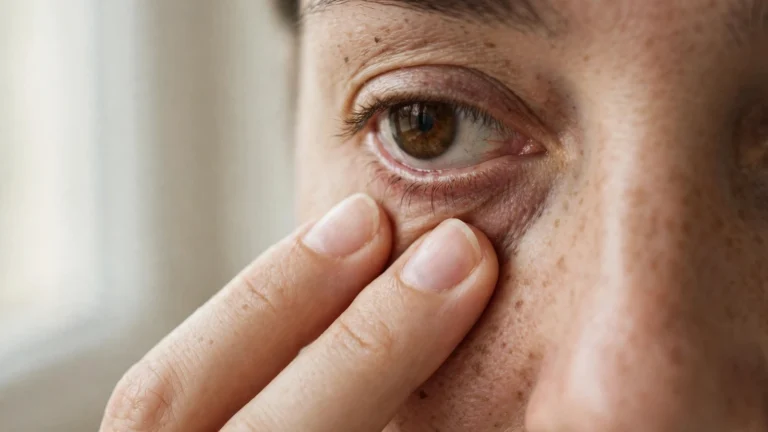
- Red, watery eyes. The whites of the eyes look bloodshot and sore, and bright light can feel uncomfortable. Doctors call this conjunctivitis.
Alongside these, many adults feel wiped out in a way that goes beyond an ordinary cold. Tiredness, muscle aches, a sore throat, and headache are all common, according to the Cleveland Clinic. What sets measles apart is what comes next: the mouth spots, then the rash.
Koplik spots: the early clue inside the mouth
Two to three days after the first symptoms begin, tiny white spots may appear inside the mouth. The CDC describes them as tiny white spots on the inside of the cheeks and the back of the lips. Doctors call them Koplik spots, and they look a little like grains of salt on a red background. They fade as the rash arrives.
Koplik spots matter because they show up before the rash, when measles still looks like any other cold. They are easy to miss, but they are one of the strongest early hints a doctor has. If you notice small white spots inside your cheeks along with a high fever, cough, and red eyes, call a doctor before going in — and say you are worried about measles.
The measles rash: what it looks like and how it spreads
The rash is usually the last of the classic signs to arrive. It appears 3 to 5 days after the first symptoms, and the WHO gives the same window.
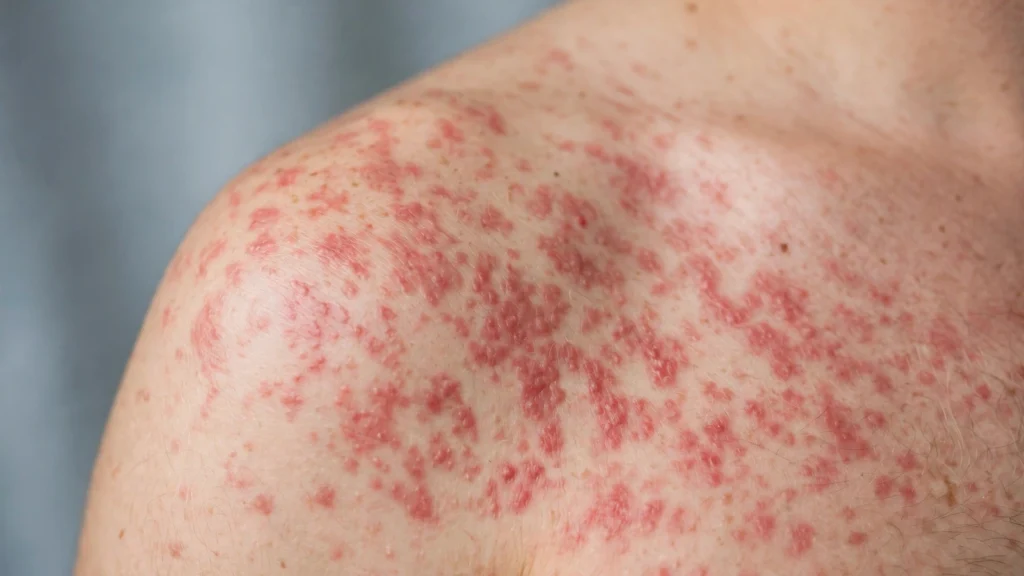
It starts as flat red spots on the face, around the hairline and behind the ears, then spreads downward to the neck, trunk, arms, legs, and feet. As the rash spreads the spots often join together into larger blotchy patches. When the rash appears, the fever may spike to more than 104°F. The rash usually lasts 5 to 6 days, then fades in the same order it appeared.
The rash is not usually itchy, which surprises anyone expecting something like chickenpox. On brown and black skin it can look purple or darker than the surrounding skin, and it may be harder to see — the NHS flags this specifically. In adults who were vaccinated long ago, the illness can be milder and the rash fainter.
Measles symptoms timeline in adults
Measles follows a timetable that is remarkably consistent. The CDC gives the incubation period as 7 to 14 days from exposure to first symptoms, typically 11 to 12 days, and the WHO notes that early symptoms usually last 4 to 7 days.
| When | What happens |
|---|---|
| Day 0 | Exposure to the virus, usually by breathing in droplets. |
| Days 7–14 | First symptoms: high fever, cough, runny nose, red watery eyes. You are already contagious. |
| Days 9–17 | Koplik spots may appear inside the mouth, 2–3 days after symptoms begin. |
| Days 10–19 | Rash appears 3–5 days after symptoms start, beginning on the face and spreading downward. Fever may spike above 104°F. |
| Days 15–25 | Rash fades in the order it appeared. Most people start to feel better within about a week. |
The Cleveland Clinic puts the whole illness at roughly 10 to 14 days when there are no complications. A fever that keeps going for more than five days after the rash, or a cough that gets worse instead of better, can be a sign of pneumonia — that needs medical attention, not more waiting.
How does measles spread, and how contagious is it?
Measles is one of the most contagious viruses known. It spreads through the air when an infected person breathes, coughs, sneezes, or talks, and the WHO says the virus stays active in the air or on surfaces for up to two hours. The Cleveland Clinic estimates that if one person in a room of unvaccinated people has measles, 9 out of 10 of them will catch it, and the WHO says one infected person can generate up to 18 secondary infections.
The part that makes outbreaks so hard to contain is the timing. You are contagious from about four days before the rash appears until four days after it starts, according to the NHS and the CDC alike — the stretch when you feel like you have a cold and have no idea it is measles.
That is also why the advice is so specific: stay home and stay off work for at least four days from when the rash first appears. The NHS gives the same four-day rule and adds that you should avoid close contact with babies, pregnant women, and anyone with a weakened immune system. Call your doctor or clinic first rather than turning up in person.
Why measles can be more serious in adults
There is a stubborn idea that catching measles as an adult is somehow milder. The numbers point the other way. The CDC lists adults older than 20 as one of the groups most likely to suffer complications, alongside children under 5, pregnant women, and people with weakened immune systems.
Part of the reason is simple exposure history. Many adults received only one dose of the MMR vaccine as children, or are unsure whether they were vaccinated at all. Others were vaccinated between 1963 and 1968, when an early version of the vaccine was used that does not give lasting protection — the Mayo Clinic says those people need to be vaccinated again.
Age itself also plays a role. An adult’s immune system responds to measles with a stronger inflammatory reaction, which is part of why fevers run so high and why pneumonia is more common in adults than in school-age children. In the 2026 outbreak, about 11% of all cases have needed hospital care, and the CDC says about 1 in 5 unvaccinated people who get measles in the US is hospitalized.
There is a longer shadow too. Measles can damage the immune system’s memory, leaving you more vulnerable to other infections after you recover. The CDC says this effect, sometimes called immune amnesia, can last months or even up to a few years.
Complications of measles in adults
Most adults recover from measles without lasting harm. But the complications, when they come, can be severe. The CDC lists pneumonia and encephalitis as the severe complications, and the WHO adds blindness, severe diarrhea, ear infections, and severe breathing problems.
- Pneumonia. Infection of the lungs, and the most common cause of death from measles. As many as 1 in 20 children with measles gets pneumonia, according to the CDC.
- Encephalitis. Swelling of the brain, which can cause convulsions and leave lasting damage such as deafness. About 1 in every 1,000 people who get measles develops it, according to the CDC.
- Ear infections. About 1 in 10 children with measles gets an ear infection, which can sometimes lead to hearing loss.
- Diarrhea and dehydration. Reported in fewer than 1 in 10 people with measles, but severe enough in some cases to need hospital care.
- Death. Nearly 1 to 3 of every 1,000 children who get measles die from respiratory and neurologic complications, according to the CDC. Six measles-associated deaths have been confirmed in the US in 2026.
- SSPE. Subacute sclerosing panencephalitis is a very rare but fatal brain disease that can develop 7 to 10 years after a measles infection.
Before the vaccine, measles was a routine killer in the United States: the CDC estimates that about 48,000 people were hospitalized and 400 to 500 died each year. Globally, the WHO estimates 95,000 people died from measles in 2024, even though vaccination has averted nearly 59 million deaths since 2000.
Measles in pregnancy
Measles during pregnancy deserves its own warning because the risks fall on two people at once. The CDC says measles in pregnancy may cause premature birth or a low-birth-weight baby, and the NHS adds miscarriage and stillbirth to that list. If you are pregnant and think you have been exposed — even if you feel fine — contact your doctor or midwife the same day. The MMR vaccine cannot be given during pregnancy, which is why checking immunity before pregnancy matters so much.
How do I know if I am protected against measles?
For most adults, the answer is in their medical records. The CDC says two doses of the MMR vaccine are about 97% effective at preventing measles, and one dose is about 93% effective. Breakthrough infections can still happen, especially where a lot of virus is circulating, but they tend to be milder.
You are generally considered protected if:
- Written records show two doses of a measles-containing vaccine given on or after your first birthday.
- A blood test has shown you have measles antibodies, or a medical record shows you had measles itself.
- You were born or living in the US before 1957. The Mayo Clinic notes that most people from before 1957 are immune because they had the infection.
There are gaps worth checking. If you only ever had one dose, you may need a second, especially if you work in healthcare or travel widely. If you were vaccinated between 1963 and 1968, that early vaccine does not give lasting protection. If you have no records, a doctor can check your immunity with a blood test or simply arrange the vaccine.
Measles only stops spreading when enough people are immune: the CDC says more than 95% of a community needs to be vaccinated. US kindergarten MMR coverage has slipped from 95.2% in 2019–2020 to 92.4% in 2025–2026, leaving about 280,000 kindergartners at risk, according to the CDC.
What to do if you think you have measles
The first step is a phone call, not a trip to the waiting room. Call your doctor, an urgent care line, or your local health department right away and describe your symptoms. Tell them you are worried about measles so they can see you separately from other patients.
There is no specific drug that kills the measles virus. The WHO is clear on this: there is no specific treatment for measles, and the Cleveland Clinic says the same — there is no cure. Care focuses on rest, fluids, and easing the fever while your body fights the infection. Doctors may use antibiotics for secondary bacterial infections such as pneumonia, but antibiotics do nothing against the virus itself.
While you are ill, stay home until at least four days after the rash appeared. Rest, drink water regularly, and open a window for fresh air. Do not share cutlery, cups, towels, or bedding, and wash your hands often. If you live with someone who is pregnant, a baby, or a person with a weakened immune system, keep your distance and let your doctor know.
When to see a doctor
Call a doctor the same day if you have a high fever with a cough, runny nose, and red eyes — especially if a rash follows or you know you have been exposed to measles. Pregnant women, people with weakened immune systems, and close contacts of a measles case should get advice urgently, even before symptoms appear.
Get emergency help straight away if you or someone with measles has trouble breathing, a seizure, confusion, severe headache, a stiff neck, or an inability to stay awake. A fever above 105°F also needs urgent attention.
In an emergency call 911 (US), 999 (UK) or 112 (EU)
Measles is easy to dismiss in its first few days, when it looks like nothing more than a heavy cold. In 2026, with the worst US outbreak in more than three decades under way, that is a mistake worth avoiding. Know the symptoms, how long you can spread it, and whether you are protected. If you are not sure about your MMR history, talk to a doctor or pharmacist — a two-minute check now is far better than a fortnight of illness.
Frequently asked questions
What are the first symptoms of measles in adults?
The first symptoms are a high fever, cough, runny nose and red, watery eyes, appearing 7 to 14 days after exposure, according to the CDC. Tiny white spots called Koplik spots may appear inside the mouth 2 to 3 days later, followed by a red rash 3 to 5 days after the first symptoms. The fever can spike above 104°F when the rash appears.
How long does measles last in adults?
Measles usually lasts about 10 to 14 days without complications, and most people start to feel better within about a week of the rash, according to the Cleveland Clinic and the NHS. You are contagious from 4 days before the rash until 4 days after it appears, and you should stay off work for at least 4 days from when the rash first shows.
Is measles more dangerous in adults than in children?
It can be. The CDC lists adults over 20 as one of the groups most likely to develop serious complications, along with children under 5, pregnant women and people with weakened immune systems. Pneumonia and encephalitis are the main risks, and about 1 in 5 unvaccinated people who get measles in the US is hospitalized.
Can you get measles if you were vaccinated as a child?
It is possible but uncommon. Two doses of the MMR vaccine are about 97% effective and one dose about 93% effective, according to the CDC, and breakthrough illness tends to be milder. People vaccinated between 1963 and 1968 need vaccinating again, as that early vaccine does not give lasting protection. A doctor can check your immunity with a blood test.
How can I tell a measles rash from other rashes?
A measles rash starts as flat red spots on the face, around the hairline and behind the ears, then spreads downward to the neck, trunk, arms and legs over a few days. The spots often join into blotchy patches, the rash is not usually itchy, and the fever often spikes above 104°F when it appears. On brown and black skin it may look purple or darker.
What should I do if I think I have measles?
Call your doctor, an urgent care line or your local health department first — do not turn up at a clinic unannounced, so staff can see you separately from other patients. There is no specific drug for measles; care focuses on rest and fluids. Stay home until at least 4 days after the rash appeared, and get emergency help for trouble breathing, a seizure or confusion.
Sources
- CDC: Measles Cases and Outbreaks www.cdc.gov
- CDC: Measles Symptoms and Complications www.cdc.gov
- NHS: Measles www.nhs.uk
- WHO: Measles fact sheet www.who.int
- Mayo Clinic: Measles — Symptoms and causes www.mayoclinic.org
- Cleveland Clinic: Measles (Rubeola) my.clevelandclinic.org
- Reuters (via LA Post): US measles cases near 6,000 mark as outbreak worsens www.lapost.com

Try the tool
Not sure if it can wait?
Common causes and warning signs for 16 everyday symptoms.
Open the symptom guide