Vitamin D Deficiency Symptoms in Winter: Signs to Watch
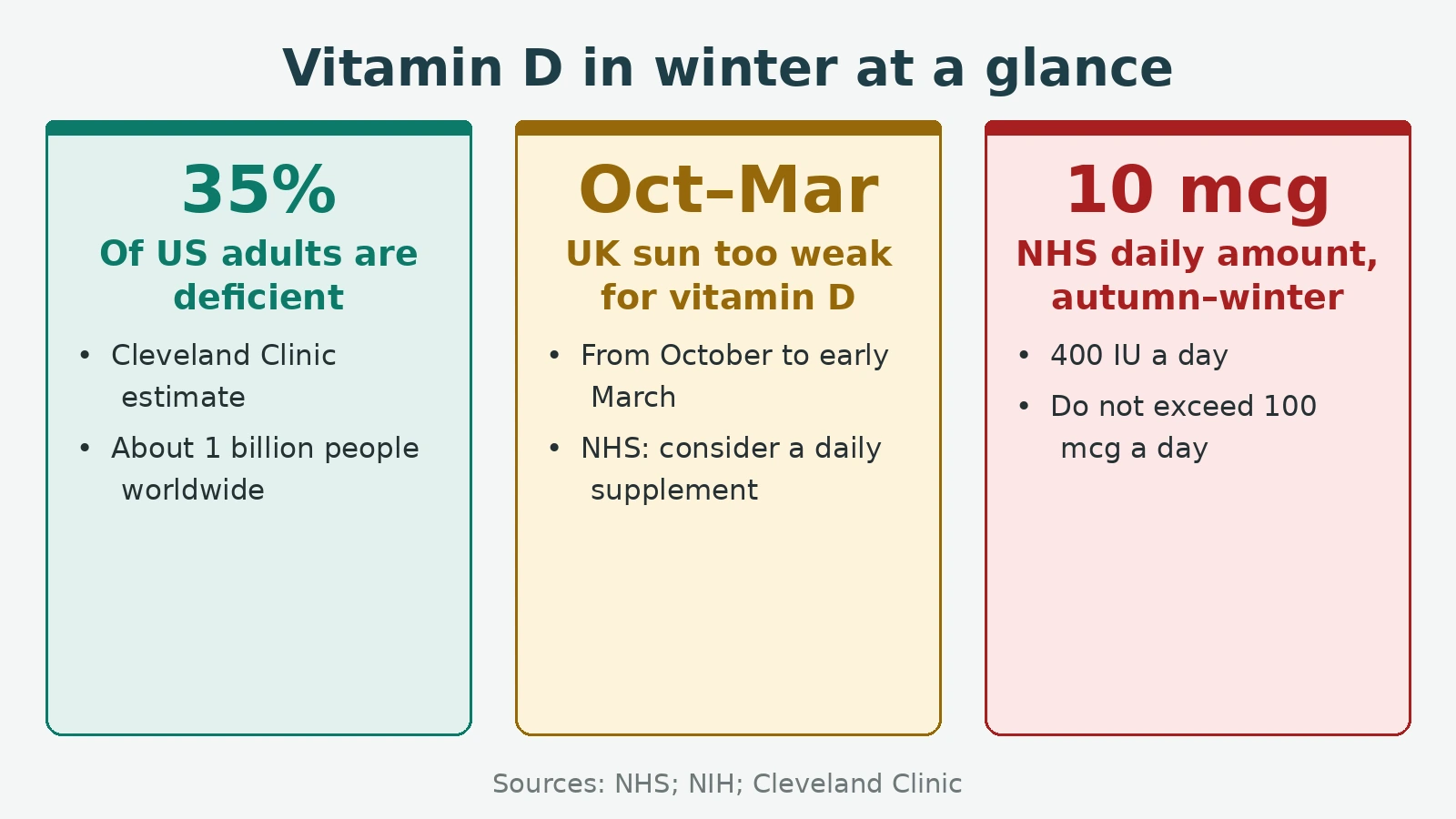
Vitamin D deficiency in winter often causes no symptoms, but tiredness, bone pain and muscle weakness can be warning signs. UK sunlight is too weak to make vitamin D from October to early March, so levels fall steadily through the darker months.
- Written by
- Health Daily Advice
- Published
- Reading time
- 9 minutes
- Sources
- 7 cited

In this guide
Vitamin D deficiency in winter often causes no symptoms at all, but when signs appear they usually include tiredness, bone pain, muscle weakness or aching, and low mood. Levels fall because UK sunlight from October to early March is too weak for skin to make vitamin D. A blood test is the only way to know for certain.
Vitamin D helps the body absorb calcium, so it plays a central part in keeping bones and muscles healthy. When levels stay low for months, bones can soften and muscles can weaken, which is why a winter shortfall matters even when it causes no obvious trouble at first. This article explains why levels dip in the darker months, which signs to watch for, who is most likely to run low, and what official guidance says about food and supplements.
Why winter lowers vitamin D levels
Vitamin D is made in the skin when UVB rays, with a wavelength of roughly 290 to 320 nanometres, strike uncovered skin. In winter at northern latitudes the sun sits too low in the sky, so UVB is too weak to trigger production, however bright the day looks or however long someone stays outside.
The NHS puts the UK cut-off plainly: from October to early March, sunlight is not strong enough for the skin to make enough vitamin D. From about late March or early April to the end of September, most people can make all they need from sunlight.
Several other factors shape how much vitamin D the skin can make. Season, time of day, length of day, cloud cover, smog, skin melanin and sunscreen all affect how much UVB reaches the skin, and UVB does not pass through glass, so sitting beside a window does not produce vitamin D. Older people and people with dark skin also make less vitamin D from sunlight, and skin synthesis drops with age.
Levels slide steadily through the darker months because the body relies on what was built up in summer, plus food and supplements. The blood marker used to measure vitamin D, 25(OH)D, has a half-life of about 15 days, so stores fall away week by week. Food alone rarely closes the gap: only about 10 to 20 percent of vitamin D typically comes from diet in the UK, which is why the NHS advises a supplement in autumn and winter.
Symptoms of vitamin D deficiency
Many people with low vitamin D have no symptoms at all, and a deficiency is often only picked up on a blood test. When symptoms do occur they tend to be vague, and they overlap with many other causes, so they are easy to miss or to blame on something else.
In adults, the symptoms listed by the Cleveland Clinic are fatigue, bone pain, muscle weakness, muscle aches or muscle cramps, and mood changes such as depression. Bone pain often affects the back, hips, legs or ribs. If low mood is affecting daily life, support is available at Get Help Now.
Tiredness, low mood or aches alone do not prove a deficiency. Only a blood test can confirm low vitamin D.
The reason these symptoms arise is that a long-term or severe shortage lowers calcium absorption, which can lead to low blood calcium and overactive parathyroid glands. The body then pulls calcium from bones, speeding up bone breakdown. Over time, soft bones can develop, known as osteomalacia in adults, along with a higher risk of fractures. In older adults even a minor fall can break a hip, and with calcium, vitamin D helps protect older adults from osteoporosis.
Vitamin D deficiency in children
In children, severe deficiency causes rickets, with bowed or bent bones, incorrect growth patterns, muscle weakness, bone pain and joint deformities. Mild deficiency in children may show only as weak, sore or painful muscles. In infants, severe deficiency can cause a soft skull, slow sitting and crawling, and muscle spasms from low calcium, with seizures in extreme cases. Parents should seek advice if a child shows bowed legs, delayed growth or slow development.
Who is most at risk
Some people are far more likely than others to run low in winter. The groups named by the NHS, Mayo Clinic and Cleveland Clinic include:
- People with dark skin. Higher melanin reduces vitamin D production from sunlight, and the risk is highest for people of African, African-Caribbean and South Asian background living in northern countries.
- Adults over 65. Skin makes vitamin D less efficiently with age, and the kidneys are less able to convert it to its active form.
- People who spend little time outdoors. This includes frail or housebound people, care-home residents, night-shift workers and office workers.
- People who cover most of their skin outdoors, for cultural or religious reasons.
- People with obesity. Body fat binds some vitamin D and keeps it out of the blood, and gastric bypass surgery also lowers absorption.
- People with conditions that limit fat absorption, such as Crohn’s disease, coeliac disease, ulcerative colitis and cystic fibrosis, since vitamin D needs fat to be absorbed.
- People with kidney or liver disease, because these organs convert vitamin D to its active form.
- Breastfed infants. Human milk provides only about 0.6 to 2.0 mcg of vitamin D per litre, so it cannot meet an infant’s needs alone.
- People on a diet low in vitamin D, including strict vegan diets, lactose intolerance or milk allergy, since most natural food sources are animal-based.
- People taking certain medicines, including steroids, some anti-seizure drugs, weight-loss drugs and cholesterol-lowering medicines, which can lower vitamin D levels or speed its breakdown.
The NHS advises some groups to consider a supplement all year round: people who are rarely outdoors, care-home residents, people who cover most of their skin outdoors, and people with dark skin. Children aged 1 to 4 and babies should also take a supplement all year, unless a baby is having more than 500 ml of infant formula a day.
How vitamin D deficiency is tested
The standard test is a blood test measuring serum 25-hydroxyvitamin D, written as 25(OH)D. It is the main indicator of vitamin D status. Testing is generally used for people with symptoms that could be due to deficiency, or people in a high-risk group, rather than for everyone.
Routine screening is not recommended. The US Preventive Services Task Force found insufficient evidence to assess the benefits and harms of screening adults without symptoms, and no national professional body recommends population screening. The Endocrine Society also does not recommend routine testing in healthy people. Results can also vary between laboratories and test methods, so a reading can be falsely low or high depending on the assay used.
The UK and the US use different thresholds, so a result that looks low in one system may be read differently in the other:
| Reading | UK interpretation | US interpretation |
|---|---|---|
| Below 25 nmol/L | Risk of poor bone and muscle health rises | At risk of deficiency |
| 25 to 29 nmol/L | Above the UK risk threshold | At risk of deficiency |
| 30 to 50 nmol/L | Above the UK risk threshold | Potentially inadequate |
| 50 nmol/L or more | Above the UK risk threshold | Sufficient for most people |
In the UK, the Scientific Advisory Committee on Nutrition set its intake recommendation to keep most of the population at or above 25 nmol/L all year. In the US, the Food and Nutrition Board bands run from below 30 nmol/L, classed as at risk of deficiency, through 30 to 50 nmol/L, classed as potentially inadequate, to 50 nmol/L or more, classed as sufficient for most people. Levels above 125 nmol/L may be linked to adverse effects.
Food sources of vitamin D
Food can help, but it rarely supplies enough on its own in winter. The richest sources are oily fish, red meat, egg yolks, fortified foods such as some fat spreads and breakfast cereals, and liver, although liver should be avoided in pregnancy. Vitamin D in eggs is found in the yolk.
Some examples from the NIH Office of Dietary Supplements show how modest food amounts are: cooked sockeye salmon provides about 14.2 mcg (570 IU) per 3 ounces, a large scrambled egg provides about 1.1 mcg (44 IU), and a serving of fortified ready-to-eat cereal provides about 2.0 mcg (80 IU). In the UK, cows’ milk is generally not a good source because it is not fortified, unlike in some other countries such as the US, where almost all milk is fortified with about 3 mcg per cup.
Vitamin D supplements: general guidance
The figures below are official general guidance, not personal advice. Anyone considering a supplement, especially people with a medical condition, on regular medication, pregnant, or caring for a baby, should discuss it with a doctor or pharmacist first.
In the UK, the NHS advises everyone to consider a daily supplement of 10 mcg (400 IU) during autumn and winter, from October to early March. People at higher risk should consider 10 mcg a day all year round. Babies up to age 1 need 8.5 to 10 mcg a day.
In the US, the recommended dietary allowance is 15 mcg (600 IU) a day for ages 1 to 70, and 20 mcg (800 IU) a day for adults over 70, with infants needing 10 mcg (400 IU). Mayo Clinic gives the same adult figures: 600 IU a day, rising to 800 IU after age 70. These figures assume minimal sun exposure.
Both vitamin D2 and D3 raise blood levels, but research shows vitamin D3 raises serum 25(OH)D more and keeps it higher for longer than D2. Vitamin D supplements can interact with medicines including orlistat, statins, steroids and thiazide diuretics, so people on regular medication should discuss intake with a healthcare professional.
Do not exceed the upper limit. In both UK and US guidance, adults should not take more than 100 mcg (4,000 IU) of vitamin D a day. Children aged 1 to 10 should not exceed 50 mcg (2,000 IU) a day, and infants under 12 months should not exceed 25 mcg (1,000 IU) a day. Taking too much over a long period can cause too much calcium to build up in the body, which can weaken bones and damage the kidneys and heart.
Too much vitamin D is rare and almost always comes from supplements, not from sun exposure, since you cannot overdose on vitamin D from sunlight. Signs of taking too much include nausea, increased thirst and urination, poor appetite, constipation, weakness, confusion, impaired balance and unclear speech. In extreme cases it can cause kidney failure, soft-tissue calcification, heart rhythm problems and death. Mayo Clinic notes that studies have not shown high vitamin D levels improve health more, and too much has been linked to health problems.
How common is vitamin D deficiency?
Low vitamin D is widespread. Around 1 billion people worldwide have vitamin D deficiency, and about 50 percent of the world’s population has vitamin D insufficiency, according to the Cleveland Clinic. About 35 percent of adults in the United States have vitamin D deficiency.
In the UK, the National Diet and Nutrition Survey for 2019 to 2023 found low vitamin D blood levels in 18 percent of adults aged 19 to 64 and 23 percent of children aged 11 to 18, with intakes from diet and supplements below recommendations. US figures from NHANES 2011 to 2014 show 18 percent of people aged 1 and older were at risk of inadequacy, with blood 25(OH)D of 30 to 49 nmol/L, and 5 percent were at risk of deficiency, below 30 nmol/L.
When to see a doctor
See a doctor promptly for persistent bone pain, muscle weakness, aches or cramps that do not settle, or unexplained fatigue, especially if you are in a high-risk group. Parents should seek advice if a child shows bowed legs, delayed growth or slow development.
Seek urgent care for signs of severe low calcium, such as muscle spasms, tingling or seizures, which can occur in severe deficiency. Also seek urgent care for signs of taking too much vitamin D, including persistent nausea or vomiting, excessive thirst, frequent urination, confusion or weakness.
In an emergency call 911 (US), 999 (UK) or 112 (EU)
Frequently asked questions
Can you be vitamin D deficient without any symptoms?
Yes. Many people with low vitamin D feel perfectly well, and the deficiency is often only found when a blood test is done for another reason. When symptoms do appear, they are usually vague, such as tiredness, bone pain, muscle weakness or low mood. Because these signs overlap with many other causes, they do not prove a deficiency, and only a 25(OH)D blood test can confirm it.
How long does it take for vitamin D levels to fall in winter?
Levels do not fall overnight. The blood marker 25(OH)D has a half-life of about 15 days, so stores built up over summer slide steadily through the darker months. In the UK, sunlight is too weak to make vitamin D from October to early March, which means levels can be at their lowest by late winter. Food supplies only about 10 to 20 percent of vitamin D in the UK, so diet alone rarely prevents the slide.
What blood level counts as vitamin D deficiency?
It depends on the country. In the UK, the risk of poor bone and muscle health rises when blood 25(OH)D falls below 25 nmol/L. In the US, below 30 nmol/L is classed as at risk of deficiency, 30 to 50 nmol/L as potentially inadequate, and 50 nmol/L or more as sufficient for most people. Ask your doctor how your result is being interpreted, since methods and thresholds vary.
Which foods are best for vitamin D in winter?
Oily fish is the richest food source, including salmon, sardines, trout, herring and mackerel. Egg yolks, red meat and fortified foods such as some fat spreads and breakfast cereals also help. Cooked sockeye salmon provides about 14.2 mcg per 3 ounces, while a large egg provides about 1.1 mcg. In the UK, cows' milk is generally not fortified, so it is not a reliable source.
Should everyone take a vitamin D supplement in winter?
Official guidance differs by country, and supplements are a personal decision to discuss with a doctor or pharmacist. In the UK, the NHS advises everyone to consider 10 mcg (400 IU) a day during autumn and winter, with higher-risk groups considering it all year. In the US, the recommended dietary allowance is 15 mcg (600 IU) a day for ages 1 to 70, rising to 20 mcg (800 IU) over 70.
Can you take too much vitamin D?
Yes, but it is rare and almost always comes from supplements, not from sunlight, since you cannot overdose on vitamin D from sun exposure. Adults in both UK and US guidance should not exceed 100 mcg (4,000 IU) a day. Signs of taking too much include nausea, increased thirst and urination, poor appetite, constipation, weakness and confusion. Taking too much over a long period can damage the kidneys and heart.
Sources
- NHS — Vitamin D www.nhs.uk
- NIH Office of Dietary Supplements — Vitamin D, Health Professional Fact Sheet ods.od.nih.gov
- Cleveland Clinic — Vitamin D Deficiency: Causes, Symptoms & Treatment my.clevelandclinic.org
- Mayo Clinic — Vitamin D deficiency (expert answers) www.mayoclinic.org
- SACN — Vitamin D and Health report (2016), gov.uk publication page www.gov.uk
- UK Parliament — Written answer on vitamin D recommendations and NDNS findings (11 Feb 2026) questions-statements.parliament.uk
- SACN — Vitamin D and Health report (2016), full PDF assets.publishing.service.gov.uk

Try the tool
Not sure if it can wait?
Common causes and warning signs for 16 everyday symptoms.
Open the symptom guide