Short Walking Breaks and Blood Sugar: What the Study Found
Splitting 45 minutes of brisk walking into nine 5-minute bouts improved blood sugar control more than one long walk in a November 2026 trial. Here is what the study found, what earlier research says, and how to use walking breaks in your day.
- Written by
- Health Daily Advice
- Published
- Reading time
- 8 minutes
- Sources
- 8 cited

In this guide
A November 2026 trial found that splitting 45 minutes of brisk walking into nine 5-minute bouts spread through the day improved blood sugar control more than doing the whole 45 minutes in one session. Over six weeks, the short-bout group spent far more time in the target glucose range, while the single-walk group’s time in range actually fell.
If your working day is mostly spent sitting, that finding matters. Most of us cannot always carve out three quarters of an hour for a single walk, and a long stretch at a desk can undo some of the good a morning workout does. This new research suggests the fix may be simpler than we thought: keep moving little and often, and let the walking fit around your day instead of the other way round.
The new study: nine short walks beat one long one
The trial, published online in the journal Obesity on 18 November 2026, was run by researchers at the University of Colorado Anschutz Medical Campus. It followed 30 adults with overweight or obesity — 16 women and 14 men, average age 34 — who all sat for more than six hours a day and were largely inactive when the study began.
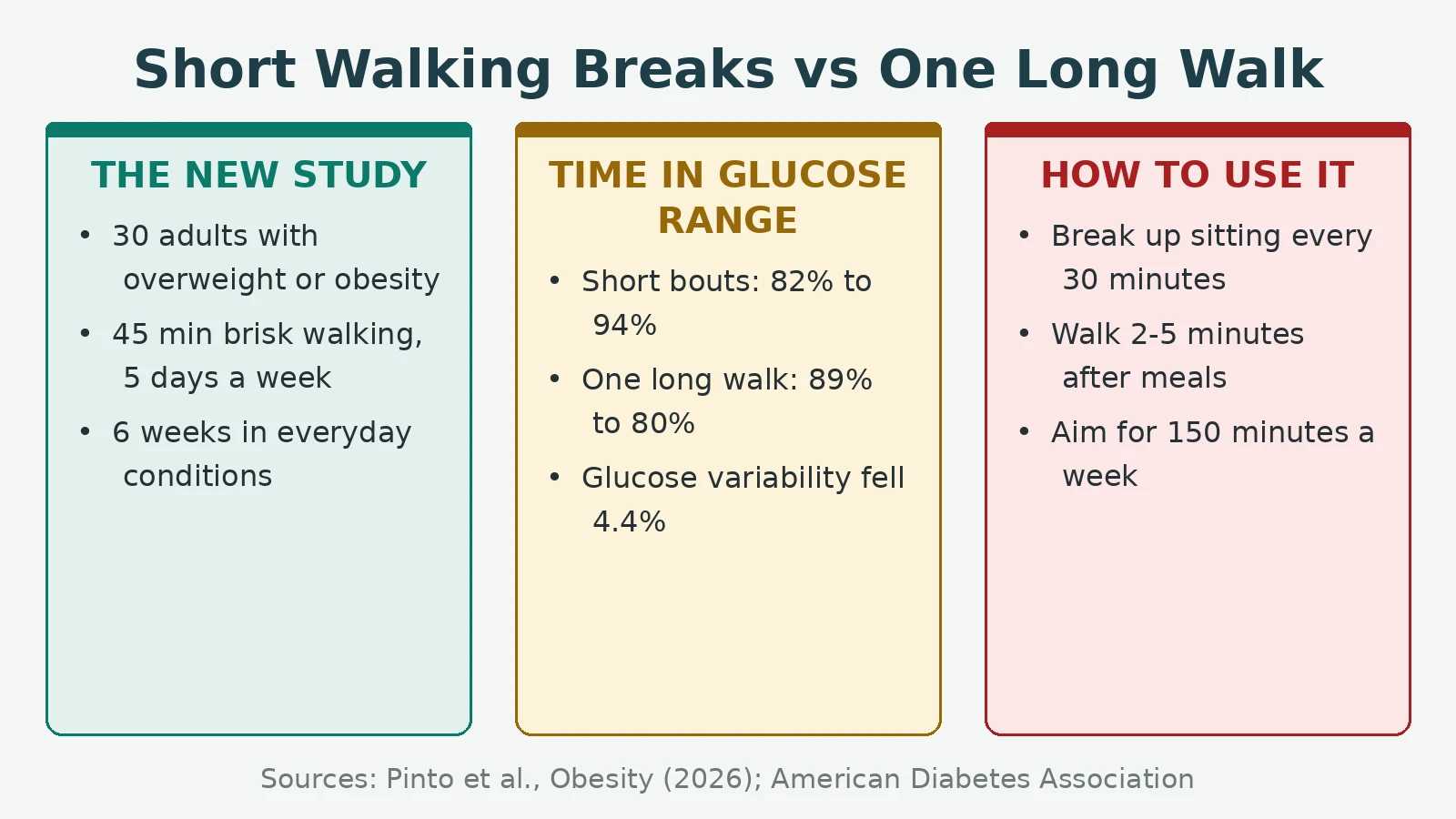
Both groups did exactly the same total amount of walking: 45 minutes of brisk walking a day, five days a week, for six weeks. The only difference was how the minutes were arranged. One group split the 45 minutes into nine 5-minute bouts, roughly hourly across a nine-hour day. The other group did the full 45 minutes in a single session. Blood sugar was tracked with continuous glucose monitors and a laboratory glucose tolerance test before and after the six weeks.
The results favoured the short-bout group on nearly every measure:
- Time in the target glucose range rose from 82% to 94% in the short-bout group, but fell from 89% to 80% in the single-walk group.
- Glucose variability — how much blood sugar swung up and down — fell by 4.4% more in the short-bout group.
- Glucose tolerance improved more with short bouts, with the test response differing by 1,652.9 mg/dL·min⁻¹ in their favour.
- Insulin sensitivity did not improve in either group, so the gains came without any detectable change in how the body responded to insulin.
- Total activity and total sitting time changed by similar amounts in both groups. Only the short-bout group cut time spent in sedentary stretches of 60 minutes or more.
The researchers’ reading is that when you move matters as much as how much you move. A single walk can be followed by hours of sitting, which may blunt some of its benefit, while short walks spread through the day keep muscles working — including around meals, when blood sugar climbs. One possible explanation is that contracting muscles can draw glucose from the blood without needing insulin, so each short walk switches that route on again. The trial was not designed to prove the mechanism, and the authors say more work is needed.
Why sitting all day hurts blood sugar
When you sit for hours, the big muscles in your legs are mostly idle. Their energy demand drops, and with it their uptake of glucose from the blood. Over time, long unbroken sitting is linked to poorer glucose regulation and a higher risk of type 2 diabetes.
A daily workout does not fully cancel that out. As the study’s lead author pointed out in coverage of the trial, many desk workers sit for eight to ten hours a day, so even a good morning walk can be followed by a long stretch of stillness. Breaking the day up keeps those muscles switching on and off, rather than lying dormant between sessions.
Standing helps a little, too. Diabetes UK notes that standing uses more than twice as much energy as sitting — a useful nudge if your work involves long phone calls or reading.
What earlier research showed
This trial was unusual because it ran for six weeks in everyday conditions. Most earlier work on breaking up sitting was short and lab-based, lasting hours or a single day. Even so, those studies pointed in the same direction.
A systematic review and meta-analysis published in Obesity Reviews in 2026 pooled 39 studies and found that activity breaks of under ten minutes, taken during prolonged sitting, lowered after-meal glucose and insulin responses compared with sitting uninterrupted. Walking breaks had the strongest effect of any break type, and breaks every 15 to 20 minutes produced the largest reductions. The biggest glucose improvements were seen in people living with obesity.
An earlier classic study from 2012 backs that up. In a trial of 19 overweight adults aged 45 to 65, published in Diabetes Care, two-minute bouts of light walking every 20 minutes cut the glucose response after a test drink by roughly a quarter compared with sitting without a break — and light walking worked just as well as moderate walking. Insulin responses fell by a similar amount.
Taken together, the evidence is consistent: you do not need to walk hard, or for long, for a break to count. You need to walk often.
Walking after meals
Mealtimes are the highest-value moment for a walking break. Blood sugar is typically at its highest about 30 to 90 minutes after eating, even in people without diabetes, so a walk soon after a meal catches the rise at its peak.
Research cited by the Cleveland Clinic suggests that walking for just two to five minutes after eating can nudge blood sugar down a little. The Clinic’s specialist is clear, though, that a short walk is not a standalone fix for diabetes — it is one useful habit among several.
For context, typical target ranges for adults are 80 to 130 mg/dL before a meal and under 180 mg/dL one to two hours after the meal starts. A reading under 70 mg/dL is generally considered low. A ten-minute walk after a meal is a realistic starting target suggested by both the CDC and Diabetes UK, and it fits neatly into the short-bout pattern the new trial tested.
How to build walking breaks into your day
The trial’s pattern — nine 5-minute walks across the day — is a useful template, but you do not need to copy it exactly. Official guidance points the same way. The American Diabetes Association’s Standards of Care in Diabetes — 2026 recommends interrupting prolonged sitting at least every 30 minutes for blood glucose and other benefits, and advises most adults with type 1 or type 2 diabetes to aim for 150 minutes or more of moderate-to-vigorous aerobic activity a week, spread over at least three days, with no more than two consecutive days without activity, plus resistance exercise two to three times a week.
Some practical ways to fit the breaks in:
- Set a reminder every 30 to 60 minutes to stand up and walk, as the trial’s lead author suggests.
- Walk after meals. Even a ten-minute stroll after lunch or dinner is a good place to start.
- Take calls on the move. Walk around the room or the house while you talk.
- Use the stairs instead of the lift, and park a little further from the door.
- Build movement into chores. Tidying up, marching on the spot, or a short dance in the kitchen all count as light activity.
- Start small. The CDC suggests beginning with a ten-minute walk after dinner and building up from there, rather than trying to hit the full weekly target at once.
Short walks are a complement to structured exercise, not a replacement for it. Keep the 150-minute weekly aerobic target and your strength sessions, and let the walking breaks fill the long gaps of sitting in between. Structured exercise programmes of at least eight weeks have been shown to lower HbA1c by 0.66% in people with type 2 diabetes, according to evidence cited in the ADA Standards of Care — a reminder that the longer sessions still earn their place.
Who benefits most — and who should check first
The people likely to gain most are those the studies actually tested. The largest glucose improvements in the 2026 meta-analysis were in people living with obesity, and both the new trial and the 2012 Dunstan study recruited overweight or obese adults. The trial’s lead author also highlights people at risk of type 2 diabetes, since spreading activity through the day may add benefit beyond a single daily session.
Desk workers and anyone sitting for six hours or more a day are another obvious group — that was the entry criterion for the new trial, and many office workers sit for eight to ten hours. Short bouts also suit people who struggle to fit in one longer workout, since five minutes between meetings is easier to find than 45 minutes in one go.
Some people should check first. The new trial did not recruit people with diagnosed diabetes, so its results cannot simply be assumed to apply to them. The participants were also relatively young, averaging 34, so the findings may not transfer directly to older adults. Diabetes UK and the ADA advise checking with a healthcare team before starting a new exercise routine, especially if you have eye, foot, kidney or heart problems.
People on insulin or medicines that can lower blood sugar should check their levels before and after activity and talk to their clinician first, since exercise can push glucose too low. A short walk is unlikely to cause a low, but harder workouts can, so keep fast-acting carbohydrate such as juice, honey or glucose tablets nearby, and check your feet and wear suitable footwear.
What the study could not prove
Honest coverage means being clear about the limits. This was a small trial — only 30 people — and it lasted just six weeks, so larger, longer studies are needed before the findings can be treated as settled.
There was no no-exercise control group, so the trial cannot separate out the absolute effect of each walking pattern against doing nothing. Diet and meal timing were not controlled while glucose was being monitored, which could have influenced the readings. And the gains were mainly in steadier glucose — less fluctuation, more time in range — rather than a clear drop in average or peak glucose.
So this is not proof that short walks prevent type 2 diabetes or heart disease, and it does not identify a single best break frequency or length. Nine 5-minute bouts were chosen as a practical, sustainable pattern, and earlier work has tested breaks as often as every 30 minutes. What the study does show is that spreading the same walking through the day gave a measurable edge over doing it all at once.
When to see a doctor
Speak to your GP before starting a new exercise routine if you have diabetes, heart, kidney, eye or foot problems, or if you take medicines that can lower your blood sugar. Ask for advice if you notice symptoms such as feeling very thirsty, needing to pass urine far more often than usual, unexplained tiredness, or blurred vision, or if your blood sugar readings are often outside the range your clinician advised.
Get urgent help if you feel confused or drowsy, have trouble breathing, notice a fruity smell on your breath, or cannot keep fluids down. In an emergency call 911 (US), 999 (UK) or 112 (EU).
Frequently asked questions
Do short walking breaks lower blood sugar?
Yes, according to a November 2026 trial of 30 adults with overweight or obesity. Splitting 45 minutes of brisk walking into nine 5-minute bouts a day improved blood sugar control more than one 45-minute walk over six weeks. Time in the target glucose range rose from 82% to 94% with short bouts, but fell from 89% to 80% with one long walk. Insulin sensitivity did not improve in either group, so the benefit was steadier glucose, not insulin response.
How long should a walking break be?
Even two to five minutes counts. In the new trial, nine 5-minute bouts spread through the day beat a single 45-minute session, and a 2012 study found two-minute walks every 20 minutes cut the glucose response after a test drink by roughly a quarter. The American Diabetes Association recommends breaking up sitting at least every 30 minutes. As a rule, stand and walk for a few minutes every half hour, including one ten-minute walk after a meal.
Is walking after a meal good for blood sugar?
Yes, it is one of the best times to walk. Blood sugar typically peaks 30 to 90 minutes after eating, so a walk after a meal catches the rise. Research cited by the Cleveland Clinic suggests walking for just two to five minutes after eating can nudge blood sugar down a little. A ten-minute walk after a meal is a realistic starting target suggested by the CDC and Diabetes UK, which fits the trial's short-bout pattern.
Can short walks replace a proper workout?
No. Short walking breaks are a complement to structured exercise, not a replacement for it. The American Diabetes Association advises 150 minutes or more of moderate-to-vigorous aerobic activity a week, spread over at least three days, plus resistance exercise two to three times a week. Walking breaks fill the gaps of sitting between sessions, which one workout does not. Structured exercise of eight weeks has been shown to lower HbA1c by 0.66% in people with type 2 diabetes.
Should I walk if I take insulin or diabetes medicine?
Usually yes, but check first. Exercise can push blood sugar too low if you take insulin or medicines that lower glucose, so check your levels before and after activity and talk to your clinician before starting one. A short walk is unlikely to cause a low, but harder workouts can, so keep fast-acting carbohydrate such as juice, honey or glucose tablets nearby. Check your feet, wear suitable footwear, and seek advice for eye, foot, kidney or heart problems.
Sources
- Medical News Today: Short walks throughout the day may help keep blood sugar in check www.medicalnewstoday.com
- Pinto et al. Interrupting Prolonged Sitting Improves Glucose Regulation More Than Continuous Walking in Adults With Overweight/Obesity. Obesity, 2026 pubmed.ncbi.nlm.nih.gov
- University of Colorado Anschutz: New Research: Short Walking Breaks May Improve Blood Sugar Control news.cuanschutz.edu
- Gale et al. Breaking up prolonged sitting with activity breaks and postprandial glucose and insulin responses: a systematic review and meta-analysis. Obesity Reviews, 2026 pubmed.ncbi.nlm.nih.gov
- Dunstan et al. Breaking up prolonged sitting reduces postprandial glucose and insulin responses. Diabetes Care, 2012 pubmed.ncbi.nlm.nih.gov
- Cleveland Clinic: Walking After Eating and Your Blood Sugar health.clevelandclinic.org
- CDC: Get Active (diabetes) www.cdc.gov
- American Diabetes Association: Standards of Care in Diabetes - 2026, Section 5 pmc.ncbi.nlm.nih.gov

Try the tool
Not sure if it can wait?
Common causes and warning signs for 16 everyday symptoms.
Open the symptom guide