COVID Symptoms 2026: What This Season Looks Like
COVID is rising again before Thanksgiving, and this season it usually starts with a sore throat. Here is what to watch for, how it differs from flu and RSV, and when to test.
- Written by
- Health Daily Advice
- Published
- Reading time
- 10 minutes
- Sources
- 9 cited

In this guide
This season, COVID-19 most often begins with a sore throat, a stuffy or runny nose, tiredness and a headache. Fever is frequently mild or missing altogether, and losing your sense of taste or smell has become uncommon. Symptoms usually appear two to five days after exposure, and only a test can separate COVID from flu or RSV.
That cold-like picture is part of the problem. When the illness feels mild, it is easy to carry on as normal, visit relatives or head into work — and pass the virus on without realising it. The CDC’s official list of possible symptoms is worth keeping in mind: it is long, and it is not exhaustive.
Is COVID rising now?
Yes — in the United States, at least. The amount of SARS-CoV-2 in US wastewater rose 9% between 31 October and 7 November 2026, reversing a decline seen in late October, and the CDC rates national wastewater activity as “moderate” and slightly increasing, according to The Sick Times and MedicalDaily. A second network, WastewaterSCAN, recorded the same 9% rise over a similar period and rates the national level “high”.
The CDC’s infectious-disease forecasting centre estimated that infections were “growing or likely growing” in 37 states and “declining or likely declining” in only 2, as of 12 November 2026 — including every state in the Midwest. Some areas look worse than the national picture: CDC wastewater levels were rated “very high” in Florida, Virginia, Kentucky, Arkansas, Washington DC, Connecticut, Massachusetts and Vermont.
One figure moved the other way. Test positivity slipped from 3.7% in the week ending 31 October to 3.3% in the week ending 7 November, probably because far fewer people now test at all. Wastewater figures are preliminary and can be revised, and they cannot count cases or predict how severe a wave will be — but the direction of travel is clear, and it arrives just before Thanksgiving on 26 November, when millions of Americans travel and gather indoors.
In Europe, the picture was calmer: in week 44 of 2026, the European Centre for Disease Prevention and Control reported respiratory illness at baseline or low levels, with SARS-CoV-2 the main contributor.
Most common symptoms in 2026
This season’s COVID usually starts with a sore throat — often described as sore, scratchy or very painful — followed by congestion or a runny nose, a cough, fatigue, headache and muscle aches. Fever or chills may follow, or may never arrive at all. The World Health Organization lists fever, chills and sore throat as the most common symptoms for currently circulating variants.
A few things are worth knowing about how the illness behaves now:
- Fever is often absent. Many people with current variants never develop one, particularly those with immunity from vaccination or an earlier infection. A normal temperature does not rule COVID out.
- Loss of taste or smell still happens, but is much less common than in 2020–21, and it is no longer a reliable tell-tale sign.
- Symptoms do not follow one set order. COVID can start with a sore throat, congestion or fatigue, and the order varies from person to person.
- Some people notice hoarseness or voice changes, and nausea, vomiting or diarrhoea occur in some cases, more often in children.
- A very painful sore throat is not always COVID. Strep throat or flu can cause it too, so a high fever with no cough plus severe pain when swallowing is worth getting checked.
All currently circulating lineages are Omicron descendants, and none had been designated a World Health Organization “variant of concern” as of early 2026. Current variants have not been shown to cause more severe illness than earlier Omicron-era variants, or a fundamentally new set of symptoms. Lineages mentioned in 2026 coverage include XFG (“Stratus”) and NB.1.8.1 (“Nimbus”), which reports have widely linked to a sore throat as an early symptom.
One claim doing the rounds deserves a clear answer: there is no official CDC list of “three new symptoms”. Headlines making that claim recycle symptoms already on the known list — a severe sore throat, hoarseness and digestive upset. The symptoms are real; the idea that the CDC has announced three new ones is not.
Symptoms in older adults
Older adults face the highest risk of severe illness. The CDC reports that more than 81% of COVID-19 deaths occur in people over 65, with risk rising with age, especially from 75. Yet in this age group the illness often looks nothing like the textbook version. According to a geriatric review summarised by Cleveland Clinic ConsultQD, typical symptoms occur in fewer than half of older patients with COVID-19.
Family members and carers should watch for changes that are easy to miss or to put down to age:
- New confusion or delirium — sudden disorientation, not acting like themselves, unusual apathy, sleeping far more than usual, or stopping speaking. In one hospital study of 111 of the oldest patients, delirium was present in more than 40% (42.3%), and 42.3% had no fever at all.
- Falls — falls were the presenting symptom in 14.4% of that hospital group, and in those who fell, fever was absent in 68.5% of cases. In people over 85, a fall or a sudden new tiredness should be treated as a possible sign of illness.
- Appetite loss — loss of appetite was present in 53.8% of the hospital group, and it can lead to dehydration and a failure to thrive.
- Weakness and reduced mobility — some older patients stop walking, become incontinent and profoundly lethargic, or collapse when they stand, from weakness and dehydration.
Fever is a poor guide in older people. Average body temperature falls with age, and the Infectious Diseases Society of America defines fever in older adults as a single oral temperature over 37.8°C (100°F), two readings over 37.2°C (99°F), or a rise of 2°F over the person’s usual baseline. Smaller clues — a sore throat, new congestion, nausea, vomiting or diarrhoea — may be more useful signs than fatigue or body aches, which are common in this age group anyway.
The reason this matters is simple: missed early signs mean older people can deteriorate before getting care, and early testing and treatment make a real difference in this group. If an older relative seems suddenly confused, unusually sleepy or unsteady, it is worth recognising as a possible illness rather than a bad day.
COVID vs flu vs RSV
Every source agrees on the central point: you cannot tell COVID-19 from flu by symptoms alone — the CDC states this explicitly, and only a test can distinguish them. The same applies to RSV and common colds, which share fever, cough, sore throat, fatigue and headache. Still, the patterns below can help you judge what is most likely while you wait for a test result.
| Feature | COVID-19 | Flu | RSV |
|---|---|---|---|
| Onset | Often gradual, builds over days | Sudden — people often remember the hour they fell ill | Gradual, cold-like at first |
| Fever | Varies; often mild or absent | Common, often high (38°C+) | Possible, less central |
| Sore throat | Very common, often the first symptom | Common | Less prominent |
| Body aches | Common | Often severe | Mild |
| Loss of taste or smell | Possible, less common now | Rare | Rare |
| Distinctive sign | Gut symptoms such as nausea or diarrhoea | Abrupt high fever with severe aches | Wheezing and heavy mucus |
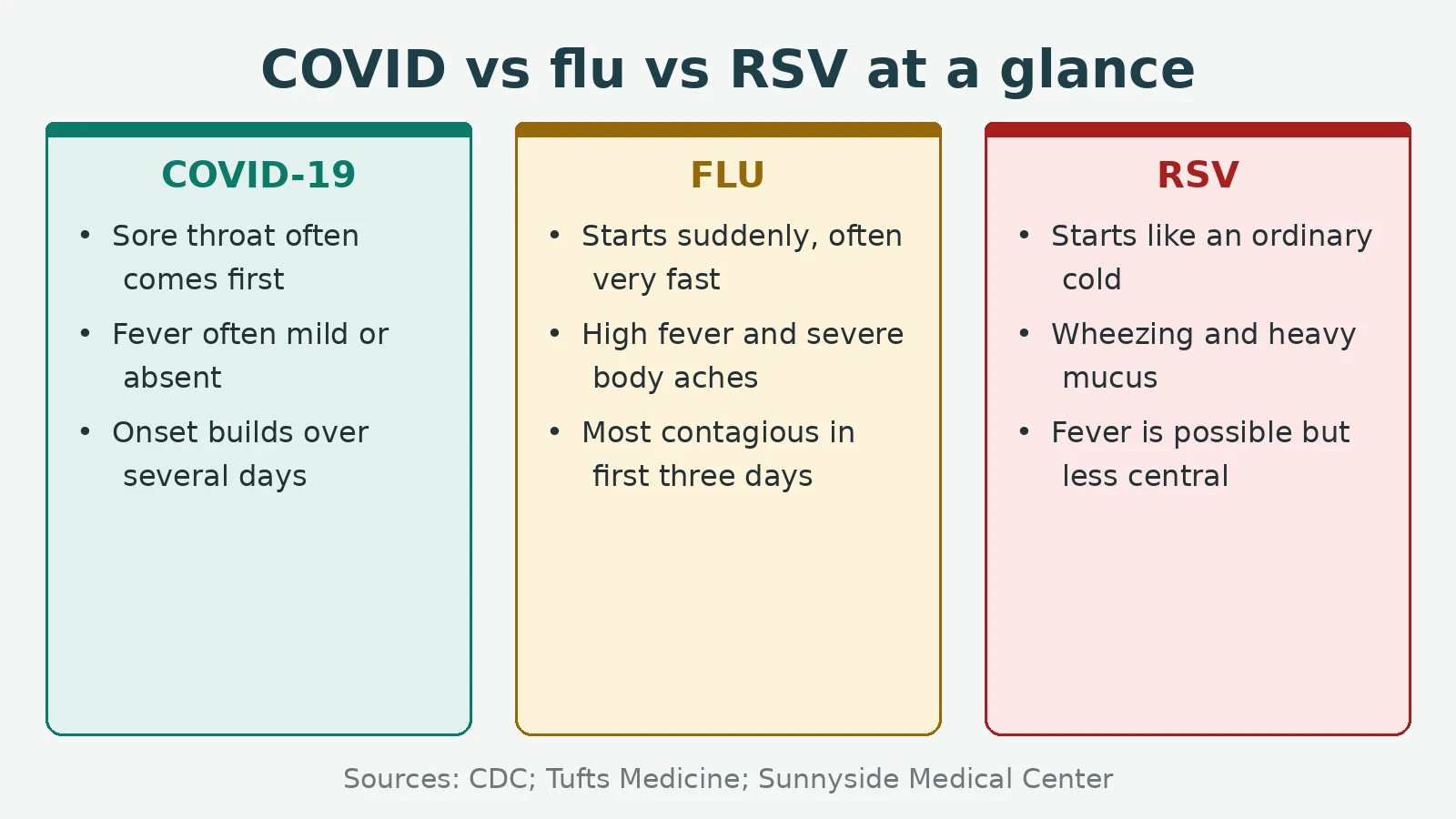
Flu usually comes on suddenly and peaks fast, and people are most contagious during the first three days. RSV in adults usually looks like a cold, but it can progress to pneumonia or bronchiolitis, and severe disease is most common in infants and people over 75. A cold, by contrast, is generally mild and resolves in 7–10 days. Combination home tests for COVID and flu are now sold, and some lab tests check for flu and COVID-19 in a single sample.
Incubation and how long you are contagious
The CDC says symptoms may appear 2–14 days after exposure, but the typical gap is much shorter in the Omicron era: a median of 3–4 days, with most people noticing first symptoms within 2–5 days. A 2025 review of Omicron studies found a pooled average of 3.7 days. The incubation period has shortened over the course of the pandemic, from about 6.5 days on average in 2020 studies to 3–4 days during heavy Omicron spread.
People can start spreading the virus 2–3 days before symptoms begin, and are most contagious about a day before symptoms start. They are generally considered contagious for about 8 days after symptoms begin, and people with no symptoms can still pass the virus on. Most mild cases improve within about a week, with the worst days typically days 2–4 of symptoms, though a cough and fatigue can linger for a couple of weeks.
After an exposure, monitor for symptoms for 14 days. If you feel well, plan the first home test for day 6, counting the exposure day as day 0.
Long COVID remains part of the picture. The World Health Organization estimates that about 6 in 100 people who have COVID-19 develop post-COVID-19 condition, with symptoms usually starting within 3 months and lasting at least 2 months. Common symptoms include fatigue, breathlessness, muscle or joint pain and poor sleep. Risk is higher for women, older adults, smokers, people with overweight or chronic conditions, and after repeated or severe infections, while vaccination is associated with a lower risk.
Testing — when and how
Test if you have symptoms, especially if you are at higher risk, live with someone who is, were recently exposed, or plan to visit someone older, pregnant or immunocompromised.
Home rapid antigen tests usually give results in 15–30 minutes, but they can be negative early in an infection, and a single negative antigen test cannot rule out infection. The US Food and Drug Administration’s advice is to repeat negative tests 48 hours apart — two tests in total if you have symptoms, and three tests 48 hours apart if you have no symptoms.
Timing matters. After an exposure with no symptoms, wait at least five full days before the first test — day 6 if the exposure day is day 0 — and test right away if symptoms start. It can take 2–5 days, sometimes longer, for a rapid test to detect the virus. Lab PCR tests are more sensitive than antigen tests and can distinguish flu from COVID-19 in one sample, although some can stay positive for up to 90 days after an infection.
In the UK, most people no longer need to test and cannot get free NHS tests; free testing is reserved for people at risk of serious illness who are eligible for COVID-19 treatments. Private lateral flow tests are available at pharmacies, and you no longer need to report private results to the NHS.
If you test positive, US CDC guidance is to stay home and away from others until, for at least 24 hours, symptoms are improving overall and there is no fever without fever-reducing medicine, then take extra precautions for the next five days — a well-fitting mask, ventilation and handwashing. UK NHS guidance is for adults who test positive to try to stay home and avoid others for five days after the day of the test, and to avoid meeting people at higher risk for 10 days.
2026–27 vaccines
The picture differs by country, and it is worth checking the detail with a doctor or pharmacist before deciding.
In the United States, the FDA told manufacturers after advisers met on 28 May 2026 that 2026–27 vaccines should target the JN.1-lineage XFG variant, and on 27 August 2026 it approved updated Comirnaty, Spikevax and mNEXSPIKE mRNA vaccines and Novavax’s protein-based Nuvaxovid. FDA eligibility is narrower than in earlier years: everyone 65 and older, plus younger people with at least one high-risk condition.
The CDC’s recommendations sit on a separate track. Because of legal uncertainty around its advisory committee, the CDC says its July 2025 schedule stays in effect for 2026–27: a vaccine for all adults 18 and older, and for children 6 months to 17 years with moderate to severe immunocompromise, with shared decision-making for other children. The CDC marks uses outside the FDA label as off-label and advises patients to discuss benefits and risks with their providers.
In England, the NHS offers the 2026–27 winter COVID-19 vaccine to people 75 and older, people aged 6 months to 74 with a weakened immune system, and care-home residents, until 31 January 2027.
The World Health Organization advises risk-based revaccination 6 to 12 months after the last dose for high-priority groups: older adults, people with severe obesity or several serious conditions, immunocompromised people, pregnant women and health workers. It notes that vaccines protect strongly against severe disease and death but do much less to stop the virus spreading.
When to see a doctor
Most cases of COVID in 2026 are mild and settle at home with rest and fluids, but some situations need prompt medical attention. Contact a clinician promptly if you are at higher risk — aged 65 or older, immunocompromised, living with a chronic condition or pregnant — and test positive. Antiviral treatment exists, and treatment works best when started early, so do not wait to see whether things improve on their own.
Also seek medical advice promptly if a fever lasts more than three days, a cough is worsening, you have ear pain or sinus pain, a sore throat is severe or not improving, or you feel better and then get worse.
The CDC’s emergency warning signs need urgent help immediately: trouble breathing, persistent pain or pressure in the chest, new confusion, inability to wake or stay awake, or lips, nail beds or skin appearing pale, grey or blue, depending on skin tone. In the UK, call NHS 111 or your GP if you are worried or symptoms are worsening, and call 999 or go to A&E if you are too breathless to speak in short sentences, have sudden chest pain, cough up blood, or collapse.
In an emergency call 911 (US), 999 (UK) or 112 (EU)
If this season’s symptoms have caught you off guard, you are not alone — the illness now looks so much like a cold that many people do not test at all. A quick test, a few days of caution around others, and prompt contact with a clinician if you are at higher risk are the three steps that matter most. For more health guides, visit healthdailyadvice.com.
Frequently asked questions
What are the most common covid symptoms in 2026?
This season, a sore throat is usually the first sign, followed by congestion or a runny nose, a cough, fatigue, headache and muscle aches. Fever is often mild or absent, and loss of taste or smell has become uncommon. Symptoms typically appear two to five days after exposure, and they vary from person to person.
How long does covid last in 2026?
Most mild cases improve within about a week, with the worst days usually falling on days two to four of symptoms. A cough and tiredness can linger for a couple of weeks after the rest has settled. People are generally considered contagious for about eight days after symptoms begin. If symptoms drag on well beyond two weeks, or you feel worse after improving, speak to a clinician.
Can you have covid without a fever?
Yes. Many people with current variants never develop a fever, particularly those with immunity from vaccination or an earlier infection. A normal temperature does not rule COVID out, and fever is also an unreliable sign in older adults, whose average body temperature runs lower. If you have a sore throat, congestion and fatigue, test rather than relying on your temperature.
When should I test for covid after exposure?
If you have no symptoms, wait at least five full days after the exposure before your first test — day six if the exposure day is day zero — and test right away if symptoms start. A single negative rapid test cannot rule out infection, so repeat negative tests 48 hours apart: two tests in total with symptoms, and three without. Lab PCR tests are more sensitive than rapid antigen tests.
How do I tell covid apart from flu or RSV?
You cannot tell them apart by symptoms alone — only a test can do that, because all three share fever, cough, sore throat, fatigue and headache. There are clues, though: flu usually starts suddenly with a high fever and severe aches, RSV often brings wheezing and heavy mucus, and COVID often begins with a sore throat and builds gradually. Combination home tests for COVID and flu are now available.
What are the three new covid symptoms?
There is no official CDC list of three new symptoms. The phrase comes from headlines that recycle symptoms already on the known list — a severe sore throat, hoarseness and digestive upset such as nausea or diarrhoea. Those symptoms are real and worth knowing about, but the idea that the CDC has announced three new ones is a misunderstanding. Stick to the established symptom list and test if you are unwell.
Sources
- CDC — Symptoms of COVID-19 www.cdc.gov
- The Sick Times — National COVID-19 trends, November 17, 2026 thesicktimes.org
- MedicalDaily — COVID Wastewater Levels Rise 9% Nationally as CDC Models Show Likely Growth in 37 States Before Thanksgiving www.medicaldaily.com
- Tufts Medicine — Flu, COVID-19, RSV & Cold: Symptoms & Guide www.tuftsmedicine.org
- Sunnyside Medical Center — COVID Symptoms 2026: October Update on New Variant Signs sunnysidemedicalcenter.com
- ContentLora — COVID-19 explained: symptoms, tests, vaccines and 2026-27 advice www.contentlora.com
- Cleveland Clinic ConsultQD — Atypical Presentations, Serious Comorbidities Pose Unique Threat to Geriatric Patients With COVID-19 consultqd.clevelandclinic.org
- Doctor2me — COVID Incubation Period 2026: Symptom Timeline www.doctor2me.com

Try the tool
Not sure if it can wait?
Common causes and warning signs for 16 everyday symptoms.
Open the symptom guide