What Is Bundibugyo Virus? Symptoms, Spread and the DRC Outbreak
Bundibugyo virus is the Ebola virus behind DR Congo's largest ever Ebola outbreak. Here are its symptoms, how it spreads, and the latest case numbers.
- Written by
- Health Daily Advice
- Published
- Reading time
- 8 minutes
- Sources
- 6 cited

In this guide
Bundibugyo virus is a rare but severe virus that causes Ebola disease, first identified in 2007 in Uganda. The current outbreak in the Democratic Republic of the Congo has reached 11,613 confirmed cases and 5,678 deaths as of 17 November 2026, and the World Health Organization still classes it as a public health emergency of international concern.
What Bundibugyo virus is
Bundibugyo virus, shortened to BDBV, is one of three viruses known to cause large Ebola disease outbreaks in people. The other two are Ebola virus and Sudan virus. All three belong to the Orthoebolavirus family, and all of them can cause severe, often fatal illness, according to the World Health Organization’s Ebola disease fact sheet.
The virus takes its name from Bundibugyo District in western Uganda, where it was first identified during an outbreak that ran from August 2007 to January 2008. A second, smaller outbreak followed in 2012 in north-eastern DR Congo, with 59 cases and 34 deaths. The WHO puts the case fatality rates of those two earlier outbreaks at 30% and 50% respectively.
What makes the current outbreak different is its scale. It is now the largest Ebola disease outbreak ever recorded in DR Congo, whatever the virus species — bigger even than the 2018–2020 Ebola outbreak. The first known case was a health worker in Mongbwalu, in Ituri Province, who fell ill on 24 April 2026. The outbreak was confirmed on 15 May, the same day DR Congo declared its 17th Ebola disease outbreak, and two days later the WHO declared it a public health emergency of international concern.
What are the symptoms of Bundibugyo virus disease?
The illness usually begins suddenly, and its first signs look like many other infections, which is part of what makes it hard to spot early. The WHO describes the usual pattern as follows.
Early symptoms
- Fever
- Fatigue and a general feeling of being unwell
- Muscle pain
- Headache
- Sore throat
These early symptoms are non-specific, so in a region where malaria is common, the illness can easily be mistaken for something else at first. That is why laboratory testing matters: a diagnosis is confirmed with a PCR test on a blood sample.
Later symptoms
As the illness progresses, most people develop stomach and gut symptoms — vomiting, diarrhoea and abdominal pain — along with a rash and signs that the kidneys and liver are struggling. In severe cases the disease can lead to shock, confusion, breathing problems, kidney failure and multiple organ failure.
Bleeding is the symptom most people associate with Ebola, but it is actually less common than the name suggests, and it usually appears later in the illness. Research summarised by ANRS MIE, the French research agency, found bleeding in only around 10% of people with confirmed Bundibugyo infection. Some patients do develop internal or external bleeding, including blood in vomit or stools and bleeding from the nose or gums.
How long does it take for symptoms to appear?
The incubation period — the time between infection and the first symptoms — ranges from 2 to 21 days. One reassuring detail is that people cannot pass the virus on before they develop symptoms. Once symptoms appear, though, a person stays infectious for as long as the virus is present in their blood.
How Bundibugyo virus spreads
Bundibugyo virus is a zoonotic disease, meaning it starts in animals. Fruit bats are the suspected natural reservoir, and the first human infection is thought to come from close contact with the blood or secretions of an infected animal, such as a bat or a non-human primate. After that, it spreads from person to person.
Person-to-person spread happens through direct contact — through broken skin or the lining of the mouth, nose or eyes — with the blood, secretions, organs or other body fluids of someone who is ill or has died from the disease. It can also pass through objects and surfaces contaminated with those fluids, such as bedding, clothing or medical equipment. The virus does not spread through the air.
Two settings drive most transmission. The first is health care: health workers have often been infected while caring for patients when infection control precautions were not strictly followed. The second is funerals and burial ceremonies that involve touching the body of someone who has died. The risk is highest late in the illness, when the amount of virus in the body is at its peak, and it stays high when handling a body after death.
Survivors need care too. The virus can linger in parts of the body such as the eyes and the testes after recovery, and Ebola virus has been found in semen up to 15 months after a person recovered, so safer sex and follow-up testing matter for survivors and their partners.
The DR Congo outbreak in numbers
Six months after the outbreak was declared, transmission in DR Congo is still running at a high, sustained level, according to the WHO’s latest update. Here is where things stand.
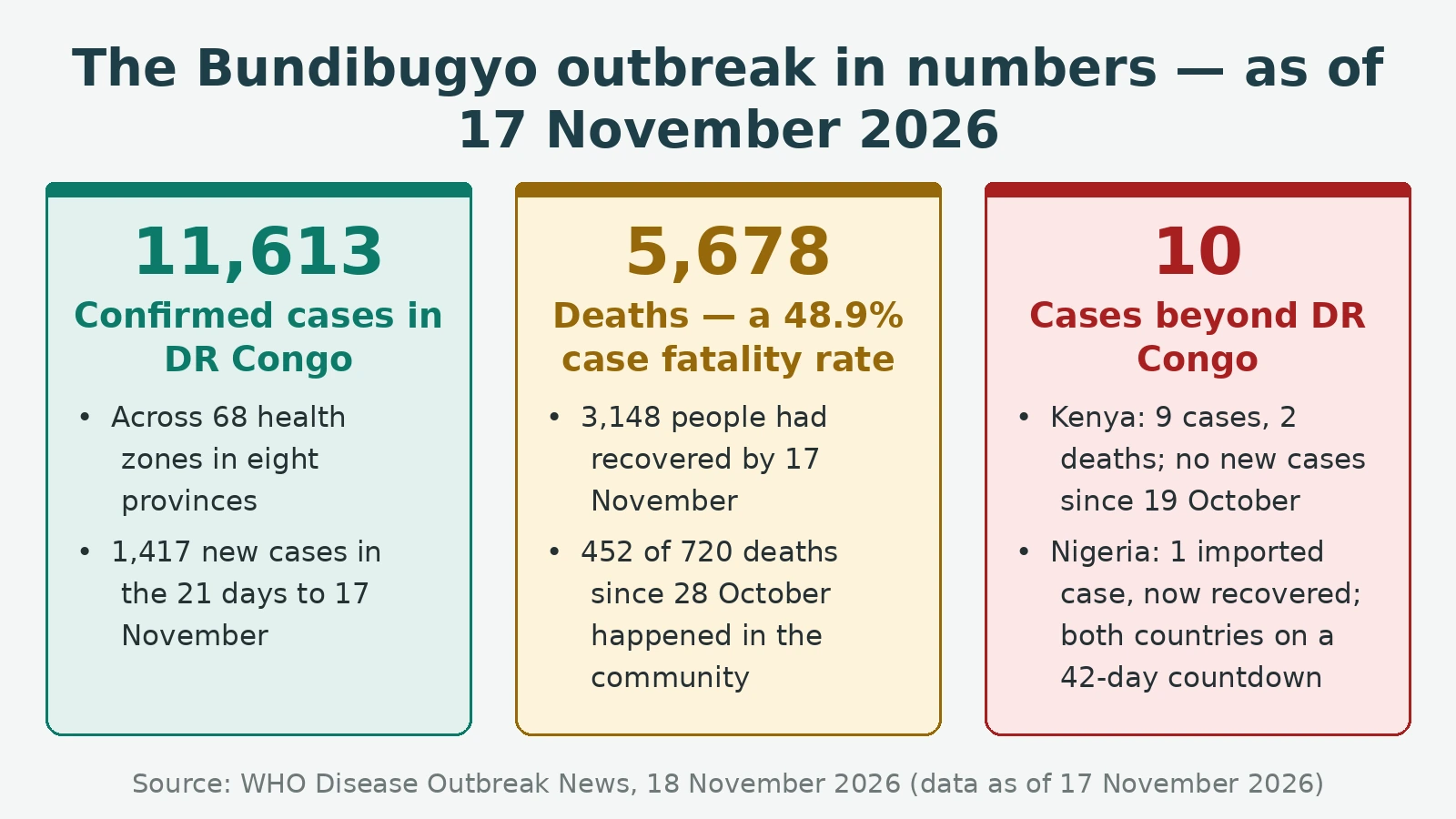
Ituri remains the hardest-hit province, with 7,946 confirmed cases and 3,751 deaths since the outbreak began. Nord Kivu follows with 2,996 cases and 1,654 deaths — and the highest provincial death rate, at 55%. In the three weeks to 17 November, 1,417 new cases were reported, most of them in Ituri and Nord Kivu.
One figure troubles responders most: of the 720 deaths reported in the three weeks to 17 November, 452 happened in communities rather than in treatment centres. That points to people still being found late, or not reaching care in time — especially young children, the WHO notes. Early, intensive supportive care, including rehydration, improves survival and can be lifesaving, so getting help quickly matters.
The response is also hampered by insecurity, which the WHO calls the greatest obstacle to expanding operations. Contact tracing is running below target too: on average, 81% of known contacts were seen each day over the previous two weeks, against a target of 95%.
What is happening in Kenya and Nigeria?
The outbreak has reached beyond DR Congo, but the picture outside the country is more encouraging. Cases have been reported in five countries since May 2026 — DR Congo, France, Kenya, Nigeria and Uganda — and the outbreaks in France and Uganda have been under control since August.
Kenya has reported 9 confirmed cases, including 2 deaths, all linked to a single imported case and one cluster of family members and health workers. There have been no new cases in Kenya since 19 October, the last patient was discharged on 11 November, and the country has begun a 42-day countdown — two maximum incubation periods — to declaring its outbreak over.
Nigeria reported a single imported case in Abuja on 20 October. The patient was medically evacuated to Switzerland on 26 October, recovered, and was discharged on 11 November after two negative PCR tests. All 62 contacts identified in Nigeria completed their 21-day follow-up, and Nigeria too is counting down 42 days to declare the end of its outbreak.
Why is it still a public health emergency?
The WHO first declared the outbreak a public health emergency of international concern on 17 May 2026, just two days after it was confirmed. On 18 November, after its emergency committee met for the third time, the WHO Director-General determined that it still qualifies — because transmission in DR Congo remains high and widespread, with active spread in 48 of the 68 affected health zones, and because the risk of further international spread has not gone away.
For now, the WHO says the high level of transmission in DR Congo calls for continued readiness across the region — cross-border surveillance, monitoring at points of entry, timely case detection and coordinated preparedness — while the response scales up further.
Is there a vaccine or treatment for Bundibugyo virus?
There is no approved vaccine and no specific treatment for Bundibugyo virus disease. That is the key difference from Ebola virus disease, for which licensed vaccines and antibody treatments exist. Care for Bundibugyo patients is supportive: fluids, treatment of symptoms and of other infections such as malaria, delivered as early as possible.
That gap is now being worked on. On 23 October 2026, the first participant was vaccinated in Tumaini — Swahili for “hope” — a Phase 2/3 trial in Bunia, DR Congo, testing vaccine candidates against Bundibugyo virus. The first candidate in the trial is Ervebo, a vaccine already licensed against Ebola virus, but its protection against Bundibugyo virus is not yet known. Two Bundibugyo-specific candidates, one from the University of Oxford and one from Moderna, are being prepared to join the trial. The trial uses ring vaccination, offering vaccination to the contacts of confirmed cases.
Treatments are being tested as well. A WHO-funded trial called PARTNERS, which began enrolling patients in DR Congo in July 2026, is evaluating an antibody cocktail called MBP134 and the antiviral remdesivir. Neither is an approved treatment yet — both are being studied to see whether they improve survival.
How is Bundibugyo virus diagnosed?
Because the early symptoms look like malaria, typhoid or other fevers, the illness cannot be diagnosed on symptoms alone. Confirmation comes from laboratory tests, usually a PCR test on a blood sample, with antibody tests also used. Samples are treated as an extreme biohazard and handled under maximum containment.
How can Bundibugyo virus be prevented?
There is no vaccine to rely on, so prevention comes down to avoiding contact with the virus and stopping it spreading once it appears. The WHO’s advice is straightforward:
- Avoid close contact with the blood or body fluids of anyone who is ill, and avoid touching the body of someone who has died from the disease.
- Do not handle or eat raw meat from bats, monkeys or apes found ill or dead.
- Keep up hand hygiene and a clean environment, and keep anyone who is ill isolated in a designated treatment centre rather than cared for at home.
- Burials should be carried out safely and with dignity, without direct contact with the body.
- Anyone who has been in contact with a case should be monitored for 21 days, and should seek care at the first sign of fever or other symptoms.
Health workers should always use standard precautions — hand hygiene, gloves and protective equipment, safe injection practices — whether or not Ebola disease is suspected.
When to see a doctor
If you have been in an area affected by the outbreak, or in close contact with someone who was ill, and you develop a fever, severe headache, muscle pain, sore throat, vomiting or diarrhoea, seek medical advice straight away and mention the possible exposure. Do not wait to see whether it passes: early care gives the best chance of recovery, and early isolation protects the people around you.
Seek urgent help if you notice bleeding, severe abdominal pain, confusion, difficulty breathing or signs of dehydration. If you are caring for someone who may be ill, avoid direct contact with their blood or body fluids and call for medical help instead.
In an emergency call 911 (US), 999 (UK) or 112 (EU)
Frequently asked questions
What is Bundibugyo virus?
Bundibugyo virus is a virus that causes Ebola disease, a severe and often fatal illness. It was first identified in 2007 in Bundibugyo District, Uganda, and is one of three viruses known to cause large Ebola outbreaks, alongside Ebola virus and Sudan virus. The current outbreak in the Democratic Republic of the Congo, which began in May 2026, is the largest Bundibugyo outbreak ever recorded.
What are the symptoms of Bundibugyo virus?
Symptoms usually appear 2 to 21 days after infection. They start suddenly with fever, fatigue, muscle pain, headache and a sore throat, then progress to vomiting, diarrhoea, abdominal pain and a rash, with kidney and liver problems in more severe cases. Bleeding is less common than many people expect, occurring in only around 10% of confirmed cases, and usually appears later in the illness.
How does Bundibugyo virus spread?
It spreads through direct contact with the blood or body fluids of a person who is ill or has died from the disease, or with objects contaminated with those fluids. It does not spread through the air. Fruit bats are the suspected natural reservoir, and the first infection in an outbreak is thought to come from contact with an infected animal. Health-care settings and burials involving contact with a body are common routes of spread.
Is there a vaccine for Bundibugyo virus?
No. There is currently no approved vaccine or specific treatment for Bundibugyo virus disease, unlike Ebola virus disease, which has licensed vaccines. A Phase 2/3 trial called Tumaini began in DR Congo in October 2026, testing vaccine candidates including Ervebo, a vaccine licensed against Ebola virus whose protection against Bundibugyo is not yet known. Until then, early supportive care is the mainstay of treatment.
How many people have died in the DR Congo outbreak?
As of 17 November 2026, the DR Congo outbreak had reached 11,613 confirmed cases and 5,678 deaths, a case fatality rate of 48.9%, according to the WHO. Ituri Province is the worst affected, with 7,946 cases and 3,751 deaths. It is the largest Ebola disease outbreak ever recorded in DR Congo. A further 3,148 people had recovered by the same date.
Can Bundibugyo virus spread outside Africa?
It can travel with people, but it only spreads through direct contact with blood or body fluids, so it does not spread easily between countries. Cases have been reported in five countries since May 2026, including France, Kenya, Nigeria and Uganda. The outbreaks in France and Uganda have been controlled since August, and Kenya and Nigeria have both started 42-day countdowns to declaring their outbreaks over.
Sources
- WHO: Ebola disease caused by Bundibugyo virus — DRC, Kenya and Nigeria (18 Nov 2026) www.who.int
- WHO: Ebola disease caused by Bundibugyo virus — DRC & Uganda (May 2026) www.who.int
- WHO: Ebola disease fact sheet www.who.int
- CEPI: First participant vaccinated in pivotal Phase 2/3 Bundibugyo vaccine trial in DRC cepi.net
- ANRS MIE: Ebola disease caused by Bundibugyo virus anrs.fr

Try the tool
Not sure if it can wait?
Common causes and warning signs for 16 everyday symptoms.
Open the symptom guide