Why Is Flu Worse After COVID? Immunity Debt Explained
Flu seasons have felt harsher since COVID. A November 2026 study puts a number on 'immunity debt' — here's what it found, what it doesn't prove, and how to protect yourself.
- Written by
- Health Daily Advice
- Published
- Reading time
- 5 minutes
- Sources
- 12 cited

In this guide
Flu does feel worse since COVID, and there is a reason. During the pandemic, flu almost disappeared, so far fewer people caught it — and that left a bigger pool of people with little recent immunity. A November 2026 study calls this gap “immunity debt” and estimates it at 42%, though the idea is still debated.
Immunity debt, explained in plain terms
Immunity debt is a simple idea with an awkward name. When a virus circulates normally, most of us meet it regularly — through mild infections we barely notice — and that contact tops up our protection. During the COVID-19 pandemic, masks, distancing, school closures and travel limits pushed flu down to almost nothing. Researchers writing in 2023 noted that flu “completely disappeared in both hemispheres” for a full year, leaving a much larger share of the population without recent exposure.
The debt is not damage. It is a gap: more people than usual who have not met flu for years, including children born during the pandemic who never caught it at all. When flu returned, it found far more people with little recent defence, so seasons hit harder and earlier. The American Association of Immunologists has stressed there is no evidence that pandemic measures weakened anyone’s immune system in the long term — the issue is missing exposure, not a broken immune system.
What the new study actually found
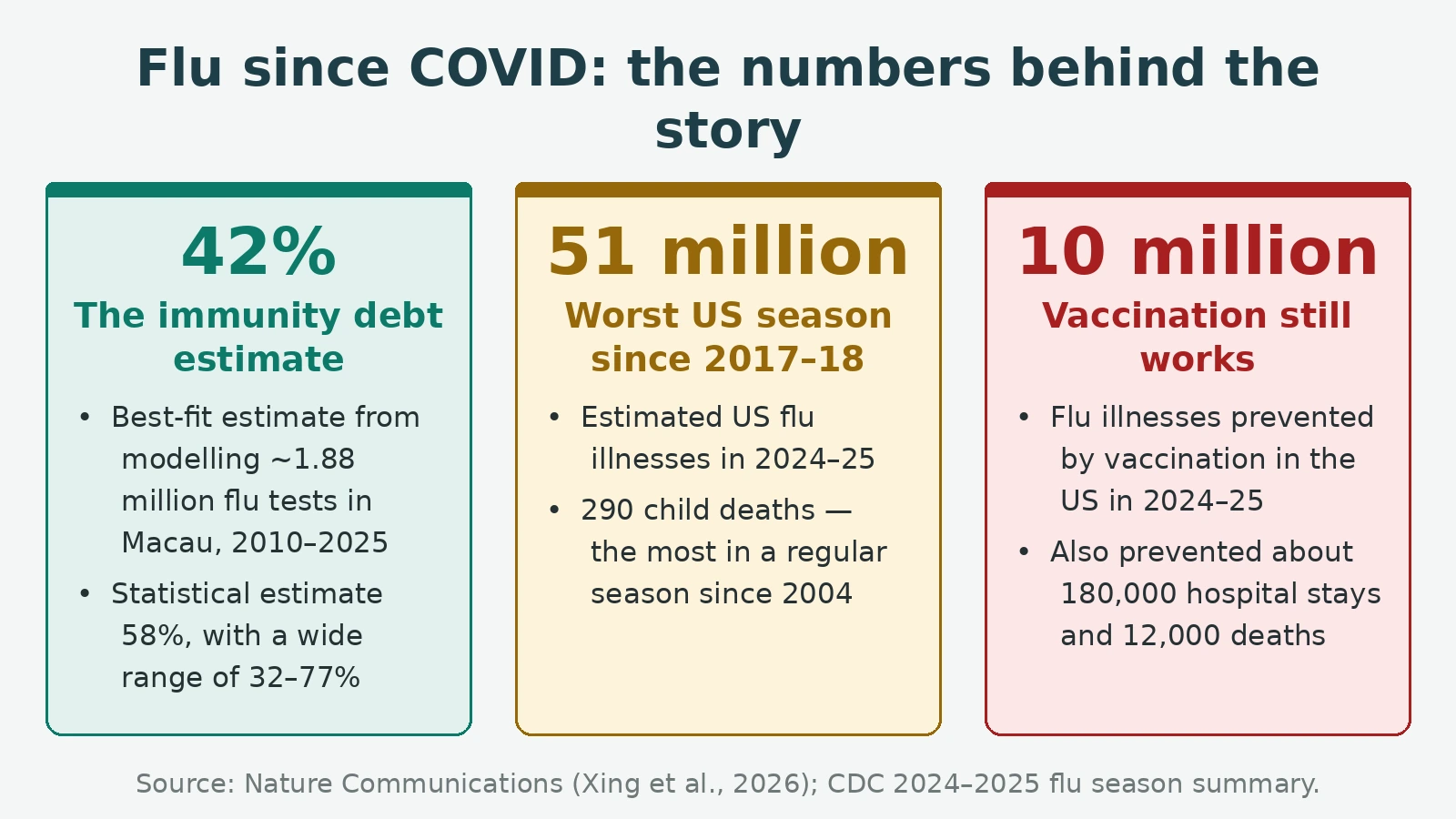
A study published in Nature Communications on 13 November 2026 gives the idea its first hard numbers. Researchers at Macao Polytechnic University and Kiang Wu Hospital analysed around 1.88 million clinical flu tests collected in Macau between 2010 and 2025, alongside weather data, air quality, travel patterns and flu genomes from Hong Kong. Their modelling put the post-pandemic immunity debt at 42% in the best-fitting model, with a statistical estimate of 58% and a wide uncertainty range of 32–77%.
Three findings stand out. First, the extra susceptibility rose more in adults than in children, which surprised the researchers. Second, vaccination coverage among high-risk groups did not fall, so the team ruled out lower vaccine uptake as the main driver. And third, the researchers found what they call “environmental decoupling”: with so many people susceptible, flu A kept spreading even when the weather would normally have held it back, while flu B was pushed down unevenly.
Why flu seasons have felt worse
Immunity debt is only part of the story, and the study itself is a model of one dense city — Macau — so its numbers cannot simply be pasted onto every country. Still, the pattern it describes matches what many countries have lived through.
The United States had its worst flu season in years in 2024–25. The CDC estimates there were 51 million flu illnesses, 23 million medical visits, 710,000 hospitalisations and 45,000 deaths — a high-severity season across every age group, the first since 2017–18. The same season saw 290 flu deaths reported among children, the highest number for a regular season since reporting began in 2004. Worldwide, the World Health Organization estimates seasonal flu causes around a billion cases a year, including 3–5 million severe illnesses and 290,000 to 650,000 respiratory deaths.
Other forces are at work too. Flu viruses keep changing, so last year’s protection never fully matches this year’s strain. Travel bounced back fast after the pandemic, and the Macau study found flu was repeatedly reintroduced through ports of entry into crowded neighbourhoods. And vaccination is patchy: in the US in 2024–25, only 31% of adults aged 18–49 were vaccinated, compared with 63% of people aged 65 and over. A bigger pool of susceptible people, plus more movement, plus a virus that keeps evolving, is a recipe for a rough season.
Is immunity debt settled science?
No — and honest scientists say so. The concept was first proposed by French paediatric specialists in August 2021, and it has been argued over ever since. Some experts prefer to talk about “reduced population immunity” rather than a debt, because the word debt suggests something owed or something broken, and neither is quite right. Others point out that waning immunity, seasonal weather patterns and changes in the virus itself can explain much of the same picture.
What is not in doubt is the underlying mechanism: protection against flu fades without regular contact, and the pandemic years removed that contact for almost everyone at once. The Macau study is valuable because it turns that mechanism into a measurable estimate for the first time — but its authors are modelling one city, and their central estimate comes with a wide range. Treat 42% as the study’s best reading of the data, not as a fact carved in stone.
Who faces the highest risk from flu?
Flu can hit anyone, but some groups face a much higher chance of serious illness. The WHO lists pregnant women, children under five, older people, people with long-term conditions such as heart, lung, kidney or metabolic disease, and people with weakened immune systems. Health and care workers are also at higher risk because of their exposure.
The numbers back that up. In the US 2024–25 season, people aged 65 and over accounted for 57% of flu hospitalisations and 71% of flu deaths, according to the CDC. Children were hit hard too: the 290 reported child deaths were the most in any regular season since reporting began. If you or someone in your household falls into a higher-risk group, that is the group to protect first.
How to protect yourself this winter
Vaccination remains the single best defence. The WHO calls it the best way to prevent flu, and safe, effective flu vaccines have been used for more than 60 years. In the US 2024–25 season, vaccination is estimated to have prevented around 10 million illnesses, 180,000 hospitalisations and 12,000 deaths. The Mayo Clinic recommends a yearly flu vaccine for everyone aged six months and older who has no medical reason to avoid it — and the NHS offers it each autumn to people at higher risk.
Everyday habits help as well. Wash your hands with soap and water for at least 20 seconds, or use a hand sanitiser with at least 60% alcohol. Cover coughs and sneezes, clean surfaces you touch often, and keep your distance from people who are ill when flu is spreading. If you do catch flu, stay home while you have a temperature — the NHS notes you are most likely to pass it on in the first five days. Rest, drink plenty of fluids, and talk to a doctor or pharmacist about easing aches and fever.
When to see a doctor
Most people recover from flu within about a week without medical care, but do not wait if you are worried. The NHS advises seeking urgent help if you are 65 or over, pregnant or recently gave birth, have a long-term medical condition, have a weakened immune system, feel very unwell or short of breath, or your symptoms have not improved after seven days. The same applies if you are worried about a baby or child.
Get emergency help straight away if you develop sudden chest pain, severe difficulty breathing, or start coughing up blood. In an emergency call 911 (US), 999 (UK) or 112 (EU)
Frequently asked questions
What is immunity debt?
Immunity debt describes a population with less recent exposure to a germ. During COVID, flu barely circulated, so fewer people caught it and topped up their protection. When flu returned, more people than usual were susceptible, so seasons hit harder. It is about missing contact with the virus, not about individual immune systems being damaged.
Does immunity debt mean COVID damaged my immune system?
No. The American Association of Immunologists has said there is no scientific evidence that pandemic measures caused lasting harm to anyone's immune system. Immunity debt refers to a whole population having less recent flu exposure, which fades protection over time. Your immune system itself is not weakened; it simply has less recent practice against flu.
Why did flu come back so strongly after COVID?
Flu returned to a population with little recent exposure, so it spread faster and hit harder. The November 2026 Macau study estimates the immunity debt at 42%, and found flu A kept spreading even in weather that would normally slow it. Travel also resumed, repeatedly reintroducing the virus, and flu itself keeps changing, so old protection never matches the new strain exactly.
Who is most at risk from flu?
Pregnant women, children under five, older people, and anyone with a long-term condition or a weakened immune system face the highest risk of serious flu. In the US 2024–25 season, people aged 65 and over accounted for 57% of hospitalisations and 71% of deaths. If you are in a higher-risk group, talk to a doctor or pharmacist about vaccination.
Does the flu jab still work after COVID?
Yes. Vaccination remains the best protection against flu, according to the WHO, and flu vaccines have been used safely for more than 60 years. In the US 2024–25 season, vaccination prevented an estimated 10 million illnesses, 180,000 hospitalisations and 12,000 deaths. It may not stop every infection, but it makes severe illness and hospital stays much less likely.
How can I protect myself from flu this winter?
Get the annual flu vaccine if you are eligible, and talk to a doctor or pharmacist if you are unsure. Wash your hands often, cover coughs and sneezes, and keep your distance from people who are ill. If you catch flu, rest, drink plenty of fluids, and stay home while you have a temperature to avoid passing it on.
Sources
- Nature Communications: Post-pandemic immunity debt and environmental decoupling reshape urban influenza transmission (Xing et al., 2026) www.nature.com
- CDC: 2024–2025 Influenza Season Summary — Severity, Disease Burden, and Burden Prevented www.cdc.gov
- NHS: Flu www.nhs.uk
- Mayo Clinic: Influenza (flu) — Symptoms and causes www.mayoclinic.org
- WHO: Influenza (seasonal) fact sheet www.who.int
- Anales de Pediatría (PMC): Changes in the epidemiology of infections in children — Is there an immune debt? pmc.ncbi.nlm.nih.gov
- American Association of Immunologists: Statement on the Concept of “Immunity Debt” (2023) www.aai.org

Try the tool
Not sure if it can wait?
Common causes and warning signs for 16 everyday symptoms.
Open the symptom guide