Do Men Get UTIs? Symptoms, Causes and Treatment
Yes, men can get UTIs — about 1 in 5 will have one in their lifetime. They are less common than in women but often signal an underlying problem such as an enlarged prostate.
- Written by
- Health Daily Advice
- Published
- Reading time
- 7 minutes
- Sources
- 6 cited

In this guide
Yes — men can get urinary tract infections, though they are less common in men than in women. Cleveland Clinic says about 1 in 5 men will have a UTI at some point in their lives, and risk rises with age. Because a UTI is unusual in a man, doctors look for an underlying cause, such as an enlarged prostate.
Why are UTIs less common in men?
A urinary tract infection, or UTI, is an infection anywhere in the urinary tract — the kidneys, ureters, bladder or urethra. The most common type in men is a bladder infection, known as cystitis, but infection can also involve the prostate or spread to the kidneys.
Anatomy is the main reason men get them less often. The male urethra is about 18 to 20 cm long, while the female urethra is just 3 to 4 cm long, according to UCLA Health — so bowel bacteria have a far longer journey to reach the bladder in men. The female urethra also sits close to the anus, a source of bacteria. Fluid produced by the prostate has antibacterial properties too, and the regular flow of urine helps flush bacteria out.
The numbers show the gap clearly. UCLA Health reports that up to 60% of women will have at least one UTI in their lifetimes, compared with about 10% to 12% of men. The National Institute of Diabetes and Digestive and Kidney Diseases (NIDDK) reports that about half of all women will develop a bladder infection in their lifetime, and about a quarter of those women will have repeat infections. Men under the age of 50 rarely get bladder infections — but the risk rises sharply with age.
Symptoms of a UTI in men
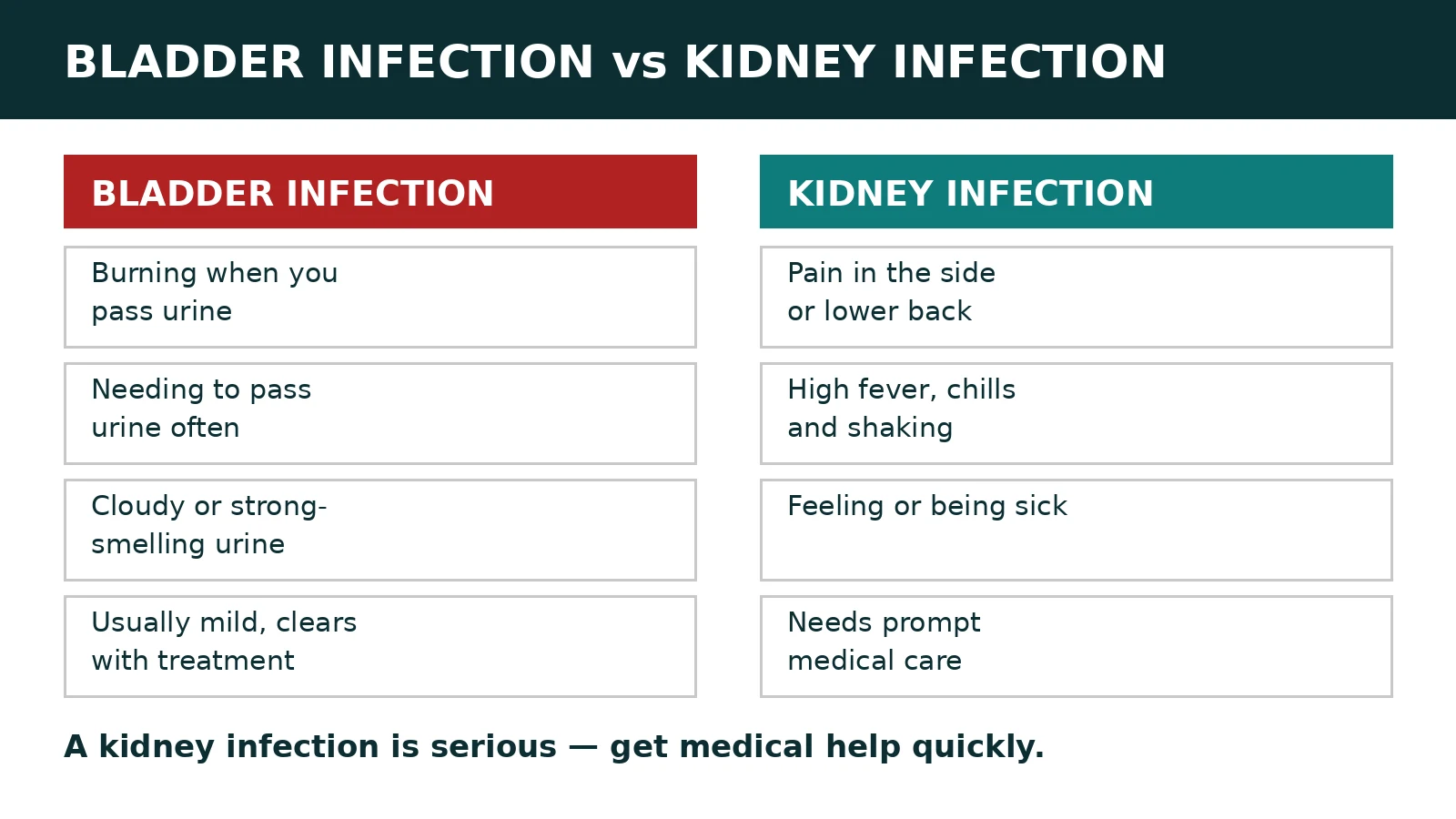
Symptoms depend on where the infection sits. A bladder infection typically causes:
- Pain or a burning feeling when passing urine
- Needing to pass urine more often than usual, including at night
- A strong, sudden urge to pass urine, yet only small amounts come out
- Difficulty starting to pass urine, a weak stream, or a feeling that the bladder has not fully emptied
- Pain, pressure or tenderness in the lower tummy or around the bladder
- Cloudy, bloody or strong-smelling urine
- A low-grade fever
If infection reaches the kidneys, the symptoms are more severe:
- Pain in the side or lower back
- High fever, with or without chills and shaking
- Feeling or being sick
- Feeling generally unwell
In older men, the only sign may be new confusion, feeling generally unwell, or being unsteady — even without obvious urinary symptoms. Some men have no symptoms at all.
Bladder infection or kidney infection?
What causes a UTI in a man?
Most UTIs are caused by bacteria, usually Escherichia coli (E. coli), a bacterium that normally lives in the bowel. The bacteria travel from the skin around the back passage into the urethra and then up to the bladder, where they multiply. Factors that raise the risk in men include:
- An enlarged prostate. The prostate squeezes the urethra, so the bladder does not empty fully, and urine left behind gives bacteria a place to multiply. This is the leading underlying cause in men over 50.
- Kidney or bladder stones. Stones can block urine flow, and bacteria can collect on them.
- A urinary catheter or a recent urinary procedure, such as a bladder scope or prostate biopsy.
- Difficulty emptying the bladder for any reason, including a narrowed urethra or nerve problems affecting bladder emptying.
- Diabetes. High sugar levels in the urine feed bacteria, and diabetes can weaken the immune system. Some diabetes medicines also raise sugar in the urine.
- A weakened immune system, for example from cancer, HIV or medicines that suppress immunity.
- Unprotected sex and STIs. Anal sex without a condom carries a higher risk because of the bacteria in that area, and sexually transmitted infections such as chlamydia and gonorrhoea can cause urethritis — burning and discharge. A UTI itself is not an STI.
- Poor hydration. Not drinking enough fluids means urine is passed less often, so bacteria are flushed out less effectively.
Because it is harder for bacteria to infect the male urinary tract, a UTI is usually a red flag that something else is going on. Cleveland Clinic’s urologists explain that male UTIs tend to be more complicated because there is often another medical problem behind them — most commonly an enlarged prostate, a kidney or bladder stone, or another cause of incomplete bladder emptying.
How is it diagnosed?
A doctor will ask about your symptoms, medical history and sexual history, and carry out a physical examination, which in men may include a rectal examination to assess the size and shape of the prostate. Diagnosis is confirmed with urine tests: a quick urinalysis checks the sample for white blood cells and blood, and a urine culture is sent to a laboratory to identify the exact bacterium and which antibiotics will work against it. Culture results typically take a few days.
If there is a fever or you seem very unwell, blood tests may be done to check kidney function. Further tests are more likely if the infection does not clear, keeps coming back, or there are signs the kidneys are involved — for example an ultrasound or CT scan of the kidneys and bladder, a PSA blood test for the prostate, a look inside the bladder with a camera, or tests of how well the bladder empties. If you are waking up to pass urine at night, that can also be a sign of prostate or bladder trouble — see our guide to why you wake up to pee at night.
How are UTIs in men treated?
Antibiotics prescribed by a doctor are the main treatment. The choice depends on the bacterium found on urine culture, local resistance patterns and how severe the infection is. Men usually need a longer course than women: Patient.info states treatment is usually about seven days in men, and the NIDDK notes that men may need antibiotics for longer than women because bacteria can move into the prostate, where infection is harder to clear. Infection of the upper tract or prostate may need three weeks or longer, according to Harvard Health. Some men with a severe kidney infection need hospital care and antibiotics given through a drip.
Most uncomplicated lower urinary tract infections begin to improve within one to two days of proper treatment, according to Harvard Health — but it is important to finish the full course even if symptoms improve sooner, because stopping early risks the infection returning.
At home, drink plenty of fluids — water is best — to help flush bacteria out and avoid dehydration. Rest, and use a painkiller such as paracetamol for pain or fever if suitable. A heating pad on the back or lower tummy may ease discomfort. Avoid drinks that may irritate the bladder, such as coffee and alcohol, while symptoms last.
What not to do: do not take leftover antibiotics, someone else’s antibiotics, or antibiotics bought without a prescription, and do not stop the prescribed course early. Do not rely on cranberry products to treat an existing infection — the NIDDK states that cranberry products do not treat bladder infections, and the NHS says there is no evidence they ease symptoms or treat a UTI once it has started. Treating the underlying cause matters too: if an enlarged prostate or a stone is behind the infection, the doctor may also treat that problem to reduce the chance of repeat infections.
Can a UTI be passed on during sex?
No — a urinary tract infection is not something you can catch from a partner or give to one. It is not classed as a sexually transmitted infection. That said, sex can move bacteria into the urethra, which is one reason infections sometimes follow intercourse, and infections such as chlamydia or gonorrhoea can produce the same kind of burning and discharge. Because the symptoms overlap, a doctor may test for STIs as well. Using condoms and passing urine after sex can lower the risk.
How can men prevent UTIs?
- Drink enough fluids, especially water, and pass urine when you feel the urge rather than holding it in; take time to empty the bladder fully.
- Pass urine soon after sex, and use condoms during sex.
- Keep diabetes well controlled, if you have it.
- Have regular prostate checks from age 50, as Cleveland Clinic advises, to pick up an enlarged prostate early.
- Speak to a doctor before using cranberry products or other supplements, and before using preventive low-dose antibiotics — these are sometimes offered only for men with recurrent infections. Recurrent UTIs are defined as two or more infections in six months, or three or more in a year.
When to see a doctor
Men should seek prompt medical care for a suspected UTI — the NHS lists being male as itself a reason to ask for an urgent GP appointment or help from NHS 111. Seek help urgently if you have a fever, feel hot or cold, or are shivering; pain in the lower tummy or in the back just under the ribs; blood in the urine; symptoms that get worse quickly or do not improve within 48 hours of starting treatment; repeated UTIs; or if you use a catheter, have diabetes or a weakened immune system. Seek care straight away if you cannot pass urine at all, have severe back or side pain, keep vomiting, or cannot keep fluids down. Untreated, a bladder infection can spread to the kidneys and cause permanent kidney damage or sepsis, so prompt treatment matters.
Call 999 or go to A&E now if you are confused, drowsy, or have difficulty speaking.
In an emergency call 911 (US), 999 (UK) or 112 (EU).
Frequently asked questions
Can men get UTIs?
Yes. They are much less common in men than in women, and rare in men under 50, but up to 1 in 5 men will have one at some point in their lives, according to Cleveland Clinic. Because they are unusual in men, doctors usually check for an underlying cause such as an enlarged prostate.
What are the symptoms of a UTI in men?
Burning or pain when passing urine, needing to pass urine often or urgently, passing only small amounts, lower tummy pain, and cloudy, bloody or strong-smelling urine. Fever, back or side pain, nausea and vomiting suggest the infection may have reached the kidneys and needs prompt care.
What causes a UTI in men?
Most are caused by bowel bacteria, usually E. coli, entering the urethra and reaching the bladder. The risk is higher with an enlarged prostate, kidney or bladder stones, a urinary catheter, diabetes, a weakened immune system, or difficulty emptying the bladder fully.
How is a UTI in men treated?
With a course of antibiotics prescribed by a doctor — usually about seven days for a bladder infection in men, and longer if the prostate or kidneys are involved. Drinking plenty of water and using paracetamol for pain or fever can help at home. Always finish the full course, even if symptoms improve sooner.
Can a UTI be passed on during sex?
A UTI itself is not a sexually transmitted infection and cannot be passed to a partner like an STI. However, sex can push bacteria into the urethra, and STIs such as chlamydia or gonorrhoea can cause similar burning and discharge, so doctors may test for STIs as well.
Sources
- Cleveland Clinic: Can Men Get a UTI? health.clevelandclinic.org
- NIDDK: Bladder Infection (UTI) in Adults www.niddk.nih.gov
- NHS: Urinary tract infections (UTIs) www.nhs.uk
- Patient.info: Urine Infection In Men (UTIs) dev.patient.info
- UCLA Health: While not common, it is possible for men to get UTIs www.uclahealth.org
- Harvard Health: Urinary Tract Infection in Men www.health.harvard.edu

Try the tool
Not sure if it can wait?
Common causes and warning signs for 16 everyday symptoms.
Open the symptom guide