GLP-1 Eye Risk: FDA Warns of Rare Vision Loss (NAION)
The FDA will require GLP-1 drug makers to warn about NAION, a rare eye condition that can cause sudden, painless vision loss. The risk is small — about 6 cases per 100,000 users a year — but the symptoms are worth knowing.
- Written by
- Health Daily Advice
- Published
- Reading time
- 6 minutes
- Sources
- 4 cited
In this guide
On 9 November 2026, the US Food and Drug Administration (FDA) said makers of GLP-1 medicines — including Ozempic, Wegovy, Mounjaro, Zepbound and Trulicity — must add a warning about a rare eye condition called NAION, which can cause vision loss. The risk is small and unproven, but patients should know the warning signs.
What is NAION, and how does it affect vision?
NAION stands for non-arteritic anterior ischemic optic neuropathy, pronounced “NYE-on”. It happens when blood flow and oxygen to the front part of the optic nerve — the cable that carries visual signals from the eye to the brain — drops suddenly. The nerve is damaged, and vision in that eye can fall away within hours. Doctors sometimes call it an “eye stroke”.
It usually affects one eye. The vision loss is sudden and painless, and in some cases it is permanent. There is no medical or surgical treatment that reverses the vision loss once it has happened, which is why the warning focuses on spotting it early and on knowing who may be more vulnerable.
NAION is rare. A neuro-ophthalmologist at UC Davis Health, Dr Yin Allison Liu, notes that it affects about 2.3 to 10.3 people per 100,000 each year among those aged 50 and over, which works out at roughly 6,000 new cases a year in the United States. It is the most common cause of sudden optic nerve damage in older adults, and it has long been linked to diabetes, high blood pressure and sleep apnoea — the same conditions many people taking GLP-1 drugs already have.
What did the FDA announce?
The FDA said it will require information about the risk of NAION to be added to the Warnings and Precautions section of the labelling of every GLP-1 receptor agonist. The class covers all the widely used drugs in this group: semaglutide (Ozempic, Wegovy), tirzepatide (Mounjaro, Zepbound), dulaglutide (Trulicity) and others. Millions of people use these medicines for type 2 diabetes or weight loss, and some are also approved to lower the risk of heart attack and stroke or to treat sleep apnoea and certain kidney and liver conditions.
The agency began looking at the issue after a 2024 study raised concerns about semaglutide, and then ran a full review of clinical trial data, animal data, reports of side effects and published observational studies. Its conclusion was careful: there is a potential increased risk of rare NAION events in people taking GLP-1 drugs, but the evidence does not prove the drugs cause the condition.
What did the studies find?
The FDA’s review pulled together several lines of evidence, and they do not all point in exactly the same direction — which is part of why the agency calls the risk “potential” rather than confirmed.
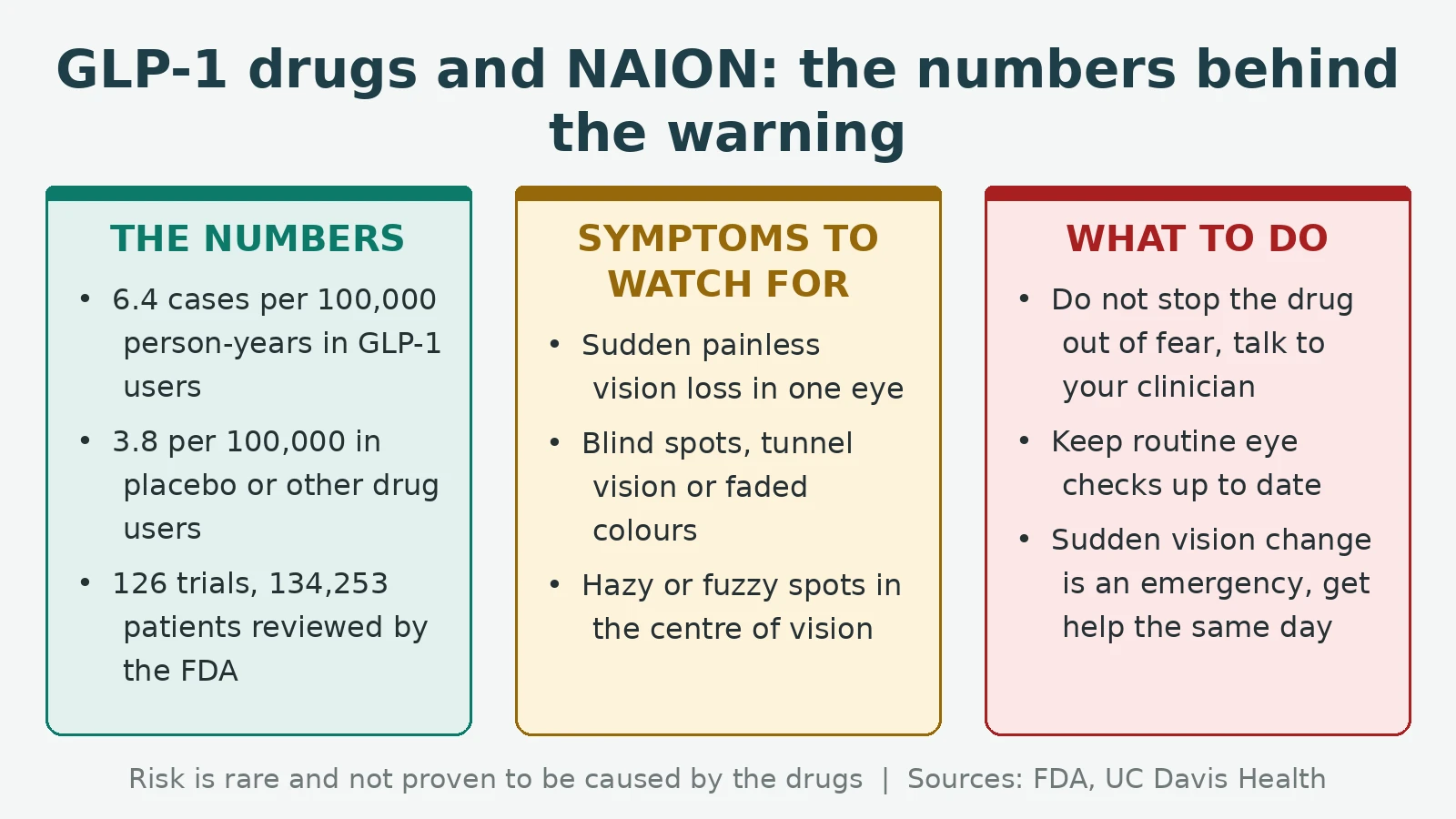
In a meta-analysis of 126 clinical trials covering 134,253 patients, the agency found 15 probable NAION events: 10 in people taking GLP-1 drugs and 5 in people taking a placebo. That gave an incidence of 6.4 cases per 100,000 person-years in GLP-1 users, compared with 3.8 per 100,000 person-years in people on a placebo or another diabetes drug. A person-year is a measure that counts both how many people were studied and how long each was followed.
The 2024 study that started the investigation, published in JAMA Ophthalmology by Hathaway and colleagues, looked at people prescribed semaglutide and reported a higher rate of NAION than in people taking other diabetes medicines. The FDA noted several limitations in that study, which is why it did its own analysis.
A separate FDA study using real-world records from 2019 to 2024 compared people with type 2 diabetes who started a GLP-1 drug with people who started two other classes of diabetes medicine. Rates of NAION were similar between GLP-1 users and people taking SGLT-2 inhibitors (around 30 to 32 cases per 100,000 person-years in both groups), but higher than in people taking DPP-4 inhibitors (26 per 100,000 person-years), with a hazard ratio of 1.43. In plain terms, that means the rate was about 43% higher than in the DPP-4 group, though the absolute numbers stayed small. Published observational studies that the FDA judged methodologically rigorous pointed the same way.
Animal studies did not find a mechanism by which GLP-1 drugs could cause NAION. And because the risk factors for NAION — diabetes, high blood pressure, sleep apnoea — overlap so heavily with the reasons people are prescribed these drugs, it is hard to separate the effect of the medicine from the effect of the underlying illness.
What are the symptoms to watch for?
NAION usually arrives without warning, often noticed on waking in the morning. The FDA lists these symptoms:
- Loss of vision in one eye that comes on suddenly and without pain
- Blurry vision, or missing patches of sight such as blind spots or tunnel vision
- Colours that look faded or washed out
- Hazy or fuzzy spots in the centre of vision
Anyone who notices these changes should call their healthcare provider straight away, or go to an emergency department. Sudden vision loss is a medical emergency, whatever the cause. Doctors are urged to send anyone with a suspected case to an eye specialist, an ophthalmologist, promptly.
Who may be more at risk?
The exact cause of NAION is not fully understood, but eye doctors know that certain features of the optic nerve make it more likely. The main one is a “crowded” optic disc: the nerve head has a small or absent central dip, called the cup, so the nerve fibres are tightly packed. This is sometimes called a “disc at risk”. Deposits inside the optic nerve head, known as optic disc drusen, can add to the crowding.
Having these features does not mean a person will develop NAION, and most people with a crowded disc never do. But they can be spotted during a routine eye examination, sometimes with extra imaging. Dr Liu suggests using regular eye care visits — including the diabetic eye checks many people on these drugs already have — to look at the optic nerve, rather than booking a separate screening appointment just because of the new warning. She also notes that these checks cannot reliably predict who will develop NAION.
People who have already had NAION in one eye should talk with their doctor about whether to keep taking a GLP-1 medicine, because having it once raises the chance of it affecting the other eye. The FDA has told doctors to consider stopping the drug in patients who develop the condition, unless the benefits clearly outweigh the risk.
Should you stop taking your GLP-1 medicine?
No — not on the basis of this warning alone. That is the clearest message from the specialists the FDA’s announcement drew on. “The absolute risk of NAION remains small,” Dr Liu said. “For someone with diabetes, obesity or substantial cardiovascular risk, the benefits of treatment may outweigh the potential risk to vision. Patients should not stop their medication simply out of fear. They should discuss their individual risks and benefits with their prescribing clinician.”
That balance matters because the same drugs are protecting people against heart attacks, strokes and kidney damage. Stopping suddenly can also send blood sugar and weight back up. The sensible step is to raise it at your next appointment, or sooner if you have had an eye problem before, and to make sure your routine eye checks are up to date. One question that is still unanswered is whether the risk changes with how long someone has been on the drug — researchers say longer studies are needed.
Research into treatment is still at an early stage. UC Davis Health is taking part in a clinical trial of cenegermin, an investigational nasal spray for people with recent-onset NAION, but its effectiveness has not been established.
When to see a doctor
Contact your prescribing clinician promptly if you notice any sudden change in your vision, even if it seems small. Do not wait for your next routine appointment. If the change is sudden or severe, go to an emergency department or see an eye specialist the same day.
Also talk to your doctor before your next prescription if you have ever had NAION, an eye stroke, or been told you have a crowded optic disc. Bring a list of your medicines so the clinician can weigh the eye risk against the benefits of the drug for your diabetes, weight or heart health.
In an emergency call 911 (US), 999 (UK) or 112 (EU)
Frequently asked questions
What is NAION?
NAION stands for non-arteritic anterior ischemic optic neuropathy. It happens when blood flow and oxygen to the front of the optic nerve drops suddenly, damaging the nerve and causing sudden, painless vision loss, usually in one eye. Doctors sometimes call it an eye stroke. It is rare, affecting about 2.3 to 10.3 people per 100,000 aged 50 and over each year.
Which GLP-1 drugs does the FDA warning cover?
All of them. The FDA is requiring a NAION warning in the labelling of every GLP-1 receptor agonist, including semaglutide (Ozempic, Wegovy), tirzepatide (Mounjaro, Zepbound) and dulaglutide (Trulicity). The warning follows the agency's review of trial data, animal data, side-effect reports and published studies.
Do GLP-1 drugs cause NAION?
That has not been shown. The FDA concluded there is a potential increased risk, not a proven cause. Its trial meta-analysis found 6.4 cases per 100,000 person-years in GLP-1 users versus 3.8 in comparators, and animal studies found no mechanism. Diabetes, high blood pressure and sleep apnoea also raise NAION risk and are common in people taking these drugs.
What are the symptoms of NAION?
Sudden, painless loss of vision in one eye, often noticed on waking; blurry vision or missing patches of sight such as blind spots or tunnel vision; colours that look faded or washed out; and hazy or fuzzy spots in the centre of vision. Anyone with these symptoms should call their healthcare provider straight away or go to an emergency department.
Should I stop taking Ozempic or Zepbound because of the eye warning?
No, not on the basis of the warning alone. Specialists stress that the absolute risk is small and that for people with diabetes, obesity or substantial heart risk, the benefits of treatment may outweigh the potential risk to vision. Talk to your prescribing clinician about your own risks and benefits, and keep routine eye checks up to date.
Who is most at risk of NAION on a GLP-1 drug?
People with a crowded optic disc — where the nerve head has a small or absent central dip — or deposits called optic disc drusen may be more vulnerable. These features can be spotted at a routine eye examination. People who have already had NAION in one eye should discuss continuing the drug with their doctor, as it raises the chance of it affecting the other eye.
Sources
- FDA: FDA Requires Safety Labeling Changes for GLP-1 Receptor Agonists Due to Potential Increased Risk of Rare But Serious Eye Condition www.fda.gov
- UC Davis Health: GLP-1s now carry a warning about a rare vision-threatening eye condition health.ucdavis.edu
- Drugs.com / HealthDay: Rare Eye Condition Prompts New FDA Warning On Popular GLP-1 Drugs www.drugs.com
- Hathaway JT, et al. Risk of Nonarteritic Anterior Ischemic Optic Neuropathy in Patients Prescribed Semaglutide. JAMA Ophthalmology, 2024 doi.org

Try the tool
Not sure if it can wait?
Common causes and warning signs for 16 everyday symptoms.
Open the symptom guide