Can Weather Changes Cause Headaches? The ‘Barometric Flu’ Truth
Storms are blamed for headaches, joint pain and flu-like misery — and 'barometric flu' is trending. Here is what falling pressure really does, and what is myth.
- Written by
- Health Daily Advice
- Published
- Reading time
- 7 minutes
- Sources
- 9 cited
In this guide
Yes — for some people. Falling barometric pressure ahead of a storm can trigger headaches and migraine in weather-sensitive people, and over a third of people with migraine name weather as a trigger. But the link is not proven for everyone, and the viral “barometric flu” is not a real illness: weather cannot give you flu.
Why weather headaches are trending now
As a cold front and a brewing nor’easter sweep the US East Coast this week, “barometric pressure” has surged in American health searches. The spark was a TikTok post on 12 November that bundled storm-linked symptoms — headaches, dizziness, joint pain and fatigue — under a new label, “the barometric flu”. Thousands of comments followed, mostly from women saying the same thing happens to them, and Yahoo Health picked up the question: is the “barometric flu” real?
It is a good question, because two different things are being mixed together. The symptoms people describe are real enough. But a pressure drop cannot give you flu — only a virus can do that. What the weather can do, for some people, is trigger a migraine or make existing pain worse.
What is barometric pressure?
Barometric pressure, also called atmospheric pressure, is the weight of the air pressing down on us. It falls as a storm or cold front approaches and rises again in clear, calm weather. Average sea-level pressure is about 1013 hPa (29.92 inHg), and readings below roughly 29.80 inHg are generally considered low and linked to rain and storms.
Nor’easters — the powerful storms that run up the US East Coast — are known for dramatic pressure drops, and they are most common and most violent between September and April, according to NOAA. In the UK the pattern is usually gentler but familiar: a damp, windy, low-pressure day arriving after a settled spell.
Can weather changes really cause headaches?
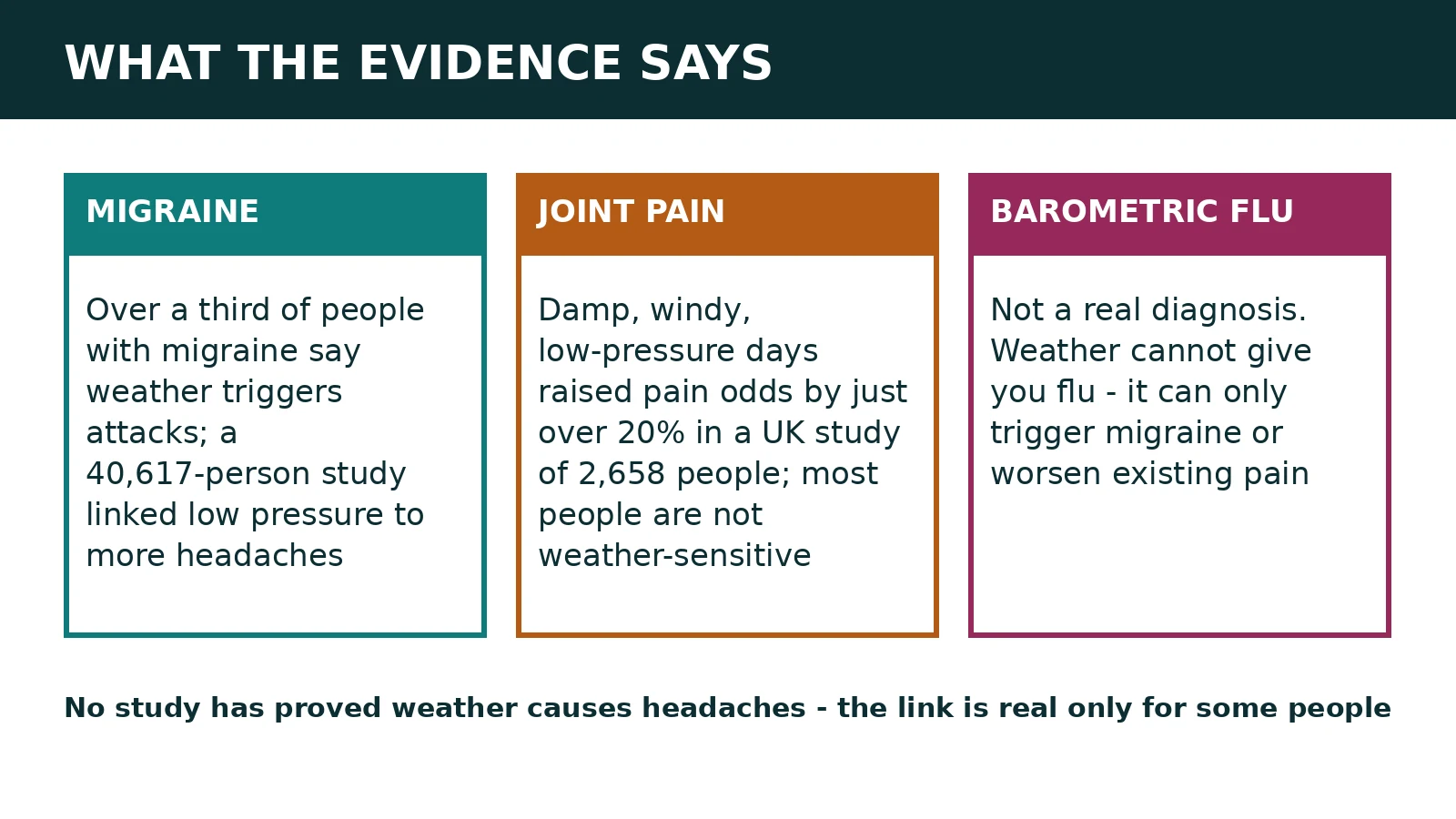
For a sizeable minority, the answer seems to be yes. The American Migraine Foundation says over a third of people with migraine report weather as a trigger at least some of the time, and other reviews put the figure at 30 to 50%. A small Japanese study found 75% of people with migraine had attacks linked to falling pressure ahead of a typhoon, compared with only 20% of people with tension-type headache. And a large Japanese smartphone study of 40,617 people found low barometric pressure, pressure changes, high humidity and rainfall were all associated with more headaches.
But the picture is messier than the headlines suggest. A 2025 systematic review in Cureus pooled 14 studies covering 2,696 participants and found inconsistent results: several studies linked pressure drops to more frequent migraine, fewer found any link to severity, and none found a link to how long attacks lasted. A separate 31-study meta-analysis found only a modest association, smaller than the effect of temperature. The honest summary, from a 2024 review, is that weather probably accounts for roughly 20% of migraine attacks — and no study has yet established a proven causal relationship.
Migraine is common enough that this matters either way. It affects about 14% of the world’s population — roughly 1.16 billion people — and is the leading cause of disability in women under 50, according to the World Health Organization.
How could falling pressure trigger a headache?
Scientists have several plausible explanations, though none is proven. The head contains air-filled pockets — the sinuses — that normally sit in balance with the air outside. When outside pressure falls, a mismatch can develop between the pressure inside the sinuses and the air outside, which can cause pain. Pressure changes also affect the inner ear, which connects to the trigeminal nerve, the main nerve involved in migraine pain; one theory is that the inner ear acts as a pressure sensor.
Another idea is about oxygen. When air pressure dips, the partial pressure of oxygen falls slightly, and the brain compensates by widening blood vessels to deliver more oxygen — extra blood flow that may trigger pain. The Mayo Clinic notes that weather changes may also disturb brain chemicals including serotonin, which can prompt a migraine.
As Cleveland Clinic neurologist Dr MaryAnn Mays puts it, pressure changes “lower the brain’s threshold for an attack”. The weather does not directly cause the headache; it tips the balance in someone already prone to them, especially when it stacks up with other triggers such as poor sleep or skipped meals.
What about joint pain?
The same storm that brings on a headache often brings aching knees — and here too the evidence is real but modest. The UK’s “Cloudy with a Chance of Pain” study followed 2,658 people with chronic pain, mostly arthritis, for 15 months. Pain was more likely on days with higher humidity and stronger wind, and less likely when atmospheric pressure was higher; temperature made no difference. The worst combination of weather raised the odds of a painful day by just over 20% compared with an average day.
But most people are not weather-sensitive at all. A re-analysis of the same project found only 1 in 10 chronic-pain patients were sensitive to temperature, 1 in 25 to humidity and just 1 in 50 to pressure. And a 2024 review pooling 11 studies with 15,315 participants found no association between humidity, air pressure, temperature or rainfall and the risk of rheumatoid arthritis flares, knee pain or low back pain. The likely mechanism, when pain does flare, is that falling outside pressure lets tissues around a joint expand slightly, pressing on nerves inside the joint — while the cold that usually comes with low pressure can make the fluid inside joints thicker and stiffer.
One thing is clear: pressure changes cannot cause arthritis. They can only worsen pain that is already there.
Is “barometric flu” real?
No. There is no recognised medical condition called “barometric flu” — the term was coined on TikTok in November 2026 and went viral. Doctors are clear that the weather itself, however dramatic the change, cannot make you ill with flu or a cold: those need a virus or bacteria.
The grain of truth is that falling pressure can trigger real symptoms that feel flu-like — headache or migraine, dizziness, sinus pressure, fatigue, brain fog and joint aches. Cold, dry winter air can also dry out the nasal passages, which makes it easier for germs to get in, so the weather can raise your vulnerability to infection without causing it. And unlike a real infection, pressure-linked symptoms are usually short-lived and ease once the weather passes.
The TikTok claim that women become more pressure-sensitive during perimenopause, because fluctuating oestrogen makes the nervous system more reactive, is plausible — oestrogen swings are a known migraine factor and migraine is two to three times more common in women — but it has not been proven by any study. A 2024 study did find low-pressure headaches occurred more often in women than in men, which is the closest evidence so far.
What helps when the weather triggers headaches
You cannot control the weather, so the advice from headache specialists is to control everything else. The migraine brain loves routine, so keep sleep, meals and exercise on a steady schedule. Keep a headache diary for at least a month, noting headache days against the forecast, to find out whether pressure is genuinely your trigger rather than a coincidence.
If it is, watch the forecast and take any prescribed migraine medicine at the first sign of a headache rather than waiting for it to become severe. Stay hydrated — dehydration is itself a migraine trigger — and use a humidifier if indoor heating dries the air out. Aim for seven to eight hours of sleep, eat regular meals and do not skip them, and build in time to unwind, since stress lowers the threshold further.
Be careful with painkillers. Cleveland Clinic’s rule is no more than twice a week for over-the-counter painkillers: using them three or four times a week can cause more headaches over time, a problem called medication-overuse headache. If headaches strike on more than five days a month, even if painkillers help, it is worth talking to a doctor about preventive treatment. If you want more ideas for fast relief, see our guide on how to get rid of a headache fast.
When to see a doctor
See a GP soon if your headaches are new, changing, or happening more often than usual, or if you need painkillers most days. Keep a note of when they happen and what the weather was doing — it helps the doctor work out whether pressure is really a trigger for you.
In an emergency call 911 (US), 999 (UK) or 112 (EU). Call for emergency help straight away for a sudden, extremely severe headache that reaches full force within seconds — a “thunderclap” headache, the worst of your life — or a headache with weakness or numbness down one side, a drooping face, slurred speech or confusion, a seizure, new vision loss or double vision, fever with a stiff neck or rash, or a severe headache after a head injury.
Frequently asked questions
Can a drop in barometric pressure cause a headache?
It can trigger one in weather-sensitive people, especially if you get migraine. Over a third of people with migraine name weather as a trigger, and studies link falling pressure to more attacks. But the link is not proven for everyone, and pressure changes lower the threshold for an attack rather than causing headaches outright.
What is 'barometric flu' — and is it real?
It is not a real diagnosis. The term was coined on TikTok in November 2026 for storm-linked headaches, dizziness, joint pain and fatigue. Those symptoms can be real, but weather cannot give you flu — only a virus can. Pressure drops can trigger migraine and worsen existing pain, which can feel flu-like.
Why do I get a headache before it rains or storms?
Pressure usually falls before rain or a storm. The leading theories are that the pressure mismatch irritates the sinuses, that the inner ear acts as a pressure sensor linked to the migraine nerve, and that blood vessels widen as oxygen pressure dips. None of these mechanisms is proven.
Can weather changes make joint pain and arthritis worse?
For some people, yes, but the effect is modest. A UK study of 2,658 people with chronic pain found damp, windy, low-pressure days raised the odds of a painful day by just over 20%. Most people are not weather-sensitive, and pressure changes cannot cause arthritis — only worsen pain that is already there.
How can I prevent weather-triggered migraines?
Keep sleep, meals and exercise on a steady schedule, stay hydrated, and keep a headache diary to confirm whether pressure is really your trigger. Watch the forecast and take prescribed migraine medicine at the first sign of a headache. Do not use over-the-counter painkillers more than twice a week.
When should I worry about a weather-related headache and seek urgent care?
Call 999 or go to A&E for a sudden, extremely severe headache, or one with weakness, slurred speech, confusion, vision loss, fever with a stiff neck, or after a head injury. See a GP soon if headaches are new, changing, or happening more than five days a month.
Sources
- Healthline: Barometric Pressure Headaches: What You Should Know www.healthline.com
- American Migraine Foundation: Seasonal Migraine americanmigrainefoundation.org
- Cureus: Impact of Barometric Pressure Changes on Migraine (systematic review, 2025) www.ncbi.nlm.nih.gov
- Mayo Clinic: Migraines: Are they triggered by weather changes? www.mayoclinic.org
- Cleveland Clinic: What Can I Do To Avoid Headache and Migraine Triggers? health.clevelandclinic.org
- Medical News Today: Barometric pressure headaches and migraine www.medicalnewstoday.com
- NHS Scotland: National Headache Pathway www.rightdecisions.scot.nhs.uk
- Fox Weather: Can cold weather make you sick? www.foxweather.com

Try the tool
Not sure if it can wait?
Common causes and warning signs for 16 everyday symptoms.
Open the symptom guide