What Is the Cancer Sponge Test? The 7-Minute NHS Check
A capsule on a thread that checks for the earliest signs of oesophageal cancer — how the 7-minute sponge test works, who it is for, and what NICE has just recommended.
- Written by
- Health Daily Advice
- Published
- Reading time
- 6 minutes
- Sources
- 7 cited
In this guide
The cancer “sponge test” is a simple check for the earliest signs of oesophageal cancer. You swallow a small capsule on a thread; it releases a tiny sponge that collects cells from your food pipe. NICE has now recommended it for wider NHS use in England.
Why the sponge test is in the news
On 16 November 2026, the National Institute for Health and Care Excellence (NICE) published draft guidance recommending capsule sponge tests — known as Cytosponge and EndoSign — for wider use on the NHS in England. The BBC reported the same day that the tests “could be offered to more people with bad indigestion”, and the story quickly became one of the most searched health topics in the UK.
The guidance is still draft: a consultation runs until 7 December 2026, the committee meets again on 16 December, and final guidance is due in February 2027. But it is the first decision under the government’s new National HealthTech Access Programme, which means that if it is confirmed, the NHS in England must fund the tests and make them available to every eligible patient. The test is already available nationally in Scotland and Wales, and thousands of people in England have already had it through NHS pilots.
What is the cancer sponge test?
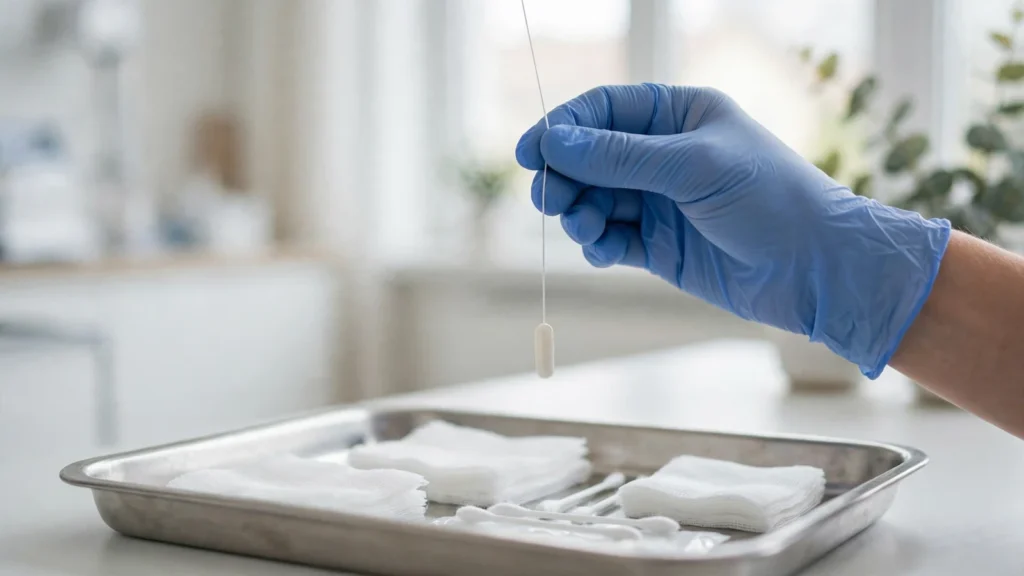
The test is disarmingly simple. You swallow a small capsule attached to a thread, with a glass of water. The capsule dissolves in the stomach after about seven minutes and releases a tiny compressed sponge. A clinician then gently pulls the sponge back up by the thread, and as it travels up it sweeps cells off the lining of the food pipe. Those cells go to a laboratory, which looks for a protein called trefoil factor 3 (TFF3) — a marker found in the abnormal cells of Barrett’s oesophagus — and for other cellular changes linked to cancer.
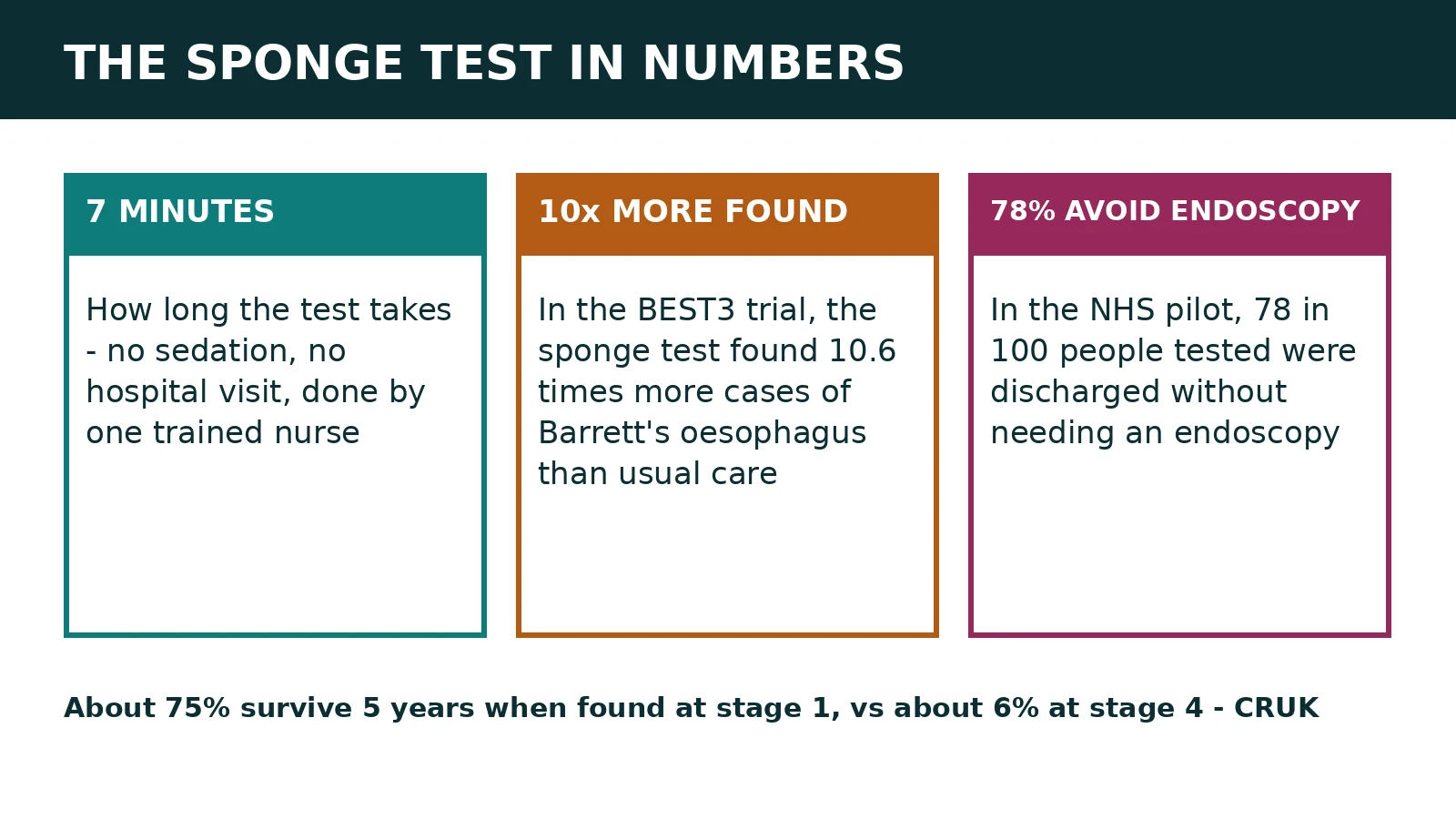
The whole thing usually takes around seven minutes and is done by a single trained nurse. There is no sedation, no hospital visit and no need to fast in the way an endoscopy demands. It can be done in a GP surgery, a pharmacy or a community diagnostic centre. Around 95 in every 100 people manage to swallow the capsule after one or more attempts.
There are two devices covered by the guidance: Cytosponge, made by Medtronic, and EndoSign, made by Cyted Health. They work in the same way.
What does it look for, and why does it matter?
The test checks for Barrett’s oesophagus — a change in the cells lining the lower food pipe, usually after years of acid reflux — and for early oesophageal cancer. Barrett’s affects an estimated 1 to 2% of adults. Most people with it never develop cancer, but it raises the risk, and finding it early is what makes the difference.
Around 9,300 to 9,500 people are diagnosed with oesophageal cancer in the UK each year, and it is usually found late: only about 19% of cases with a recorded stage in England were found at stages 1 or 2 in 2022, and the share found at stage 4 rose from 25.1% in 2013 to 36.6% in 2022. Survival depends heavily on stage. Cancer Research UK figures show around 75% of people diagnosed at stage 1 survive five years or more, compared with only about 6% at stage 4. A test that finds the warning signs years earlier is, in principle, a test that saves lives.
How accurate is the sponge test?
The main evidence comes from the BEST3 trial, published in The Lancet in 2020. It ran in 109 GP practices in England and involved 13,514 people on long-term reflux medication. Offering the sponge test led to about 10.6 times more diagnoses of Barrett’s oesophagus than usual care — 140 diagnoses in the test group against 13 in usual care over around 12 months. Nine people in the test group were found to have pre-cancerous changes or stage 1 cancer, against none in usual care.
On accuracy, NICE’s committee reviewed one cohort study and two case-control studies and found the test picked up 73 to 80% of Barrett’s cases (sensitivity) and correctly cleared 92 to 94% of people who did not have it (specificity). A 2025 meta-analysis of six studies put the figures in a similar range. That is good, but not perfect — up to 1 in 10 cases can be missed even when the capsule is swallowed properly, which is why a negative result does not rule out disease and people with a clear result should still be monitored.
Sponge test or endoscopy?
Endoscopy — a camera passed down the throat — remains the gold standard, but it is a bigger undertaking: it needs at least two nurses plus an endoscopist in a hospital, usually with sedation, and carries small risks such as bleeding, damage to the food pipe and complications from sedation. The sponge test avoids most of that, and patients strongly prefer it: in one NHS survey of more than 350 patients, 94% reported only mild or no pain, and at one pilot hospital almost 9 in 10 patients preferred the sponge to a gastroscopy.
It also frees up endoscopy capacity. In the NHS England pilot evaluation of 2,550 patients, 78% were discharged without needing an endoscopy at all; only 22% needed one. At East and North Hertfordshire NHS Trust, 72% of reflux patients were sent back to their GP without an endoscopy. The device costs about £280, against £407 for a standard endoscopy on the NHS tariff, and the pilot evaluation put the saving at around £400 per patient.
Who will be offered the sponge test?
Not everyone with indigestion. The draft guidance targets people with persistent gastro-oesophageal reflux disease — long-term acid reflux — plus multiple risk factors, who do not need an urgent suspected-cancer referral. For them, the sponge test would be used instead of a first endoscopy, to decide who needs further investigation. People already diagnosed with Barrett’s oesophagus could also use it as part of a surveillance programme, as a periodic check for cell changes.
It is not for people who need an urgent suspected-cancer referral — those patients should still go straight to endoscopy. And some people cannot have it at all, including people with difficulty swallowing, certain abnormalities of the food pipe or stomach, recent surgery on the food pipe or stomach, portal hypertension or varices, anyone who is pregnant, or anyone taking blood-thinning medication.
What happens if the result is positive?
A positive result means a referral for an endoscopy so the findings can be confirmed and their severity assessed — the sponge test alone does not make a diagnosis. In the NHS pilot, patients whose sponge test was positive had the highest rate of confirmed Barrett’s, at 27.2%, while none of those with a negative result who went on to have an endoscopy were found to have it.
If Barrett’s is confirmed, patients enter a surveillance programme of regular checks — now possibly using the sponge test itself — and if pre-cancerous changes are found, they can be offered treatment to remove the abnormal cells before cancer develops. That is the whole point of the test: to find the danger while it is still treatable.
The most common side effect is a sore throat, sometimes lasting up to 48 hours. Serious side effects are rare, but in fewer than 1 in 5,000 cases the sponge detaches from the string and stays in the stomach, needing removal by endoscopy — one such detachment happened in the BEST3 trial.
When to see a doctor
Do not wait for the sponge test to reach your area. If you have heartburn or acid reflux that keeps coming back, especially if you have had it for a long time, see your GP and mention it — that is the first step whatever test follows. The same applies if swallowing becomes difficult, food feels stuck, you lose weight without trying, or you vomit blood or pass black stools.
In an emergency call 911 (US), 999 (UK) or 112 (EU). Call for emergency help if you vomit blood, cough up blood, or have severe chest pain or difficulty breathing.
Frequently asked questions
What is the Cytosponge 'sponge on a string' test?
You swallow a small capsule attached to a thread, with water. It dissolves in the stomach and releases a tiny sponge, which is gently pulled back up, collecting cells from the lining of the food pipe for lab analysis. The test takes about seven minutes, needs no sedation and can be done in a GP surgery.
Who will be offered the sponge test on the NHS?
People with persistent acid reflux plus multiple risk factors who do not need an urgent suspected-cancer referral, and people already diagnosed with Barrett's oesophagus who need regular checks. It is not for everyone with indigestion, and final NICE guidance is due in February 2027.
Does the sponge test hurt, and how long does it take?
Most people find it uncomfortable rather than painful. In one NHS survey of over 350 patients, 94% reported only mild or no pain. It takes about seven minutes, and a sore throat afterwards is the most common side effect, sometimes lasting up to 48 hours.
How accurate is the Cytosponge test compared with endoscopy?
NICE's review found it detects 73 to 80% of Barrett's cases and correctly clears 92 to 94% of people without it. Endoscopy remains more accurate, and a positive sponge result always needs an endoscopy to confirm. Up to 1 in 10 cases can be missed, so a negative result does not rule out disease.
What happens if my sponge test result is positive?
You will be referred for an endoscopy so the findings can be confirmed and assessed. If Barrett's oesophagus is confirmed, you enter a surveillance programme of regular checks, and pre-cancerous changes can be treated before cancer develops.
Who cannot have the sponge test?
People with difficulty swallowing, certain abnormalities of the food pipe or stomach, recent surgery on the food pipe or stomach, portal hypertension or varices, anyone pregnant, or anyone taking blood-thinning medication. People needing an urgent suspected-cancer referral go straight to endoscopy instead.
Sources
- NICE: Less invasive capsule sponge tests could help detect oesophageal cancer earlier, 16 Nov 2026 www.nice.org.uk
- Cancer Research UK: Capsule sponge testing www.cancerresearchuk.org
- NHS England: Simple sponge on a string test replaces need for endoscopy for thousands of NHS patients www.england.nhs.uk
- Medscape: Capsule sponge tests recommended in draft NICE guidance www.medscape.com
- Fitzgerald RC, et al. Cytosponge-trefoil factor 3 versus usual care to identify Barrett's oesophagus (BEST3). The Lancet, 2020 www.thelancet.com
- NICE Medtech Innovation Briefing MIB240: Cytosponge for detecting Barrett's oesophagus www.nice.org.uk
- Cancer Research UK: Oesophageal cancer survival by stage www.cancerresearchuk.org

Try the tool
Not sure if it can wait?
Common causes and warning signs for 16 everyday symptoms.
Open the symptom guide