Alzheimer’s Blood Test: What It Can (and Can’t) Tell You
A simple blood draw can now detect the plaques of Alzheimer's disease — but what the result means, who should be tested and what happens next are less simple.
- Written by
- Health Daily Advice
- Published
- Reading time
- 8 minutes
- Sources
- 6 cited
In this guide
An Alzheimer’s blood test measures proteins in your blood — p-tau217 and amyloid beta — that reflect plaques and tangles of Alzheimer’s disease. Since May 2025 the US FDA has cleared four such tests for people with memory symptoms. They help doctors work out whether Alzheimer’s is the likely cause, but no blood test can diagnose Alzheimer’s on its own.
Until recently, confirming the biology of Alzheimer’s meant a brain scan or a spinal tap. A PET scan is expensive, takes hours and exposes you to radiation; a lumbar puncture is invasive and uncomfortable. That is why a simple blood draw has been such a sought-after goal — and why searches for Alzheimer’s blood tests have surged this autumn. The science has moved fast, but the tests come with limits that matter just as much as their promise.
How does an Alzheimer’s blood test work?
Alzheimer’s disease is defined by two changes in the brain: clumps of amyloid beta protein, known as plaques, and tangles of a protein called tau. A blood test cannot see your brain, but it can measure fragments of these proteins that leak into the bloodstream.
The most useful marker so far is p-tau217, a form of tau that is phosphorylated at a specific point (threonine 217). Levels of p-tau217 rise as amyloid and tau build up in the brain. Most cleared tests measure p-tau217 on its own, or compare it with amyloid beta 42 in a ratio. A high result suggests Alzheimer’s pathology is present; a low result makes it unlikely. Neither result, on its own, is a diagnosis.
That distinction matters. A blood test estimates the chance that amyloid plaques are present. It does not measure your memory, your thinking or your ability to manage daily life, and it cannot tell you whether Alzheimer’s is actually causing your symptoms — or whether those symptoms will get worse.
Which blood tests has the FDA cleared?
As of October 2026, the US Food and Drug Administration has cleared four blood tests for amyloid pathology, all for people who already have signs or symptoms of cognitive decline. Each is read alongside a clinical evaluation, never on its own.
| Test | Cleared | Who it is for | How results are reported |
|---|---|---|---|
| Lumipulse G pTau217/β-Amyloid 1-42 Plasma Ratio (Fujirebio) | May 2025 | Adults 55 and over with signs and symptoms, in specialist care | Positive, indeterminate or negative |
| Elecsys Phospho-Tau (181P) Plasma (Roche) | October 2025 | Adults 55 and over, initial assessment in primary care | One cut-off, mainly to rule Alzheimer’s out |
| PrecivityAD2 (C2N Diagnostics) | August 2026 | Adults 40 and over with signs or symptoms of cognitive impairment | Positive, likely positive or negative |
| Elecsys Phospho-Tau (217P) Plasma (Roche) | August 2026 | Adults 55 and over with signs, symptoms or complaints of cognitive decline | Positive, intermediate or negative |
The first of these, Lumipulse, was cleared on 16 May 2025 after the FDA reviewed data from 499 people with cognitive impairment. It was the first blood test of its kind to be cleared anywhere, and it opened the door for the others. The Roche pTau181 test, cleared in October 2025, works differently: it is designed mainly as a rule-out test in primary care, to help a GP decide whether a referral to a memory specialist is needed.
How accurate are Alzheimer’s blood tests?
In the FDA’s review of the Lumipulse test, 91.7% of people with a positive result had amyloid plaques confirmed by a PET scan or spinal fluid test, and 97.3% of people with a negative result did not. That is strong performance — but it is not the whole story.
The middle band is the catch. Fewer than 20% of the 499 people in the FDA study received an indeterminate result, and about one in five results land in this uncertain zone with the other tests too. An indeterminate result means the test cannot say either way, and the person usually needs a PET scan or spinal fluid test after all.
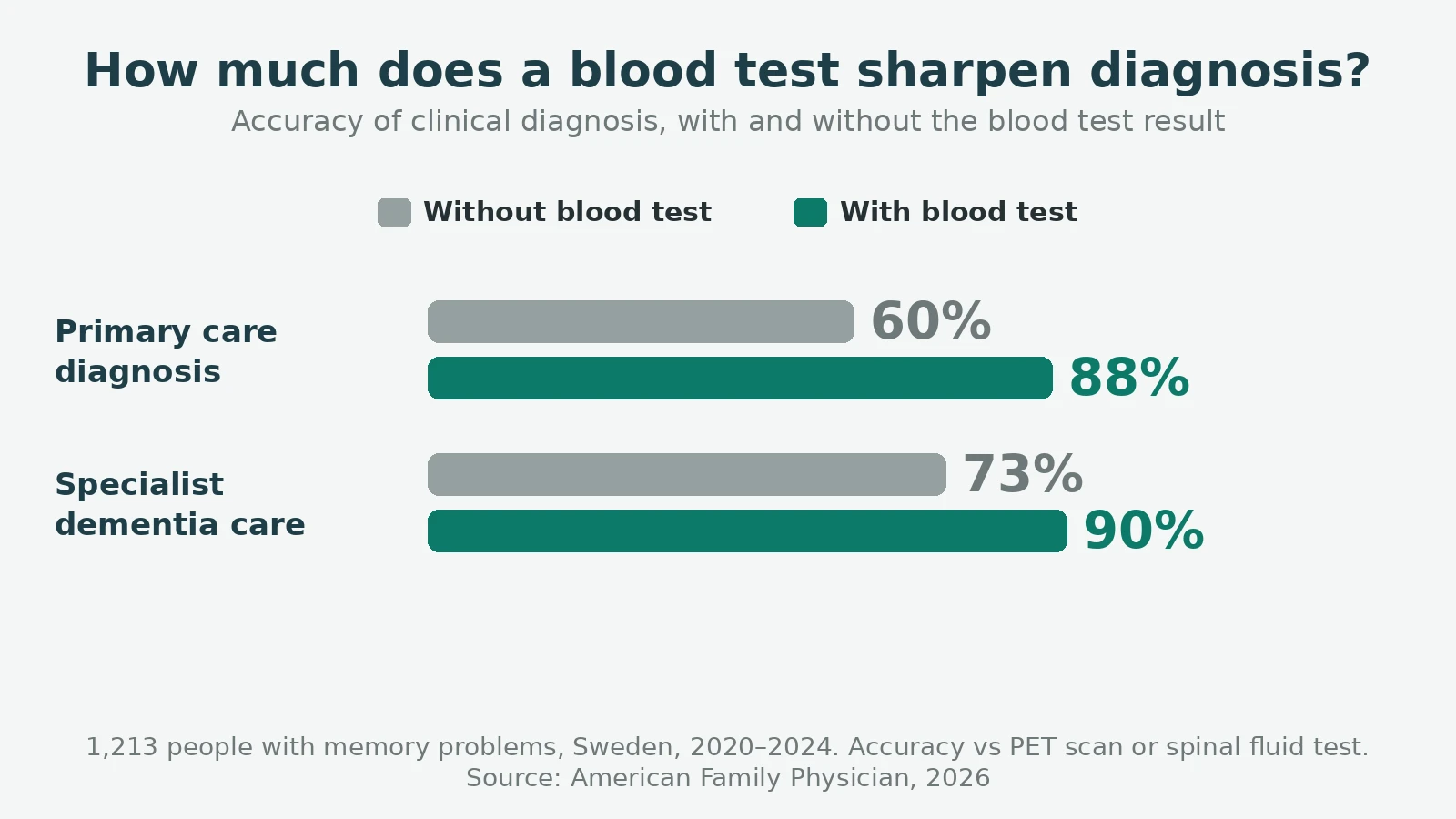
The tests also sharpen ordinary clinical judgement. In a Swedish study of 1,213 people seen in primary care and specialist dementia clinics, adding the Lumipulse result raised the accuracy of a clinical diagnosis from 60% to 88% in primary care and from 73% to 90% in specialist care. Even so, the Alzheimer’s Association’s guideline warns that many commercially available blood tests do not meet its accuracy thresholds, and that tests vary a great deal — they are not interchangeable.
What does a result actually mean?
A result is best understood as one piece of a larger assessment, not a verdict.
A negative result is the most useful outcome. In the FDA data, 97.3% of people with a negative Lumipulse result had no amyloid on PET or spinal fluid testing. The Alzheimer’s Association’s guideline says a high-quality blood test can be used as a triage test in this way: a negative result rules Alzheimer’s pathology out with high probability, and the clinician can look for other causes of the memory problems.
A positive result means Alzheimer’s pathology is likely present — but it does not prove Alzheimer’s is causing the symptoms. Amyloid plaques are common in people who never develop dementia, and they can appear alongside other conditions. A positive result should be confirmed with another method, such as a spinal fluid test or a PET scan, before any treatment decisions are made.
An indeterminate result is uninformative. Around one in five results fall here. The diagnosis then rests on the clinical assessment, imaging, and a spinal fluid test or PET scan if it would change the person’s care.
Some everyday factors can also nudge a result. UK guidance published in October 2026 notes that poor kidney function, low body weight and anaemia can push p-tau217 up, while a very high body weight can push it down. That is one reason the result must always be read by a clinician who knows the person’s full picture.
Who should — and shouldn’t — get tested?
The cleared tests are for people who already have measurable memory or thinking problems and are being assessed by a specialist, where Alzheimer’s is already suspected. They are not screening tests for the general public, and current guidance recommends against testing people without symptoms outside of research.
That is a deliberate boundary. Alzheimer’s pathology is common in people who will never develop symptoms from it — possibly in more than half of cognitively healthy people over 80. A positive result in someone with no symptoms would raise difficult questions it cannot answer: when, or even whether, dementia will follow.
Testing is also not the right step when another cause of the symptoms can already be confidently identified, or when the result would not change what happens next. The UK’s Association of British Neurologists and Royal College of Psychiatrists, in guidance published in October 2026, say the test should sit inside a full specialist assessment — never in place of one — and should not be used to decide who gets to see a dementia specialist.
What about the UK and the NHS?
Blood tests for Alzheimer’s are not yet a routine part of NHS care. The UK guidance, published in Practical Neurology in October 2026 and endorsed by the Alzheimer’s Society and Alzheimer’s Research UK, recommends plasma p-tau217 as the test of choice — but only within specialist memory services, and only for people with objective cognitive impairment where Alzheimer’s is suspected.
Two national trials, ADAPT and READ-OUT, are testing how the blood tests perform in real NHS clinics and whether they are cost-effective. Their results are not in yet. The gap they are trying to close is real: NICE has recommended spinal fluid testing to confirm Alzheimer’s pathology since 2018, but fewer than 5% of NHS dementia diagnostic services have been able to offer it, and diagnosis on clinical assessment and brain imaging alone matches the post-mortem picture only around 70% of the time.
Private blood tests are already being sold in the UK, and the guidance warns that a result bought directly can be hard to interpret without a clinician. If you are considering one, talk to your GP first — and ask what would happen with each possible result before the blood is drawn.
How much does it cost, and how do you get one?
In the US, the Lumipulse test has been estimated to cost between $500 and $1,000, and the Alzheimer’s Association notes that blood tests often cost 70% to 90% less than a PET scan. Reimbursement is still inconsistent, and the test is prescription-only: a clinician orders it, and the result is interpreted in the context of the person’s history, examination and cognitive testing.
In the UK there is no standard NHS price yet, because the test is not a routine NHS service. The Blood Biomarker Challenge, a research programme backed by the Alzheimer’s Society, Alzheimer’s Research UK and the National Institute for Health and Care Research, is working to bring blood testing into NHS memory services, with the aim of making it part of standard care by the end of the decade.
Demand is clearly there. The Alzheimer’s Association’s 2025 figures found that 91% of Americans would want a simple test such as a blood biomarker test if one were available, and nearly four in five would want to know if they had Alzheimer’s before it affected their lives — mainly so they could access treatment and care earlier.
What happens after the test?
A blood test result can speed up the next steps. If it points towards Alzheimer’s, the specialist may confirm the finding with a spinal fluid test or PET scan, and then talk through eligibility for disease-modifying treatments, which are offered only when Alzheimer’s pathology has been confirmed. If it points away, the team can focus on other causes — from depression and medication effects to thyroid problems and vitamin deficiencies — some of which are treatable.
Either way, the result is the start of a conversation, not the end of one. A diagnosis of Alzheimer’s changes plans for work, driving, finances and family life, and it deserves time, support and a second opinion if anything feels unclear. Ask the specialist to explain what the result does and does not mean, what the next test would add, and what support is available while you wait.
When to see a doctor
See a GP if you or someone close to you has noticed memory or thinking changes that are getting worse, are out of character, or are starting to affect everyday life — such as getting lost in familiar places, struggling with bills or appointments, or repeating the same questions. It helps to take a family member along, and to write down examples beforehand. Memory problems have many causes, and most of them are not Alzheimer’s, but only an assessment can sort them out.
Get help sooner if confusion comes on suddenly, if there is a new severe headache, weakness on one side of the body, slurred speech or a fall — these need urgent medical attention. In an emergency call 911 (US), 999 (UK) or 112 (EU).
Frequently asked questions
Can a blood test diagnose Alzheimer's disease?
No. A blood test can show whether amyloid plaques — a hallmark of Alzheimer's — are likely present, but it cannot diagnose the disease on its own. The FDA-cleared tests are aids to diagnosis, read alongside a clinical evaluation, cognitive testing and, where needed, a PET scan or spinal fluid test. A positive result means pathology is likely, not that Alzheimer's is definitely causing your symptoms.
How accurate is the Alzheimer's blood test?
In the FDA's study of 499 people, 91.7% of positive Lumipulse results matched amyloid on PET or spinal fluid tests, and 97.3% of negative results did too. In a Swedish study of 1,213 people, adding the blood test raised diagnostic accuracy from 60% to 88% in primary care. But about one in five results are indeterminate, and accuracy varies between tests.
Who can get an Alzheimer's blood test?
The FDA-cleared tests are for adults with signs or symptoms of cognitive decline who are being assessed by a clinician — usually in specialist memory care. They are not for people without symptoms, and they are not screening tests. In the UK they are not yet a routine NHS service, though they are used in research and in some private clinics.
How much does an Alzheimer's blood test cost?
In the US, the Lumipulse test has been estimated at $500 to $1,000, and blood tests generally cost 70% to 90% less than a PET scan. Reimbursement varies, so check with your insurer or clinic before testing. In the UK there is no standard NHS price yet because the test is not part of routine NHS care.
What happens if my Alzheimer's blood test is indeterminate?
An indeterminate result means the test cannot say whether amyloid is present. About one in five results fall in this middle band. Your clinician will rely on the rest of your assessment — history, examination and brain imaging — and may arrange a spinal fluid test or PET scan if the answer would change your care.
Can I get an Alzheimer's blood test on the NHS?
Not yet as a routine test. UK guidance from October 2026 recommends p-tau217 testing only within specialist memory services, and two national trials — ADAPT and READ-OUT — are still testing how the blood tests work in NHS practice. Private tests are available, but talk to your GP first about what the result would mean for you.
Sources
- FDA: FDA Clears First Blood Test Used in Diagnosing Alzheimer's Disease www.fda.gov
- Alzheimer's Association: New Clinical Practice Guideline for Blood-Based Biomarkers aaic.alz.org
- Alzheimer's Association: Statement on First Blood Test Used in Diagnosing Alzheimer's Disease Cleared by FDA www.alz.org
- NIHR Dementia Researcher: Alzheimer's Blood Test Guidance: Who to Test and How www.dementiaresearcher.nihr.ac.uk
- American Family Physician: Lumipulse Blood Biomarker Test for Diagnosis of Alzheimer Disease www.aafp.org
- Bond Health: How p-tau217 blood tests are changing Alzheimer's screening bondtrials.com

Try the tool
Not sure if it can wait?
Common causes and warning signs for 16 everyday symptoms.
Open the symptom guide