R21 Malaria Vaccine: Whole-Village Trial Cuts Infection by 70%
- Written by
- Health Daily Advice
- Published
- Reading time
- 4 minutes
- Sources
- 5 cited
In this guide
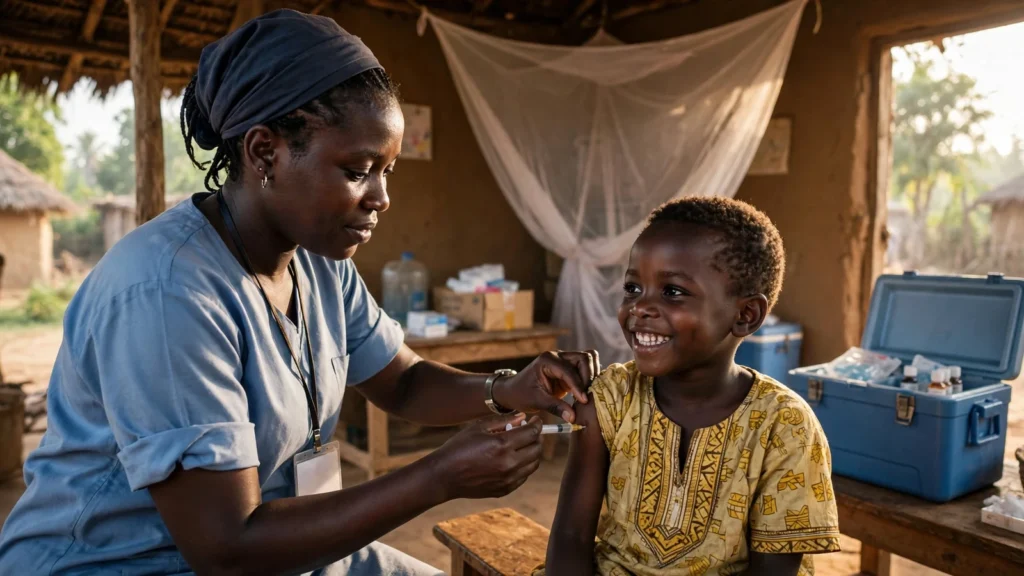
Vaccinating entire villages with the R21 malaria vaccine before the rainy season cut the odds of infection by up to 70%, a landmark trial published in The Lancet has found. The SERVAL study gave three monthly doses to whole communities in The Gambia and Burkina Faso, and also cut clinical malaria cases by up to 47%.
What is the R21 vaccine?
R21/Matrix-M is the second malaria vaccine recommended by the World Health Organization (WHO), which endorsed it in October 2023 after recommending the first malaria vaccine, RTS,S, in 2021. It was developed by the University of Oxford with the Serum Institute of India and uses a booster ingredient called Matrix-M. Until now it has been given to young children as part of routine immunisation in African countries. The new trial is the first to test what happens when whole communities — adults and older children included — are vaccinated ahead of the rainy season.
How the SERVAL trial worked
Researchers ran a cluster-randomised trial across 54 villages: 30 in The Gambia, where malaria transmission is seasonal and low to moderate, and 24 in Burkina Faso, where transmission is intense. About 20,000 residents aged five months and older took part. Half the villages received three monthly doses of R21 between May and August, before peak transmission; the other half served as a comparison group. Standard malaria control, including seasonal malaria chemoprevention for children, continued in both groups.
What the trial found
At peak transmission in November, the odds of malaria infection were 70% lower in the vaccinated villages in The Gambia and 25% lower in Burkina Faso. Clinical malaria — people actually falling ill, rather than simply carrying the parasite — fell by 47% in The Gambia and 30% in Burkina Faso.
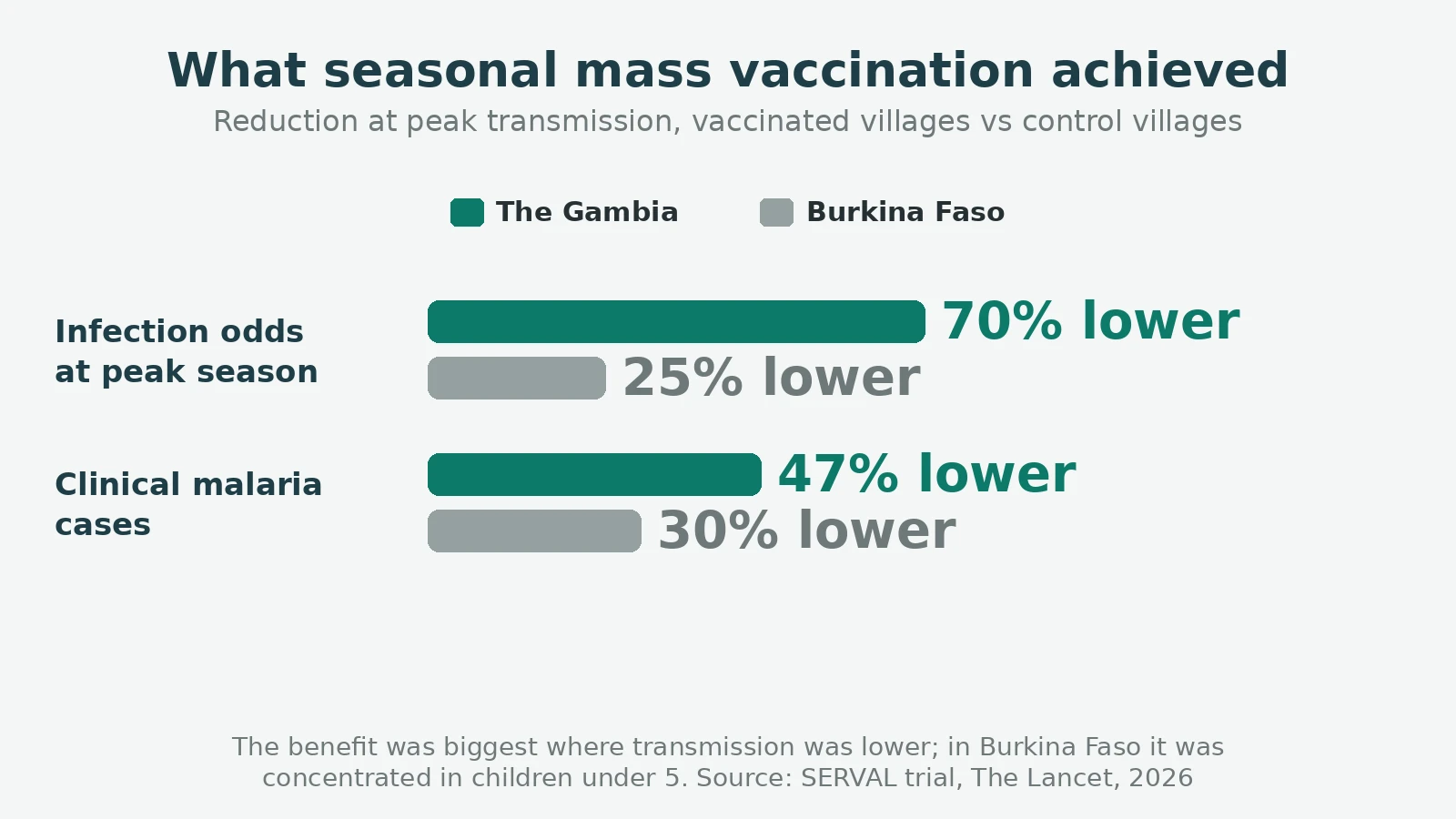
In The Gambia the benefit was seen across all age groups. In Burkina Faso the biggest reductions were in children under five, who carry the heaviest burden of the disease, although older age groups saw some protection too.
Why the results differed between the two countries
The gap reflects how hard malaria hits each place. In The Gambia, transmission is seasonal and moderate, so vaccinating a whole village can push infection down sharply. In Burkina Faso, people are bitten by infected mosquitoes far more often, so even a vaccinated community still faces heavy exposure. As the trial’s Burkina Faso lead, Professor Halidou Tinto, put it, combining seasonal mass vaccination with chemoprevention still delivered a measurable reduction even under that pressure — an encouraging result for the wider Sahel region.
Is the R21 vaccine safe?
The trial found the vaccine safe and well tolerated. The most common side effects were mild headache and fever. Adverse events were reported in 13.5% of vaccinated people in The Gambia and 11.3% in Burkina Faso. Out of 69 serious adverse events recorded across the trial, only one — a fever-related convulsion in an eight-year-old after the second dose — was judged related to vaccination.
One practical challenge was coverage: only 59.5% of eligible residents in The Gambia and 65.3% in Burkina Faso received all three doses. That suggests the real-world benefit could be larger still if more people complete the course.
Why this matters
Malaria remains a huge global problem. The WHO estimates there were 282 million cases and 610,000 deaths in 2024, with 95% of both in the African Region and children under five accounting for about three-quarters of deaths there. Progress against the disease has stalled over the past decade. The trial’s lead investigator, Professor Umberto D’Alessandro, said the findings disprove the assumption that the vaccine would not work in older children, adolescents and adults — a point that matters because vaccinating whole communities could help break transmission, not just protect individual children.
The Gambia’s National Malaria Control Programme is now looking at how seasonal mass vaccination could fit into national control and elimination plans. But the researchers are clear that vaccination is an additional tool, not a replacement: bed nets, chemoprevention and prompt testing and treatment remain essential, and the vaccine does not give complete protection.
What about travellers?
R21 is given in routine childhood immunisation programmes in parts of Africa. It is not a vaccine travellers can ask for before a holiday. Anyone travelling to a malaria area should talk to a doctor or travel clinic several weeks before departure about preventive medicine, and take steps to avoid mosquito bites — sleeping under a treated net, using repellent after dusk and wearing protective clothing.
When to see a doctor
Malaria symptoms usually start 10 to 15 days after an infected mosquito bite. The most common early symptoms are fever, headache and chills. Because these can look like many other illnesses, early testing matters — untreated P. falciparum malaria can become severe and life-threatening within 24 hours. Seek medical advice urgently if you develop a fever during or after travel to a malaria area, and tell the clinician where you have been. In an emergency call 911 (US), 999 (UK) or 112 (EU).
Frequently asked questions
What is the R21 malaria vaccine?
R21/Matrix-M is the second malaria vaccine recommended by the World Health Organization, endorsed in October 2023 after the first vaccine, RTS,S, in 2021. It was developed by the University of Oxford with the Serum Institute of India. It is given to young children in routine immunisation programmes in African countries, and the new SERVAL trial tested it in whole communities for the first time.
How well does the R21 vaccine work?
In the SERVAL trial, vaccinating whole villages cut the odds of malaria infection by 70% in The Gambia and 25% in Burkina Faso at peak transmission. Clinical malaria cases fell by 47% and 30% respectively. The effect was strongest where transmission was lower, and it was seen across all age groups in The Gambia, with the biggest benefit in young children in Burkina Faso.
Is the R21 malaria vaccine safe?
The trial found it safe and well tolerated, with mostly mild headache and fever. Adverse events were reported in about 13% of recipients in The Gambia and 11% in Burkina Faso. Of 69 serious adverse events recorded, only one — a fever-related convulsion in an eight-year-old after the second dose — was judged related to vaccination.
Can I get the R21 vaccine before travelling to Africa?
No. R21 is given in routine childhood immunisation programmes in parts of Africa and is not available as a travel vaccine in the UK, US or Europe. Travellers to malaria areas should see a doctor or travel clinic several weeks before departure for preventive medicine, and use bed nets, repellent and protective clothing to avoid mosquito bites.
Does the R21 vaccine replace bed nets?
No. The researchers stress that vaccination is an additional tool, not a replacement. Bed nets, seasonal chemoprevention and prompt testing and treatment remain essential, and the vaccine does not give complete protection. The highest impact comes from combining the vaccine with the other measures already in use.
Sources
- LSHTM: Seasonal mass vaccination with the R21 vaccine effective in reducing malaria www.lshtm.ac.uk
- MedicalXpress: Seasonal mass vaccination with R21 malaria vaccine effective in reducing malaria infection medicalxpress.com
- WHO: Malaria (fact sheet) who.int
- SERVAL Trial Investigators: Seasonal mass vaccination with R21/Matrix-M against malaria in The Gambia and Burkina Faso. The Lancet, 2026 (trial summary) journaljams.org

Try the tool
Not sure if it can wait?
Common causes and warning signs for 16 everyday symptoms.
Open the symptom guide