Type 2 Diabetes and Alzheimer’s Risk: What New Research Shows
A major 2026 review of 40 studies links type 2 diabetes with a 53% higher Alzheimer's risk. What the numbers really mean, why the link may exist, and what helps.
- Written by
- Health Daily Advice
- Published
- Reading time
- 6 minutes
- Sources
- 6 cited

In this guide
People with type 2 diabetes face a 53% higher risk of Alzheimer’s disease, according to a major review of 40 studies published in November 2026. The same research estimates about five new cases of Alzheimer’s a year for every 1,000 people with type 2 diabetes. The link is an association, not proof that diabetes causes Alzheimer’s.
What did the new study find?
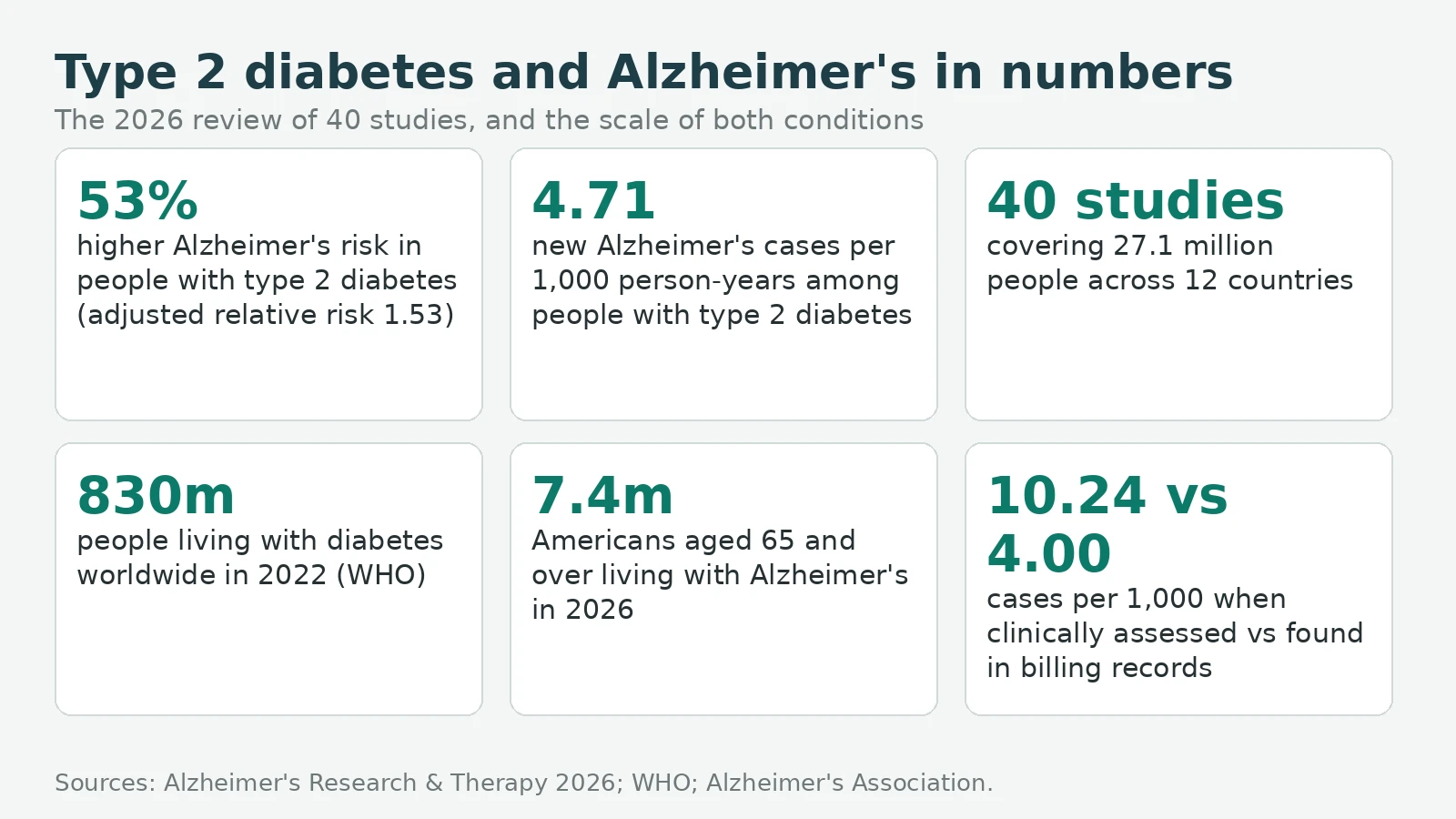
Researchers at Curtin University in Australia pulled together 40 studies covering more than 27 million people, searching medical databases up to April 2026. Their review, published in the journal Alzheimer’s Research & Therapy on 9 November 2026, is the first to measure both how often Alzheimer’s develops in people with type 2 diabetes and how much higher their risk is compared with people without the condition.
The headline numbers are striking. Across the studies, about 4.71 new cases of Alzheimer’s occurred per 1,000 person-years among people with type 2 diabetes — roughly five cases a year for every 1,000 people. After adjusting for other factors, people with type 2 diabetes had a 53% higher relative risk of Alzheimer’s than people without diabetes (an adjusted relative risk of 1.53).
Lead author Dr Emmanuel Adewuyi said the two numbers together give a clearer picture than either alone: relative risk shows how two groups compare, while incidence shows how often new cases actually occur.
What does a 53% higher risk actually mean?
A 53% higher risk sounds alarming, but it is a relative figure — it describes the increase compared with people without type 2 diabetes, not the chance for any one person. The absolute figure matters just as much: around five new cases of Alzheimer’s a year for every 1,000 people with type 2 diabetes. Put another way, in a group of 1,000 people with type 2 diabetes followed for a year, about five would be expected to develop Alzheimer’s.
Most people with type 2 diabetes will not develop Alzheimer’s. Age remains the biggest risk factor for the disease: about 1 in 9 Americans aged 65 and over has Alzheimer’s, according to the Alzheimer’s Association, and the risk rises steeply with age.
One detail from the review is worth knowing. Studies that identified Alzheimer’s through billing codes and administrative records found about four cases per 1,000 person-years, while studies that used proper clinical assessments found about 10 per 1,000. The researchers suggest that records-based approaches probably miss milder cases, so the true figure may sit closer to the higher end.
What is type 2 diabetes?
Type 2 diabetes is a lifelong condition in which blood sugar (glucose) becomes too high because the pancreas does not make enough insulin, or the body’s cells stop responding to insulin properly. Insulin is the hormone that lets glucose move from the blood into cells for energy.
It is far more common than many people realise. The World Health Organization says the number of people living with diabetes rose from 200 million in 1990 to 830 million in 2022, and more than 95% of them have type 2 diabetes. In 2022, 14% of adults worldwide were living with diabetes — double the share in 1990 — and more than half of adults aged 30 and over with diabetes were not taking any medication for it.
Symptoms often creep in slowly and can be easy to miss. The NHS lists peeing more than usual, especially at night, feeling thirsty all the time, feeling very tired, losing weight without trying, repeated thrush, cuts or wounds that heal slowly, and blurred vision. The risk is higher if you are over 40 (or 25 for south Asian people), have a close relative with diabetes, are overweight, or are of south Asian, Chinese, African-Caribbean or black African origin. Diabetes is diagnosed with a blood test, usually one that measures average blood sugar over the previous few months (HbA1c).
Why might diabetes affect the brain?
Scientists do not yet fully understand the connection, but several overlapping mechanisms are plausible. A widely cited review in Nature Reviews Neurology points to problems with how the brain handles insulin, damage from high blood sugar, inflammation, oxidative stress and the build-up of substances called advanced glycation end products.
Insulin does more than control blood sugar — the brain uses it too. When cells become resistant to insulin, the brain’s handling of two proteins linked to Alzheimer’s — amyloid-beta and tau — can go awry. Amyloid-beta forms the sticky plaques found in Alzheimer’s brains, while tau forms the tangles inside nerve cells. In animal studies, diabetes increased the abnormal phosphorylation of tau, a key step in tangle formation.
Blood vessels are another part of the story. Diabetes damages small blood vessels throughout the body, including in the brain, and vascular damage is itself a risk factor for dementia. In one Mayo Clinic registry study, 80% of people with Alzheimer’s had either impaired glucose tolerance or frank diabetes.
None of this means diabetes directly causes Alzheimer’s. The review’s authors are clear that the finding is an association: shared risk factors such as age, weight, blood pressure and lifestyle, as well as medicines and other unmeasured factors, may all contribute.
Who is most at risk?
The review found the raised risk held up across different analyses and was similar for men and women, although the rate of new cases was numerically higher in women than in men. Incidence was highest in North America (7.54 cases per 1,000 person-years) and lowest in Europe and Central Asia (1.17 per 1,000) — a difference the authors say could reflect regional variation in heart and metabolic risk, access to care or how cases are found, but which has not been tested directly.
Age is the dominant factor. Alzheimer’s becomes much more common as people get older, and type 2 diabetes is also more common with age, so the two conditions often travel together. An estimated 7.4 million Americans aged 65 and over are living with Alzheimer’s in 2026, and the Alzheimer’s Association projects that number could reach 13.8 million by 2060.
Can looking after diabetes protect the brain?
There is no proven way to prevent Alzheimer’s, and no diabetes treatment has been shown to lower Alzheimer’s risk. But the same steps that help manage type 2 diabetes are also linked to better brain health in general, and they are worth doing for their own sake.
The WHO says a healthy diet, regular physical activity, keeping a healthy weight and not smoking can prevent or delay the onset of type 2 diabetes. For people who already have it, the NHS advises regular check-ups — blood sugar checks every three months when newly diagnosed, then every six months once stable, plus yearly foot, eye, blood pressure and cholesterol checks — because keeping blood sugar, blood pressure and cholesterol in check lowers the risk of complications such as heart disease, stroke, nerve damage and sight loss.
Researchers are also studying whether diabetes medicines themselves affect dementia risk. Earlier work has linked metformin, pioglitazone and acarbose with lower dementia risk, and observational evidence hints the same may be true for newer drug classes such as GLP-1 receptor agonists and SGLT2 inhibitors. That evidence is observational only — it shows a pattern, not a proven effect — and the review’s authors say proper trials are needed to test whether treating metabolic disease changes a person’s odds of developing Alzheimer’s. Never start, stop or change a medicine to try to protect your brain without talking to your doctor or pharmacist first.
What this means for you
If you have type 2 diabetes, this research is a reason to take your diabetes care seriously — not a reason to panic. The absolute risk is small, the link is not proof of cause, and the steps that protect your heart and blood vessels are the same ones linked to better brain health. If you notice memory problems or changes in thinking, mention them at your next appointment rather than assuming they are just part of getting older: early assessment matters, and many causes of memory trouble are treatable. Our guide to how Alzheimer’s is diagnosed explains what the tests involve.
When to see a doctor
See your GP promptly if you have symptoms of type 2 diabetes — peeing more than usual, constant thirst, unexplained tiredness, weight loss without trying, or blurred vision — or if you are worried you may be at higher risk. The earlier diabetes is found and treated, the better the outlook.
Also see your GP if you or someone close to you notices memory problems, confusion, difficulty finding words, or changes in mood or behaviour that persist or get worse. These symptoms have many possible causes, and only a proper assessment can sort out what is going on.
In an emergency call 911 (US), 999 (UK) or 112 (EU). Seek urgent help for sudden confusion, a sudden severe headache, weakness on one side of the body, slurred speech, or a sudden change in vision — these can be signs of a stroke.
Frequently asked questions
Does type 2 diabetes cause Alzheimer's disease?
It has not been proven to cause Alzheimer's. A 2026 review of 40 studies found a 53% higher risk in people with type 2 diabetes, but the authors stress this is an association. Shared factors such as age, weight, blood pressure, blood vessel damage and lifestyle may all contribute, and most people with type 2 diabetes never develop Alzheimer's.
How much higher is the Alzheimer's risk with type 2 diabetes?
The relative risk is 53% higher than in people without type 2 diabetes. In absolute terms, the review estimated about 4.71 new cases of Alzheimer's per 1,000 person-years — roughly five cases a year for every 1,000 people with type 2 diabetes. Studies using proper clinical assessments found a higher rate, about 10 cases per 1,000 person-years.
What are the symptoms of type 2 diabetes?
Symptoms often develop slowly and can be easy to miss. The NHS lists peeing more than usual, especially at night, feeling thirsty all the time, feeling very tired, losing weight without trying, repeated thrush, cuts or wounds that heal slowly, and blurred vision. Many people have no obvious symptoms, and diabetes is often found during a routine check-up or blood test.
Can controlling blood sugar lower Alzheimer's risk?
No diabetes treatment has been proven to lower Alzheimer's risk. But the steps that help manage type 2 diabetes — a healthy diet, regular activity, a healthy weight and not smoking — are also linked to better brain health. Some diabetes medicines have been linked with lower dementia risk in observational studies, but that is not proof, so never change a medicine without talking to your doctor.
Should I be screened for Alzheimer's if I have type 2 diabetes?
There is no routine Alzheimer's screening for people with type 2 diabetes. If you notice memory problems, confusion, difficulty finding words or changes in mood that persist, mention them to your GP. Many causes of memory trouble are treatable, and a proper assessment can sort out what is going on. Diagnosis usually starts with a GP visit and memory tests.
What is the difference between type 1 and type 2 diabetes?
In type 1 diabetes, the body's immune system attacks the cells that make insulin, so no insulin is produced and daily insulin is needed. In type 2 diabetes, the pancreas does not make enough insulin or the body's cells stop responding to it properly. Type 2 is far more common: the WHO says more than 95% of people with diabetes have type 2.
Sources
- Nguyen TTH et al. Incidence and risk of Alzheimer's disease in individuals with type 2 diabetes: a systematic review and meta-analysis. Alzheimer's Research & Therapy, 2026 link.springer.com
- WHO: Diabetes fact sheet www.who.int
- NHS 111 Wales: Diabetes, type 2 111.wales.nhs.uk
- Alzheimer's Association: 2026 Alzheimer's Disease Facts and Figures www.alz.org
- Sims-Robinson C et al. How does diabetes accelerate Alzheimer disease pathology? Nature Reviews Neurology, 2010 pmc.ncbi.nlm.nih.gov
- Managed Healthcare Executive: Type 2 diabetes associated with 53% higher Alzheimer's risk (18 Nov 2026) www.managedhealthcareexecutive.com

Try the tool
Not sure if it can wait?
Common causes and warning signs for 16 everyday symptoms.
Open the symptom guide