What Is Sarcopenia? Muscle Loss, Signs and Treatment
Muscle loss speeds up with age, but it is not inevitable. What sarcopenia is, how common it is, the signs to watch for, and the exercise and protein steps that help.
- Written by
- Health Daily Advice
- Published
- Reading time
- 6 minutes
- Sources
- 10 cited

In this guide
Sarcopenia is the gradual loss of muscle mass, strength and physical performance that comes with ageing. It usually starts in your 30s or 40s and speeds up after 65, making stairs, walking and balance harder. It is common, it raises the risk of falls and fractures, and strength exercise plus enough protein can slow it — and partly reverse it.
What is sarcopenia?
Sarcopenia is the loss of skeletal muscle mass and strength as a result of ageing. The Cleveland Clinic describes it as a gradual process: as you age, your body does not build protein as well, hormone levels such as testosterone and insulin-like growth factor (IGF-1) fall, and both the size and number of muscle fibres shrink. The result is weaker muscles, slower movement and less stamina.
Doctors now treat sarcopenia as a real muscle disease, not just a normal part of getting old. The 2019 European consensus (EWGSOP2) defines it as a muscle disease — muscle failure — in which low muscle strength is the key characteristic, low muscle quantity confirms the diagnosis, and poor physical performance marks severe sarcopenia. It even has its own diagnosis code, so it can be recorded and billed as a condition in its own right.
That matters because muscle is not only about strength. Muscle keeps you upright, steadies you when you trip, and lets you get out of a chair, carry shopping and climb stairs. When muscle fades, everyday life gets harder and independence shrinks.
How common is sarcopenia?
More common than most people realise. Estimates vary because the definition used changes the count: a systematic review cited in a 2019 Korean study put the range at 9.9% to 40.4% of older adults, depending on how sarcopenia was defined.
Using the stricter European EWGSOP2 definition, a large Korean study of 2,099 community-dwelling adults aged 70 to 84 found combined low muscle strength and low muscle quantity in 4.6% to 14.5% of men and 6.7% to 14.4% of women. Severe sarcopenia — low strength, low muscle and low physical performance together — was much rarer, at 0.3% to 2.2% of men and 0.2% to 6.2% of women.
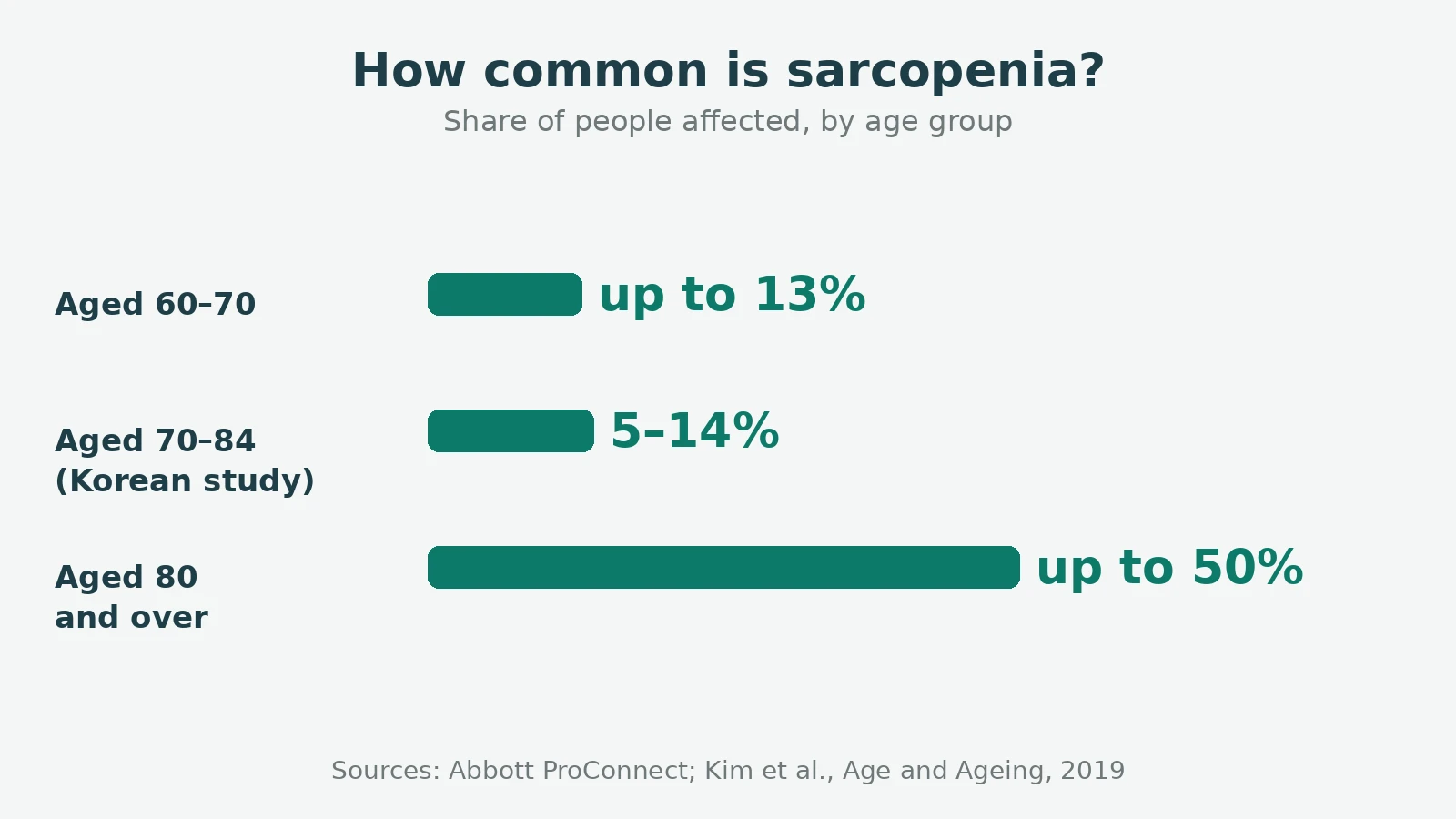
The share rises steeply with age. UK guidance for NHS services puts it at up to 13% of adults aged 60 to 70, increasing to 50% of people aged over 80.
What are the signs of sarcopenia?
Sarcopenia creeps up slowly, so the early signs are easy to miss or blame on age alone. The Cleveland Clinic lists these as the most common:
- Muscle weakness — the most common symptom
- Loss of stamina, tiring on walks that used to be easy
- Difficulty with daily activities, such as rising from a chair without using your arms
- Walking more slowly than before
- Trouble climbing stairs
- Poor balance and more falls
- Noticeably smaller muscles, especially in the arms and legs
A weaker grip is another early clue: struggling with jars, bottles and heavy doors. Because the change is gradual, comparing yourself with a year ago — not with other people — is usually the most telling check.
What causes sarcopenia?
Ageing itself is the main driver, but several factors speed it up. An NHS guide from Mersey Care NHS Foundation Trust names four:
- Age. From age 30 to 60 we lose roughly 250 g of muscle each year. After 70, the loss accelerates to around 15% of muscle per decade.
- Malnutrition. Too little protein and too few calories leave the body unable to maintain muscle.
- Physical inactivity. Muscle that is not used shrinks. Even a short spell of bed rest during an illness can cost an older adult noticeable strength.
- Chronic disease. Long-term inflammatory conditions such as chronic obstructive pulmonary disease (COPD) upset the balance between building and breaking down muscle.
Other risk factors listed by the Cleveland Clinic include being overweight, obese or underweight, heart disease, diabetes, osteoporosis and osteoarthritis, smoking, drinking alcohol, and living alone or on a low income. Losing weight — whether on purpose or not — can also strip muscle along with fat, especially without strength exercise. That is worth keeping in mind if you are considering a weight-loss medicine: talk to a doctor or pharmacist about protecting muscle while you lose weight.
How do doctors check for sarcopenia?
There is no single blood test. Doctors usually start with simple checks and only move to scans if the picture is unclear.
The SARC-F questionnaire. Five quick questions about strength, walking, rising from a chair, climbing stairs and falls. A score of 4 or higher suggests a risk of sarcopenia.
Grip strength. A handgrip test is the standard measure of muscle strength. Under the EWGSOP2 cut-offs, grip below 27 kg in men and below 16 kg in women counts as low.
Walking speed and chair stands. A usual walking speed of 0.8 metres per second or slower, or taking more than 15 seconds to stand up from a chair five times, points to low physical performance.
Body scans. A DXA scan — the same low-radiation scan used for bone density — can measure how much muscle you actually carry. Bioelectrical impedance analysis is a simpler alternative sometimes used in clinics.
If the checks point to sarcopenia, a doctor will also look for what is driving it: low protein intake, an undiagnosed illness, a medicine that affects muscle, or a long period of inactivity.
Can sarcopenia be treated or reversed?
Yes — muscle responds to training at almost any age, and sarcopenia can often be slowed and partly reversed. There is no medicine approved specifically for sarcopenia, so treatment centres on two things: exercise and food.
Resistance exercise is the main treatment. Strength training — chair stands, step-ups, heel raises, resistance bands and light weights — rebuilds muscle and improves balance. The NHS physical activity guidelines for older adults advise activities that improve strength, balance and flexibility on at least two days a week, ideally guided by a physiotherapist at first, especially if you have fallen before or have joint problems.
Enough protein matters as much as the exercise. The Cleveland Clinic suggests aiming for 20 to 35 grams of protein per meal, while the Mersey Care NHS guide advises 25 to 30 grams of high-quality protein with each meal — lean meat, fish, eggs, dairy, beans, nuts and tofu. Spreading protein across the day works better than saving it all for dinner. Vitamin D also matters for muscle strength, and it is commonly low in older adults, so ask a doctor whether a supplement is right for you.
Treating the underlying cause helps too: managing a chronic condition, reviewing medicines that sap strength, and getting support with meals if cooking has become hard. A dietitian can help build a plan that fits your appetite, budget and health conditions.
How to slow muscle loss as you age
You do not need a gym membership to protect your muscles. Small, steady habits add up:
- Do strength exercises at least twice a week — even ten minutes of chair stands, wall push-ups and resistance-band work counts.
- Walk daily and take the stairs when you can; sitting for long stretches is one of the fastest ways to lose muscle.
- Put protein on the plate at every meal, not just at dinner.
- Keep your weight steady — both gaining and losing a lot of weight in later life can raise the risk.
- Stay connected: eating with others and keeping up usual activities helps appetite and motivation, both of which protect muscle.
Starting in your 40s and 50s is ideal, but it is never too late: the Cleveland Clinic notes that resistance training can help reverse muscle loss, and muscle keeps responding to strength work at almost any age.
When to see a doctor
See a GP if you notice weakness, slower walking, trouble rising from a chair, a weaker grip, or falls that keep happening. These can have other causes too — thyroid problems, low vitamin B12, nerve problems or a medicine side effect — so it is worth getting checked rather than assuming it is just age. A GP can run the simple strength and walking tests, arrange a scan if needed, and refer you to a physiotherapist or dietitian.
Get help sooner if muscle weakness comes on suddenly, if you cannot stand or walk safely, or if weakness comes with unexplained weight loss, numbness or pain. In an emergency call 911 (US), 999 (UK) or 112 (EU).
Frequently asked questions
What is sarcopenia in simple terms?
Sarcopenia is the loss of muscle mass and strength that comes with ageing. Muscles shrink and weaken gradually, so everyday tasks such as climbing stairs, carrying shopping or getting out of a chair get harder. It is now classed as a muscle disease, with low strength as the key sign. It is common in later life, but it is not inevitable, and strength exercise plus enough protein can slow it or partly reverse it.
At what age does sarcopenia start?
Muscle loss begins gradually in your 30s or 40s, according to the Cleveland Clinic, and speeds up between 65 and 80, when you can lose as much as 8% of muscle per decade. An NHS guide puts it at about 250 g of muscle a year from age 30 to 60, accelerating to around 15% per decade after 70. Because it creeps up slowly, most people notice it only when stairs, walking or balance start to feel harder.
Can sarcopenia be reversed?
Often partly, yes. Muscle responds to strength training at almost any age, and the Cleveland Clinic says resistance exercise and extra protein can help reverse muscle loss. There is no medicine approved specifically for sarcopenia, so exercise and food are the treatment. Gains take weeks of steady work, and the sooner you start the better — but starting late still helps, so talk to a doctor or physiotherapist about a safe plan.
What is the best exercise for sarcopenia?
Resistance exercise — strength training — is the most effective. Chair stands, step-ups, heel raises, resistance bands and light weights all build muscle and improve balance. The NHS advises strength, balance and flexibility activities on at least two days a week. Start gently, ideally with a physiotherapist's guidance, and build up gradually; even short sessions count, and consistency matters more than intensity.
How much protein should older adults eat to protect muscle?
Older adults need more protein than they often eat. The Cleveland Clinic suggests 20 to 35 grams of protein per meal, and an NHS guide advises 25 to 30 grams of high-quality protein with each meal — lean meat, fish, eggs, dairy, beans, nuts or tofu. Spreading protein across the day works better than saving it for dinner. Ask a doctor or dietitian what suits your health and appetite.
Is sarcopenia the same as frailty?
No, but they overlap. Sarcopenia is specifically the loss of muscle mass and strength with age. Frailty is broader: a state of reduced reserve across the body that leaves someone more vulnerable to illness, falls and hospital stays. Sarcopenia often leads to frailty, and the two commonly occur together with malnutrition in older people. Both improve with strength exercise, enough protein and treatment of underlying illness.
Sources
- Cleveland Clinic: Sarcopenia my.clevelandclinic.org
- Mersey Care NHS Foundation Trust: Sarcopenia guide www.merseycare.nhs.uk
- Cruz-Jentoft AJ, et al. Sarcopenia: revised European consensus on definition and diagnosis (EWGSOP2). Age Ageing, 2019 pmc.ncbi.nlm.nih.gov
- Kim S, et al. Prevalence of sarcopenia in community-dwelling older adults using EWGSOP2: Korean Frailty and Aging Cohort Study. Age Ageing, 2019 academic.oup.com
- NHS: Physical activity guidelines for older adults www.nhs.uk
- Abbott ProConnect: Strength for Life — Frailty www.proconnect.abbott
- Rising Trends: Top 50 Health & Wellness Trends, November 2026 www.risingtrends.co

Try the tool
Not sure if it can wait?
Common causes and warning signs for 16 everyday symptoms.
Open the symptom guide