Do Adults Need a Measles Booster? Who Should Get One
Measles cases hit 5,838 in the US in 2026, and many adults are asking whether they need another jab. Most do not — but some do. Here is who needs one dose, two doses, or none.
- Written by
- Health Daily Advice
- Published
- Reading time
- 4 minutes
- Sources
- 7 cited

In this guide
Most adults do not need a measles booster. Two doses of the MMR vaccine protect for life — one dose is about 93% effective and two doses about 97% — and no routine booster is recommended. But some adults do need another dose: people with only one dose, those vaccinated in 1963–1967, healthcare workers and international travellers.
Why everyone is asking now
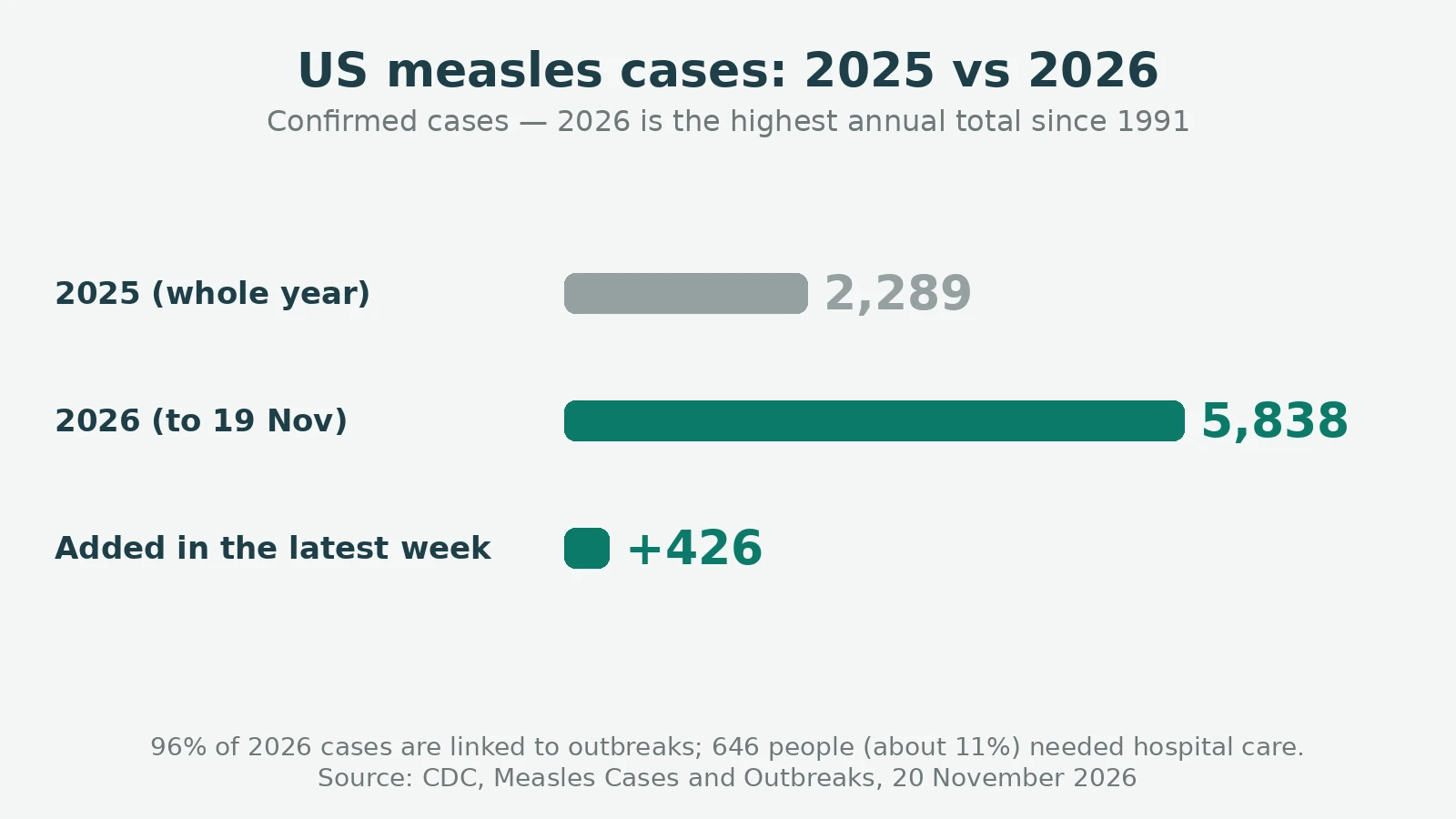
Measles is spreading fast in the United States. The CDC reported 5,838 confirmed cases in 2026 as of 19 November — 426 more than the week before, the largest one-week jump in decades, and about 2.6 times the 2,289 cases recorded in all of 2025. Almost all of them — 96% — are linked to outbreaks, and 646 people, about 11% of cases, have needed hospital care. The CDC has confirmed six deaths in 2026.
It is the highest annual total since 1991, and it comes just after the Pan American Health Organization ruled on 17 November that the US had lost the measles elimination status it had held since 2000, because the same strain of the virus has now spread without a break for more than a year. At the same time, routine vaccination has slipped: national kindergarten MMR coverage fell from 95.2% in 2019–20 to 92.4% in 2025–26. With measles back in the news, many adults are now wondering whether their own childhood jabs still protect them.
How well does the MMR vaccine work?
The MMR vaccine — which protects against measles, mumps and rubella — is one of the most effective vaccines in use. One dose is about 93% effective at preventing measles, and two doses are about 97% effective. The second dose is not a booster: it exists to catch the roughly 7% of people whose immune systems do not respond to the first dose. Once you have had the recommended doses, protection is considered lifelong, which is why health authorities do not recommend routine booster doses for adults or children who are already fully vaccinated.
Who needs a dose — and who does not
Whether you need another dose depends on your age, your records and your risk. The table below follows US guidance from Immunize.org, which summarises the CDC’s recommendations.
| Your situation | What is recommended |
|---|---|
| Born before 1957 | Usually no dose — you are presumed immune, because almost everyone caught measles as a child. Blood surveys suggest 95% to 98% of this group are immune. |
| Born in 1957 or later, low risk, with one or more documented doses | No further dose needed. |
| Born in 1957 or later, never vaccinated | One dose if you are at low risk; two doses, four weeks apart, if you are at high risk. |
| High risk: healthcare worker, international traveller, student, close contact of an immunocompromised person | Two documented doses, at least four weeks apart, unless you have other proof of immunity. |
| Vaccinated in 1963–1967 and unsure which type you had | Revaccinate with the live MMR vaccine — one dose if low risk, two if high risk. |
| You do not know your vaccination history | Check your records or talk to a doctor; a blood test can check for immunity, or a dose of MMR can be given. |
Adults who had measles itself are also protected for life, though only a laboratory-confirmed case counts as proof — a doctor’s diagnosis on its own no longer does. And in places where measles is actively spreading, local health departments sometimes recommend that everyone has two doses, even if they would normally be considered protected.
What about a booster “just to be safe”?
For most adults, a booster is not needed — and doctors say most people are already protected without one. But getting an extra dose when you do not strictly need it is not generally harmful, unless you belong to a group that should not have the vaccine at all, such as pregnant women. The MMR vaccine is not given during pregnancy because it contains a live, weakened virus. If you are unsure about your status, the safest step is to check your records and talk to a doctor or pharmacist rather than guessing.
If you have been exposed to measles
Speed matters. An MMR dose given within 72 hours of first exposure may prevent measles or make the illness milder. For people at high risk of complications who cannot be vaccinated, immunoglobulin given within six days of exposure is an option. Do not turn up at a clinic or GP surgery unannounced: phone first so staff can advise you without putting others at risk. If you develop a fever, cough, red eyes or a rash after a possible exposure, seek medical advice promptly.
How to check your vaccination status
Many adults have no idea how many MMR doses they received. The CDC suggests asking your parents or your doctor, checking with your high school or college health services, or contacting previous employers that required immunisations. Some states keep registries that include adult vaccines. A blood test can show whether you have antibodies against measles, though experts note the result does not map perfectly onto how protected you are. If your records cannot be found, a doctor may simply recommend a dose of MMR — an extra dose is considered safe for most people.
Children need attention too. Babies aged 6 to 11 months who are travelling or living in an outbreak area can be given an early MMR dose, but it does not count towards the usual two-dose series, which still starts at 12 to 15 months with a second dose at 4 to 6 years. If you are unsure about your child’s doses, check with your GP or health visitor.
When to see a doctor
Talk to a doctor or pharmacist if you are not sure whether you are protected, if you were vaccinated between 1963 and 1967, if you work in healthcare or are travelling internationally, or if you may have been exposed to measles. Seek medical advice promptly if you develop a fever, cough, red eyes or a rash. Measles can be serious, especially for young children, pregnant women and people with weakened immune systems. If you think you have measles, phone ahead before visiting a clinic so you do not expose others. In an emergency call 911 (US), 999 (UK) or 112 (EU).
Frequently asked questions
Do I need a measles booster if I had two doses as a child?
No. Two documented doses of the MMR vaccine are considered to protect for life, and no booster is recommended for adults or children with that record. One dose is about 93% effective and two doses about 97%, with the second dose catching the roughly 7% of people who do not respond to the first. If you are unsure how many doses you had, check your records or ask your doctor.
I only had one MMR dose — am I protected?
Mostly, yes — one dose is about 93% effective. But about 7% of people do not develop immunity from a single dose, which is why a second dose is recommended. Adults in higher-risk groups — healthcare workers, international travellers, students and close contacts of immunocompromised people — should have two doses. If you live where measles is spreading, talk to your doctor about a second dose.
I was vaccinated against measles in the 1960s — do I need another dose?
It depends on which vaccine you received. Between 1963 and 1967 some children were given an inactivated (killed) measles vaccine that did not work well; fewer than 1 million people received it. If you had that vaccine, or you are not sure which type you had, that dose does not count and you should be revaccinated with the live MMR vaccine. A documented live vaccine from that era is valid and does not need repeating.
Can I get the MMR vaccine if I am pregnant?
No — the MMR vaccine is not given during pregnancy because it contains a live, weakened virus. If you are pregnant and have been exposed to measles, or you are not sure whether you are protected, contact your doctor or midwife straight away for advice. They may offer immunoglobulin, which can be given within six days of exposure. Anyone planning a pregnancy should check their MMR status first.
What should I do if I have been exposed to measles?
Act quickly and call ahead. An MMR dose given within 72 hours of exposure may prevent measles or make it milder, and immunoglobulin given within six days can help people at high risk who cannot be vaccinated. Phone your GP surgery, clinic or local health department before visiting, so they can advise you without exposing others. If you develop a fever, cough, red eyes or a rash, seek medical advice promptly.
Sources
- CDC: Measles Cases and Outbreaks www.cdc.gov
- Immunize.org: Ask The Experts About Vaccines: MMR www.immunize.org
- Associated Press via MedicalXpress: With measles spreading, do you need a booster shot? medicalxpress.com
- Minnesota Department of Health: Measles Vaccination Recommendations www.health.state.mn.us
- Vermont Department of Health: Measles www.healthvermont.gov
- Norton Healthcare: Can I get measles as an adult? nortonhealthcare.com

Try the tool
Not sure if it can wait?
Common causes and warning signs for 16 everyday symptoms.
Open the symptom guide