GLP-1 Drugs and the Brain: What the Science Says
GLP-1 drugs like Ozempic do more than curb appetite — they act on the brain's reward circuits. Here is what the 2026 evidence shows about food noise, cravings, addiction, mood and memory.
- Written by
- Health Daily Advice
- Published
- Reading time
- 6 minutes
- Sources
- 6 cited

In this guide
Yes — GLP-1 drugs like Ozempic do affect the brain, mainly in the circuits that control hunger and reward. They quiet the constant ‘food noise’ many people describe, and a 2026 study in Nature mapped the brain pathway involved. The effects on mood, memory and addiction are still unclear, and the drugs are not a treatment for those problems.
What are GLP-1 drugs?
GLP-1 receptor agonists copy a hormone your gut makes after you eat. The best known are semaglutide, sold as Ozempic for type 2 diabetes and Wegovy for weight management, and tirzepatide, sold as Mounjaro and Zepbound. They were developed to improve blood sugar control, and the weight loss that followed turned them into some of the most widely used medicines in the world. As millions more people started taking them, patients began reporting something the original trials had not focused on: a change in how they thought about food.
How do GLP-1 drugs reach the brain?
Surprisingly, the older injectable drugs barely enter the brain at all. Semaglutide crosses the blood-brain barrier — the protective layer that keeps most substances in the blood out of the brain — only to a small extent, GoodRx explains. Instead, the drugs act on areas near the brainstem that can sense hormones circulating in the blood, and those areas pass the message on to the parts of the brain that control appetite. That indirect route is enough to change hunger, fullness and cravings.
Newer drugs may go further. A 2026 study found that small-molecule oral GLP-1 drugs — the cheaper, easier-to-make pills now in development — can reach deep brain regions that the injectable versions do not, because they are small enough to get past the brain’s defences.
The reward circuit discovery
In May 2026, researchers at the University of Virginia published a study in Nature that mapped exactly where GLP-1 drugs act in the brain. Using mice engineered with human GLP-1 receptors, they found the drugs switch on a circuit that runs from the hindbrain to the central amygdala and on to dopamine-producing neurons. When this circuit is active, the brain releases less dopamine in the nucleus accumbens — the region that registers pleasure and reward — when tasty food is on offer.
The lead researcher, Ali Güler, put it plainly: the drugs act on the system that makes you want the cake, not just the system that makes you feel full. That distinction matters, because it explains why people on these drugs often say food simply stops calling to them, rather than that they feel stuffed.
The study also helps explain a puzzle: why some people feel sick on these drugs while others mainly lose their cravings. Nausea and reward run through different circuits, so future drugs might be designed to hit the reward circuit while skipping the one that causes nausea. It is worth remembering this was a mouse study, so the same circuits still need to be confirmed in people.
What is “food noise”?
“Food noise” is not a medical term, but it is the phrase many people use for the constant mental chatter about food — what to eat next, when the next meal is, whether to have one more biscuit. GLP-1 drugs appear to turn the volume down by calming the brain’s dopamine response to food cues: the sight, smell or thought of food produces a smaller dopamine surge, so the urge to eat feels less pressing. The drugs do not lower dopamine levels themselves, and food can still taste good — the pleasure is just less insistent.
Could they help with addiction?
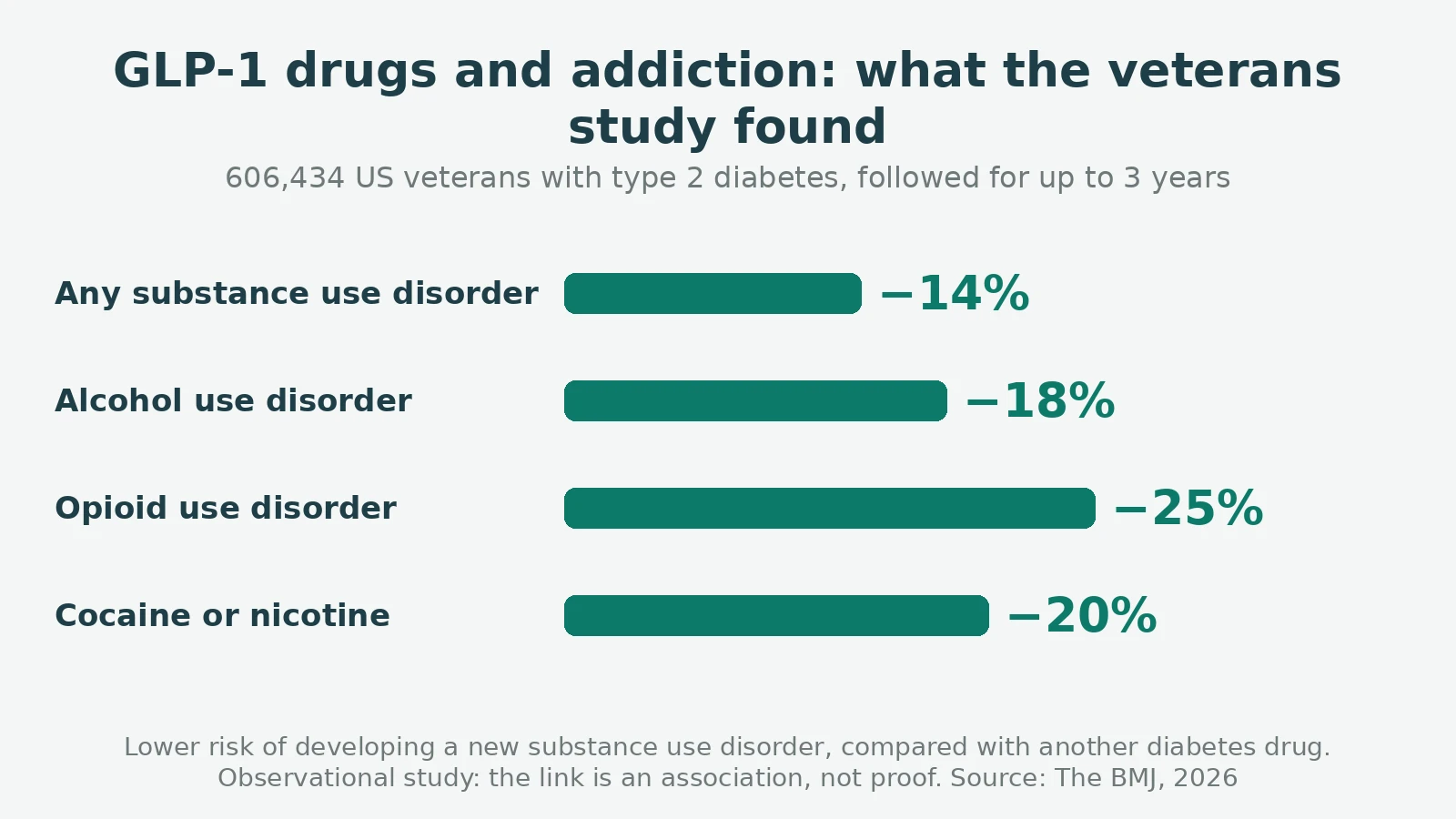
The same reward system that responds to food also responds to alcohol, nicotine and other drugs, so researchers have asked whether GLP-1 drugs could quiet cravings more broadly. The largest study so far, published in The BMJ in March 2026, looked at the health records of 606,434 US veterans with type 2 diabetes over three years, comparing GLP-1 drugs with another diabetes medicine. People taking a GLP-1 drug had a 14% lower risk of developing any substance use disorder — 18% lower for alcohol, 25% lower for opioids, 20% lower for cocaine and nicotine, and 14% lower for cannabis. That worked out at seven fewer new cases for every 1,000 people taking a GLP-1 drug.
The results were even more striking for people who already had a substance use disorder: 30% fewer drug-related emergency department visits, 25% fewer hospital admissions, 40% fewer overdoses and 50% fewer drug-related deaths. But there are important limits. The study was observational, so it shows a link rather than proving the drugs caused the difference. The veterans studied were mostly older white men with diabetes, and the comparison was with another drug rather than with no treatment. GLP-1 drugs are not approved for addiction, and addiction specialists say the findings are not a reason to choose them over approved addiction treatments. Clinical trials are now testing whether they can treat addiction directly.
Mood, anxiety and suicidal thoughts
Early safety reports raised a worry that GLP-1 drugs might affect mood. In January 2026 the FDA completed a large review and found no increased risk: a meta-analysis of 91 placebo-controlled trials with 107,910 patients found no higher risk of suicidal thoughts or behaviour, anxiety, depression, irritability or psychosis, and a separate study of 2,243,138 users found no increased risk of intentional self-harm. The FDA has asked drug makers to remove the warning about suicidal thoughts from the labels of Saxenda, Wegovy and Zepbound.
Even so, some people do report low mood, anxiety or a flatter sense of pleasure while taking these drugs, and the Nature study suggests the dampened reward response may be part of the reason. If you notice new or worsening depression, anxiety, mood changes or thoughts of self-harm, tell your clinician straight away. If you are struggling, support is available at Health Daily Advice: Get Help Now.
Memory and dementia: the Alzheimer disappointment
The biggest hope for GLP-1 drugs and the brain was Alzheimer’s disease. Early research in animals suggested the drugs might protect brain cells, and the idea was tested in the largest trials of their kind: Novo Nordisk’s EVOKE and EVOKE+ trials, which gave oral semaglutide or a placebo to 3,808 people aged 55 to 85 with early Alzheimer’s for most of 156 weeks. When the results were announced in November 2025, the drug had failed to slow the disease, even though some Alzheimer’s biomarkers improved. Novo Nordisk has ended its semaglutide trials in Alzheimer’s. For now, there is no proof that GLP-1 drugs protect memory — though better blood sugar, weight and blood pressure control may still help the brain indirectly.
Can GLP-1 drugs harm the brain?
There is no strong evidence that they do. The brain fog, headaches and dizziness some people report are often linked to changes that come with the treatment itself: eating less, low blood sugar, dehydration or poor sleep. These symptoms usually improve as eating and drinking routines settle. There is also no evidence the drugs are addictive — they do not produce a high, people do not need rising doses for the same effect, and stopping does not cause withdrawal. Appetite generally returns to its usual level once the drug is stopped.
What this means if you take one
If you take a GLP-1 drug, the brain effects are part of how it works, not a sign that something has gone wrong. Tell your prescriber about any mood changes, persistent headaches, dizziness or brain fog, and about eating very little. Small adjustments to eating, hydration and sleep often help. If you are thinking of stopping the drug, talk to your prescriber first. These are prescription medicines, so they should only be used under the supervision of a healthcare team.
When to see a doctor
Contact your GP or prescriber if you notice new or worsening depression or anxiety, mood changes, thoughts of self-harm, persistent headaches, dizziness or brain fog, severe vomiting, or if you are eating very little. Seek urgent help if you have thoughts of harming yourself. In an emergency call 911 (US), 999 (UK) or 112 (EU).
Frequently asked questions
Does Ozempic permanently change your brain?
No — the evidence so far says the changes are not permanent. In studies, most people's appetite returned to baseline once they stopped taking the drug, and there is no sign of lasting damage. What changes is how the brain responds to food cues while you are taking it, mainly through the reward circuits mapped in the 2026 Nature study. If you stop, food thoughts usually come back gradually.
Can GLP-1 drugs treat alcohol or drug addiction?
Not yet — they are not approved for addiction, and no one should take them for that reason. A large 2026 study of 606,434 US veterans found GLP-1 users had a 14% lower risk of developing a substance use disorder, but it was observational, so it cannot prove the drugs caused the difference. Clinical trials are now testing whether GLP-1 drugs can treat addiction directly. Approved addiction treatments remain the first choice — talk to a doctor.
Do GLP-1 drugs cause depression or suicidal thoughts?
The best evidence says no. In January 2026 the FDA reviewed 91 placebo-controlled trials with 107,910 patients and found no increased risk of suicidal thoughts or behaviour, anxiety, depression, irritability or psychosis, and asked for the warning to be removed from the labels of Saxenda, Wegovy and Zepbound. Some people do report low mood while taking them, so tell your clinician straight away if your mood changes.
Can Ozempic protect against dementia?
There is no proof that it can. Early hopes rested on the idea that GLP-1 drugs might protect brain cells, but most of that evidence came from animals. The largest test so far — Novo Nordisk's EVOKE and EVOKE+ trials in 3,808 people with early Alzheimer's — found oral semaglutide did not slow the disease, even though some biomarkers improved. The company has ended those trials. Better blood sugar, weight and blood pressure control may still help the brain indirectly.
Will I stop enjoying food on Ozempic?
Most people do not lose their enjoyment of food, but the experience often changes. The drugs calm the brain's reward response, so food may feel less exciting and easier to stop eating — which many people welcome. A smaller number report a flatter sense of pleasure overall, which researchers link to the same reward circuits. If food has lost all appeal, or you are eating very little, talk to your prescriber.
Sources
- GoodRx: What Does Ozempic Do to Your Brain? www.goodrx.com
- Neuroscience News: GLP-1 Drugs Found to Directly Rewire Brain's Reward System neurosciencenews.com
- Godschall EN, et al. A brain reward circuit inhibited by next-generation weight-loss drugs in mice. Nature, 2026 doi.org
- WashU Medicine: GLP-1 medications get at the heart of addiction: study source.washu.edu
- FDA: FDA Requests Removal of Suicidal Behavior and Ideation Warning from GLP-1 RA Medications www.fda.gov
- Scientific American: GLP-1 Pill Fails to Slow Alzheimer's Progression in Clinical Trial www.scientificamerican.com

Try the tool
Not sure if it can wait?
Common causes and warning signs for 16 everyday symptoms.
Open the symptom guide