What Is Fluticasone Nasal Spray? Uses and Side Effects
Fluticasone is a steroid nasal spray used for hay fever and nasal polyps — but it is not instant, and technique matters. Here is what it treats, how long it takes to work, how to use it properly and the side effects to watch for.
- Written by
- Health Daily Advice
- Published
- Reading time
- 8 minutes
- Sources
- 15 cited

In this guide
Fluticasone nasal spray is a corticosteroid medicine — a steroid sprayed directly into the nose — that calms swelling and irritation in the nasal lining. It is used to prevent and treat hay fever and other allergic rhinitis, and to shrink nasal polyps. It works where it is sprayed, with very little medicine reaching the rest of the body.
If your nose streams every spring, or a blocked nose has become your normal, you have probably heard of it. In the US, 25.2% of adults had a diagnosed seasonal allergy in 2024, according to the CDC — and the sneezing, itchy eyes and blocked nose that come with it are exactly what fluticasone is made for. This guide explains what it is, what it treats, how long it takes to work, how to use it properly, and when to get medical advice.
What is fluticasone nasal spray?
Fluticasone is a type of medicine called a corticosteroid. The word “steroid” puts some people off, but the NHS is clear: it is not the same as anabolic steroids, the muscle-building drugs sometimes misused by athletes. A corticosteroid calms inflammation; an anabolic steroid builds muscle. They share a word and little else.
There are two forms, and it helps to know which one you have, because the doses are different. Fluticasone propionate — sold in the UK as Flixonase and Nasofan, and in the US as Flonase — delivers 50 micrograms per spray. Fluticasone furoate — sold in the UK as Avamys — delivers 27.5 micrograms per spray. They are not interchangeable, so check the name on your own bottle or prescription.
In the UK, Flixonase, Avamys and Nasofan are prescription-only, while Pirinase can be bought from a pharmacy if you are 18 or over. Fluticasone also comes as nasal drops, prescribed to shrink nasal polyps, and as an inhaler or cream for asthma and eczema — but this article is about the nasal spray.
What does it treat?
Fluticasone nasal spray is used to prevent and treat the symptoms of allergic rhinitis and hay fever: sneezing, an itchy and runny nose, itchy and watery eyes, and a blocked nose. The triggers are familiar ones — pollen, house dust mites, mould and animal dander, the tiny flecks of skin animals shed. On prescription it can also relieve non-allergic rhinitis, where similar symptoms appear without an allergy behind them, and the drops are used for nasal polyps, the soft, painless growths that can block the nose.
It is worth knowing what it does not do. It does not treat the common cold, and it is not a treatment for asthma. It controls symptoms while you use it; it does not cure the allergy itself. Even so, it is a strong option: Mayo Clinic notes that for many people, nasal corticosteroid sprays are the most effective hay fever medicines and are often the first type recommended.
How does it work?
When pollen or another allergen reaches the nose, the immune system releases a rush of inflammatory substances. Fluticasone blocks the release of several of them at the source — including histamine, prostaglandins, cytokines, tryptases, chemokines and leukotrienes — which reduces the swelling and irritation inside the nose. That is the key difference from an antihistamine tablet, which mostly acts on histamine alone, and a big reason why a steroid spray often works better for a blocked nose.
Because the spray acts where it lands, barely any of the medicine travels through the rest of the body. That local action is why the risk of wider steroid side effects stays low when it is used as directed, as the NHS explains.
How long does it take to work?
Fluticasone is not a quick fix, and that catches people out. You may start to feel relief on the first day, and symptoms may begin to improve within 1 to 2 days, according to MedlinePlus — but it takes several days for the spray to build up to full effect, and for some people the maximum benefit takes 2 weeks or more. Mayo Clinic Press puts it the same way: steroid nasal sprays usually start working after a few days but can take a few weeks to reach peak effect.
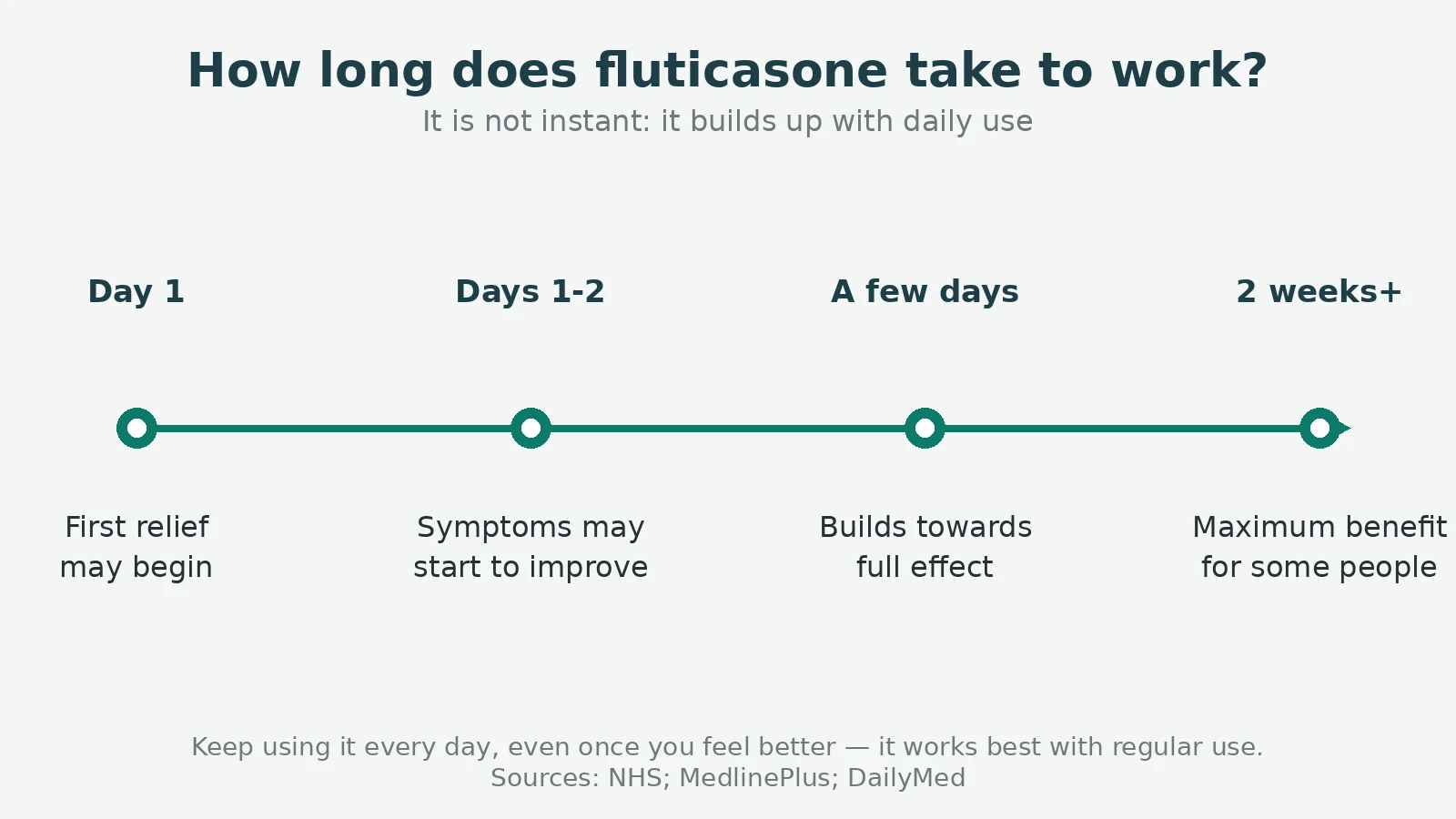
Daily use is what makes it work, so it helps to build it into a routine — same time each morning, for instance. If you have hay fever, start at least a couple of weeks before the season begins, so the medicine is already working when the pollen count rises. And if you feel no better after using the spray for 7 days, tell your doctor.
How to use it correctly
Technique matters more than most people expect. A spray aimed at the middle wall of the nose does little good and can cause nosebleeds; aimed outwards, it reaches the lining it is meant to treat. Follow these steps:
- Shake the bottle gently before each use.
- Prime the pump if it is a new bottle, or if you have not used it for a while — pump it into the air, away from your face, until a fine mist appears.
- Blow your nose gently until your nostrils are clear.
- Close one nostril with a finger, tilt your head slightly forward and keep the bottle upright.
- Put just the tip of the nozzle into the other nostril, aiming outwards — towards the outer corner of your eye — and away from the septum, the centre wall between the nostrils.
- While sniffing gently, press the nozzle to release the spray. Breathe out through your mouth.
- Repeat in the other nostril if you need a spray there too.
- Wipe the nozzle with a clean tissue and replace the cap.
Clean the nozzle weekly, or sooner if it clogs — remove it, rinse it under a running tap and let it dry at room temperature. Do not try to unblock it with a pin or anything sharp, which can damage it. And do not share your bottle with anyone else: it is for one person only, and sharing can spread germs. Keep track of how many sprays you have used, because once the labelled number is reached, each spray may not deliver a full dose even if liquid remains.
What the label says about use
Your own dose is the one on your prescription or packaging — but it helps to know what the standard label says. The US over-the-counter label says adults and children aged 12 and over usually use 2 sprays in each nostril once daily in the first week, then 1 or 2 sprays in each nostril once daily. For children aged 4 to 11, the label says 1 spray in each nostril once daily, with an adult supervising, and to talk to the child’s doctor if the spray is needed for longer than two months a year. Children under 4 should not use it. The label also says to use it only once a day, not to use more than directed, and to ask a doctor if you have used it daily for 6 months. That is what the label says — it is not a personal recommendation. If your dose is different, follow your own prescription or ask your doctor or pharmacist.
Side effects
Most people use fluticasone without much trouble, and serious side effects are rare, because the medicine works in the nose and barely any of it travels through the body. The common side effects are:
- Nosebleeds, or bloody mucus in the nose
- A dry or sore nose or throat
- An unpleasant taste or smell
- Headache
- Stinging, burning or irritation inside the nose, or sneezing for a few seconds after spraying
- A sore throat, cough, nausea or a change in taste or smell
A few rarer effects need medical attention. Stop using the spray and get help if you notice a constant whistling sound from your nose, severe or frequent nosebleeds, white patches in your nose or mouth — a sign of thrush — crusting or sores inside the nose, or changes to your vision, such as cloudy or reduced vision. Fluticasone can raise the risk of glaucoma or cataracts, so regular eye checks may be advised during treatment. An allergic reaction — swelling of the face or tongue, a rash, wheezing or feeling faint — needs urgent help. Signs of infection, such as severe face pain, thick nasal discharge or a fever, should also be checked promptly.
Common myths about fluticasone
- It is not a decongestant. Decongestant sprays such as oxymetazoline work quickly, but they should not be used for more than 2 to 3 days at a time, because they can make congestion worse when used continuously — rebound congestion. Fluticasone does not cause rebound, which is why it can be used daily for months.
- It does not cure allergies. It controls the symptoms while you use it; stop, and the symptoms usually return.
- It does not treat colds or asthma. It is for allergies, non-allergic rhinitis and nasal polyps — not for a cold, and not as an asthma treatment.
- It does not cause drowsiness. And when used as directed, it does not increase blood pressure, according to the US label on DailyMed.
Who should talk to a doctor or pharmacist first
Fluticasone suits most people, but check first if any of these apply to you:
- Pregnancy or breastfeeding. Ask a health professional before use. The NHS advises speaking to a doctor or pharmacist before buying it at a pharmacy if you are pregnant, and it is not known whether fluticasone harms an unborn baby or passes into breast milk. Do not assume it is safe — get advice.
- Eye problems. Tell your doctor if you have or have had glaucoma or cataracts, or notice any change in your vision.
- Recent nose surgery or injury, or sores inside the nose. The spray should not be used until the nose has healed.
- Chickenpox, measles or tuberculosis — or recent contact with someone who has one of these. Stop using the spray and ask a doctor.
- Other medicines. Some medicines can interact with fluticasone, including ritonavir (an HIV medicine), antifungal pills such as ketoconazole, and other steroid medicines, according to Cleveland Clinic. Tell your doctor or pharmacist about everything you take.
- Children. Long-term use may slow a child’s growth rate, and children on high doses for a long time may need their height and weight monitored. Whether it affects final adult height is not known.
- Allergy to fluticasone or to any ingredient in the spray — do not use it.
If a doctor prescribes high doses of fluticasone for a long time, ask whether you should carry a steroid emergency card — a small red card that tells other health professionals you use a steroid medicine.
When to see a doctor
See a doctor or pharmacist if your symptoms do not improve after 7 days of daily use, or if they get worse. Get medical advice promptly for severe facial pain, thick nasal discharge, a fever, a constant whistling sound from your nose, severe or frequent nosebleeds, white patches in your nose or mouth, or any change in your vision. Seek urgent help straight away for swelling of the face, lips or tongue, difficulty breathing or swallowing, wheezing, or feeling faint.
In an emergency call 911 (US), 999 (UK) or 112 (EU).
Frequently asked questions
How long does fluticasone nasal spray take to work?
You may start to feel some relief on the first day, and symptoms often begin to improve within 1 to 2 days. But it takes several days for the spray to build up to full effect, and for some people the maximum benefit takes 2 weeks or more. Daily use matters, so start a couple of weeks before hay fever season if you can. If you feel no better after 7 days, tell your doctor.
Is fluticasone nasal spray a steroid?
Yes — fluticasone is a corticosteroid, a type of steroid that calms inflammation. It is not the same as anabolic steroids, the muscle-building steroids sometimes misused by athletes. Because it is sprayed into the nose, it works mainly where it is needed, and barely any of it travels through the rest of the body. That local action is why the risk of steroid side effects is low when it is used as directed.
Can I use fluticasone nasal spray every day?
Yes — it is designed for daily use, and using it every day is how it works best. The US over-the-counter label says adults and children aged 12 and over can use it daily for up to 6 months before checking with a doctor. Unlike decongestant sprays, it does not cause rebound congestion, so there is no 2 to 3 day limit. Always follow the dose on your own label or prescription.
What are the most common side effects of fluticasone nasal spray?
The most common side effects are nosebleeds, a dry or sore nose or throat, an unpleasant taste or smell, and headache. Some people get stinging or a burning feeling inside the nose, sneezing for a few seconds after spraying, or a change in their sense of taste or smell. These are usually mild and settle with continued use. Severe or frequent nosebleeds, a constant whistling sound from the nose, or white patches inside the nose or mouth need a doctor.
Can I use fluticasone nasal spray while pregnant?
Ask a health professional first — do not assume it is safe. The NHS advises speaking to a doctor or pharmacist before buying fluticasone nasal spray at a pharmacy if you are pregnant, and the US label says the same for pregnancy and breastfeeding. It is not known whether fluticasone harms an unborn baby or passes into breast milk. A doctor or pharmacist can weigh the benefits against the unknowns and suggest the safest option for you.
Is fluticasone nasal spray the same as a decongestant spray?
No. Fluticasone is a corticosteroid that reduces swelling and irritation over days; decongestant sprays such as oxymetazoline shrink swollen blood vessels and work quickly, but they should not be used for more than 2 to 3 days because they can make congestion worse when used continuously — rebound congestion. Fluticasone does not cause rebound, which is why it can be used daily for months. The two sprays work in different ways and are not interchangeable.
Sources
- NHS: About fluticasone nasal spray and drops www.nhs.uk
- NHS: Common questions about fluticasone nasal spray and drops www.nhs.uk
- MedlinePlus: Fluticasone Nasal Spray medlineplus.gov
- Cleveland Clinic: Fluticasone Nasal Spray my.clevelandclinic.org
- Mayo Clinic: Hay fever — diagnosis and treatment www.mayoclinic.org
- Mayo Clinic Press: Nasal polyps — your treatment options mcpress.mayoclinic.org
- CDC FastStats: Allergies and Hay Fever www.cdc.gov
- DailyMed: Fluticasone Propionate Nasal Spray, USP 50 mcg per spray dailymed.nlm.nih.gov

Try the tool
Not sure if it can wait?
Common causes and warning signs for 16 everyday symptoms.
Open the symptom guide