Can You Get Measles If You Are Vaccinated?
Yes, it can happen — but it is uncommon, and usually milder. How often vaccinated people catch measles, why it happens, and what to do after an exposure.
- Written by
- Health Daily Advice
- Published
- Reading time
- 6 minutes
- Sources
- 9 cited
In this guide
Yes, it is possible, but it is uncommon. Two doses of the MMR vaccine are about 97% effective at preventing measles, so around 3 in 100 fully vaccinated people may still catch it if exposed. When it does happen, the illness is usually milder, and most cases in the current US outbreak are in people who were never vaccinated.
That short answer is reassuring, but it leaves the real questions open: how often does it actually happen, why does it happen at all, and what should you do if you have been exposed? With measles spreading again in the United States and other countries, those questions are being asked more than they have been in years.
How well does the MMR vaccine work?
The measles, mumps and rubella (MMR) vaccine is one of the most effective vaccines in routine use. According to the CDC, two doses are about 97% effective at preventing measles, and one dose is about 93% effective. In the UK, the NHS puts it slightly differently: after two doses, around 99% of people are protected against measles and rubella.
Those numbers are not quite the same because they are measured in different ways, but the message is consistent: two doses give strong, long-lasting protection. Protection starts within about two weeks of the jab, and the NHS notes that the two doses should be given at least a month apart.
The vaccine has a long record behind it. The World Health Organization estimates that measles vaccination prevented nearly 59 million deaths between 2000 and 2024, and that the vaccine has been in use for about 60 years.
How common are breakthrough measles cases?
A breakthrough infection is when someone catches measles despite being vaccinated. The CDC says these cases are uncommon, and that their number is consistent with previous years — roughly 10% of all measles infections. That may sound high, but it is what you would expect from a vaccine that is 97% effective: in a large outbreak, a small share of cases will be in vaccinated people, while the large majority are in people who were never vaccinated.
The pattern shows up clearly in the figures. In 2024, the CDC reported that 89% of US measles cases were in people who were unvaccinated or whose vaccination status was unknown, 7% had received one dose, and 4% had received two doses.
Pennsylvania’s outbreak tells the same story. As of 23 November 2026, the state had recorded 1,638 cases and nine deaths — yet only five of those cases were in vaccinated people, under 1% of the state’s total.
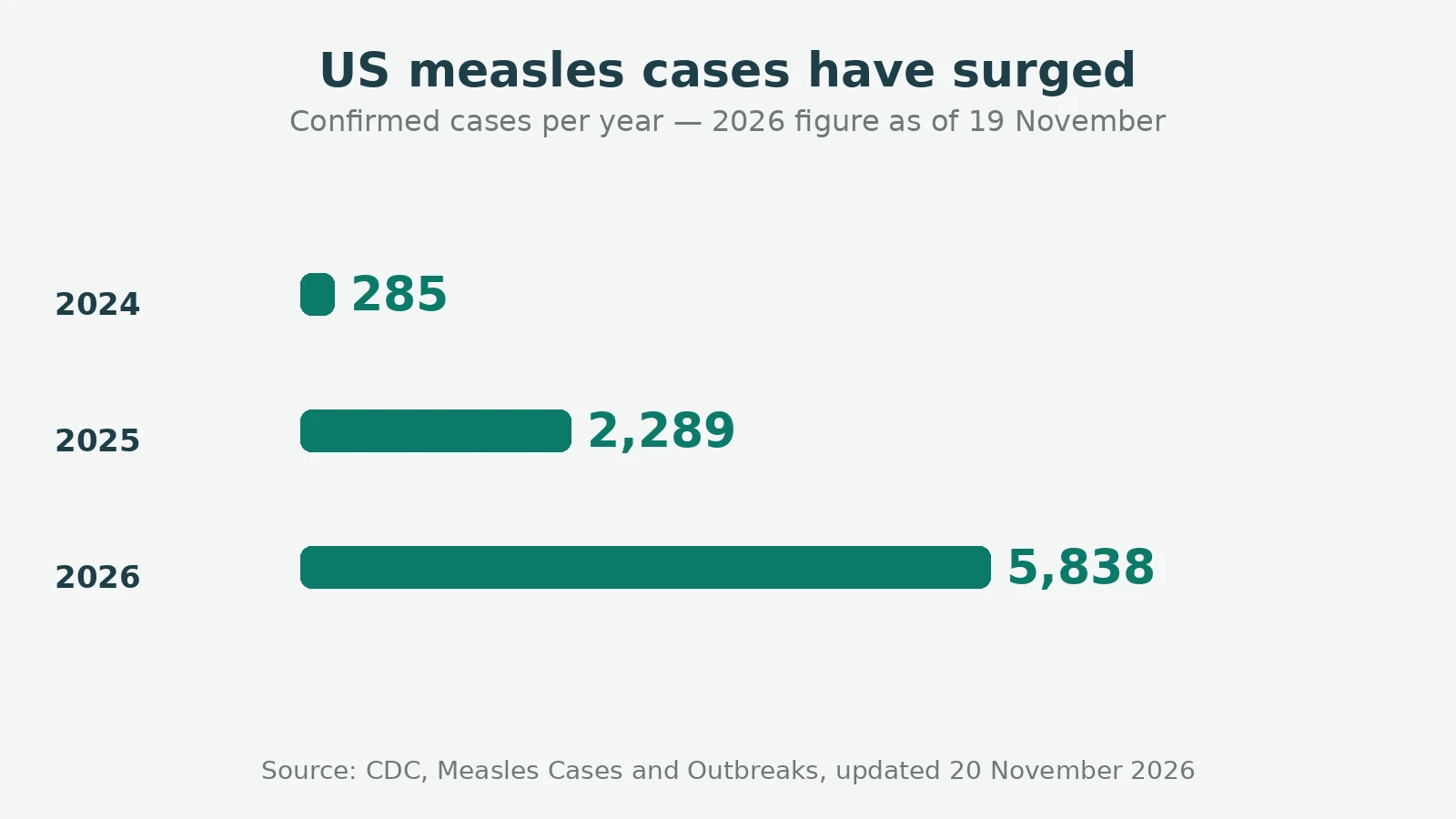
The outbreak itself is the reason the question is being asked so often. As of 19 November 2026, the CDC had recorded 5,838 confirmed measles cases in the United States across 47 jurisdictions, with 43 outbreaks and 96% of cases linked to outbreaks. That compares with 2,289 cases in the whole of 2025 and 285 in 2024. Sustained spread over at least 12 months also cost the United States the measles elimination status it had held since 2000.
Why can vaccinated people still catch measles?
No vaccine protects absolutely everyone. There are a few reasons a vaccinated person can still develop measles:
- The vaccine did not take. A small number of people do not develop full immunity after vaccination. This is more likely after a single dose, which is why two doses are recommended.
- Heavy exposure. Measles is one of the most contagious diseases known. The CDC says up to 9 in 10 unprotected people who come into close contact with someone with measles will catch it, and the WHO notes that one infected person can generate up to 18 further infections. The virus can linger in the air for up to two hours after an infected person has left a room.
- Protection fading over time. Immunity after MMR is long-lasting, but it is not always lifelong for everyone. This is one reason health authorities check vaccination records when measles is circulating.
- A weakened immune system. People whose immune systems are suppressed by illness or treatment may not respond as strongly to the vaccine.
It is also worth knowing that a single dose leaves a bigger gap than two. At about 93% effectiveness, one dose leaves roughly 7 in 100 people unprotected, compared with about 3 in 100 after two doses.
Are breakthrough cases milder?
Usually, yes. People who catch measles after vaccination tend to have a milder illness than people who were never vaccinated, with a lower chance of the serious complications that make measles dangerous: pneumonia, swelling of the brain (encephalitis) and, in the worst cases, death.
That does not mean a breakthrough infection should be ignored. Measles symptoms usually appear 7 to 14 days after exposure, starting with a high fever that can rise above 104°F, a cough, a runny nose and red, watery eyes, followed by a rash. Complications are most likely in children under five, adults over 20, pregnant women and people with weakened immune systems, according to the CDC.
There is also a wider cost. The WHO estimates that about 95,000 people died from measles worldwide in 2024, mostly children under five who were unvaccinated or under-vaccinated. Vaccinated people who catch a mild case can still pass the virus on to someone who has no protection at all.
What should you do if you were exposed?
If you have been in close contact with someone with measles, do not assume you are safe — check your vaccination record. The Mayo Clinic notes that people over six months old who are not immune can be given the MMR vaccine up to three days after contact, and that infants up to 11 months old can be given a shot of protective antibodies, called immune globulin, up to six days after exposure.
Anyone who was exposed should also watch for symptoms for three weeks and stay away from other people if symptoms appear, especially from babies, pregnant women and anyone with a weakened immune system. There is no antiviral drug that treats measles itself; care focuses on rest, fluids and easing symptoms, and a doctor may prescribe antibiotics only for bacterial complications such as pneumonia or an ear infection.
How do you check whether you are protected?
Most adults who received two doses of MMR as a child are protected and do not need anything further. You may be less sure if you were born before routine two-dose vaccination, if you only ever had one dose, or if your records are missing. In the UK, your GP surgery can tell you which vaccinations you have had; in the US, your doctor or state immunisation registry can check.
Community protection matters too. The CDC says that when more than 95% of people in a community are vaccinated, most people are protected through community immunity. But MMR coverage among US kindergarten children has fallen from 95.2% in the 2019–2020 school year to 92.4% in 2025–2026, leaving about 280,000 kindergarten children at risk — and pockets of low coverage are where outbreaks take hold.
When to see a doctor
See a doctor promptly if you develop a fever and rash after being near someone with measles, or if you have been exposed and are unsure of your vaccination status. Call ahead before visiting a clinic or GP surgery so staff can keep you apart from other patients — measles spreads through the air and can linger for up to two hours.
Get urgent help if you have difficulty breathing, a severe headache, confusion, a stiff neck, or a rash that does not fade when pressed. These can be signs of a serious complication. In an emergency call 911 (US), 999 (UK) or 112 (EU).
Frequently asked questions
Can you get measles if you had both MMR doses?
Yes, but it is uncommon. Two doses of the MMR vaccine are about 97% effective, so around 3 in 100 fully vaccinated people may still catch measles if exposed. When it happens, the illness is usually milder, with a lower chance of serious complications. Most cases in the current US outbreak are in people who were never vaccinated.
How long after exposure do measles symptoms appear?
Symptoms usually appear 7 to 14 days after exposure to the virus. They start with a high fever, which can rise above 104°F, a cough, a runny nose and red, watery eyes, followed by a rash that usually begins on the face and upper neck. If you were exposed, watch for symptoms for three weeks.
Can vaccinated people spread measles?
Yes, a vaccinated person who catches measles can pass the virus on, though this is uncommon. Measles spreads through the air when an infected person coughs or sneezes, and the virus can linger in the air for up to two hours. That is why anyone with measles symptoms should stay away from babies, pregnant women and people with weakened immune systems.
Is one dose of the MMR vaccine enough?
One dose gives good protection — about 93% effective — but two doses are better, at about 97%. The second dose catches most of the people the first dose did not protect. In the UK the NHS says two doses protect around 99% of people against measles. If you are unsure whether you had both doses, your GP or doctor can check your records.
What should I do if I was exposed to measles?
Check your vaccination record first. The Mayo Clinic notes that people over six months old who are not immune can be given the MMR vaccine up to three days after contact, and infants up to 11 months old can be given protective antibodies up to six days after exposure. Watch for symptoms for three weeks, and call a doctor before visiting a clinic so you can be kept apart from other patients.
Sources
- CDC: About Measles www.cdc.gov
- CDC: Measles Cases and Outbreaks www.cdc.gov
- NHS: MMR vaccine www.nhs.uk
- WHO: Measles fact sheet www.who.int
- Mayo Clinic: Measles www.mayoclinic.org

Try the tool
Not sure if it can wait?
Common causes and warning signs for 16 everyday symptoms.
Open the symptom guide