What Is Maladaptive Daydreaming? Signs, Causes and How to Cope
Vivid daydreams that swallow hours of your day and crowd out real life are more than a wandering mind. Here is what maladaptive daydreaming is, why it happens, and what actually helps.
- Written by
- Health Daily Advice
- Published
- Reading time
- 8 minutes
- Sources
- 5 cited

In this guide
Maladaptive daydreaming is a pattern of vivid, immersive daydreaming that takes up hours of the day and starts to interfere with work, study, relationships or sleep. Unlike ordinary daydreaming, it feels hard to stop, often works as an escape from stress or painful feelings, and can leave people feeling ashamed or frustrated with themselves.
A few minutes picturing a holiday or replaying a conversation is normal — and often useful. Maladaptive daydreaming is different in degree, not just in kind: the fantasies are far more detailed, run far longer, and begin to cost the person something in real life.
What is maladaptive daydreaming?
The term was first described in 2002 by Professor Eli Somer, a clinical psychologist at the University of Haifa in Israel, who studied six patients whose inner fantasy lives had become so consuming they crowded out everyday life. He defined it as extensive fantasy activity that replaces human interaction or gets in the way of school, work or relationships — a definition researchers still use today.
People who experience it often describe daydreams with ongoing plots and recurring characters, like a private television series that continues from one session to the next. The daydreamer is often an idealised version of themselves: more confident, more admired, more in control. Crucially, people know the daydream is not real — unlike schizophrenia, where telling fantasy from reality is itself the struggle.
It is not listed as a disorder in the DSM-5, the manual psychiatrists use to diagnose mental health conditions, and there is no official diagnostic test for it. That does not mean it is imaginary — research has grown steadily since 2002, and many clinicians now take it seriously as a real source of distress.
What are the signs of maladaptive daydreaming?
Researchers tend to group the signs into two clusters: what the daydreaming looks like, and how it affects daily life.
How the daydreaming looks
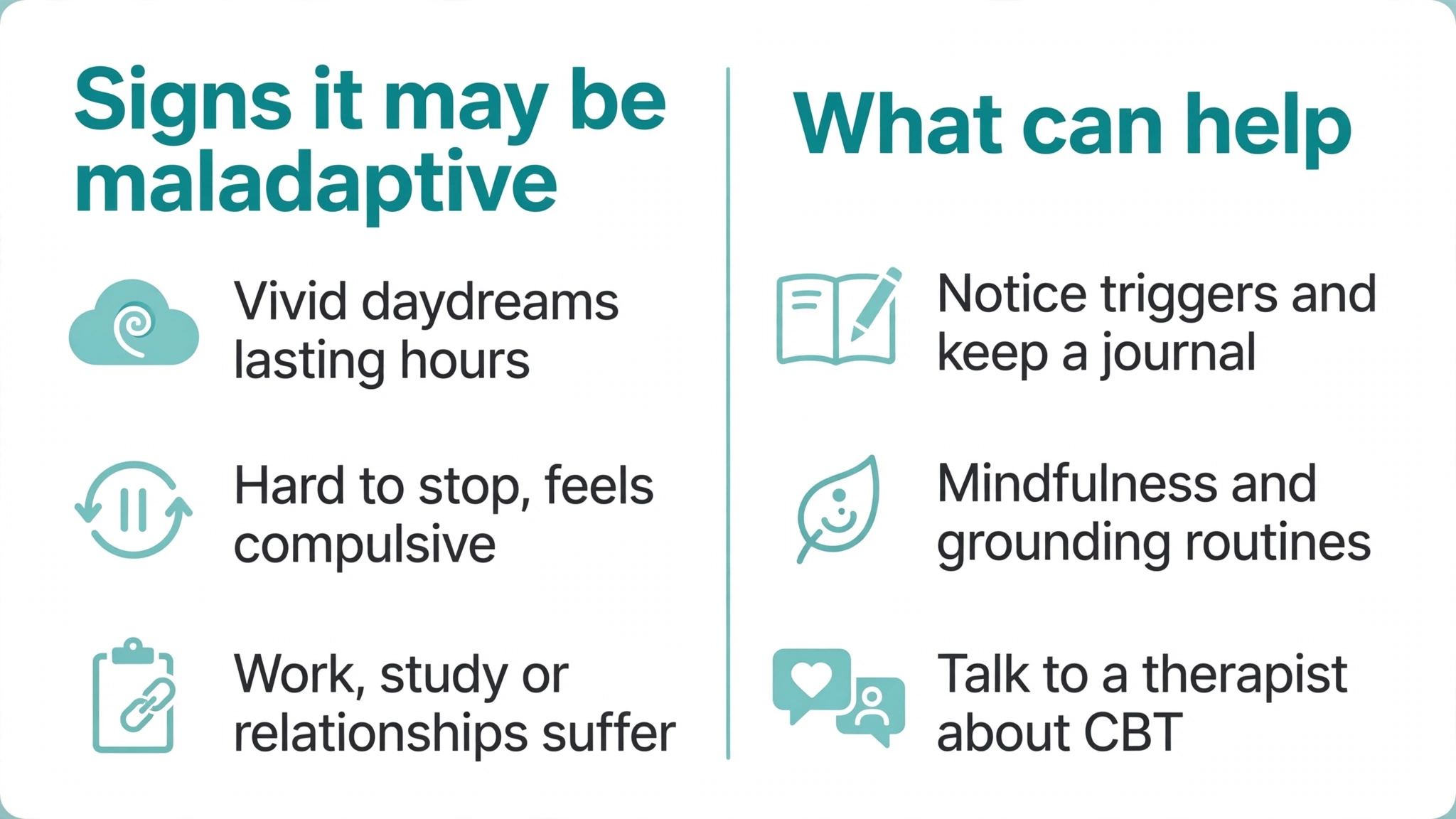
- Very vivid and detailed. The fantasies are rich and cinematic, with settings, dialogue and characters that return again and again.
- Long-lasting. Episodes can run for minutes or for hours at a stretch. Research summaries describe people commonly spending around four to eight hours a day daydreaming, although this varies a great deal from person to person.
- Deliberate. Unlike a stray thought, these daydreams are often started on purpose — the person chooses to slip into them.
- Hard to stop. There is a compulsive pull to keep going, and irritation or distress when the daydream is interrupted.
- Triggered by cues. Music, films, a conversation, a smell or a particular place can set an episode off.
- Physical habits. Some people pace, rock, whisper or make facial expressions while they daydream, often without realising it.
How it affects daily life
- Work and study suffer. Concentration slips, deadlines are missed, tasks take far longer than they should.
- Relationships thin out. Daydreaming can start to feel more appealing than spending time with friends or family.
- Sleep is disrupted. Some stay up late to daydream, and poor sleep makes focus even harder the next day.
- Shame and guilt. Many feel embarrassed about the time lost, especially after failed attempts to cut back.
- Repeated failed attempts to stop. Trying to quit and finding it does not work is itself a common feature of the pattern.
How is maladaptive daydreaming different from normal daydreaming?
Daydreaming itself is ordinary — researchers estimate we spend about 47% of our waking hours with our minds wandering, and most of that is harmless or even helpful. The line between normal and maladaptive comes down to control, duration and cost.
| Normal daydreaming | Maladaptive daydreaming |
|---|---|
| Brief — seconds or a few minutes | Long — minutes to hours, sometimes most of the day |
| Easy to stop when needed | Feels compulsive and hard to interrupt |
| Simple, everyday content | Elaborate plots with recurring characters |
| Does not interfere with life | Disrupts work, study, sleep and relationships |
| No distress afterwards | Often followed by shame, guilt or frustration |
| Happens on its own | Often deliberately started and triggered by music or media |
What causes maladaptive daydreaming?
Experts do not know exactly why it develops, and there is probably no single cause. But it rarely appears on its own: it tends to arrive alongside other mental health patterns, often beginning as a coping strategy that outgrows its purpose.
Dissociation and escape
Many researchers describe it as a form of dissociative absorption — mentally stepping away from something painful. The early patients Somer studied were trauma survivors, for whom the fantasy world felt safer than the real one. A later study of 90 self-identified daydreamers found 27% reported childhood trauma, suggesting trauma is a risk factor for some but not a necessary ingredient. It can also switch off boredom, loneliness or problems that feel too big to face.
ADHD
The overlap with attention deficit hyperactivity disorder is striking: Cleveland Clinic reports it affects about 20% of adults with ADHD. Both involve difficulty steering attention — with ADHD the mind drifts, while with maladaptive daydreaming it locks onto a fantasy and will not let go. People with both tend to report more loneliness and lower self-esteem than people with ADHD alone.
Anxiety and depression
The Sleep Foundation notes that more than half of people with maladaptive daydreaming have a mental health disorder, with anxiety and depression the most common. The pattern often works as a short-term mood regulator: the fantasy feels good, so the brain reaches for it whenever real life feels flat or stressful — but the relief is brief, and the problems are still there when it ends. If anxiety is part of your picture, our guide to what anxiety is and how it works may help.
Links have also been found with obsessive-compulsive disorder, emotional dysregulation, low self-esteem, loneliness and heavy internet use — and in each case the relationship runs both ways: the underlying difficulty feeds the daydreaming, and the daydreaming makes it worse by eating the time and energy that might have gone into dealing with it.
How common is maladaptive daydreaming?
Good estimates are still thin, because the condition is not officially recognised and many people never mention it to a doctor. An Israeli study found about 2.5% of adults met the criteria for clinical-level maladaptive daydreaming, rising to around 4.3% among younger adults who were students; other summaries put the younger-adult figure at 5.5% to 8.5%. A 2023 study using a large US sample found similar rates.
How is maladaptive daydreaming assessed?
Because there is no official diagnosis, a doctor cannot formally diagnose it. What they can do is assess it with tools developed by researchers — and look for the conditions that commonly travel with it, such as anxiety, depression or ADHD.
The main tool is the Maladaptive Daydreaming Scale, or MDS-16 — a 16-item questionnaire developed by Somer and colleagues in 2016, covering how vivid your daydreams are, how much control you have over them, how distressing they feel and how much they interfere with daily life. A score of 40 or higher suggests clinical-level maladaptive daydreaming — a good prompt to discuss the results with a clinician. A short five-item version, the MD-SF5, is used for quick screening. Online versions exist, but a score is not a diagnosis.
What helps with maladaptive daydreaming?
There is no standard treatment, because the condition is so new to research. But several approaches have shown promise, and practical habits can make a real difference while you work on the deeper picture.
Talking therapy
Cognitive behavioural therapy (CBT) has the most encouraging early evidence. It focuses on spotting triggers, challenging the thoughts that send you into a daydream, and building alternative coping skills for the feelings underneath. In a 2018 case study described by Psych Central, a person using CBT cut their daydreaming by about half. That is one person, not a trial — but it points in a hopeful direction. A therapist can also help you process any trauma feeding the pattern, and suggest techniques such as changing your daydreams’ endings so they feel less rewarding.
Mindfulness-based approaches have also shown promise: an eight-session online programme combining mindfulness meditation with self-monitoring significantly reduced symptoms in a trial. Regular practice helps many people notice the moment a daydream starts — the moment you still have a choice about it.
Practical coping strategies
- Keep a daydreaming journal. Note when episodes happen, what triggered them and how long they lasted — patterns usually show up within a week or two.
- Spot your triggers. Music is a common one — try switching to instrumental tracks or podcasts while you work. Films, books and certain apps can be triggers too.
- Use grounding techniques. When you catch yourself drifting, the 5-4-3-2-1 method (five things you can see, four you can touch, three you can hear, two you can smell, one you can taste) brings your attention back to the room.
- Schedule daydreaming time. Banning it completely often backfires — try a 20 to 30 minute timer for deliberate daydreaming, and protect the rest of the day.
- Build structure into the day. Regular sleep, meals and a planned routine leave fewer empty stretches for fantasy to fill — our guide to simple ways to reduce stress has ideas that fit well here.
- Move your body. Exercise that demands full attention — a run, a swim, a workout class — is hard to do while daydreaming.
- Tell someone you trust. Explaining what is happening lets friends or family gently pull you back when they notice you drifting, and takes the secrecy — and some of the shame — out of it.
- Protect your sleep. Tiredness and late nights make daydreaming harder to resist, so keep a regular sleep schedule and a calm bedtime routine — see our guide on how to fall asleep in 2 minutes if sleep is a struggle.
When to see a doctor
Speak to a doctor or mental health professional if daydreaming regularly interferes with work, study, relationships or sleep; if you feel unable to stop despite trying; or if it comes with low mood, anxiety or thoughts of harming yourself. A GP can refer you for talking therapy and check for related conditions such as anxiety, depression or ADHD.
If you are struggling right now, you do not have to wait for an appointment to reach out. Visit our get help now page for support resources and crisis helplines.
In an emergency call 911 (US), 999 (UK) or 112 (EU)
Frequently asked questions
What is maladaptive daydreaming?
Maladaptive daydreaming is a pattern of vivid, immersive daydreaming that lasts for hours and interferes with work, study, relationships or sleep. The fantasies often have ongoing plots and recurring characters, feel hard to stop, and are usually used to escape stress or painful feelings. It was first described by Professor Eli Somer in 2002 and is not yet listed as a disorder in the DSM-5.
Is maladaptive daydreaming a mental illness?
Not officially. It is not listed in the DSM-5, so a doctor cannot formally diagnose it. But research treats it as a real and distressing pattern, and it is closely linked to ADHD, anxiety, depression and dissociative experiences. A clinician can assess it with the MDS-16 questionnaire and check for any related conditions that need support.
How do I know if my daydreaming is maladaptive?
Ask whether it costs you something: if daydreams regularly run for hours, feel hard to stop, and interfere with work, study, sleep or relationships, that points toward maladaptive daydreaming. A score of 40 or higher on the MDS-16 questionnaire suggests clinical-level daydreaming, but only a clinician can put the pattern in context for you.
What causes maladaptive daydreaming?
No single cause is known. It often starts as a coping strategy, a way to escape stress, boredom, loneliness or trauma, and becomes a habit that is hard to break. It is more common in people with ADHD, anxiety, depression, OCD or dissociative tendencies; about 20% of adults with ADHD experience it.
How can I stop maladaptive daydreaming?
There is no quick fix, but strategies help. Keep a journal of triggers, use grounding techniques when a daydream starts, schedule short deliberate daydreaming sessions instead of banning it, build a structured routine and protect your sleep. Talking therapy, especially CBT, has the best early evidence: in one case study it cut daydreaming by about half.
Can maladaptive daydreaming be cured?
There is no established cure, because there is no standard treatment yet. But it can be managed: CBT and mindfulness-based approaches have shown promise in early research, and many people reduce their daydreaming substantially with therapy and practical habits. If it is affecting your daily life, speak to a doctor or mental health professional.
Sources
- Cleveland Clinic: Maladaptive Daydreaming: What It Is, Symptoms & Treatment my.clevelandclinic.org
- Sleep Foundation: Maladaptive Daydreaming: Symptoms, Causes, and Treatment www.sleepfoundation.org
- Psych Central: Maladaptive Daydreaming: Definition, Symptoms, and How to Cope psychcentral.com
- Balanced Mind Psychotherapy: Maladaptive Daydreaming Research Review balancedmindofny.com

Try the tool
How have you felt over the last 2 weeks?
The PHQ-9 and GAD-7 that GPs use. Private, about 3 minutes.
Start the self-check