What Is Social Anxiety? Signs, Causes and Getting Help
Social anxiety is a long-term, overwhelming fear of being judged in social situations. Learn its signs, causes, how it differs from shyness, and the self-help steps and treatments that can help.
- Written by
- Health Daily Advice
- Published
- Reading time
- 7 minutes
- Sources
- 7 cited

In this guide
Social anxiety, also called social phobia, is a long-term and overwhelming fear of social situations where you worry about being judged, embarrassed or humiliated. It is more than shyness: the fear does not go away and can affect work, school, relationships and everyday life, but effective help is available.
Feeling nervous before a presentation or a first date is normal. Social anxiety is different because everyday interactions — meeting strangers, starting conversations, speaking on the phone, eating with company or working while others watch — can cause significant anxiety, self-consciousness and embarrassment. The fear of being scrutinised or judged negatively sits at the centre of it, and the avoidance that follows can disrupt daily life. The good news is that social anxiety is treatable, and many people learn to manage it with self-help, talking therapy or a combination of treatments.
Signs and symptoms of social anxiety
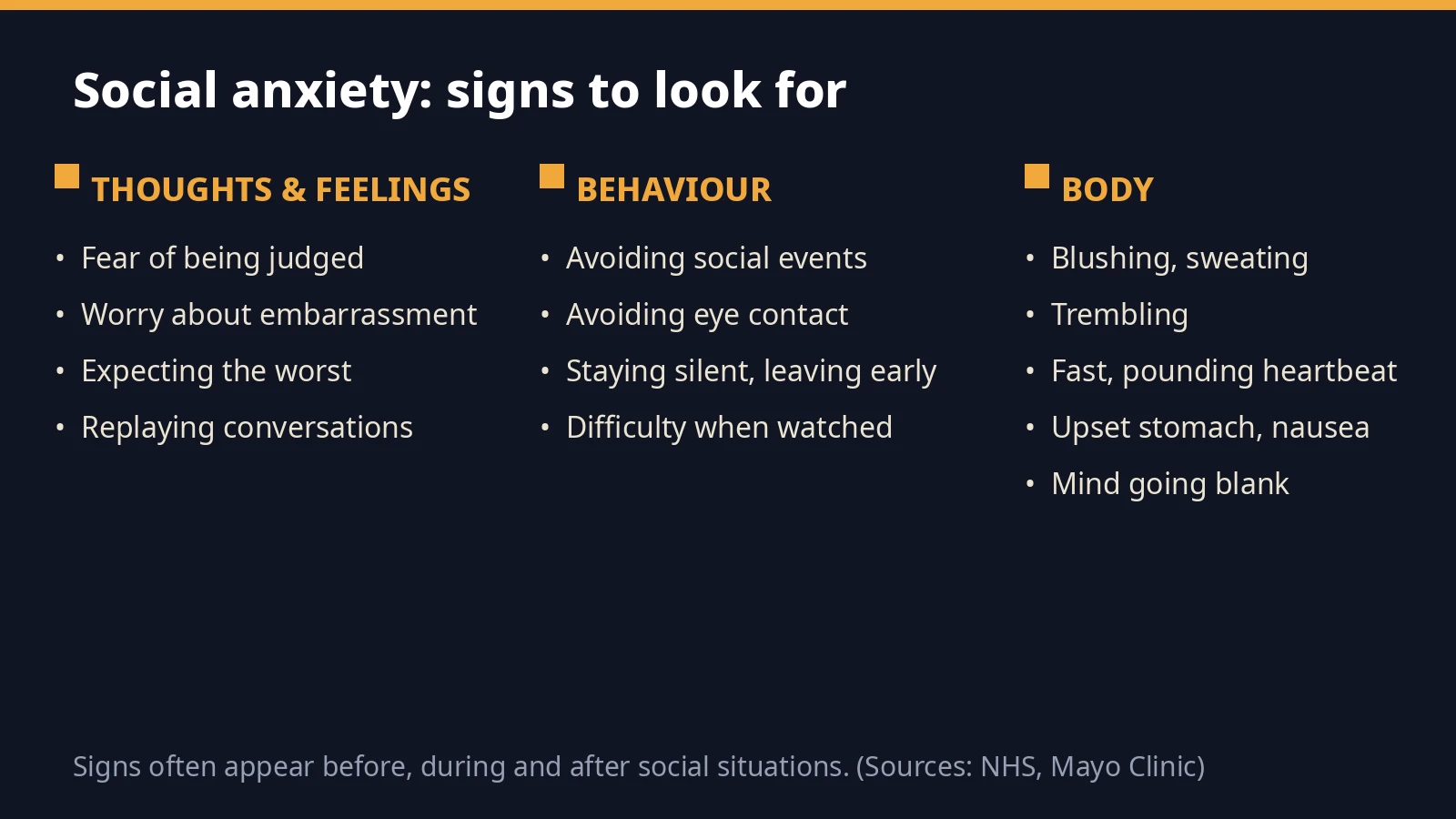
Everyone’s experience is different, and you may not notice every sign listed here. Symptoms often appear before, during and after social situations, and they can flare up when life brings extra change, stress or demands. Common signs include:
Emotional and behavioural signs
- Constant fear of situations in which you may be judged negatively, or worry about embarrassing or humiliating yourself
- Intense fear of interacting or talking with strangers, or fear that others will notice you look anxious
- Anxiety in anticipation of a feared event, followed by replaying the interaction afterwards and picking out flaws
- Avoiding social activities such as group conversations, parties, eating with company or speaking in public
- Finding it difficult to do things when others are watching, feeling as though you are being watched and judged all the time
- Fearing criticism, avoiding eye contact or having low self-esteem
- Expecting the worst possible consequences from a negative experience during a social situation
Physical signs
- Blushing, sweating or trembling
- A fast, pounding heartbeat
- Feeling sick or having an upset stomach
- Trouble catching your breath, dizziness or light-headedness
- Feeling that your mind has gone blank, or muscle tension
- Panic attacks, where you feel an overwhelming sense of fear and anxiety, usually only for a few minutes
Social anxiety can also affect sleep and self-esteem, and many people with social anxiety also experience other mental health difficulties such as depression, generalised anxiety disorder or panic disorder. If you notice these patterns, you do not have to face them alone — support is available, including through the get help now page.
What causes social anxiety?
Researchers do not know one single cause. Like many mental health conditions, social anxiety likely arises from a complex interaction of biological and environmental factors. Possible contributors include:
- Inherited traits and family history. Anxiety disorders tend to run in families, although it is not entirely clear how much of this is due to genetics and how much is due to learned behaviour. You are more likely to develop social anxiety if a biological parent or sibling has the condition.
- Brain structure. A structure in the brain called the amygdala may play a role in controlling the fear response. People who have an overactive amygdala may have a heightened fear response, causing increased anxiety in social situations.
- Environment and experiences. Social anxiety may be a learned behaviour. Some people develop significant anxiety after an unpleasant or embarrassing social situation, and children who experience teasing, bullying, rejection, ridicule or humiliation may be more prone to it. There may also be an association with parents who model anxious behaviour in social situations or who are more controlling or overprotective.
- Temperament. Children who are shy, timid, withdrawn or restrained when facing new situations or people may be at greater risk.
- New social or work demands. Meeting new people, giving a speech or making an important work presentation may trigger symptoms for the first time.
Social anxiety usually starts during the teenage years, according to the NHS, although it can sometimes start in younger children or in adults. It can build up gradually over time or appear quite suddenly, and you may not always know exactly why you feel anxious.
Social anxiety vs shyness: how they differ
Shyness and social anxiety are often confused, but they are not the same thing. The table below sets out the key differences.
| Shyness | Social anxiety |
|---|---|
| Feeling nervous or reserved in some social situations, especially with unfamiliar people | Intense, persistent fear of being judged, embarrassed or humiliated in social situations |
| Discomfort usually fades as you warm up to people | Fear does not go away and is felt before, during and after social situations |
| Does not usually stop you doing everyday activities | Interferes with relationships, daily routines, work, school or other activities |
| You can still take part, even if you feel awkward | Often leads to avoidance — skipping events, staying silent or leaving early |
As the Mind guide puts it, it is very common to feel nervous when meeting new people, but with social anxiety the symptoms are very intense, they might make it hard to interact with people at all, and it might be very hard to make the feelings go away. Comfort levels in social situations vary with personality and life experience — some people are naturally reserved and others are more outgoing — so being quiet or introverted on its own is not a sign of social anxiety.
Self-help and coping strategies
Self-help can help reduce social anxiety and may be a useful first step before trying other treatments. The following ideas, drawn from NHS and Mind guidance, may help:
- Understand your anxiety. Think about or write down what goes through your mind and how you behave in certain social situations. Keeping a diary can help you spot patterns, triggers and what makes you feel better.
- Break situations into smaller parts. Break down challenging situations into smaller steps and work on feeling more relaxed with each part, building up gradually rather than tackling the hardest situation first.
- Challenge unhelpful thoughts. Ask yourself whether you are focusing on the most likely outcome or just the worst-case scenario, and think of positives to socialising, not just negatives.
- Shift your focus outwards. Try to focus on what people are saying rather than just assuming the worst. Noticing details about other people or your surroundings, and grounding techniques such as noticing things you can see, hear, touch and smell, can help you feel more connected and less self-conscious.
- Try relaxation techniques. Breathing exercises for stress can help calm physical symptoms such as a racing heart or trembling.
- Take things slowly. Build up to interactions bit by bit, and notice small successes along the way.
- Look after the basics. Regular exercise, enough sleep and avoiding unhealthy substance use can help reduce the impact of symptoms. Alcohol and drugs may seem to help in the moment, but they do not address the cause of anxiety and can lead to longer-term problems.
It can also help to talk to someone you trust about how you feel. If social anxiety is making everyday life difficult, self-help alone may not be enough — and that is a good reason to talk to a doctor, not a failure.
Treatment options: an overview
A number of treatments are available for social anxiety. What suits you best depends on how much it affects your life, and a doctor or mental health professional can talk through the options with you. The main options described by the NHS are:
- Cognitive behavioural therapy (CBT) with a therapist. CBT helps you identify negative thought patterns and behaviours and change them. It can be done one-to-one, in a group, or with parents or carers for younger people. CBT is generally considered the best treatment, according to the NHS, but other treatments may help if it does not work or you do not want to try it.
- Guided self-help. This involves working through a CBT-based workbook or online course with regular support from a therapist.
- Antidepressant medicines. These are usually a type called a selective serotonin reuptake inhibitor (SSRI), such as escitalopram or sertraline. Some people need a combination of treatments, and medicines may be used alone or alongside therapy. A doctor can explain the benefits and possible side effects and help you decide.
Support groups and charities can also help. The NHS lists organisations including Anxiety UK, Mind and YoungMinds, and you can refer yourself directly to an NHS talking therapies service without a referral from a GP. Treatment takes time, and it may take a while to find the approach that works best for you — that is normal, so keep talking to your doctor about what is and is not helping.
When to see a doctor
It is a good idea to talk to a doctor if you think you have social anxiety, especially if it is having a big impact on your life. In particular, talk to a doctor if fear and avoidance of normal social situations cause embarrassment, worry or panic, or if anxiety is affecting your work, school, relationships or enjoyment of life. Anxiety can be harder to manage if you wait, so getting help early is a sensible step. A doctor will ask about your feelings, behaviours and symptoms, and may refer you to a mental health specialist for a full assessment and a discussion about treatments.
If you feel you need support right now, visit our get help now page for sources of help.
In an emergency call 911 (US), 999 (UK) or 112 (EU).
Sources
Frequently asked questions
What is social anxiety?
Social anxiety, also called social phobia, is a long-term and overwhelming fear of social situations where you worry about being judged, embarrassed or humiliated. Unlike occasional nervousness, the fear does not go away and can affect work, school, relationships and everyday activities. It usually starts in the teenage years, but help is available.
How is social anxiety different from shyness?
Shyness is feeling nervous or reserved in some social situations, and the discomfort usually fades as you warm up. Social anxiety is more intense and persistent: the fear is felt before, during and after social situations, it is hard to make go away, and it often leads to avoiding situations altogether. Being naturally quiet or introverted on its own is not a sign of social anxiety.
What causes social anxiety?
There is no single known cause. It likely arises from a mix of inherited traits, brain differences such as an overactive fear response, temperament, and environment — including teasing, bullying, rejection or embarrassing experiences. New social or work demands, such as public speaking or meeting new people, can also trigger symptoms for the first time.
What self-help steps can reduce social anxiety?
Helpful steps include keeping a diary to spot patterns and triggers, breaking challenging situations into smaller parts and building up gradually, challenging worst-case thoughts, focusing on what others are saying rather than assuming the worst, and trying breathing exercises for stress. Regular exercise, enough sleep and avoiding alcohol as a coping tool can also help.
What treatments are available for social anxiety?
The main options are cognitive behavioural therapy (CBT) with a therapist, guided self-help based on CBT with regular therapist support, and antidepressant medicines, usually a type called an SSRI. CBT is generally considered the best treatment, but other options may help if it does not work or you do not want to try it, and some people need a combination.
When should I talk to a doctor about social anxiety?
Talk to a doctor if you think you have social anxiety, especially if it is having a big impact on your life — for example, if fear and avoidance of normal social situations cause embarrassment, worry or panic, or affect your work, school or relationships. A doctor can refer you to a mental health specialist for assessment and treatment options.
Sources
- NHS www.nhs.uk
- Mayo Clinic www.mayoclinic.org
- Mind www.mind.org.uk
- Cleveland Clinic my.clevelandclinic.org

Try the tool
How have you felt over the last 2 weeks?
The PHQ-9 and GAD-7 that GPs use. Private, about 3 minutes.
Start the self-check