What Is Anhedonia? When Nothing Feels Enjoyable Any More
Nothing feels enjoyable any more — not friends, food, music or sex. That flat, empty feeling has a name: anhedonia. Here is what it is, why it happens and how people get better.
- Written by
- Health Daily Advice
- Published
- Reading time
- 6 minutes
- Sources
- 6 cited

In this guide
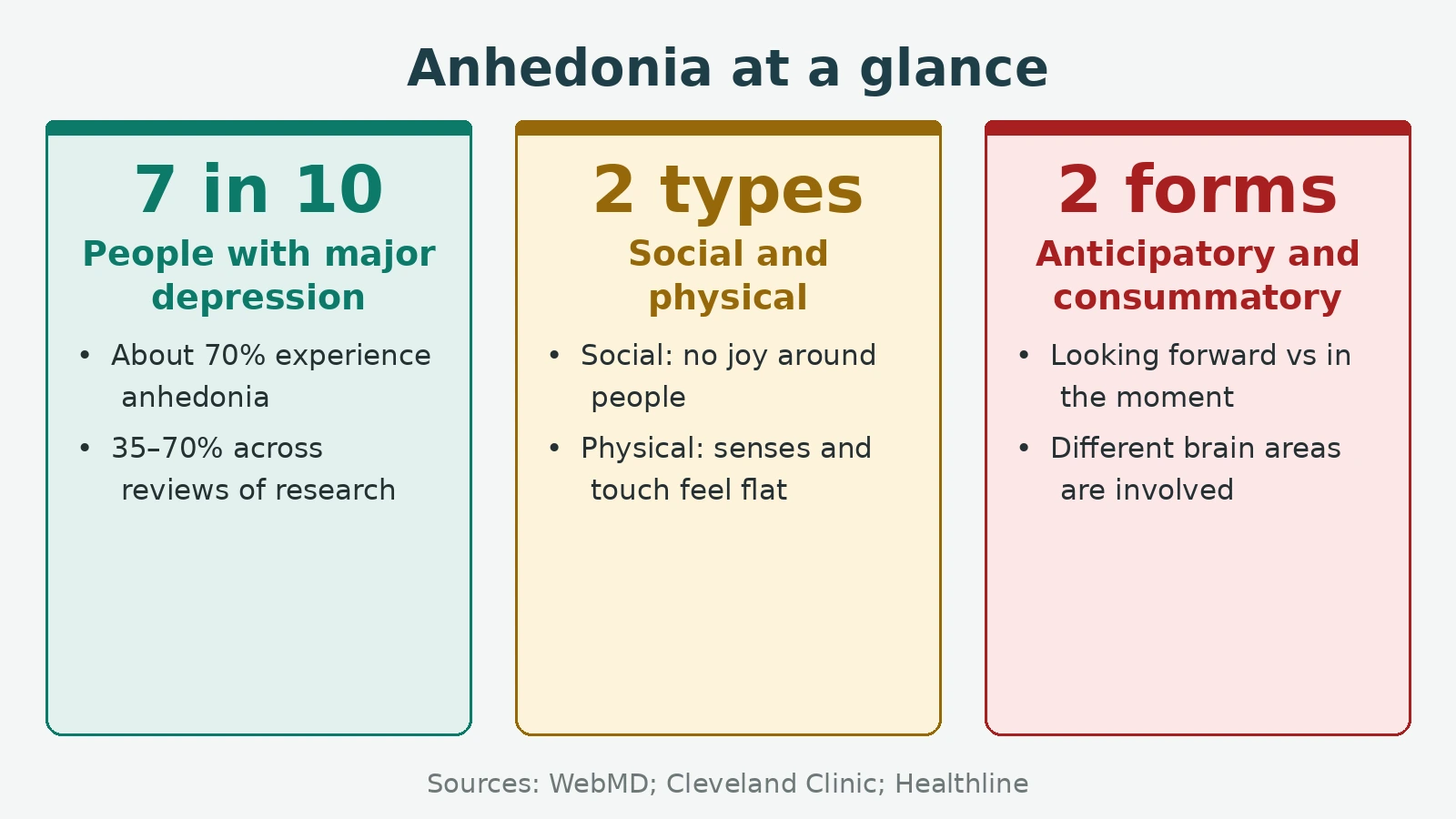
Anhedonia is the loss of interest or pleasure in things that once made you happy — friends, hobbies, food, music, even sex. It is not a diagnosis in itself but a symptom, most often of depression, and about 7 in 10 people with major depression experience it. It can be treated, and it can lift.
What does anhedonia feel like?
People with anhedonia often describe an emptiness where their feelings should be — as if a dark cloud were blocking the sunlight. Things that used to bring joy can feel flat, muted or dull, and even good moments may not land. It can show up as numbness, boredom, apathy or a low, negative mood, and it can make planning anything feel pointless.
It is not the same for everyone, and it can change over time. For some people it is a passing phase after a stressful event such as a bereavement. When it lasts for weeks and starts to affect daily life, it may be a sign of a mental health condition such as depression.
The two main types
Doctors usually describe two main kinds of anhedonia. Social anhedonia is losing pleasure in being around people: friends feel like an effort, family gatherings hold no appeal, and staying home feels easier. Physical anhedonia is losing pleasure in sensory things: a hug can feel empty rather than comforting, favourite foods can taste bland, and music can leave you cold.
Researchers also split anhedonia another way. Anticipatory anhedonia is losing the excitement of looking forward to something — you know an event should be fun, but you feel nothing about it in advance. Consummatory anhedonia is losing pleasure during the activity itself. Brain imaging suggests the two involve different parts of the reward system, and knowing which one dominates can help shape treatment.
Anhedonia is not the same as apathy
Anhedonia and apathy are often confused, and they can occur together, but they are different. Anhedonia is about pleasure: you may still value your relationships and goals, but you cannot feel the reward in them. Apathy is about motivation and energy: you do not want to do anything at all. It is also different from social anxiety, where people avoid others because they fear how an encounter will go — with anhedonia, they avoid it because it seems to hold no pleasure or point.
What lies behind anhedonia?
Anhedonia is most often a symptom of depression, and it is one of depression’s two core features, alongside persistent low mood. It is also one of the hardest symptoms to treat, and a significant risk factor for long-term depression. But depression is not the only cause: anhedonia can also appear in schizophrenia, bipolar disorder, post-traumatic stress disorder, substance use disorders, eating disorders, chronic pain, traumatic brain injury, and neurodegenerative conditions such as Parkinson’s and Alzheimer’s disease.
What happens in the brain is not fully understood. Research points to the brain’s reward circuitry — areas such as the ventral striatum and the ventral tegmental area, which use dopamine to signal reward. In depression, the brain’s response to rewards seems to weaken: in one laboratory experiment, people showed less brain activity in response to winning money when they were depressed than when they were not. Experts stress that this is an area of ongoing research with few studies, not a settled explanation.
How common is it?
About 7 in 10 people with major depressive disorder experience anhedonia, and some reviews put the figure at between 35% and 70% of people with the condition. It also shows up well beyond depression: an estimated 35% of people with epilepsy, nearly 20% of people who have had a stroke, and about 25% of people with chronic pain experience it. No reliable figure exists for how common anhedonia is in the general population.
How is anhedonia assessed?
Anhedonia is not something you can diagnose yourself — only a health professional can work out what is causing it. A doctor will usually start by asking about your mood and symptoms, and may arrange blood tests to check for things such as low vitamin D or thyroid problems, along with a physical examination.
Doctors sometimes use questionnaires to measure it. The best known is the Snaith-Hamilton Pleasure Scale, a 14-question test covering pleasure from socialising, eating and drinking, and hobbies. Others, such as the Temporal Experience of Pleasure Scale and the Dimensional Anhedonia Rating Scale, help tell anticipatory anhedonia apart from consummatory anhedonia.
Treating anhedonia
There is no treatment for anhedonia itself. Treatment means finding and treating the underlying condition — most often depression — and that usually involves a combination of therapy and, where appropriate, medicine.
One of the most effective approaches is behavioural activation, a step-by-step therapy that helps people get back to activities they once enjoyed, scheduling each small step that leads up to the activity. Talking therapies such as cognitive behavioural therapy can also help, by challenging the thoughts that keep someone from feeling pleasure. Newer approaches focus on positive emotions and on meaning, identity and social connection.
Medicines are usually aimed at the underlying condition rather than at anhedonia directly. Standard antidepressants do not always help with anhedonia, and some experts think they can blunt emotions and make it worse, so a doctor may try a different medicine or approach. For severe cases that do not respond, options can include ketamine treatment, transcranial magnetic stimulation or electroconvulsive therapy — all given under specialist care.
The outlook is hopeful: anhedonia is not necessarily permanent. With treatment it can go into remission, though it may come and go over time. Sticking with the treatment plan, even after starting to feel better, lowers the chance of it returning.
Small steps that can help day to day
Alongside professional treatment, small daily steps can help rebuild the habit of pleasure — though they are not a substitute for getting help. Start small and go at your own pace: a short walk, a favourite meal, a visit to a park or library, or time spent on a creative hobby such as painting, music or writing. You may not feel much better straight away, and that is normal; the idea is to keep showing up for the activity while the feeling catches up.
Movement helps: even ten minutes of walking or stretching a day is a good start, and exercising with other people adds social connection. So does paying deliberate attention to small pleasures — noticing what you can see, hear, taste, smell and touch, and writing down things you are grateful for. A regular sleep routine matters too: aim for seven to nine hours a night, and try to keep a daily schedule that gets you out of bed and out of the house.
When to see a doctor
Talk to your doctor if you have lost pleasure in things you used to enjoy and it has lasted for weeks, if it is affecting your daily life, relationships or work, or if it comes with other signs of depression such as a sad mood lasting two weeks or more, changes in sleep or appetite, or difficulty concentrating. Early treatment makes a real difference.
If you are having thoughts of harming yourself or suicide, do not wait. In the US, call or text 988 to reach the Suicide and Crisis Lifeline, which is open around the clock. In the UK and Ireland, call Samaritans free on 116 123, any time of day or night. You can also find support and crisis resources at Health Daily Advice: Get Help Now. In an emergency call 911 (US), 999 (UK) or 112 (EU).
Frequently asked questions
What is anhedonia?
Anhedonia is the loss of interest or pleasure in things that once made you happy — friends, hobbies, food, music or sex. The word comes from Greek and means 'without pleasure'. It is not a diagnosis in itself but a symptom, most often of depression, though it can also appear in other mental health conditions and in Parkinson's disease, chronic pain and after a brain injury.
Is anhedonia the same as depression?
No, but they are closely linked. Anhedonia is one of the two core features of depression, alongside persistent low mood, and about 7 in 10 people with major depression experience it. It can also appear on its own, without the sadness or hopelessness of depression, and in other conditions such as schizophrenia, bipolar disorder, PTSD and Parkinson's disease. Only a health professional can work out what is causing it.
What causes anhedonia?
The exact causes are not fully understood, and research is ongoing. It is most often a symptom of depression, but it can also be caused by schizophrenia, bipolar disorder, PTSD, substance use disorders, eating disorders, chronic pain, traumatic brain injury and neurodegenerative diseases. Studies point to the brain's reward circuitry and the chemical messenger dopamine, but this is not a settled explanation.
Can anhedonia go away?
Yes, it can. Anhedonia is not necessarily permanent, and with treatment it can go into remission, though it may come and go over time. Treating the underlying condition — most often depression — is the key, and therapy such as behavioural activation is one of the most effective approaches. Sticking with the treatment plan even after feeling better lowers the chance of it returning.
How is anhedonia treated?
There is no treatment for anhedonia itself, so doctors treat the underlying condition. That often means therapy, such as cognitive behavioural therapy or behavioural activation, which helps people gradually return to activities they once enjoyed. Medicines may be used for the underlying condition, though standard antidepressants do not always help anhedonia. Severe cases may be treated with ketamine, transcranial magnetic stimulation or electroconvulsive therapy.
When should I see a doctor about anhedonia?
See a doctor if you have lost pleasure in things you used to enjoy for weeks, or if it is affecting your daily life, relationships or work. Also seek help if it comes with a sad mood lasting two weeks or more, changes in sleep or appetite, or difficulty concentrating. If you are having thoughts of suicide or self-harm, reach out right away — call or text 988 in the US or Samaritans on 116 123 in the UK.
Sources
- Cleveland Clinic: Anhedonia — What It Is, Causes, Symptoms & Treatment my.clevelandclinic.org
- WebMD: Anhedonia — Symptoms, Causes, Treatment www.webmd.com
- Healthline: Anhedonia — Symptoms, Treatment, and More www.healthline.com
- WebMD: The Overlooked Symptom That Makes Depression So Hard to Treat (28 July 2025) www.webmd.com
- HelpGuide: The Symptoms, Causes and Treatment of Anhedonia www.helpguide.org
- Samaritans: Talk to us on the Phone www.samaritans.org

Try the tool
How have you felt over the last 2 weeks?
The PHQ-9 and GAD-7 that GPs use. Private, about 3 minutes.
Start the self-check