Fear of Failure: Why It Happens and How to Overcome It
Fear of failure, or atychiphobia, is an intense dread of failing that can stop you taking exams, applying for jobs or trying anything new. Here is why it happens and what actually helps.
- Written by
- Health Daily Advice
- Published
- Reading time
- 7 minutes
- Sources
- 10 cited

In this guide
Fear of failure — also called atychiphobia — is an intense, persistent dread of failing that goes beyond ordinary nerves. It can make you avoid exams, interviews and new opportunities, and it often brings anxiety, procrastination and physical symptoms such as a racing heart. It is a type of specific phobia, and talking therapies such as CBT can help.
What is fear of failure?
Fear of failure means feeling intense anxiety at the thought of failing — before an exam, a job interview, a presentation, or even a relationship or a new project. The clinical name is atychiphobia, from the Greek word atyches, meaning “unfortunate”, according to the Cleveland Clinic.
It is classed as a specific phobia, a type of anxiety disorder. It is not a separate diagnosis in the DSM-5, the manual psychiatrists use: a doctor would diagnose it under the umbrella of specific phobia, Medical News Today explains. That does not make it any less real. A normal fear of failing can motivate you — a student who worries about an exam might plan a study schedule. It becomes a phobia when the fear is extreme, out of proportion, persistent, and leads to behaviour that works against you, such as avoiding the thing you fear altogether.
Fear of failure is not the same as perfectionism. Perfectionism is an intense focus on being flawless and on success. Atychiphobia is a focus on failure itself, with panic, worry or dread about what could happen if things go wrong. Extreme perfectionism can, however, feed the fear: when you set impossibly high standards, even a small mistake can feel catastrophic.
How common is fear of failure?
There is no reliable figure for atychiphobia specifically — the Cleveland Clinic notes that many people keep it to themselves or do not recognise it as a phobia. What is known is that specific phobias in general are common: about 1 in 10 American adults and about 1 in 5 teenagers will deal with a specific phobia disorder at some point in their lives, according to the Cleveland Clinic.
For a specific phobia to be diagnosed, the symptoms must last 6 months or longer, always occur with the feared trigger, and interfere with daily functioning, Healthline reports. In other words, it is not the occasional bout of nerves before a big day — it is a pattern that keeps shaping your choices.
Why are some people afraid of failing?
There is rarely a single cause. Research and clinical guidance point to several factors that often combine:
- A painful past failure. A distressing failure with important consequences — missing out on a job, failing a key exam — can seed the fear, particularly if it was humiliating.
- Upbringing. Growing up where failure was treated as unacceptable, or where love and approval felt conditional on performance, can teach a child that failing is dangerous. Watching a parent who fears failure can pass the same fear on.
- Perfectionism and unrealistic expectations. Impossibly high standards turn ordinary setbacks into proof that you are not good enough.
- Low self-esteem. People who already feel “not good enough” are more prone to dread being found out.
- Family history. Phobias, anxiety and depression running in the family increase the likelihood, although the exact role of genetics is not fully understood.
- Controlling environments. A 2019 study of athletes, cited by Medical News Today, found that a controlling coaching style was linked to greater fear of failure, while coaching that encouraged autonomy was not.
- Other mental health conditions. Anxiety disorders, depression and eating disorders can co-exist with, or contribute to, fear of failure.
The NHS adds general risk factors for phobias: a frightening experience in childhood, learning the fear from family or friends, embarrassment about a panic reaction, and a family history of anxiety disorders.
What are the signs of fear of failure?
The signs fall into three groups, and most people notice a mix of them.
Mental and emotional signs
- Constant “what if I fail?” thoughts, and catastrophising small mistakes
- Intense anxiety about being judged by others, and panic when thinking about possible failure
- Shame, embarrassment, self-doubt and harsh negative self-talk
- Feeling detached from yourself, powerless, or as though you have lost control
- Low mood, pessimism, irritability or anger
Behavioural signs
- Procrastination — putting off a task precisely because it feels challenging
- Avoiding situations where failure is possible: exams, interviews, applications, new opportunities
- Self-sabotage, such as not starting a big project so that failing feels less personal
- Over-preparing without ever launching, or giving up at the first setback
- Refusing constructive criticism or help, and struggling to make decisions
The link with procrastination is backed by research: a 2020 study found a correlation between students’ fear of failure and their tendency to procrastinate, and a 2018 study of more than 1,000 undergraduates in China found that the students who procrastinated the most were also more likely to have a higher fear of failure, lower self-esteem, or both, according to Medical News Today.
Physical signs
- Faster heart rate or palpitations, and faster, shallower breathing
- Sweating, trembling or shaking, and muscle tension
- Dizziness or lightheadedness, nausea or digestive upset
- Chest tightness or pain, and hot or cold flashes
- Panic attacks — the NHS lists a strong fear of fainting, losing control or dying during a panic attack
How fear of failure affects work, school and relationships
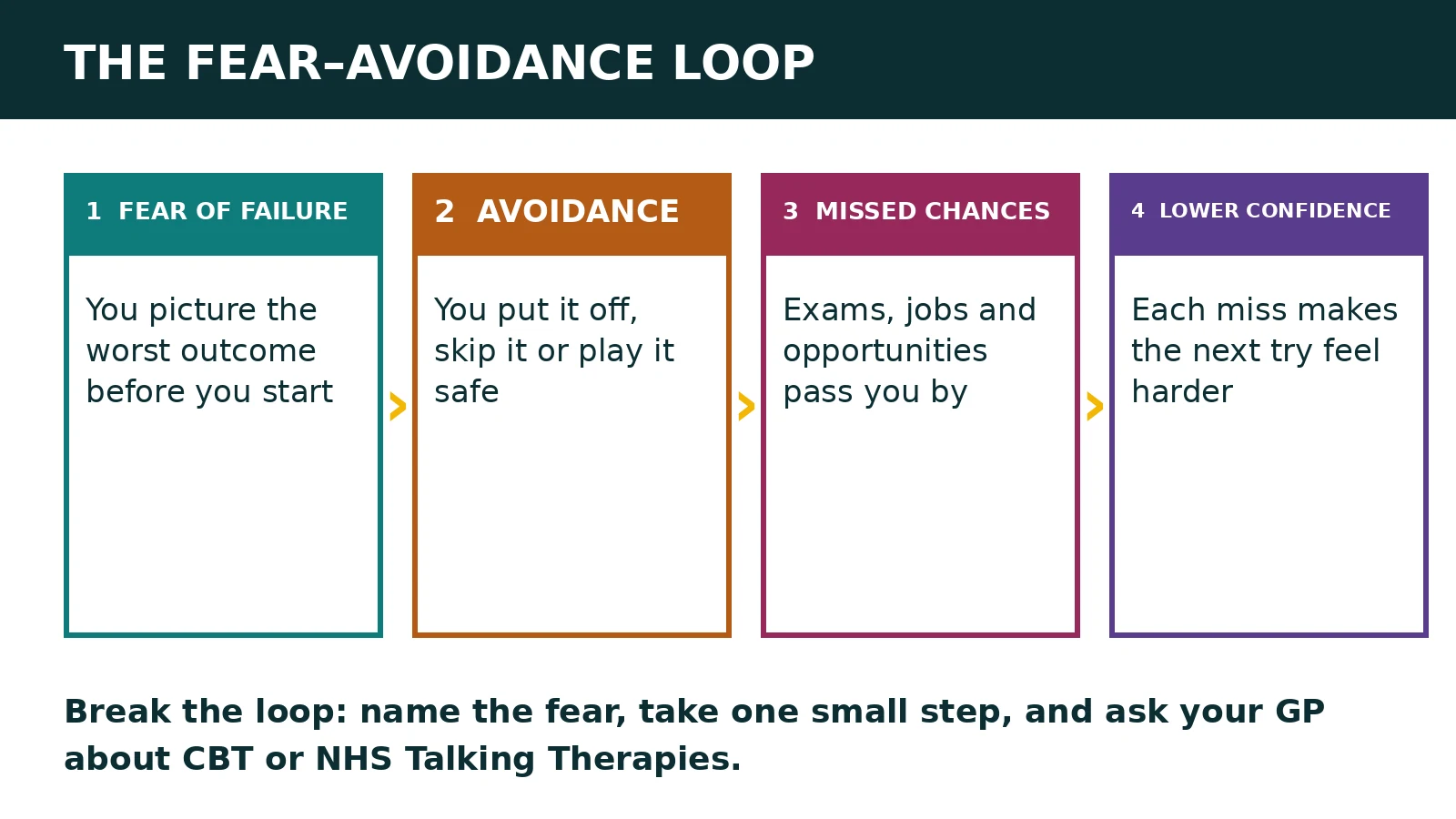
The cruel part of this fear is that it often creates the very outcome it dreads. The Cleveland Clinic gives a simple example: if you are so scared of failing a test that you refuse to take it, you may end up failing the whole class.
At work, it can mean avoiding new responsibilities, staying quiet in meetings, turning down promotions and underperforming in tasks you could do well. At school, it can mean refusing tests, avoiding challenging courses, poor grades or even dropping out. In relationships, fear of judgement or rejection can make it hard to form and keep close connections, and some people withdraw from social situations altogether.
Over time, the pattern narrows your life: missed opportunities, lower quality of life, and a growing sense of shame that feeds the fear further. In children and teenagers, fear of failure most often centres on school performance, and it is most common in older children aged 7 to 16, Healthline reports.
How to overcome fear of failure
Mild fear of failure can sometimes be eased with practical changes alone, Healthline notes. But when the fear is persistent and limiting, the evidence points to talking therapy — and the sooner you start, the more effective it tends to be.
Cognitive behavioural therapy (CBT)
CBT is the main talking therapy for phobias. A therapist helps you notice and challenge the thoughts that drive the fear — for example, the assumption that one failure proves you are a failure — and to see setbacks as opportunities for learning instead. The Cleveland Clinic explains that CBT also teaches coping strategies such as deep breathing and meditation for the moments when anxiety spikes.
Exposure therapy
Exposure therapy is the primary treatment for specific phobias, according to the Mayo Clinic. It means facing the feared situation gradually, in a safe and supportive setting — starting with simply thinking about it, then working up to the real thing — so you learn that the feared outcome either does not happen or is something you can cope with. The Mayo Clinic describes it as a graded ladder that builds a sense of mastery and confidence step by step.
Medication
Medication is not usually the first option for a phobia. Beta blockers, which blunt the physical effects of adrenaline such as a racing heart and shaking, and sedatives may be used short term for a specific situation, such as before a presentation. Antidepressants may help if depression or anxiety is present alongside the fear. Any medication should be discussed with a doctor.
Practical steps you can take yourself
- Name the fear. Write down exactly what you are afraid will happen, and what evidence there is for and against it. Most feared outcomes are vaguer — and less likely — than they feel.
- Shrink the step. Break a daunting task into the smallest first action: opening the application form, writing one paragraph, booking the appointment.
- Set process goals, not just outcome goals. Aim to prepare for 30 minutes a day, rather than to “ace the exam”. You control the process; you never fully control the outcome.
- Reframe setbacks as information. A failed attempt tells you what to adjust next time. Treat it as data, not as a verdict on you.
- Look after the basics. Regular exercise, sleep and cutting back on caffeine all help keep anxiety lower, and the NHS suggests breathing exercises, talking to someone you trust and joining a self-help group.
- Talk about it. Telling a friend, a colleague or a mentor that you are afraid of failing often shrinks the fear — and you may find they feel the same way.
When to see a doctor
Speak to your GP if the fear is affecting your daily life — your studies, work, relationships or ability to reach your goals — or if it has lasted 6 months or more. The same applies if you have panic attacks, persistent shame or low mood alongside the fear, or if you are missing out on important opportunities because of it. Your GP can refer you to a mental health professional. In England, you can also self-refer directly to NHS Talking Therapies without a GP referral.
Fear of failure can also be a symptom of other conditions, such as generalised anxiety disorder, social anxiety disorder, obsessive compulsive disorder or depression, so a professional assessment matters — the right help depends on getting the full picture.
If you are struggling with your mental health right now, support is available — visit Health Daily Advice: Get Help Now for helplines and resources.
In an emergency call 911 (US), 999 (UK) or 112 (EU).
Frequently asked questions
Is fear of failure a real phobia?
Yes. It is called atychiphobia and is classed as a specific phobia, a type of anxiety disorder. It is not a separate diagnosis in the DSM-5 — a doctor would diagnose it as a specific phobia. It becomes a phobia when the fear is extreme and persistent, and leads to avoidance that interferes with daily life.
What causes fear of failure?
There is rarely one cause. Common factors include a painful past failure, growing up where failure felt unacceptable, perfectionism, low self-esteem, a family history of anxiety, and controlling environments. Underlying anxiety or depression can also contribute. The fear is often learned early in life and reinforced each time avoidance brings relief.
How do I stop being afraid of failure?
Start small: name exactly what you fear, break the task into the smallest first step, and set goals about the process rather than the outcome. Talking therapies work best for persistent fear — CBT helps you challenge unhelpful thoughts, and exposure therapy lets you face feared situations gradually until they lose their power.
Can fear of failure be cured?
Many people overcome it, especially with the right help. Specific phobias respond well to CBT and exposure therapy, and mild fear can sometimes be eased with practical steps and lifestyle changes alone. Recovery is usually gradual — confidence builds as you collect small successes — rather than overnight.
When should I get help for fear of failure?
See your GP if the fear has lasted 6 months or more, affects your work, studies, relationships or goals, or comes with panic attacks, persistent low mood or shame. In England you can self-refer to NHS Talking Therapies without a GP referral. Early help tends to work better.
Is fear of failure the same as perfectionism?
No, although they often go together. Perfectionism is an intense focus on being flawless and on success. Fear of failure is a focus on failure itself, with dread about what could go wrong. Extreme perfectionism can feed the fear, because impossibly high standards make any small mistake feel catastrophic.
Sources
- Cleveland Clinic: Fear of Failure (Atychiphobia) my.clevelandclinic.org
- Healthline: Atychiphobia: Understanding Fear of Failure www.healthline.com
- Medical News Today: Fear of failure (atychiphobia): Symptoms and treatment www.medicalnewstoday.com
- Mayo Clinic: Specific phobias – Symptoms and causes www.mayoclinic.org
- Mayo Clinic: Specific phobias – Diagnosis and treatment www.mayoclinic.org
- Mind: Phobias www.mind.org.uk
- NHS: Phobias www.nhs.uk

Try the tool
Is it a fear, or a phobia?
Look up the name of 45 fears and take a 5-question check.
Open the phobia finder