What Is Agoraphobia? Symptoms, Causes and Treatment
Agoraphobia is more than a fear of going outside: it is the fear of being trapped somewhere you cannot escape. Here is what it is, why it happens, and how treatment can help you get your life back.
- Written by
- Health Daily Advice
- Published
- Reading time
- 7 minutes
- Sources
- 9 cited

In this guide
Agoraphobia is an anxiety disorder that makes you fear places or situations where escape might be difficult or help might not be available if panic strikes. Crowds, public transport, open spaces and even leaving home can trigger intense anxiety, so many people start avoiding them. It is treatable, and most people improve with talking therapy and gradual exposure.
What is agoraphobia?
Agoraphobia is a type of anxiety disorder. The NHS describes it as a fear of being in situations where escape might be difficult or help would not be available if things go wrong. The fear is much bigger than the actual risk, which is what makes it a phobia rather than ordinary caution.
Many people think agoraphobia simply means never leaving the house. For some people that is true, but it is only part of the picture. Mind calls it a complex phobia: it is not focused on one single thing, like spiders or flying, but on a whole set of situations that share the same worry — being trapped, helpless or embarrassed if something goes wrong.
That worry often centres on having a panic attack in public. Some people with agoraphobia have panic disorder as well, but not everyone does. According to the MSD Manual, 30 to 50% of people with agoraphobia also have panic disorder. Others fear different things happening — falling ill, fainting, being sick, or being caught in a place they cannot leave quickly.
What situations trigger agoraphobia?
Everyone’s triggers are different, but the Mayo Clinic lists the most common ones:
- Leaving home alone
- Crowds or waiting in a queue
- Enclosed spaces, such as cinemas, lifts or small shops
- Open spaces, such as car parks, bridges or shopping centres
- Using public transport, such as a bus, train or plane
- Being too far away from home
Some people can go out only with a trusted person beside them. Others can go out alone but only at certain times of day, only to certain places, or only if they carry supplies that help them feel safe. In severe cases, a person may not be able to leave home at all.
Symptoms of agoraphobia
The main symptom is fear of certain situations because you worry something will go wrong. That fear brings thoughts, physical symptoms and changes in behaviour.
Physical symptoms
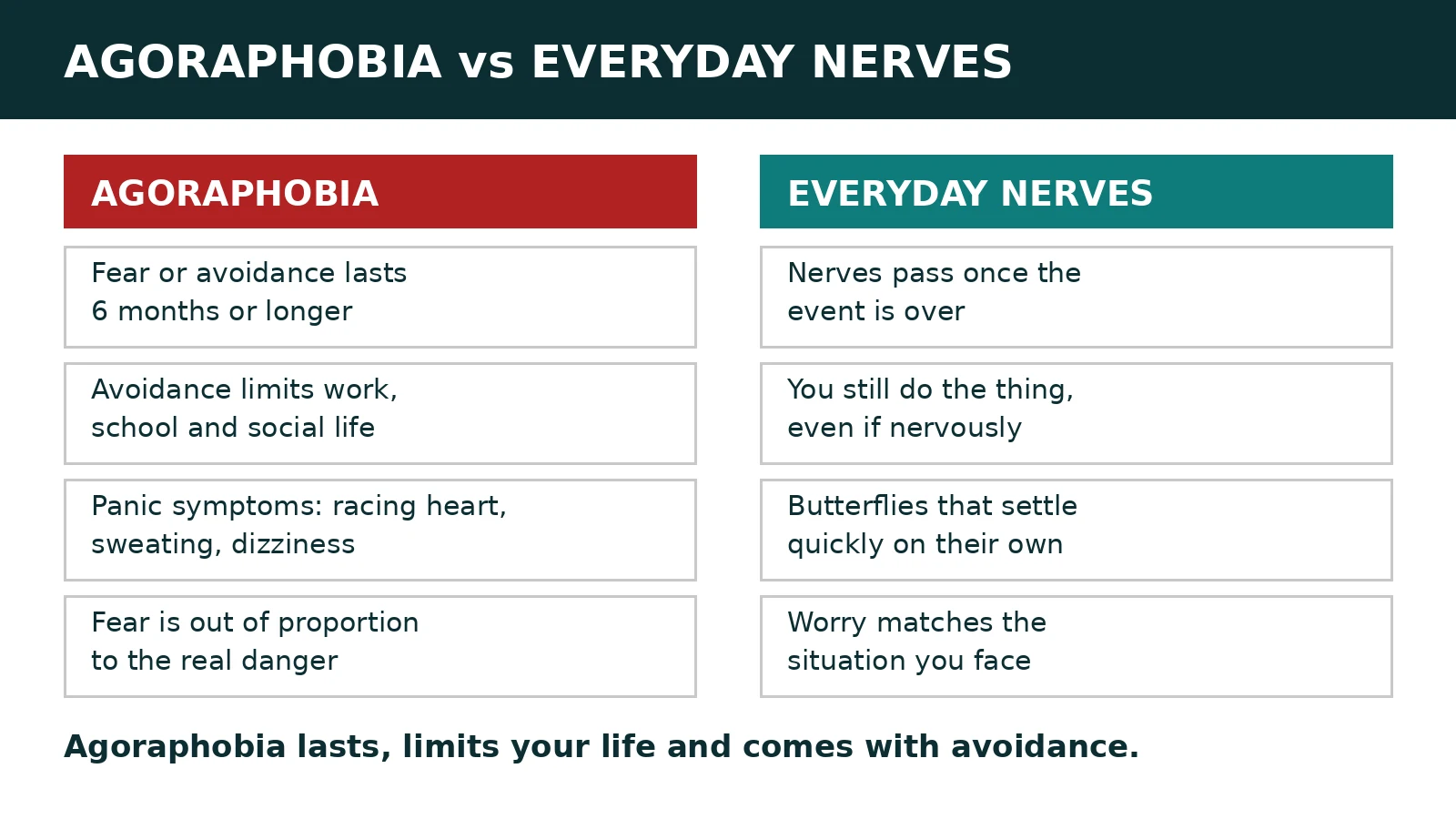
When you are in a feared situation, your body can react as if you are in danger. The NHS lists symptoms including a faster heartbeat, breathing very quickly, chest pain, feeling lightheaded or dizzy, feeling sick or being sick, feeling hot or sweaty, shaking or trembling, and stomach problems such as stomach ache or diarrhoea. These are the same symptoms as a panic attack, which is common in people with agoraphobia.
Thoughts and feelings
You may feel you are losing control, or that something bad is about to happen. Thoughts such as “people will laugh at me”, “nowhere is safe” or “I will not be able to cope” are common, according to Mind. The dread can start hours before you even leave the house, and the relief of staying in can make the fear stronger next time.
Behaviour and avoidance
Avoidance is the behaviour that holds agoraphobia in place. You might order groceries online instead of going to the supermarket, turn down invitations, or only travel with a companion. These are sometimes called safety behaviours. They feel helpful in the moment, but they stop you learning that the feared situation is survivable, so the fear tends to grow and your world tends to shrink.
Agoraphobia and panic attacks
Panic attacks and agoraphobia often travel together. A panic attack is a sudden feeling of extreme fear that reaches a peak within a few minutes, bringing a rapid heart rate, trouble breathing, chest pain, sweating, shaking and a fear of dying. After one attack in a public place, it is natural to dread going back there — and that dread can spread to other places too.
Agoraphobia is more common than many people realise. The US National Institute of Mental Health (NIMH) estimates that 0.9% of US adults had agoraphobia in the past year, and 1.3% experience it at some point in their lives. The average age it starts is 20, and it usually begins in the late teens or early adult years, though it can appear at any age. It is more common in women than in men.
What causes agoraphobia?
There is no single cause. The NHS says agoraphobia does not usually have an obvious cause, but several things can raise the chances of developing it:
- Having another anxiety disorder, such as panic disorder or other phobias
- A painful long-term health condition, such as arthritis
- Close relatives with anxiety disorders, depression or other mental health conditions
- A history of stressful or traumatic experiences, such as domestic violence, child abuse or bullying
Mayo Clinic adds that biology, personality, stress and learning experiences can all play a part, and that responding to panic attacks with a great deal of fear and avoidance makes agoraphobia more likely. Sometimes it builds up gradually; sometimes it comes on very suddenly after a frightening experience.
How is agoraphobia diagnosed?
Speak to your GP if you think you may be affected. They will ask about your worries and physical symptoms, and it helps to be as honest as you can, even if talking about your feelings is difficult. A diagnosis usually involves fear or avoidance that has lasted six months or longer, is out of proportion to the real danger, and causes distress or problems with work, relationships or daily life. Your GP may refer you to a psychiatrist if the picture is unclear.
How is agoraphobia treated?
Treatment can help you manage your symptoms, although it may take time. The main treatments a GP may offer, according to the NHS, are talking therapies — usually cognitive behavioural therapy (CBT) — medicines for anxiety, usually a type of antidepressant called an SSRI, and referral to a community mental health team. A GP will usually suggest talking therapy before prescribing medicine.
CBT is the most common treatment. It looks at the connection between your thoughts and your actions, and helps you build more helpful thinking patterns. It is normally combined with exposure therapy: facing feared situations a little at a time, in a planned order, until each one feels less frightening. This is called graded exposure. In the UK, if you are 18 or over, you can refer yourself directly to an NHS Talking Therapies service without seeing a GP first.
Coping strategies that can help
There are things you can try alongside treatment:
- Build tolerance in small steps. Make a list of feared situations, from the easiest to the hardest, and work through it slowly, repeating each step until it no longer makes you anxious. Having someone with you at first can help.
- Challenge your thoughts. Ask yourself whether you are imagining the worst case or the most likely outcome, and whether the thought is a fact or a fear.
- Learn to manage panic. Slow, deep breathing and focusing on something visible and non-threatening can help during a panic attack.
- Look after your body. Regular exercise, good sleep and regular meals can reduce anxiety. The NHS advises cutting back on caffeine and avoiding alcohol, cigarettes and drugs to relieve anxiety, as these can make mental health worse.
- Talk about it. Telling a friend, family member or counsellor how you feel can help. Charities such as Mind, Rethink Mental Illness and Anxiety UK offer information and support, and Samaritans can be reached on 116 123.
If you find it hard to face your triggers at all, a professional such as a GP or therapist can help you get started. Some NHS trusts offer workbooks for graded exposure that you can download or ask your GP about.
Agoraphobia vs social anxiety
Agoraphobia and social anxiety can look similar — both can make you avoid going out — but the fear is different. In social anxiety, the fear is about being judged or embarrassed by other people. In agoraphobia, the fear is about being trapped or unable to get help if something goes wrong. The two can overlap, and both are treatable with similar talking therapies.
When to see a doctor
Get medical help if you have the symptoms of agoraphobia and it is affecting your life, or if treatments you have tried are not working. Contact your GP if you think you might have agoraphobia, or if you have been diagnosed and treatment is not helping. In the UK, you can also refer yourself directly to NHS Talking Therapies. If you feel you might act on thoughts of harming yourself, call Samaritans on 116 123 or 999 in an emergency. You can also find support and crisis resources at https://www.healthdailyadvice.com/get-help-now/.
In an emergency call 911 (US), 999 (UK) or 112 (EU).
Frequently asked questions
What is agoraphobia?
Agoraphobia is an anxiety disorder where you fear places or situations where escape might be difficult or help might not be available if you panic. Crowds, public transport, open spaces and leaving home alone are common triggers. The fear leads to avoidance, which can shrink your daily life. It is treatable, usually with talking therapy and gradual exposure.
Is agoraphobia just a fear of leaving the house?
No. Some people with agoraphobia cannot leave home at all, but many can go out with limits — only with a companion, only to certain places, or only at certain times. The core fear is being trapped or unable to get help if something goes wrong, not the outdoors itself. It is a complex phobia that affects people differently.
What causes agoraphobia?
There is no single cause. It often develops after panic attacks, when the fear of another attack leads to avoiding the places where attacks happened. Other risk factors include other anxiety disorders, a family history of anxiety or depression, stressful or traumatic experiences, and a long-term health condition. Biology, personality and stress can all play a part.
Can agoraphobia be cured?
Many people improve a great deal with treatment, though recovery takes time. The most effective treatment is cognitive behavioural therapy combined with gradual exposure to feared situations. Some people also benefit from an SSRI antidepressant. With the right help, most people can widen their world again, though some continue to manage symptoms long term.
How is agoraphobia different from social anxiety?
In social anxiety, the fear is about being judged or embarrassed by other people. In agoraphobia, the fear is about being trapped or unable to get help if something goes wrong, such as a panic attack. The two can overlap, and both are treated with similar talking therapies.
When should I get help for agoraphobia?
See a GP if fear or avoidance is affecting your work, relationships or daily life, or if self-help is not working. In the UK, adults can also refer themselves directly to NHS Talking Therapies. If you feel you might act on thoughts of harming yourself, call Samaritans on 116 123 or 999 in an emergency.
Sources
- NHS: Agoraphobia overview www.nhs.uk
- NHS: Agoraphobia www.nhs.uk
- Mayo Clinic: Agoraphobia — symptoms and causes www.mayoclinic.org
- Mind: Agoraphobia www.mind.org.uk
- NIMH: Agoraphobia www.nimh.nih.gov
- MSD Manual: Agoraphobia www.msdmanuals.com

Try the tool
Is it a fear, or a phobia?
Look up the name of 45 fears and take a 5-question check.
Open the phobia finder