What Is Arachnophobia? Fear of Spiders Explained
- Written by
- Health Daily Advice
- Published
- Reading time
- 6 minutes
- Sources
- 9 cited
In this guide
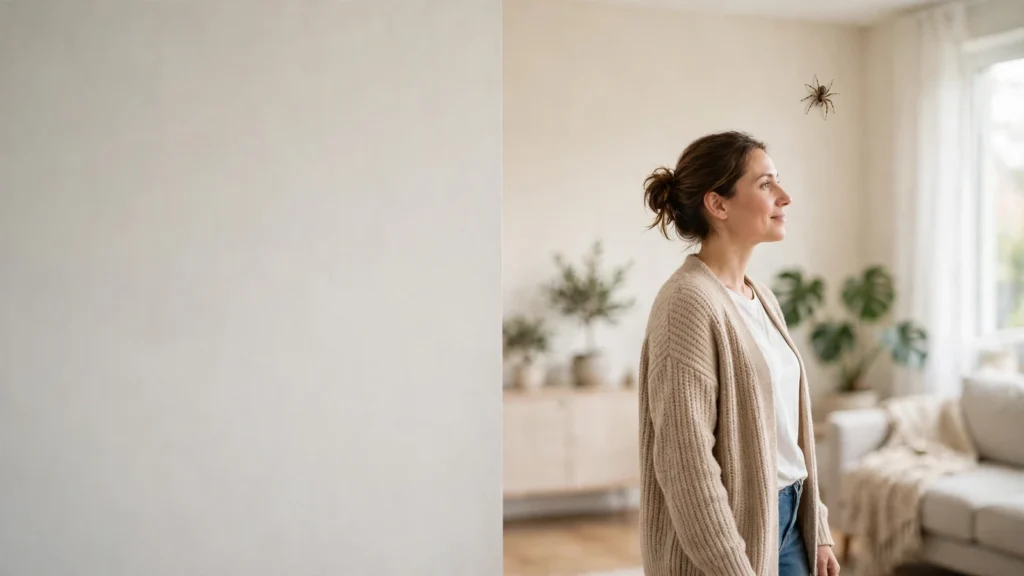
Arachnophobia is an intense, persistent fear of spiders that goes beyond ordinary dislike or caution. It can trigger immediate anxiety or panic when a person sees, thinks about, or even pictures a spider, and it often leads to avoidance that disrupts everyday life. It is common, and effective talking therapies can help.
What is arachnophobia?
Arachnophobia is the fear of spiders. It is classed as a specific phobia of the animal type, which means the fear centres on a particular animal rather than on a situation or place. NHS 111 Wales lists spiders among the common animal phobias, alongside dogs, snakes and rodents. A phobia is more than a dislike: it is an overwhelming fear that can organise daily life around avoidance.
Many people feel uneasy around spiders, and that unease alone is not a phobia. Arachnophobia is different because the reaction is immediate, strong and out of proportion to the danger posed by most spiders, and because the fear or the avoidance that comes with it causes real distress or gets in the way of work, school, relationships or everyday activities.
How common is arachnophobia?
Arachnophobia is one of the most common specific phobias. Research summarised in a peer-reviewed spider-fear study puts its prevalence at 2.7–6.1% of the general population, with rates varying by country. The same study reports 2.7% in the Netherlands, 3.5% in Sweden and up to 9.5% in Hungary, showing that where you live and how spider fear is measured both affect the figure.
Women are affected more often than men. The study notes that spider phobia may affect up to 4 times as many women as men. Strong spider fear is also widespread below the level of a clinical phobia: in a survey of 813 American college students, 34% reported significant or severe fear of spiders, compared with fear of snakes in a smaller share of the same group.
Signs and symptoms
Symptoms may start as soon as a person sees a spider, and sometimes just thinking about one is enough. NHS 111 Wales describes this as anticipatory anxiety: anxiety that arrives before any contact with the feared object. Mayo Clinic notes that anxiety in a specific phobia tends to worsen as the feared object gets closer, whether in space or in time.
Physical symptoms can include:
- sweating, trembling or shaking
- a rapid heartbeat or palpitations
- shortness of breath or a tight chest
- dizziness, light-headedness or nausea
- an upset stomach, hot flushes or chills
- a feeling of dread, fear of losing control or fear of fainting
These reactions come from the body’s fight-or-flight response. NHS 111 Wales explains that the body releases adrenaline in response to the perceived threat, which drives symptoms such as sweating, trembling, breathlessness and a rapid heartbeat. The symptoms feel real and frightening, even when the person knows the fear is out of proportion.
Behavioural signs are just as important. A person with arachnophobia may:
- avoid cellars, attics, sheds, gardens or rooms where spiders might be
- check bedding, clothing and corners repeatedly for spiders or webs
- leave a room, or refuse to enter it, if a spider is present
- ask someone else to remove every spider, however small
- avoid camping, travelling or outdoor activities because of spider worry
Avoidance brings short-term relief, but it also keeps the phobia going. Each avoided encounter removes the chance to learn that the feared outcome did not happen and that the anxiety itself can pass.
Why does arachnophobia develop?
There is no single cause. NHS 111 Wales lists a frightening incident, a learned response from a parent or sibling, and a general tendency towards anxiety as associated factors. A child who repeatedly watches a parent panic at a spider may learn the same response, even without a bad experience of their own.
Evolutionary explanations also play a part. Spiders move quickly and unpredictably, look unusual, and can be linked in the mind with dirt or contamination. Psychepedia’s review of arachnophobia describes preparedness theory: humans may be biologically primed to learn spider fear quickly, and that fear may then be harder to unlearn than fears of modern, harmless objects.
Disgust matters too. The spider-fear study notes that spiders elicit more fear and disgust than other arthropods, and that their presence in hidden, dark places in the home, plus fast, unpredictable movement, adds to the sense of threat. None of this means a person chose the fear or can simply reason it away.
Is it a fear or a phobia?
Clinicians distinguish an ordinary fear from a specific phobia by its pattern, duration and impact. Under the DSM-5 criteria for a specific phobia, the fear must typically persist for 6 months or more, almost always provoke immediate fear or anxiety, be out of proportion to the actual danger, and cause significant distress or impairment. The fear must also not be better explained by another mental health condition.
An assessment usually involves talking through symptoms, when they started, what triggers them and how they affect daily life. Questionnaires that measure spider fear can support that assessment, but they do not replace professional judgement. Only a clinician can confirm a diagnosis.
What helps with arachnophobia?
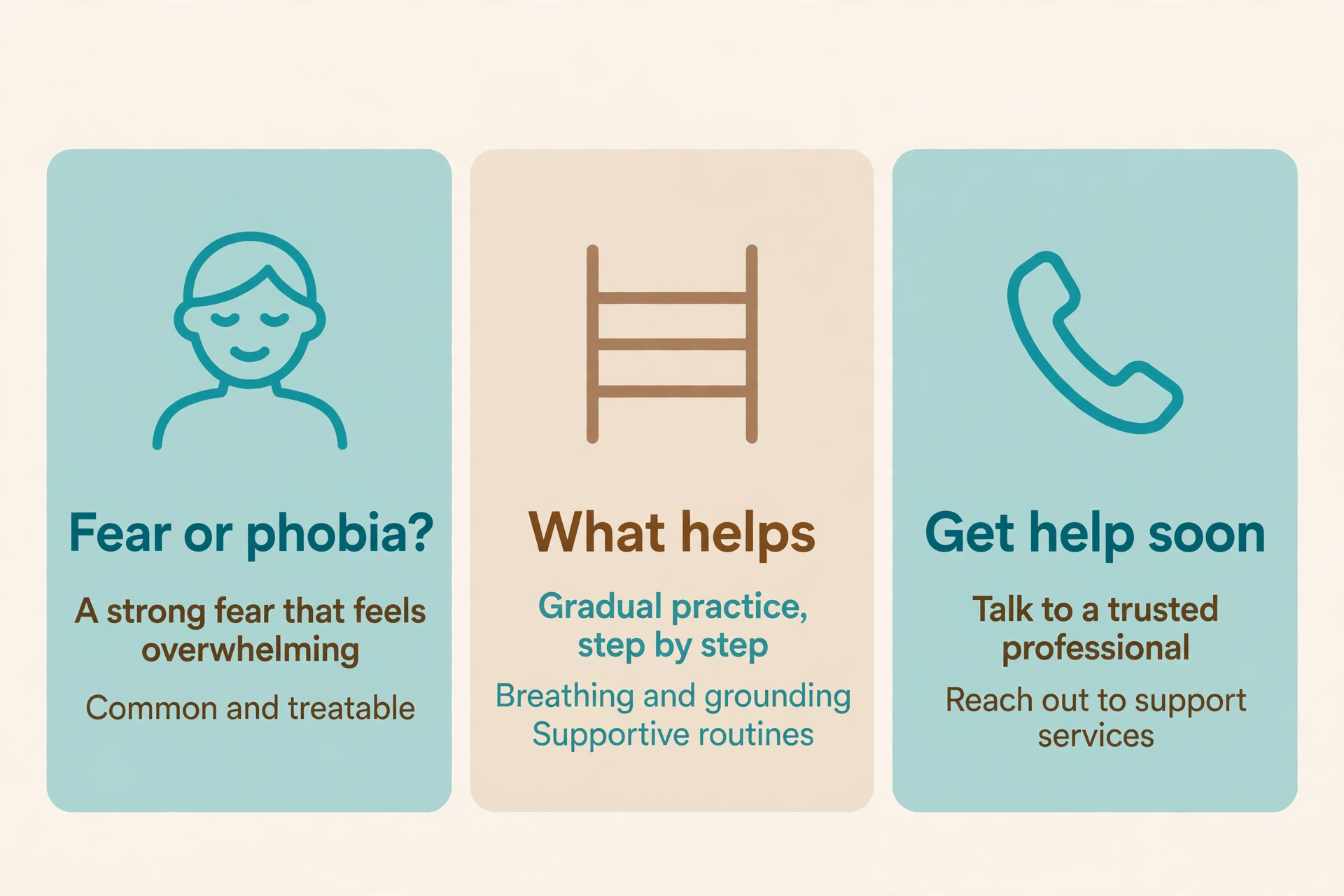
The good news is that specific phobias are among the most treatable anxiety conditions. Mayo Clinic describes exposure therapy as the best treatment for specific phobias. It works through gradual, repeated contact with the feared object in a safe, controlled way, so the person learns to manage anxiety rather than escaping it.
Cleveland Clinic names cognitive behavioural therapy (CBT) and exposure therapy as the two main treatments for arachnophobia. In CBT, a person learns to recognise, re-evaluate and change unhelpful thoughts about spiders, and to keep mind and body calm. Exposure therapy may start with talking about spiders or looking at pictures, move on to videos or virtual reality, and later involve being in the same room as a spider in a safe setting. Cleveland Clinic notes that therapy also includes relaxation and breathing exercises, and that the plan is tailored to the severity of symptoms.
A gradual exposure ladder might look like this:
- Talking about spiders and learning how they behave
- Looking at drawings, then photographs, of spiders
- Watching short videos of spiders moving
- Being near a picture or video without leaving the room
- Being in a room with a spider in a secure container, with support
- Staying calmly in the room and letting anxiety rise and fall
Steps are taken at the person’s pace, with a therapist’s guidance. Forcing sudden, intense contact is not the same as exposure therapy and can make fear worse. NHS 111 Wales notes that medication is not usually used to treat phobias, because talking therapies are usually effective; medicine is sometimes prescribed on a short-term basis to help with anxiety, so talk to a doctor or pharmacist about options rather than seeking out a product yourself.
Living with spider fear day to day
While waiting for, or alongside, professional help, small habits can make daily life easier:
- Slow, steady breathing and grounding — noticing what you can see, hear and feel around you — when anxiety rises
- A simple plan for finding a spider, such as leaving the room calmly and asking someone for help, instead of panicking
- Keeping bedrooms and living spaces tidy and well lit, which can reduce surprise encounters
- Talking openly with family or friends, so they understand the fear is real and not attention-seeking
- Noticing and noting small progress, such as staying in a room for a little longer than before
When to see a doctor
See a GP or a mental health professional if fear of spiders regularly disrupts your life: if you avoid rooms, activities, work or social plans because of it, if anxiety is frequent or severe, or if the fear is getting worse rather than better. A GP can discuss referral for talking therapy, such as CBT with exposure work. In England, you can also self-refer to NHS Talking Therapies for anxiety conditions including phobias.
If you ever feel you might act on thoughts of harming yourself, or you feel unable to stay safe, get help right away. You can find support and crisis contacts on our get help now page.
In an emergency call 911 (US), 999 (UK) or 112 (EU)
Frequently asked questions
Is arachnophobia common?
Yes, it is one of the most common specific phobias. Research summarised in a peer-reviewed spider-fear study puts its prevalence at 2.7-6.1% of the general population, with rates varying by country. Women are affected more often than men. Strong spider fear below the level of a clinical phobia is even more widespread, so you are far from alone if spiders make you anxious.
What causes arachnophobia?
There is no single cause. It can follow a frightening experience with a spider, or be learned in childhood by watching a parent or sibling panic around spiders. A general tendency towards anxiety can raise vulnerability, and humans may be biologically primed to learn spider fear quickly. Disgust at spiders' appearance and fast, unpredictable movement can also keep the fear going, even when a person knows most spiders are harmless.
How is arachnophobia treated?
The main treatments are cognitive behavioural therapy (CBT) and exposure therapy, often used together. Exposure therapy involves gradual, repeated contact with spiders in a safe, controlled setting, starting with talking about spiders or looking at pictures and building up slowly. CBT helps you recognise and re-evaluate unhelpful thoughts about spiders and learn calming skills. Medication is not usually the main treatment, but a doctor may sometimes discuss it for anxiety alongside therapy.
Can I overcome arachnophobia on my own?
Some people manage mild spider fear with self-help, such as learning about spiders, practising slow breathing and grounding, and taking small, gradual steps at their own pace. But sudden, intense contact can make fear worse, so professional guidance is safer, especially if the fear is severe or disruptive. If avoidance is shaping your daily life, talk to a GP about referral for talking therapy rather than trying to force yourself through it alone.
When should I see a doctor about fear of spiders?
See a GP or mental health professional if fear of spiders regularly disrupts your life, for example if you avoid rooms, activities, work or social plans, if anxiety is frequent or severe, or if the fear keeps getting worse. A GP can discuss referral for talking therapy such as CBT with exposure work. Get help urgently if you ever feel you might act on thoughts of harming yourself or feel unable to stay safe.
Sources
- Cleveland Clinic: Arachnophobia (Fear of Spiders) my.clevelandclinic.org
- Mayo Clinic: Specific phobias - Symptoms and causes www.mayoclinic.org
- Mayo Clinic: Specific phobias - Diagnosis and treatment www.mayoclinic.org
- NHS 111 Wales: Phobias 111.wales.nhs.uk
- Measuring fear evoked by the scariest animal: Czech versions of the Spider Questionnaire and Spider Phobia Beliefs Questionnaire www.springermedizin.de
- Psychepedia: Arachnophobia - Conquer Your Fear of Spiders for Good psychepedia.arabpsychology.com

Try the tool
Is it a fear, or a phobia?
Look up the name of 45 fears and take a 5-question check.
Open the phobia finder

