What Is Claustrophobia? Causes, Symptoms and Treatment
Claustrophobia is an intense fear of confined spaces such as lifts, tunnels and tube trains. Here is what triggers it, what it feels like, and the treatments that help.
- Written by
- Health Daily Advice
- Published
- Reading time
- 5 minutes
- Sources
- 6 cited
In this guide
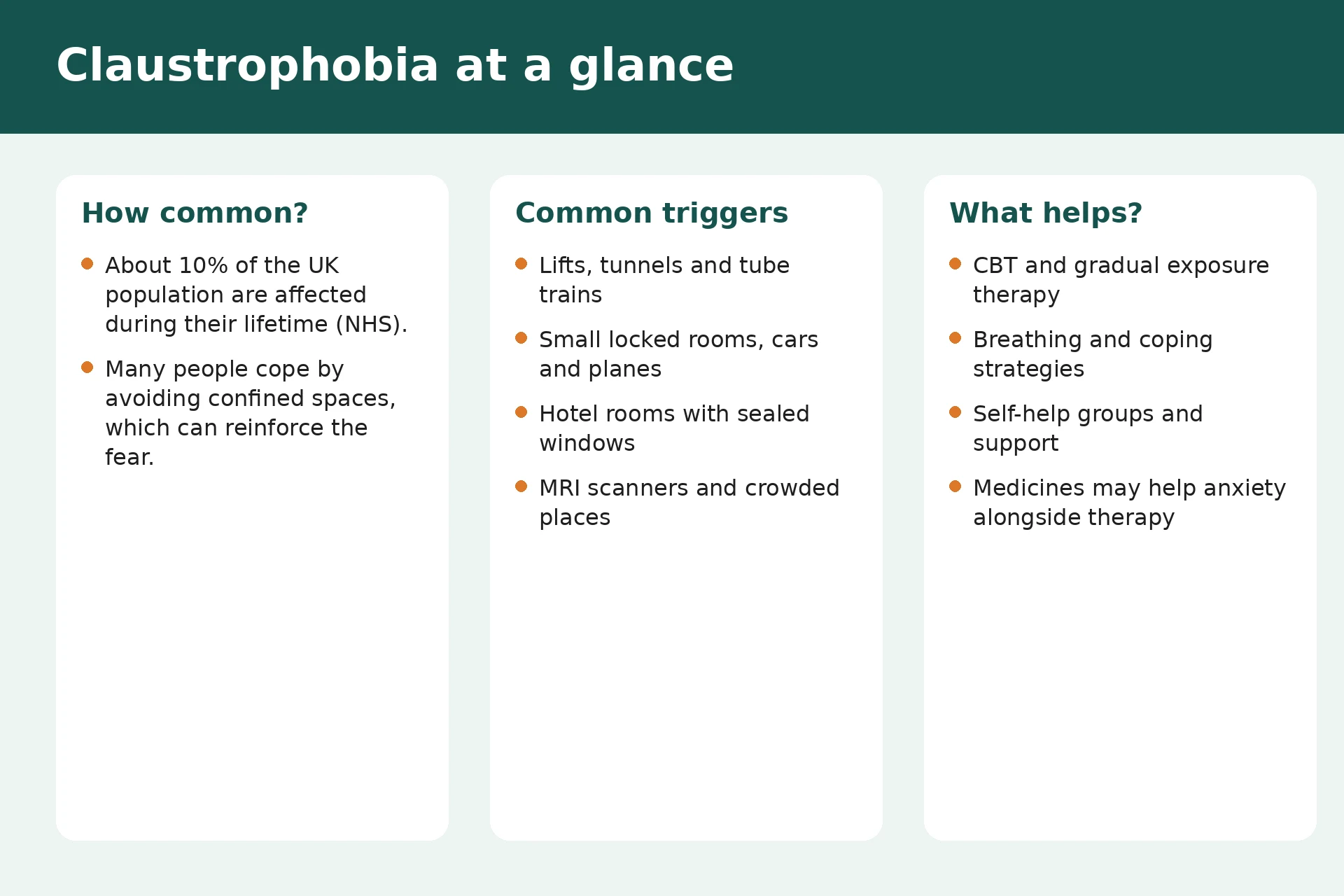
Claustrophobia is an intense, irrational fear of confined spaces, such as lifts, tunnels, tube trains and small locked rooms. It can cause panic, sweating and a strong urge to escape, even when there is no real danger. With the right help, including talking therapy, most people can learn to manage it.
What is claustrophobia?
Claustrophobia is a type of specific phobia: a fear that is out of proportion to the actual risk and that leads to avoidance. The NHS describes claustrophobia as the irrational fear of confined spaces, and notes that people affected often go out of their way to avoid such places. Avoidance brings short-term relief, but it can reinforce the fear over time, because the person never learns that the feared place was safe.
Claustrophobia is not simply disliking small spaces. Many people prefer open rooms, yet still travel in lifts or trains without distress. Claustrophobia is diagnosed when the fear is persistent, causes real distress or interferes with daily life, work, travel or health care.
Common triggers
Triggers vary from person to person. The NHS lists lifts, tunnels, tube trains, public toilets, rooms where doors have to be locked, cars, hotel rooms with sealed windows and planes among the common triggers. For some people, the trigger is feeling unable to move freely; for others, it is feeling unable to leave, or being in a crowded place where escape feels difficult.
Even thinking about a confined space can trigger anxiety, and the fear can be linked to a related worry, such as fear of suffocation or of losing control. MRI scans are a well-known problem: the NHS advises people with claustrophobia to tell hospital staff before the appointment, so options such as a sedative or, in some cases, an open scanner can be discussed.
Symptoms of claustrophobia
Symptoms range from mild unease to a full panic attack. The NHS lists physical symptoms including sweating, trembling, hot flushes or chills, shortness of breath, a choking sensation, a rapid heartbeat, chest pain or tightness, feeling sick, headaches, dizziness, feeling faint, numbness or pins and needles, a dry mouth, a need to go to the toilet, ringing in the ears, and feeling confused or disorientated.
Severe claustrophobia can also bring psychological symptoms, such as fear of losing control, fear of fainting, feeling detached from your body, or fear of dying. The NHS notes that a panic attack can last up to an hour, with symptoms usually peaking within 10 minutes and most attacks lasting between 5 and 30 minutes.
What causes claustrophobia?
There is rarely a single cause. The NHS says claustrophobia is often linked to a traumatic event in early childhood, such as being trapped or kept in a confined space, being bullied or abused, or having a parent with claustrophobia. A child can also learn the fear by watching a parent’s anxiety in confined spaces and associating those places with danger.
Unpleasant experiences later in life can also trigger it, for example turbulence when flying or being stuck in a tube tunnel between stations. The NHS phobias guidance adds that phobias usually develop in childhood, adolescence or young adulthood, and that a frightening experience, learning a fear from family or friends, and a family history of anxiety disorders can all raise the likelihood.
It is important to separate claustrophobia from other conditions. Fear of confined spaces can overlap with panic disorder or agoraphobia, and breathing problems or heart problems can mimic panic symptoms. That is why a professional assessment matters rather than self-diagnosis.
How is claustrophobia diagnosed?
A GP or a mental health professional, such as a psychologist, will ask about your symptoms, how long they have lasted, what triggers them, and how much they affect your life. The NHS notes that if you have felt anxious in the last six months about being in a confined space or crowded place, or have avoided such situations for that reason, you are likely to be affected by claustrophobia.
There is no blood test or scan for a phobia. Diagnosis rests on the pattern of fear, avoidance and distress, and on ruling out other explanations for the symptoms.
Treatment for claustrophobia
Treatment can help, and many people do not need to live with the fear untreated. The NHS lists talking treatments, including cognitive behavioural therapy (CBT) and exposure therapy, self-help, and medicines such as antidepressants or tranquillisers.
Cognitive behavioural therapy (CBT). CBT explores the thoughts, feelings and behaviours that keep a phobia going, and builds practical ways of dealing with it. In England, you can refer yourself directly to an NHS talking therapies service without a GP referral, or ask your GP to refer you.
Exposure therapy. Exposure therapy is a type of CBT that gradually exposes you to the feared situation, sometimes called desensitisation therapy. Cleveland Clinic explains that a therapist usually starts with mild to moderate exposure and builds to more intense exposure, teaching slow, controlled breathing and other strategies along the way. You might begin by looking at pictures of a lift, then standing near one, then riding one floor with support.
Medicines. Medicines do not cure a phobia, but a doctor may discuss them for anxiety or panic symptoms alongside therapy. Talk to a doctor or pharmacist about whether any option suits you; do not start or stop a medicine on the basis of an article.
Coping with claustrophobia day to day
Small steps can make confined spaces easier while you seek help:
- Practise slow breathing before and during a feared situation, and focus on something neutral and visible, such as the time on your watch.
- Plan ahead: check whether a building has stairs, a larger lift or an open waiting area, and tell staff in advance if you need an MRI scan or a long journey.
- Go gradually, not all at once. Short, planned exposures with a trusted person are more helpful than forcing yourself through a severe panic.
- Talk to someone you trust, and consider a self-help group. The NHS suggests breathing exercises, talking about the phobia, and joining a self-help group online or in person.
- If a panic attack starts, stay where you are if it is safe to do so. The NHS advises not rushing to a place of safety, and reminding yourself that the frightening sensations are panic and will pass.
Avoidance feels protective, but routinely skipping lifts, trains, appointments or social events can shrink your life and strengthen the fear. If avoidance is already shaping your choices, that is a good reason to seek help, not a reason to feel embarrassed.
When to see a doctor
See a GP if fear of confined spaces is affecting your daily life, work, travel or health care, if panic attacks keep happening, or if you are avoiding important appointments such as scans. A GP can discuss referral to a psychologist or a talking therapies service, and check whether another condition could explain your symptoms.
If you feel you might act on thoughts of harming yourself, seek urgent help. You can find support at Health Daily Advice: Get Help Now.
In an emergency call 911 (US), 999 (UK) or 112 (EU).
Frequently asked questions
Is claustrophobia a real condition?
Yes. Claustrophobia is a recognised specific phobia, not simply a dislike of small spaces. The NHS describes it as an irrational fear of confined spaces that can cause severe anxiety or panic attacks. It is diagnosed when the fear is persistent and affects daily life, work, travel or health care, and effective treatments are available.
What triggers claustrophobia?
Common triggers include lifts, tunnels, tube trains, public toilets, locked rooms, cars, planes and hotel rooms with sealed windows. For some people the trigger is feeling unable to move freely; for others it is feeling unable to leave. Even thinking about a confined space can trigger anxiety, and MRI scans are a well-known problem for people with claustrophobia.
Can claustrophobia be cured?
Many people improve a great deal, although there is no single cure that works overnight. The NHS lists cognitive behavioural therapy and exposure therapy as the main treatments, with self-help and medicines for anxiety in some cases. Exposure therapy gradually builds tolerance, starting with mild steps and increasing only as confidence grows.
How can I cope with an MRI scan if I am claustrophobic?
Tell hospital staff before your appointment, not on the day. The NHS advises discussing a sedative with your consultant well in advance, and in some cases an open or upright MRI centre may be an option, although these are often only available privately. Bringing a trusted person, practising slow breathing and asking what to expect can also help.
When should I see a GP about claustrophobia?
See a GP if fear of confined spaces affects your daily life, work, travel or health care, if panic attacks keep happening, or if you are avoiding important appointments such as scans. A GP can refer you to a psychologist or an NHS talking therapies service, and check whether another condition could explain your symptoms.
Sources
- NHS: Claustrophobia www.nhs.uk
- NHS: Phobias www.nhs.uk
- Mind: Phobias www.mind.org.uk
- Cleveland Clinic: Exposure Therapy my.clevelandclinic.org

Try the tool
Is it a fear, or a phobia?
Look up the name of 45 fears and take a 5-question check.
Open the phobia finder