What Is Nomophobia? Fear of Being Without Your Phone
Panic when your battery dies or your phone goes missing? Nomophobia is the fear of being without your phone — here is what it is, how common it is and what helps.
- Written by
- Health Daily Advice
- Published
- Reading time
- 6 minutes
- Sources
- 7 cited

In this guide
Nomophobia is the fear or anxiety felt when you are separated from your mobile phone, or when it runs out of battery, loses signal or cannot connect. It is short for “no-mobile-phone phobia”. It is not an official diagnosis, but the worry can be strong enough to disrupt sleep, work and relationships.
What is nomophobia?
Nomophobia describes the fear of being without your phone or beyond mobile phone contact. The word is short for “no-mobile-phone phobia”, and it covers more than losing the handset itself: a dying battery, no signal, no Wi-Fi and even switching the phone off can all trigger it. The term was coined after a 2008 study commissioned by the UK Post Office, which found that 53% of the 2,163 British phone owners surveyed felt anxious when they lost their phone, ran out of battery or had no network coverage. Men were slightly more affected than women (58% compared with 47%).
Most people rely on their phone for calls, messages, maps, banking, work and entertainment, so some unease when it goes missing is normal. Nomophobia is different: the fear is persistent and severe enough to affect daily life. Researchers have described it as a type of phone dependence, and some argue it is closer to an addiction than a classic phobia. Either way, it is not listed in the latest edition of the Diagnostic and Statistical Manual of Mental Disorders (DSM-5), and mental health experts have not yet agreed on formal diagnostic criteria.
Signs and symptoms of nomophobia
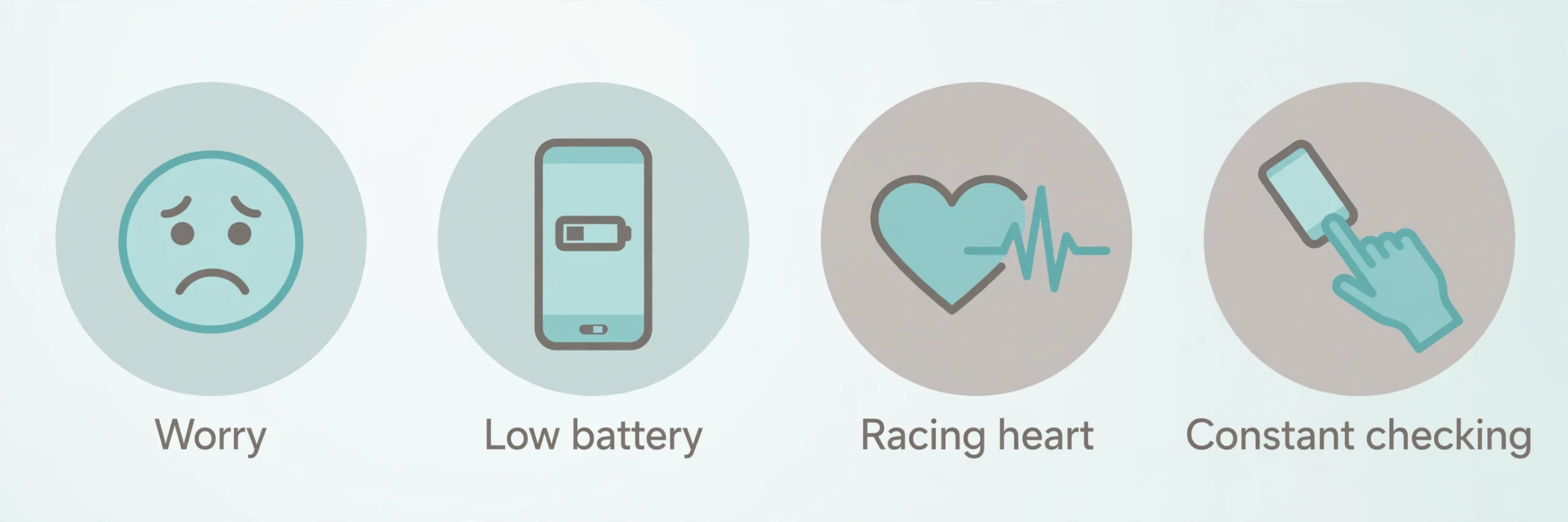
Nomophobia looks much like other anxiety disorders. Emotional symptoms include worry, fear or panic at the thought of being without your phone, agitation when you have to put it down, irritation when you cannot check it, and panic if you briefly cannot find it. Physical symptoms can include a tight chest, trouble breathing, trembling, sweating, feeling faint or dizzy, and a rapid heartbeat. In severe cases the fear can escalate into a panic attack.
Everyday behaviours can also be a clue. You may recognise some of these:
- being unable to turn your phone off, so it stays on 24 hours a day
- constantly checking for missed messages, emails or calls
- charging the battery even when it is nearly full
- taking your phone everywhere, even into the bathroom
- repeatedly checking that you still have your phone with you
- worrying about bad things happening without being able to call for help
- skipping activities or events to spend time on your phone
Researchers at Iowa State University developed a 20-item Nomophobia Questionnaire (NMP-Q) to measure the fear. It groups the experience into four dimensions: not being able to communicate, losing connectedness, not being able to access information, and giving up convenience.
How common is nomophobia?
Some degree of nomophobia appears to be very common. A 2023 meta-analysis of 52 studies involving 47,399 young people from 20 countries found that about 20% had mild symptoms, about 50% had moderate symptoms and about 20% had severe symptoms. University students from non-Western cultures were the most likely to report severe symptoms.
Smaller studies tell a similar story. A 2017 study of 145 first-year medical students in India found 17.9% had mild nomophobia, 60% had moderate symptoms and 22.1% had severe symptoms. The fear appears most often in teenagers and young adults, who have grown up with phones as a constant part of daily life.
What causes nomophobia?
Experts have not found a single cause, but several factors are thought to contribute:
- Fear of isolation. If your phone is your main way of contacting the people you care about, being without it can feel like being cut off.
- Fear of not being reachable. Waiting for an important call or message can turn keeping the phone close into a hard-to-break habit.
- A past bad experience. Losing a phone before, or being unable to call for help in an emergency, can make you worry it will happen again.
- Underlying anxiety. Living with anxiety in general, or having a close family member with a phobia or another anxiety disorder, can raise the risk.
- Low self-esteem and social difficulties. A 2023 review lists low self-esteem, anxiety disorders and social difficulties among the risk factors, along with a tendency towards addiction.
- Instant gratification. Smartphones deliver instant communication and rewards, which can build compulsive checking habits. A 2014 study found college students spent as much as nine hours a day on their phones.
Nomophobia is also linked to other mental health problems. Research suggests people with anxiety and panic disorders may be more likely to develop it, and higher nomophobia scores have been linked to higher levels of obsessiveness. It shares features with social anxiety, and some researchers have proposed that it is less a specific phobia than a form of smartphone addiction.
Coping strategies that can help
You do not have to give up your phone to feel better. Small, gradual changes are usually more realistic than going cold turkey, and they help you build tolerance for being without the device:
- Turn your phone off at night. If you need an alarm, keep the phone far enough away that you cannot easily check it during the night.
- Leave it at home for short trips. Try a walk to the shops or a quick errand without it, then build up to longer periods.
- Set phone-free times and places. Meals, the bedroom and the first hour after waking are good starting points.
- Use built-in screen-time tools. Most phones can report your usage and set daily limits, and apps can lock distracting apps after a set time.
- Replace scrolling with something else. Reading, walking, exercise or a hobby can fill the time you would otherwise spend checking your phone.
- Meet people in person. Face-to-face contact with friends, family, neighbours or colleagues can ease the feeling that your phone is your only connection to others.
- Practise relaxation. Slow breathing, progressive muscle relaxation and meditation can help you cope when the urge to check your phone feels overwhelming.
One study found that helping students improve their self-esteem was an effective way to reduce nomophobia, which underlines how much the fear is tied to confidence and social connection rather than the phone itself.
Treatment for nomophobia
There is no specific treatment for nomophobia, because it is not an officially recognised disorder. A doctor or therapist will usually recommend the same approaches used for other phobias:
- Cognitive behavioural therapy (CBT). This helps you spot and challenge the thoughts that drive the fear, such as “if I lose my phone, I will never talk to my friends again”, and replace them with more realistic ones.
- Exposure therapy. You gradually face the fear by spending short periods without your phone, starting with a few minutes in another room and working up to longer stretches. The aim is not to stop using your phone, but to learn that being without it is manageable.
- Talking therapy and counselling. Stress reduction exercises, relaxation techniques and counselling can all help, alongside gradually reducing phone use.
Medication can help with severe anxiety symptoms, but it does not treat the root cause, and it is usually only considered alongside therapy. Talk to a doctor about what options might suit you.
When to see a doctor
Frequently using your phone, or worrying about not having it, does not on its own mean you have nomophobia. But it is a good idea to talk to a doctor if you have had symptoms for six months or longer, especially if they are frequent, persist through the day, affect your work or relationships, make it hard to sleep, or harm your health or quality of life. A doctor can refer you to a psychologist or another specialist. If you are struggling right now, our get help now page lists support and crisis resources.
In an emergency call 911 (US), 999 (UK) or 112 (EU)
Frequently asked questions
Is nomophobia a real phobia?
It is a real and recognised fear, but not an official diagnosis. Nomophobia is short for “no-mobile-phone phobia” and describes anxiety about being without your phone, a dead battery or no signal. It is not listed in the DSM-5, and experts have not agreed on formal diagnostic criteria. Some researchers argue it is closer to a form of phone dependence or addiction than a classic phobia.
What are the signs of nomophobia?
Emotional signs include worry, fear or panic at the thought of being without your phone, agitation when you put it down, and irritation when you cannot check it. Physical signs can include a tight chest, trouble breathing, trembling, sweating, dizziness and a rapid heartbeat. Behavioural clues include being unable to turn the phone off, charging it when it is nearly full, and taking it everywhere, even into the bathroom.
How common is nomophobia?
Very common, at least in mild form. A 2023 meta-analysis of 52 studies with 47,399 young people from 20 countries found about 20% had mild symptoms, about 50% had moderate symptoms and about 20% had severe symptoms. Teenagers and young adults are the most affected. The original 2008 UK study found 53% of phone owners felt anxious when they lost their phone, had a dead battery or no signal.
Can nomophobia be cured?
There is no single cure, because nomophobia is not an officially recognised disorder, but it can improve a great deal. Cognitive behavioural therapy helps you challenge the fearful thoughts, and exposure therapy gradually builds your tolerance for being without your phone. Self-care helps too: phone-free times, screen-time limits, and replacing scrolling with other activities. If symptoms persist, a doctor can refer you to a therapist.
How can I stop panicking without my phone?
Start small and build up gradually. Try leaving your phone in another room for a few minutes, then leave it at home for a short walk. Turn it off at night, set phone-free times such as meals, and use your phone's screen-time tools to set limits. Slow breathing and relaxation exercises can calm the physical symptoms. If panic keeps happening or affects your daily life, talk to a doctor or a therapist for support.
Sources
- Healthline: Nomophobia www.healthline.com
- Verywell Mind: Nomophobia — The Fear of Being Without Your Phone www.verywellmind.com
- Medical News Today: Nomophobia — Definition, causes, symptoms, and treatment www.medicalnewstoday.com
- Banerjee I, et al. Nomophobia: An emerging problem. J Family Med Prim Care / PMC pmc.ncbi.nlm.nih.gov
- Jahrami H, et al. Prevalence of mild, moderate, and severe nomophobia symptoms: a systematic review and meta-analysis. Behav Sci, 2023 pubmed.ncbi.nlm.nih.gov

Try the tool
Is it a fear, or a phobia?
Look up the name of 45 fears and take a 5-question check.
Open the phobia finder