Ectopic Pregnancy Warning Signs: Symptoms Not to Ignore
An ectopic pregnancy can be hard to spot at first — and deadly if it is missed. The warning signs, the emergency red flags, and why deaths from the condition have nearly doubled in the US.
- Written by
- Health Daily Advice
- Published
- Reading time
- 5 minutes
- Sources
- 8 cited
In this guide
An ectopic pregnancy happens when a fertilised egg implants outside the womb, usually in a fallopian tube, and it cannot continue normally. The first warning signs are usually light vaginal bleeding and pelvic pain, often on one side. Sudden severe pain, heavy bleeding, fainting or shoulder-tip pain can mean the tube has burst and need emergency care.
What is an ectopic pregnancy?
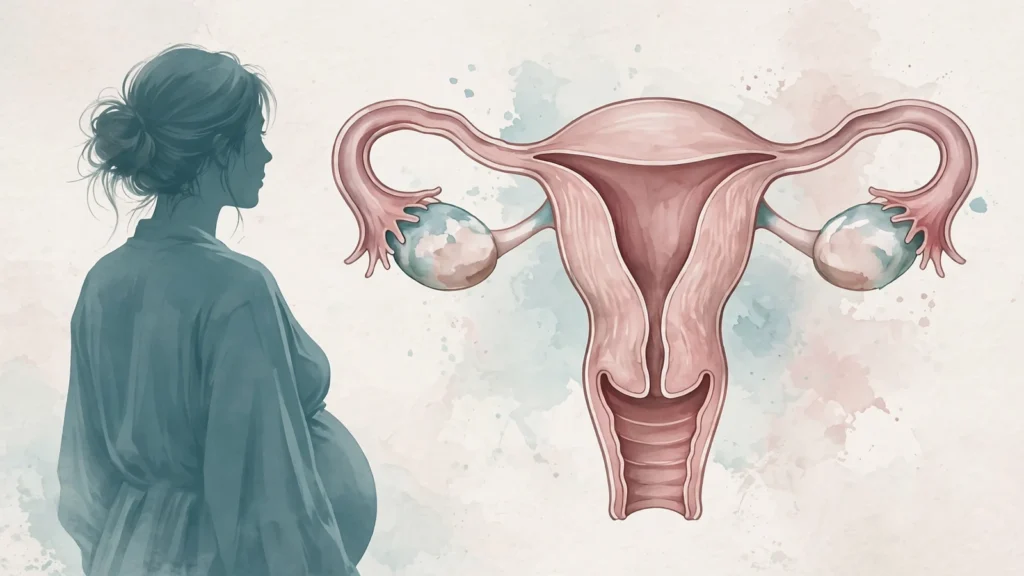
Normally, a fertilised egg travels down a fallopian tube and implants in the womb, where the pregnancy grows. In an ectopic pregnancy, the egg implants somewhere else — most often inside a fallopian tube, but occasionally in an ovary, the cervix or the abdomen. The pregnancy cannot survive outside the womb, and as it grows it can split the tube open, causing severe internal bleeding.
Ectopic pregnancy is uncommon but serious: it affects up to 2% of pregnancies, according to ProPublica’s reporting on US data, and it is the leading cause of death in the first trimester of pregnancy. That is why recognising the warning signs early matters so much.
Early warning signs
Some women have no symptoms at first, and an ectopic pregnancy may only be found during a routine scan. When symptoms do appear, they usually develop between the sixth and fourteenth week of pregnancy — around two weeks after a missed period. The Mayo Clinic says the first warning signs are often light vaginal bleeding and pelvic pain, and the NHS notes that symptoms can be vague at first, which is one reason diagnosis is not always straightforward.
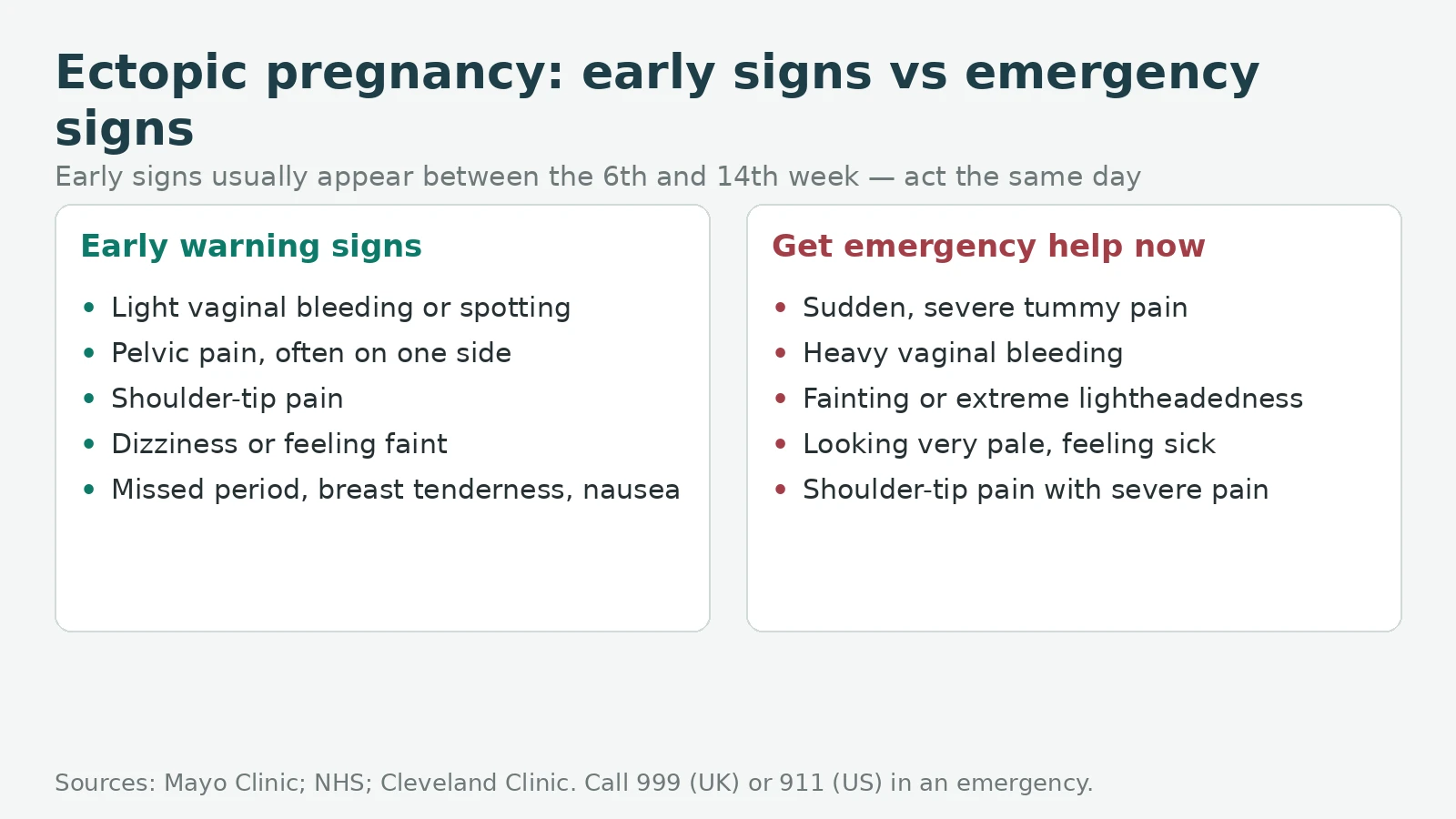
- Light vaginal bleeding or spotting that is different from your normal period — it may be lighter or heavier, or darker than usual.
- Pain in your lower abdomen or pelvis, often on one side. It may come on suddenly or build up gradually over several days.
- Shoulder-tip pain — pain at the tip of your shoulder, which can happen when blood leaks into the abdomen and irritates a nerve. It tends to be there all the time and may be worse when you lie down.
- Dizziness or feeling faint, or an urge to have a bowel movement, which can happen when blood collects in the abdomen.
- A missed period and other early signs of pregnancy, such as breast tenderness or nausea — a pregnancy test will still be positive.
These symptoms do not always mean an ectopic pregnancy — they can be caused by other things, including a stomach bug or a normal early pregnancy. But if you are pregnant, or think you might be, and you have bleeding or pain, get checked the same day rather than waiting to see if it passes.
Emergency symptoms: when a tube may have burst
If the fertilised egg keeps growing, the fallopian tube can rupture. Heavy bleeding inside the abdomen is likely, and this is a medical emergency. Call 999 (UK) or your local emergency number, or go to your nearest emergency department immediately, if you have a combination of:
- a sharp, sudden and intense pain in your tummy
- feeling very dizzy or fainting
- heavy vaginal bleeding
- feeling sick or looking very pale
- shoulder-tip pain with severe abdominal pain
These symptoms could mean the tube has split open. Do not drive yourself — ask someone to take you, or call an ambulance.
Who is at higher risk?
Any sexually active woman of childbearing age can have an ectopic pregnancy, and often no cause is found. The risk is higher if you:
- have had an ectopic pregnancy before — the NHS puts the chance of another at around 10%
- have had pelvic inflammatory disease, usually caused by a sexually transmitted infection
- have had surgery on your fallopian tubes, including sterilisation
- became pregnant through fertility treatment such as IVF
- became pregnant while using an intrauterine device (IUD) or coil — rare, but more likely to be ectopic if it happens
- smoke, or are aged 35 to 40
How is an ectopic pregnancy diagnosed?
Most women do not know the pregnancy is ectopic until they see their pregnancy care provider for an appointment, bloodwork or ultrasound. To diagnose it, a doctor will usually do a pregnancy test, an ultrasound scan to see where the fertilised egg has implanted, and blood tests to measure the pregnancy hormone hCG. Because a very early pregnancy may not show up clearly on a scan, tests sometimes need to be repeated over several days, and a doctor may suspect an ectopic pregnancy from how hCG levels change between blood tests.
How is it treated?
An ectopic pregnancy needs treatment as soon as possible, and the approach depends on how far along it is and whether the tube has ruptured. Cleveland Clinic explains that treatment is usually a medication called methotrexate, given by injection, or surgery to remove the pregnancy. If the tube has burst, emergency surgery is needed. Your doctor will talk through the options with you, including what follow-up is needed and what it means for future pregnancies — many women go on to have a healthy pregnancy afterwards, but it is important to discuss timing and care with your doctor.
Why deaths from ectopic pregnancy have risen in the US
Deaths from ectopic pregnancy have nearly doubled in the United States in recent years, according to a ProPublica analysis of CDC death-certificate data published in September 2026. Almost 200 women died with an ectopic pregnancy recorded on their death certificates between 2020 and 2025, compared with about 100 in the previous six years. The rate reached 9.8 deaths per million live births in 2023–2025, roughly double the rate a decade earlier.
The rise was steeper in the 18 states that banned abortion at six weeks or earlier after the US Supreme Court overturned Roe v. Wade in 2022, where the rate reached 13.1 per million live births, compared with 7.1 in the 27 jurisdictions that never enacted a ban. ProPublica’s analysis cannot establish whether abortion bans caused the increase, and experts interviewed for the investigation did not agree on the causes — but they pointed to delays in diagnosing and treating ectopic pregnancies, and to hospitals and doctors hesitating over the law even though ectopic treatment is exempt from the bans. Maternal-health experts called the trend unacceptable, noting that a death from an ectopic pregnancy should be preventable.
The rise began during the COVID-19 pandemic, and the UK responded to a similar post-pandemic rise by changing emergency services and promoting awareness of the symptoms. In the US, the CDC does not track how many ectopic pregnancies occur each year, which makes the trend harder to spot — the doubling was visible only at national level.
When to see a doctor
If you are pregnant, or think you might be, and you have vaginal bleeding, pelvic pain, shoulder-tip pain or dizziness, contact your doctor, midwife or early pregnancy unit the same day — do not wait for a routine appointment. If you have sudden severe abdominal pain, heavy bleeding, fainting or extreme lightheadedness, call an ambulance or go to your nearest emergency department straight away. In an emergency call 911 (US), 999 (UK) or 112 (EU).
Frequently asked questions
How early can you tell if a pregnancy is ectopic?
Symptoms usually appear between the sixth and fourteenth week, about two weeks after a missed period, but some women have no symptoms and it is only found on a routine scan. Diagnosis uses a pregnancy test, an ultrasound to locate the pregnancy, and blood tests for the hormone hCG, sometimes repeated over several days.
Can an ectopic pregnancy go away on its own?
Rarely, and it is not something to wait for. An ectopic pregnancy cannot continue normally, and as it grows it can split the fallopian tube open, causing life-threatening internal bleeding. Treatment is usually a medication called methotrexate or surgery. If you have symptoms, get checked the same day.
What does ectopic pregnancy pain feel like?
It is often pain in the lower abdomen or pelvis, usually on one side, that may come on suddenly or build up over several days. Some women describe it as sharp or cramping. Shoulder-tip pain, dizziness or an urge to have a bowel movement can also occur. Sudden severe pain with heavy bleeding or fainting needs emergency care.
Can you still get pregnant after an ectopic pregnancy?
Many women do go on to have a healthy pregnancy, but it depends on what happened and whether a fallopian tube was damaged or removed. The NHS puts the chance of another ectopic pregnancy at around 10%. Talk to your doctor about when to try again and what care you should have in an early pregnancy.
Why have ectopic pregnancy deaths increased in the US?
A ProPublica analysis of CDC data found deaths nearly doubled from 2020 to 2025, from about 100 to almost 200. Experts point to delays in diagnosing and treating ectopic pregnancies, and to doctors hesitating over abortion laws even though ectopic treatment is exempt. The analysis cannot prove what caused the rise, and experts did not agree on the causes.
Can an ectopic pregnancy be prevented?
There is no guaranteed way to prevent one, and often no cause is found. You can lower your risk by not smoking, using protection against sexually transmitted infections that can damage the fallopian tubes, and seeking prompt care for pelvic infections. If you have had an ectopic pregnancy before, tell your doctor as soon as you know you are pregnant.
Sources
- Mayo Clinic: Ectopic pregnancy — symptoms and causes www.mayoclinic.org
- Cleveland Clinic: Ectopic Pregnancy: Causes, Symptoms & Treatments my.clevelandclinic.org
- nidirect (NHS): Ectopic pregnancy www.nidirect.gov.uk
- ProPublica (via Johns Hopkins Population Center): Ectopic Pregnancy Deaths Have Nearly Doubled popcenter.jhu.edu
- ProPublica (via Radio Free): An Alarming Spike in Ectopic Pregnancy Deaths Was Hiding in Plain Sight in a Federal Dataset www.radiofree.org
- MSD Manual (Consumer Version): Ectopic Pregnancy www.msdmanuals.com

Try the tool
When is your next period and fertile window?
Six cycles ahead from your last period date.
Open the calculator