Skin Cancer Symptoms in Older Adults: What to Check
Skin cancer is rising in older adults, but most cases are curable when caught early. Here are the warning signs, the ABCDE rule and a five-minute monthly check.
- Written by
- Health Daily Advice
- Published
- Reading time
- 6 minutes
- Sources
- 9 cited
In this guide
Skin cancer is rising in older adults because a lifetime of sun exposure adds up: by age 59, the average person has banked about three-quarters of their lifetime UV damage. Check your skin monthly for a new spot, a changing mole, or a sore that does not heal within four weeks. Caught early, melanoma’s five-year survival is over 99%.
Why is skin cancer rising in older adults?
Age is one of the strongest risk factors for skin cancer, and the numbers show it clearly. A study published in JAMA Dermatology in 2025 found that in adults aged 65 and over, the global burden of skin cancer rose significantly between 1990 and 2021. In 2021 alone there were an estimated 154,000 melanomas, 1.46 million squamous cell carcinomas and 2.8 million basal cell carcinomas in people aged 65 and over worldwide — and the researchers project that keratinocyte skin cancers will keep rising to 2050, with basal cell carcinoma possibly more than doubling.
The pattern is the same country by country. In the UK, more than 10,000 people aged 55 and over were diagnosed with malignant melanoma in a single year for the first time, compared with around 3,100 twenty years earlier — a rise of 155% in the over-55s, against 63% in younger adults. In the US, the Skin Cancer Foundation projects 234,680 new melanomas in 2026, a 10.6% increase on the previous year, with invasive cases up 46.6% over the decade. Melanoma mortality in the over-65s rises steeply with age, from 2.5 deaths per 100,000 among 65- to 69-year-olds to 21.28 per 100,000 among those aged 95 and over.
The main reason is cumulative sun damage. The Skin Cancer Foundation’s lifetime-exposure figures put average accumulated sun exposure at 23% by age 18, 47% by age 40 and 74% by age 59 — most of a lifetime’s UV damage is banked before old age, and it shows up decades later. A weaker immune system with age also makes it harder for the body to detect and repair abnormal cells. Men are affected more than women from age 50 on: in adults 65 and over, the squamous cell carcinoma rate in men is roughly 2.2 times the rate in women.
How common is skin cancer?
Skin cancer is the most common cancer in the United States — more people are diagnosed with it each year than with all other cancers combined. The headline figures from the Skin Cancer Foundation are stark:
- At least 1 in 5 Americans will develop skin cancer by the age of 70.
- More than 9,500 people in the US are diagnosed with skin cancer every day.
- Basal cell carcinoma accounts for about 3.6 million US cases a year; squamous cell carcinoma for about 1.8 million.
- An estimated 8,510 people will die of melanoma in the US in 2026.
- About 90% of non-melanoma skin cancers are linked to UV radiation from the sun.
- Having five or more sunburns doubles a person’s risk of melanoma.
- Only 20 to 30% of melanomas are found in existing moles — 70 to 80% appear on apparently normal skin.
The good news is that early detection changes everything. When melanoma is found early, the five-year survival rate is over 99%. Once it has spread to distant organs, that figure falls to 35% — which is why looking at your skin regularly matters so much.
The three main types of skin cancer
| Type | What it looks like | Where it appears | How it behaves |
|---|---|---|---|
| Basal cell carcinoma (BCC) — the most common | Pearly or waxy bump; flat flesh-coloured or brown scar-like patch; sore that bleeds, scabs, heals and returns | Sun-exposed skin: face, neck, arms | Grows slowly, rarely spreads |
| Squamous cell carcinoma (SCC) — second most common | Firm red nodule; flat scaly, crusted patch; sore or ulcer that does not heal; wart-like growth | Face, ears, lips, hands | Grows faster than BCC, small risk of spreading |
| Melanoma — least common, most dangerous | Large brownish spot with darker speckles; a mole that changes colour, size or feel, or bleeds; a lesion with irregular borders in red, pink, white, blue or blue-black | Anywhere, including soles of feet, under nails and skin rarely exposed to sun | Can spread to other parts of the body |
BCC and SCC together are known as keratinocyte cancers. They are far more common than melanoma, and when caught early they are usually curable. Melanoma accounts for more than 90% of skin cancer deaths, which is why a changing mole deserves prompt attention.
Skin cancer symptoms: what to look for
Most early skin cancers are painless, which is exactly why looking matters. The warning signs differ by type:
- Basal cell carcinoma: a shiny, pearly bump that may bleed easily; a sore that heals and comes back; a flat, scaly patch, sometimes with a raised edge; or a white, waxy, scar-like area without a clear border.
- Squamous cell carcinoma: a thick, scaly patch that crusts and bleeds; a firm red lump; an open sore with raised edges that will not heal; or a persistent sore on the lip.
- Melanoma: a mole that changes in size, shape or colour, or starts to itch, bleed or crust; a new dark spot that looks different from your other moles; or a spot that is painful, itchy or burning.
One useful rule is the “ugly duckling” test: a spot that looks different from all your other moles should be checked, even if it does not match any textbook description.
The ABCDE rule for moles
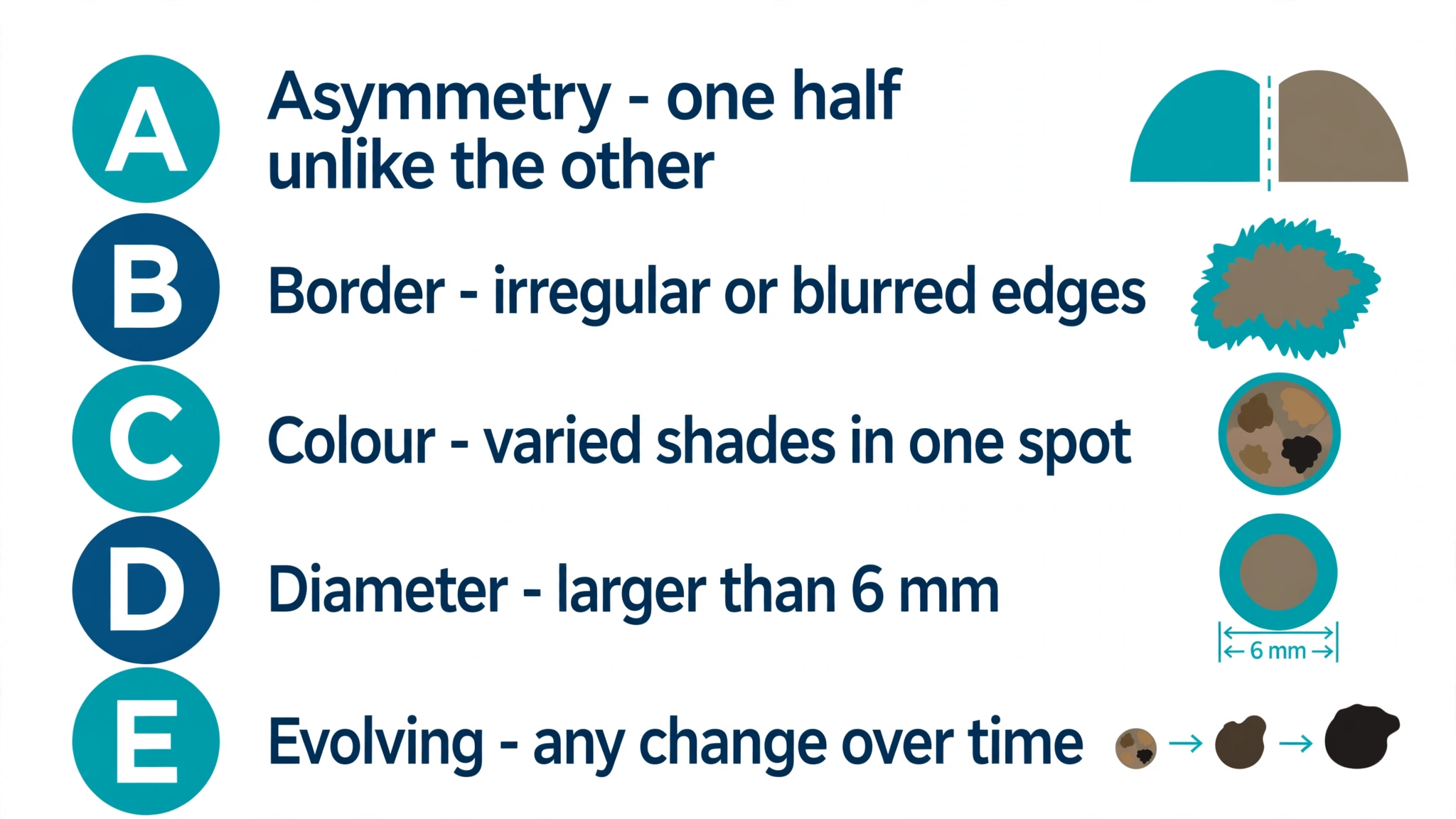
Doctors use the ABCDE rule to judge whether a mole might be melanoma. It is worth learning, because it turns a vague worry into something concrete you can check:
- A — Asymmetry: one half of the spot is unlike the other half.
- B — Border: the edges are irregular, scalloped or blurred.
- C — Colour: the spot has varied colours or shades — tan, brown, black, white, red or blue.
- D — Diameter: larger than about 6 millimetres, roughly the size of a pencil eraser (though melanomas can be smaller).
- E — Evolving: the spot is changing in size, shape or colour, or starts to bleed, itch or crust.
How to do a monthly skin check
The American Academy of Dermatology recommends checking your skin about once a month. It takes five to ten minutes once you know your skin, and it is best done after a bath or shower, in a well-lit room, with a full-length mirror and a hand mirror:
- Examine your body front and back in the full-length mirror, then your right and left sides with your arms raised.
- Bend your elbows and look carefully at your forearms, underarms, fingernails and palms.
- Look at the backs of your legs and feet, the spaces between your toes, your toenails and the soles of your feet.
- Examine the back of your neck and scalp with a hand mirror, parting your hair for a closer look.
- Check your back and buttocks with a hand mirror.
Also check inside your mouth, under your breasts, and the skin between your fingers. Take photos of any spots so you can compare them month to month, and ask a partner or friend to help with hard-to-see areas — your hairdresser or barber can also flag unusual spots on your scalp. What you are looking for is anything new, anything changing, and any sore that does not heal.
Skin cancer prevention after 60
It is never too late for sun protection to help. The Mayo Clinic advises using a broad-spectrum sunscreen of at least SPF 30, even on cloudy days, applied generously and reapplied every two hours, or more often if you are swimming or sweating. Regular daily use of an SPF 15 or higher sunscreen reduces the risk of squamous cell carcinoma by about 40% and melanoma by 50%.
Stay out of the sun in the middle of the day — for much of North America the rays are strongest between about 10 a.m. and 3 p.m. — and wear dark, tightly woven clothing covering your arms and legs, plus a wide-brimmed hat that shades your face and ears. And do not use tanning beds: the World Health Organization’s cancer agency classifies UV tanning devices as Group 1 carcinogens, and people who first use a tanning bed before age 35 increase their melanoma risk by 75%.
When to see a doctor
See a GP or doctor promptly if you have a growth on your skin that is getting bigger or has changed colour or texture, or any area of skin that hurts, itches, bleeds, crusts or scabs for more than four weeks. The same applies to any lump, ulcer, lesion or discolouration that has not healed after four weeks. Do not try to diagnose a spot from a photo online, and do not cut, squeeze or burn one off at home. A doctor can look at it properly, and if it needs a closer look they can refer you to a dermatologist. Most skin cancers are curable if caught early — the check itself is quick, and it is the single best thing you can do.
In an emergency call 911 (US), 999 (UK) or 112 (EU).
Frequently asked questions
What are the first signs of skin cancer in older adults?
A new spot that does not go away, a mole that changes size, shape or colour, or a sore that bleeds, scabs and heals then returns. Basal cell carcinoma often looks like a pearly bump, squamous cell carcinoma like a scaly patch, and melanoma like a changing mole. Any spot that is new or different deserves a prompt check.
How often should older adults check their skin?
About once a month, after a bath or shower, in good light with a full-length mirror and a hand mirror. The American Academy of Dermatology's five-step check takes five to ten minutes once you know your skin. Take photos of spots so you can compare them month to month, and ask a partner to help with hard-to-see areas.
What does melanoma look like?
Often a mole that changes, or a new dark spot that looks different from your other moles. Doctors use the ABCDE rule: asymmetry, irregular border, varied colour, diameter larger than about 6 millimetres, and evolving — any change in size, shape or colour, or a spot that bleeds, itches or crusts.
Can you get skin cancer at 70 or 80?
Yes — risk rises with age, because sun damage accumulates over a lifetime. In the UK, melanoma cases in people aged 55 and over rose 155% in 20 years, and globally the skin cancer burden in over-65s rose significantly between 1990 and 2021. That is why monthly checks matter more, not less, as you get older.
Does sunscreen still help after 60?
Yes. Daily use of an SPF 15 or higher sunscreen reduces the risk of squamous cell carcinoma by about 40% and melanoma by 50%. Use a broad-spectrum SPF 30 or higher, apply it generously, reapply every two hours outdoors, and pair it with a hat, shade and protective clothing. Avoid tanning beds entirely.
Sources
- Skin Cancer Foundation: Skin Cancer Facts www.skincancer.org
- JAMA Dermatology: Burden of Skin Cancer in Older Adults jamanetwork.com
- American Academy of Dermatology: How to Examine Your Skin www.aad.org
- Cleveland Clinic: ABCDEs of Melanoma my.clevelandclinic.org
- Mayo Clinic: Skin Cancer Symptoms and Causes www.mayoclinic.org
- NHS: Symptoms of Non-Melanoma Skin Cancer www.nhs.uk
- UCLA Health: How to Check for Skin Cancer www.uclahealth.org
- Medical News Today: Cancer Research UK Melanoma Figures www.medicalnewstoday.com

Try the tool
Not sure if it can wait?
Common causes and warning signs for 16 everyday symptoms.
Open the symptom guide