Why Am I Losing Hair at 30? Causes Men Should Know
Thinning at 30 is common and usually inherited male pattern hair loss. Here is how genes and DHT cause it, what is normal, the myths to forget, and when loss needs a GP.
- Written by
- Health Daily Advice
- Published
- Reading time
- 4 minutes
- Sources
- 7 cited
In this guide
Losing hair at 30 is most often male pattern hair loss, called androgenetic alopecia in the United States. It is a slow, inherited process in which the hormone DHT gradually shrinks scalp follicles. About two-thirds of men notice some loss by 35, so it is common — and shedding some hair each day is normal.
What male pattern hair loss actually is
Male pattern hair loss — the term used in the UK, while the US more often says androgenetic alopecia — is the most common type of hair loss in men, according to the British Association of Dermatologists. It is caused by a combination of genetics and the hormone dihydrotestosterone (DHT), which is made from testosterone.
DHT acts on the follicles in a process dermatologists call miniaturisation: affected hairs become gradually thinner, shorter and lighter in colour until the follicles shrink and eventually stop producing hair. This happens even though your hormone levels are normal — it is the follicles’ inherited sensitivity to DHT that matters, not the amount of hormone in your blood.
The genes do not come from only one parent. The condition is polygenetic — multiple genes contribute — and it can be inherited from either or both parents, as both the BAD and Cleveland Clinic explain. More than 190 contributing genes have been identified, which is why hair loss can affect family members at different ages and to different degrees.
Why it shows up at 30
Male pattern hair loss can start at any time after puberty. The process often begins in the late teens or twenties but only becomes visible around the mid-30s — Cleveland Clinic says about two-thirds of men notice some degree of hair loss by age 35. That is why 30 is one of the most common ages for men to first notice thinning.
Once it starts, the condition progresses very slowly, over years or decades. One thing worth knowing: the BAD notes that an earlier age of onset may lead to quicker progression, so loss that starts in the late twenties can advance faster than loss that starts at 50. There is no cure, but treatments exist that can slow it — see below.
What it usually looks like — and what is normal
The pattern is recognisable: a receding hairline at the temples and thinning on the crown, while the hair at the sides and back of the head is spared. Affected hairs are initially smaller in diameter and shorter than those elsewhere. There are usually no scalp symptoms, although some men describe an itch.
Some things are simply normal and not a sign of disease:
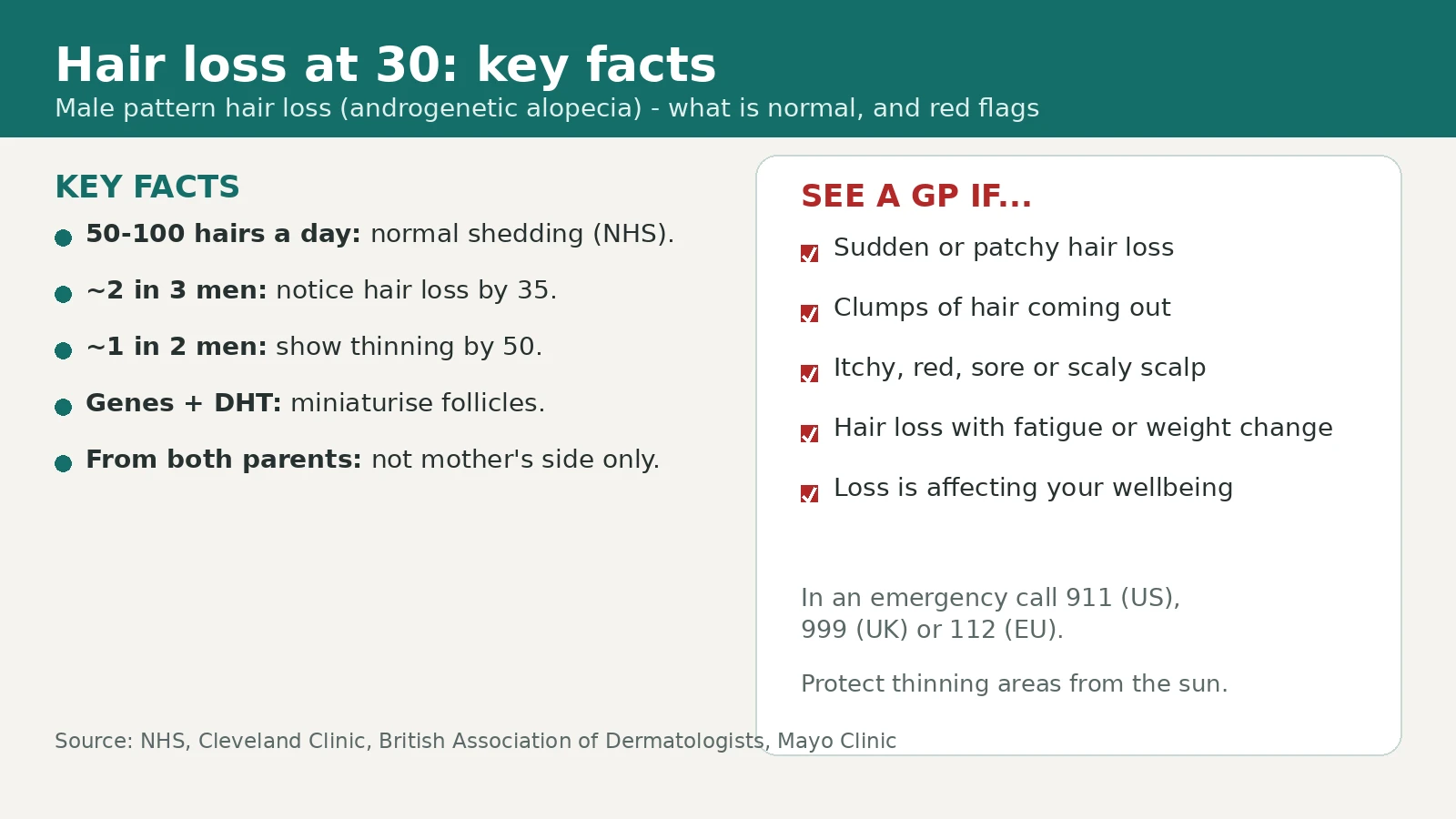
- Losing 50 to 100 hairs a day, often without noticing — new hair grows in at the same time (Mayo Clinic agrees).
- A hairline that sits slightly higher than it did in your teens — mild temple recession alone does not always progress.
- Slow, steady change over years rather than sudden shedding.
Hair loss myths worth forgetting
Cleveland Clinic’s dermatologist debunks several common explanations that are not the real reason men lose hair:
- Wearing hats or washing your hair too often — these do not cause pattern hair loss.
- It comes only from your mother’s side — it is inherited from both sides of the family.
- You have too much testosterone — DHT sensitivity, not high testosterone, drives the process.
Stress deserves a special mention. It is not usually the primary cause of male pattern baldness, but major stress can trigger a separate, temporary shedding called telogen effluvium, which usually recovers. It can also sit on top of pattern loss and make it look worse. Anabolic steroids are one genuine accelerator: the Australasian College of Dermatologists warns they can speed up progression, and Mayo Clinic notes an association between smoking and baldness in men.
Other causes your GP may rule out
Not all hair loss at 30 is the male pattern kind. The NHS and Mayo Clinic list several other causes of hair loss that a GP will consider:
- Thyroid problems and iron deficiency
- Illness, major weight loss or a stressful event (temporary shedding, months later)
- Medicines — including some for cancer, arthritis, depression, heart problems, gout and high blood pressure
- Scalp infections such as ringworm, and patchy autoimmune loss (alopecia areata)
- Tight hairstyles that pull the hair (traction alopecia)
What you can do
The NHS’s main treatments for male pattern baldness are finasteride and minoxidil. They do not work for everyone, they only work for as long as they are used, and they are not all available on the NHS, so you may have to pay. Neither should be started casually: talk to a doctor or pharmacist about whether any option suits you, and avoid buying unproven products online.
Everyday steps support scalp health: eat a balanced diet with enough protein, manage stress, be gentle with your hair, and protect thinning areas from the sun — the BAD reminds men that bald scalp is at risk of sunburn and long-term sun damage. Losing hair can affect confidence and wellbeing, and that is a valid reason to seek help in itself; the NHS says your GP can arrange counselling or point you to a support group.
When to see a doctor
The NHS advises seeing a GP if you are worried about your hair loss — and to get a GP’s view on the cause before going to a commercial hair clinic. Book an appointment if your loss is sudden, patchy, affects the whole scalp, or comes with other symptoms such as fatigue, unexplained weight change, or a sore, red, itchy or scaly scalp. Mayo Clinic adds that sudden hair loss can signal an underlying medical condition that needs treatment.
In an emergency call 911 (US), 999 (UK) or 112 (EU)
Frequently asked questions
Is it normal to lose hair at 30?
Yes. The process often starts at the temples in your twenties and becomes visible by the mid-thirties — Cleveland Clinic notes about two-thirds of men notice some loss by 35. Earlier onset can mean faster progression, and an earlier start does not mean something is wrong. A receding hairline and crown thinning at 30 usually means inherited male pattern hair loss, and it is not caused by anything you did wrong.
Does hair loss come from your mother's side?
No — that is a myth. Male pattern hair loss is polygenetic, with over 190 contributing genes inherited from both parents. Looking at the hair history on both sides of the family gives the best sense of your likelihood. Blaming one side of the family, or one parent, is simply not how the genetics work.
Can stress or wearing hats cause male pattern baldness?
No. Hats, frequent washing and high testosterone are not the cause, and stress is not usually the primary driver. However, a major stressful event can trigger a separate, temporary shedding called telogen effluvium, which usually recovers. It can also sit on top of pattern loss and make thinning look worse than it is.
Will my hair grow back on its own?
Male pattern hair loss is progressive and does not reverse by itself; without treatment it advances very slowly over years. Temporary shedding after illness, weight loss or a stressful event usually does grow back once the trigger passes. If you are unsure which type you have, a GP can tell the difference by looking at your hair.
What can slow hair loss down?
Medical treatments exist that can slow male pattern hair loss and sometimes encourage regrowth, but they do not work for everyone and only work while you keep using them. Talk to a doctor or pharmacist about whether any option suits you before starting anything, and avoid buying unproven products from the internet.
Sources
- NHS: Hair loss www.nhs.uk
- Cleveland Clinic: Why Do Some Men Go Bald? health.clevelandclinic.org
- British Association of Dermatologists: Hair loss male pattern (patient information leaflet, June 2024) cdn.bad.org.uk
- Australasian College of Dermatologists: Androgenetic alopecia (in men) www.dermcoll.edu.au
- Mayo Clinic: Hair loss (via Stormont Vail Health library) www.stormontvail.org

Try the tool
Not sure if it can wait?
Common causes and warning signs for 16 everyday symptoms.
Open the symptom guide

