Irregular Sleep and Heart Disease: What the Study Found
Irregular sleep was linked to a 24% higher risk of serious heart events in a study of 10,362 adults. What the research shows, and how to steady your sleep.
- Written by
- Health Daily Advice
- Published
- Reading time
- 6 minutes
- Sources
- 7 cited

In this guide
People whose nightly sleep length varied the most had a 24% higher relative risk of a serious heart event, according to a study of 10,362 adults published in November 2026. The link held for bedtime and wake-time swings too, while average sleep length showed no clear link. The study shows an association, not proof that irregular sleep causes heart disease.
What the new study found
Most sleep advice focuses on how many hours you get. This study asked a different question: does it matter how regularly you sleep? Researchers at the University of Maryland Medical System and Boston Children’s Hospital linked Fitbit sleep data with electronic health records from the US National Institutes of Health’s All of Us Research Program, and followed 10,362 adults for a median of 3.7 years.
Each person contributed at least 90 nights of valid Fitbit data across a 180-day baseline — more than a million nights of sleep in total. Over the follow-up, 230 people (about 2.2%) had a serious heart event: a heart attack, heart failure, cardiomyopathy or an ischaemic stroke.
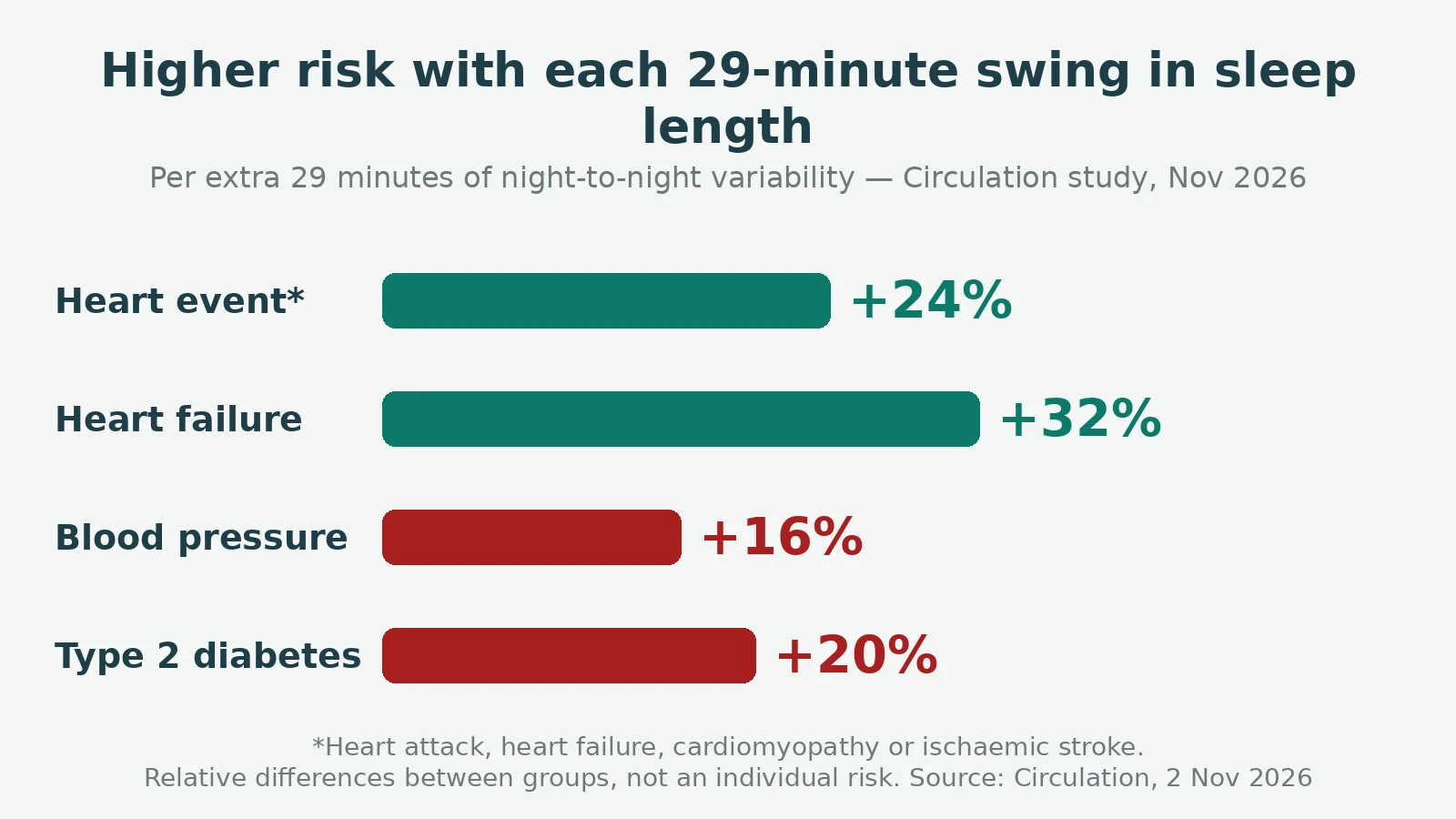
The headline finding was about night-to-night variability. For every extra 29 minutes of swing in nightly sleep duration — one standard deviation in this sample — the risk of that combined heart outcome was 24% higher (hazard ratio 1.24). The same pattern showed up for swings in bedtime (23% higher), wake time (20% higher) and sleep midpoint (21% higher).
Irregular sleep was also linked to the conditions that lead to heart disease:
| Outcome | Higher risk per 29-minute swing in sleep length |
|---|---|
| Heart attack, heart failure, cardiomyopathy or ischaemic stroke | 24% higher |
| Heart failure | 32% higher |
| High blood pressure | 16% higher |
| Type 2 diabetes | 20% higher |
These are relative differences between groups, not an individual’s chance of developing heart disease. Only 2.2% of participants had a heart event during the study, so for any one person the absolute risk was low. The findings were published on 2 November 2026 in Circulation: Population Health and Outcomes, and presented at the American Heart Association’s Scientific Sessions 2026.
The surprise: how long you sleep didn’t matter — in this study
Perhaps the most striking result is the one that didn’t appear. Average sleep duration — how many hours people slept on a typical night — showed no clear link to the heart-event outcome (hazard ratio 0.96, with a confidence interval that crossed 1.0, meaning no reliable effect).
That does not mean hours don’t matter. The authors studied a relatively healthy group of volunteers with no heart or metabolic disease at the start, and the result says nothing about the large body of evidence linking short sleep with heart risk. The CDC notes that adults who sleep fewer than 7 hours a night are more likely to report health problems including heart attack, and that nearly half of US adults have high blood pressure, a leading risk for heart disease and stroke.
What the study adds is a second dimension. Sleep health is not one number. The American Heart Association’s 2022 Life’s Essential 8 checklist scored sleep by duration alone; its 2025 scientific statement on sleep health now treats sleep as multidimensional — quantity, quality, timing and regularity. This study is evidence for that shift: in this sample, consistency carried the signal that duration did not.
Why would irregular sleep strain the heart?
The study itself cannot answer that — it shows a link, not a mechanism. But the paper’s authors point to what experiments have shown: irregular schedules repeatedly misalign the body’s internal clock, which raises blood pressure and impairs glucose regulation, while disrupted sleep alters autonomic balance and inflammation.
For many people, irregularity is a weekend habit. Lead researcher Dr Nguyen Minh Tuan Viet put it plainly: “Sleep irregularity is often due to weekends — we get to sleep a little bit later on a Friday night; or people have shift work.” The Mayo Clinic calls the weekend version “social jet lag”: going to bed and waking up later on weekends than weekdays, which it links to poorer health, worse mood and increased sleepiness.
Shift work is the other obvious source, and it is harder to fix than a late Friday night. The study adjusted for age, sex, race, education, income, smoking, alcohol, cancer and mental health conditions, but irregular sleep can still reflect other things — illness, caring duties or stress — that also affect heart risk.
There was also an exploratory finding about sleep cycles, the repeating rounds of light, deep and REM sleep. People who completed more full sleep cycles a night had a 28% lower risk of atrial arrhythmia (an irregular heartbeat). The paper itself calls this a novel finding needing confirmation, so it should be read as a lead for future research, not a conclusion.
What the study cannot prove
It is worth being clear about the limits, because the headline numbers are easy to over-read.
- It is observational. The study shows that irregular sleep and heart events travel together; it cannot prove one causes the other.
- Fitbit data is an estimate. Sleep stages were estimated by a wrist-worn device at home, not measured with brain monitoring in a sleep laboratory, the standard for sleep studies.
- The volunteers were not typical. Participants were All of Us volunteers who owned and linked a Fitbit: 70% women, 81.6% white, median age 53, with no heart or metabolic disease at the start. The results may not generalise to other groups or countries.
- Events were few. Only 230 heart events in 10,362 people, so the estimates rest on small numbers and the confidence intervals are fairly wide.
- No trial has tested the fix. Nothing in this study shows that stabilising a sleep schedule reduces heart risk — that would need an intervention trial.
An independent expert quoted by the American Heart Association, Dr Marie-Pierre St-Onge of Columbia University, made the same point: “We are still lacking the data to support a causal, independent impact of sleep regularity on cardiovascular disease risk. This study should prompt scientists to further evaluate links between sleep regularity and cardiovascular disease, so that we can make the same recommendations for regularity that we can for duration.”
How to make your sleep more regular
Keeping a steady schedule is already standard advice from the CDC and the NHS, and it costs nothing. The practical steps are simple, though not always easy:
- Keep the same bedtime and wake time every day, including weekends. The NHS adds: do not sleep in after a bad night — stick to your regular hours.
- Get natural light earlier in the day, and avoid bright artificial light, especially from screens, in the hours before bed.
- Be physically active during the day, but not within a few hours of bedtime. The NHS advises against exercising within 4 hours of bed.
- Wind down for at least an hour before bed — a bath, a book, or another quiet activity — and keep the bedroom cool, dark and quiet.
- Watch what you eat and drink late in the day. Avoid large meals late at night, and avoid alcohol, tea and coffee for at least 6 hours before bed, the NHS advises.
- Do not nap during the day if you struggle to sleep at night.
As the lead researcher put it: “While we often focus on getting a full eight hours of sleep every night, having a regular sleep schedule — consistent bedtimes, wake times, and sleep duration from night to night — is a practical, actionable step anyone can take that may help protect their heart and blood vessels.” Note the word “may”: the study supports regularity as a sensible habit, not as a proven way to prevent heart disease.
When to see a doctor
See a GP or doctor if changing your sleeping habits has not helped, if trouble sleeping has lasted months, or if poor sleep is affecting your daily life. The NHS gives the same advice for insomnia that does not improve with self-help.
Get medical advice sooner if you snore loudly, gasp or stop breathing during sleep — these can be signs of sleep apnoea, which raises the risk of high blood pressure, heart attack and stroke — or if you feel very sleepy during the day, fall asleep while driving, or have chest pain, breathlessness or palpitations.
In an emergency call 911 (US), 999 (UK) or 112 (EU)
Frequently asked questions
Does irregular sleep cause heart disease?
Not proven. The study found that people with more irregular sleep had more heart events, but it is observational, so it cannot show that irregular sleep caused them. Irregular sleep can reflect shift work, illness, stress or other factors that also affect heart risk. An independent expert quoted by the American Heart Association said the evidence is not yet strong enough to claim a causal effect.
How much sleep irregularity is too much?
The study measured risk per 29 minutes of extra night-to-night swing in sleep length — that was one standard deviation in its sample. Each extra 29 minutes was linked to a 24% higher relative risk of a serious heart event. The study does not set a safe threshold, and the absolute risk was low: only 2.2% of participants had a heart event over about 3.7 years.
Does this mean how long I sleep doesn't matter?
No. In this study, average sleep length showed no clear link to heart events, but the participants were relatively healthy volunteers with no heart or metabolic disease at the start. It does not overturn the large body of evidence linking short sleep — under 7 hours — with higher heart risk. The CDC still advises adults to get at least 7 hours a night, and to keep it regular.
What is social jet lag?
Social jet lag is the gap between your weekday and weekend sleep times — going to bed and waking up later on weekends than on workdays. The Mayo Clinic links it to poorer health, worse mood and increased sleepiness and fatigue, and says some studies connect it with a higher likelihood of heart disease. Keeping the same bedtime and wake time every day, including weekends, is the usual advice.
How can I make my sleep more regular?
Keep the same bedtime and wake time every day, including weekends, and do not sleep in after a bad night. Get natural light earlier in the day, be active during the day, and wind down for an hour before bed. Keep the bedroom cool, dark and quiet, and avoid large meals, alcohol and caffeine late in the day. If poor sleep lasts months, see a GP.
Can a fitness tracker tell me if my sleep is irregular?
It can give a rough picture. The study used Fitbit data to measure night-to-night changes in sleep length, bedtime and wake time. But a wrist-worn device estimates sleep stages rather than measuring them, and it is not a medical test. Use it to spot patterns — such as very different weekend sleep times — not to diagnose a sleep problem. Persistent trouble sleeping needs a doctor, not an app.
Sources
- Circulation: Population Health and Outcomes — Tran AK, Nguyen MTV. Sleep and Cardiometabolic Disease: A Wearable-Electronic Health Record Study in the US All of Us Research Program. Published 2 Nov 2026 www.ahajournals.org
- American Heart Association news release: Is a consistent sleep schedule important to heart health? newsroom.heart.org
- ScienceAlert: This One Sleep Factor Matters More Than How Many Hours You Get, Study Suggests www.sciencealert.com
- CDC: About Sleep and Your Heart Health www.cdc.gov
- NHS: Insomnia www.nhs.uk
- Mayo Clinic News Network Q&A: Still sleepy every morning? You may need a sleep test newsnetwork.mayoclinic.org
- Medical Bag / The Cardiology Advisor: Sleep Regularity Predicts Cardiometabolic Disease Risk www.medicalbag.com

Try the tool
Not sure if it can wait?
Common causes and warning signs for 16 everyday symptoms.
Open the symptom guide