Does Morning Sunlight Reset Your Circadian Rhythm?
Morning sunlight really does talk to your body clock — but the viral version skips the dose. Here is what the evidence says about light, timing and how much you actually need.
- Written by
- Health Daily Advice
- Published
- Reading time
- 7 minutes
- Sources
- 9 cited
In this guide
Yes, morning sunlight can nudge your body clock earlier, but not as the viral advice suggests. Light is the strongest signal your brain uses to set its roughly 24-hour rhythm, and bright morning light tells it the day has started. The catch is dose: the studies behind the claims used bright light for far longer than a couple of minutes.
You have probably seen the routine online: step outside first thing, look towards the morning sun for a few minutes, and your body clock resets itself. It sounds too easy, and in one important way it is. The science behind it is genuine, but the version doing the rounds on social media quietly drops the part about how much light, and for how long, the research actually used.
What is your circadian rhythm?
Your circadian rhythm is your internal body clock, the roughly 24-hour cycle that times sleep, waking, body temperature and hormone release. Cleveland Clinic describes it as the clock that regulates the approximately 24-hour cycle of biological processes, and notes that the word comes from Latin meaning “around the day”.
Left alone, that clock runs a little longer than 24 hours, so it needs a daily correction to stay in step with the real day. That correction comes mostly from light. A small cluster of nerve cells in the brain, the suprachiasmatic nucleus, acts as the master clock, and it takes its timekeeping cues from the eyes. Without a strong light signal each morning, the clock drifts later, which is why you can end up wide awake at midnight and groggy at 7am.
How does morning light reset the body clock?
Light reaches the master clock through a special set of cells in the retina. These are not the rods and cones you use to see. They are intrinsically photosensitive retinal ganglion cells, and they contain a pigment called melanopsin that is especially sensitive to the blue wavelengths plentiful in morning skylight. When they detect light, they send a signal straight to the master clock.
A review of the research by Joshua Gooley puts it plainly: light is the most important environmental signal for synchronising human circadian rhythms. The same review explains that the effect depends on when the light arrives. Light in the late biological night and early morning shifts the clock earlier, a phase advance. Light in the early biological night shifts it later, a phase delay. Stronger light, longer exposure and blue-rich light all make the shift bigger.
That timing rule is the whole story. Morning light pulls your sleepiness earlier in the evening. Evening light does the opposite, pushing sleepiness later. So the morning walk only helps if the evening does not undo it.
What does the evidence actually show?
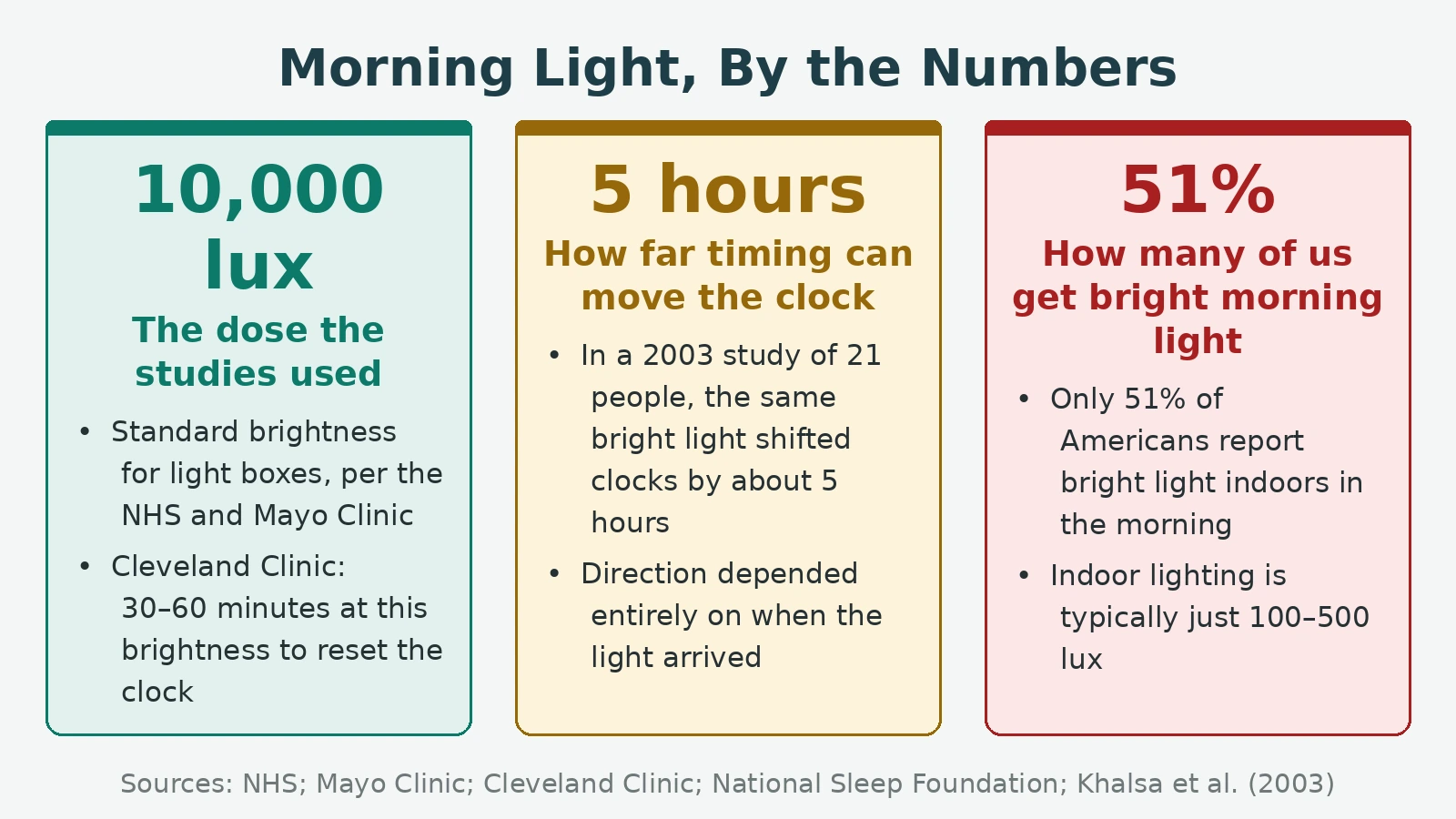
The most often cited experiment is a 2003 study in which 21 people were given several hours of bright light at different times of day, and researchers then measured what had happened to their body clocks. Light in the morning made them sleepy earlier the following evening, while light late at night made them sleepy later. The gap between the largest delay and the largest advance was about five hours, and timing was the only thing that varied. Ultrahuman’s review of the study reports the peak-to-trough shift as 5.02 hours.
That is a striking result, but look at the dose. Those volunteers sat in bright light for hours, at around 10,000 lux. Clinical bright light therapy works the same way: Cleveland Clinic says a high-intensity light of 10,000 lux is required, with sessions lasting thirty to sixty minutes. Mayo Clinic gives a similar picture for light boxes: 10,000 lux, for about 20 to 30 minutes, within the first hour of waking.
None of that says a couple of minutes outside is useless. Outdoors is vastly brighter than indoors. Direct sunlight on a summer midday reaches about 100,000 lux, and even an overcast winter day outdoors gives 1,000 to 3,000 lux, against ordinary indoor lighting of just 100 to 500 lux. So a short spell outside still delivers far more light than a whole morning indoors. It is simply not the same exposure the big clock-shifting studies used, and it works best as a daily habit rather than a one-off reset.
How much morning light do you actually need?
There is no single prescribed number of minutes, because the light you get depends on the weather, the season and where you live. A sensible approach, drawn from what the sources above agree on, looks like this:
- Go outside within an hour of waking. The National Sleep Foundation says your rhythm is most sensitive to light about one hour after your usual wake time, and suggests stepping outside for at least an hour each morning or afternoon.
- Give it at least ten minutes, and more if you can. Ten minutes outside is a reasonable floor. The studies that produced the largest shifts used hours of bright light, so there is no practical upper limit within a normal day.
- Step outside rather than sitting by a window. Glass cuts the intensity considerably, so the same ten minutes works harder outdoors.
- Go out on cloudy days too. Even a dull day outdoors is far brighter than a lit room, so the habit still counts in winter.
- Repeat it daily. The clock responds to a signal it receives every day, so one bright morning will not fix a late-running clock on its own.
One thing to get right: do not look directly at the sun. Let the light reach your eyes from the open sky while you walk, have your morning coffee outside, or simply stand in the garden. And keep the usual sun sense for your skin once the sun climbs higher.
Why timing matters more than the dose
Getting the morning part right is only half the job, because light at night pushes the clock the other way. A 2011 study of 116 people found that ordinary room light before bedtime suppressed the onset of melatonin, the hormone that signals sleep, and the same study is reported to have delayed melatonin onset in 99% of participants at light levels under 200 lux. That is dimmer than most living rooms in the evening.
The National Sleep Foundation makes the same point in plainer terms: light exposure at night is like resetting your body clock at the wrong time, and it recommends dimming the lights as you unwind and switching screens off at least one hour before bed. A morning light habit paired with bright evenings is working against itself.
This also explains why the viral advice can feel disappointing. If you get your few minutes of morning sun and then spend the evening under bright lights and screens, the two signals cancel each other out. The clock listens to the whole day, not just the first ten minutes of it.
Who should be careful with bright light?
Ordinary morning daylight is part of everyday life, and stepping outside in the morning is a low-risk habit for most people. Bright light therapy with a light box is a different matter, and it deserves a conversation with a doctor first.
The NHS advises speaking to a GP before trying light therapy, noting that it might not be suitable if you have certain eye conditions or take medicines that increase your sensitivity to light. If you do buy a light box, the NHS says to choose one that is 10,000 lux, UV-free and UKCA or CE marked, and to follow the manufacturer’s instructions.
Mayo Clinic adds two specific cautions: if you have bipolar disorder, the advisability and timing of a light box should be carefully reviewed with your health care provider, because increasing exposure too fast or using it for too long may trigger manic symptoms; and if you have eye problems such as glaucoma, cataracts or eye damage from diabetes, get advice from your eye specialist first.
The bottom line
Morning sunlight does reset your circadian rhythm, in the sense that it is the strongest signal your master clock uses to set itself for the day. What it does not do is reset it in two minutes flat. The evidence points to bright outdoor light, taken most mornings, for longer than the viral routine suggests, with dimmer evenings to protect the gain. Treat it as a daily habit rather than a quick fix, and it is one of the simplest, cheapest things you can do for your sleep.
When to see a doctor
See a doctor if your sleep problems last more than a few weeks, if you regularly cannot fall asleep until very late and cannot wake in the morning, or if poor sleep is affecting your work, mood or health. A doctor can check for a circadian rhythm sleep disorder or another sleep problem, and can advise whether light therapy is suitable for you. Keep a short note of your usual bedtime, wake time and how you feel during the day to take to the appointment.
Get urgent help if you feel so sleepy during the day that you fall asleep while driving or at work, or if you have sudden severe sleepiness with weakness, hallucinations or loss of muscle control. In an emergency call 911 (US), 999 (UK) or 112 (EU)
Frequently asked questions
Does morning sunlight reset your circadian rhythm?
Yes, it can shift your body clock earlier. Light is the strongest signal your master clock uses to set itself, and morning light tells it the day has started. But the shift depends on dose and timing: the studies that moved clocks used bright light of around 10,000 lux for much longer than a few minutes, and light in the evening pushes the clock later instead. Think of it as a daily habit, not a one-off reset.
How long should I spend in morning sunlight?
Aim for at least ten minutes outside within an hour of waking, and more if you can. The National Sleep Foundation suggests stepping outside for at least an hour each morning or afternoon, and the studies that produced the largest clock shifts used hours of bright light. Even an overcast day outdoors gives 1,000 to 3,000 lux, far more than indoor lighting, so a longer walk on a dull day still counts.
Is a few minutes of morning sun enough to reset my body clock?
Probably not on its own. A few minutes outside is better than staying indoors, because even a short spell outdoors is far brighter than a lit room. But the trials that shifted body clocks used bright light of around 10,000 lux for 30 to 60 minutes or more, and the biggest shifts came from hours of exposure. Treat morning light as a daily habit and pair it with dimmer evenings for the best chance of a real shift.
Can morning light help me fall asleep earlier?
It can help, if your clock is running late. Morning light shifts the clock earlier, which can bring sleepiness forward in the evening — in a 2003 study, people given bright light in the morning felt sleepy earlier the next evening. It works best alongside a regular wake time and dim light in the evening, since bright light at night pushes the clock later and can undo the morning's work.
Is morning sunlight safe for everyone?
Stepping outside in morning daylight is a low-risk habit for most people, and you should never look directly at the sun. Bright light therapy with a light box is different: the NHS advises speaking to a GP first, as it may not suit people with certain eye conditions or medicines that increase light sensitivity. Mayo Clinic adds that people with bipolar disorder or eye problems such as glaucoma should get specialist advice first.
Sources
- Gooley JJ: Light-induced Resetting of Circadian Rhythms in Humans www.jstage.jst.go.jp
- National Sleep Foundation: Good Light, Bad Light, and Better Sleep www.thensf.org
- NHS: Seasonal affective disorder (SAD) www.nhs.uk
- Mayo Clinic: Seasonal affective disorder treatment — Choosing a light box www.mayoclinic.org
- Cleveland Clinic: Circadian Rhythm Disorders my.clevelandclinic.org
- Ultrahuman: Why a good night's sleep starts with morning light www.ultrahuman.com

Try the tool
Not sure if it can wait?
Common causes and warning signs for 16 everyday symptoms.
Open the symptom guide