Sleep and Activity Patterns Linked to Dementia Risk
Two disrupted sleep and activity patterns were linked to nearly double the dementia hazard in a 12-year study of 3,973 older adults — but poor sleep alone carried no extra risk when daily rhythms stayed strong.
- Written by
- Health Daily Advice
- Published
- Reading time
- 7 minutes
- Sources
- 8 cited

In this guide
Two combinations of broken sleep and disrupted daily rhythms were linked to nearly twice the dementia hazard in a 12-year study of 3,973 older adults, published in JAMA Network Open on 18 November 2026. The reassuring twist: poor sleep alone carried no extra risk when daily rhythms stayed strong and people kept moving.
What did the new study find?
Researchers from the Whitehall II study followed 3,973 British adults aged 60 and over with no dementia at the start. Each wore a wrist movement sensor for nine days in 2012–2013, and health records were tracked for a median of 12.3 years. In that time, 379 people — about one in ten — received a dementia diagnosis.
The team sorted people into nine sleep–wake profiles from 36 measurements of rhythm, daytime activity, sleep and timing. Two profiles stood out. Compared with the healthiest pattern, both carried almost double the adjusted hazard of dementia — a hazard ratio of 1.94 for one group and 1.96 for the other, as reported in the study in JAMA Network Open.
A hazard ratio of 1.94 does not mean a 94% chance of developing dementia — it means diagnoses appeared at a rate roughly 94% higher than in the comparison group, after accounting for age, sex, lifestyle and other health factors. The absolute figures tell a calmer story: dementia was diagnosed in 8.3% of the healthiest group, against 16.9% and 15.1% in the two higher-risk groups.
How did researchers measure sleep and activity?
Most earlier work on sleep and dementia relied on people remembering and reporting how they slept. This study used wrist accelerometers — small motion sensors worn day and night — so sleep and movement were measured objectively. The sensors captured the shape of each person’s whole 24-hour cycle, not just how long they slept. The four dimensions the researchers combined were:
- Rest–activity rhythm: how clearly the day was active and the night restful, and how stable that pattern was day to day.
- Daytime activity: time spent moving, including light activity, versus sitting still.
- Sleep: duration, efficiency (time in bed actually spent asleep) and fragmentation (how often sleep was broken up).
- Chronotype: whether activity and sleep tended to run early or late.
Dementia diagnoses were picked up from linked hospital, mental health and mortality records up to March 2025. Separately, 3,806 participants took cognitive tests — memory, reasoning, verbal fluency and processing speed — at three points across a decade, so the team could track how quickly thinking skills changed.
Which sleep and activity patterns carried the highest dementia risk?
The comparison group, profile 3, had a strong, stable rhythm, plenty of light activity and longer, efficient sleep. Against that benchmark, the two patterns below were linked to nearly double the dementia hazard. A third group, the most sedentary of all, showed no significant rise in diagnosed dementia once health was taken into account — but its members’ thinking skills declined fastest.
| Pattern | What it looked like | Dementia cases | Adjusted hazard ratio |
|---|---|---|---|
| Profile 3 — reference | Strong, stable rhythm; more light activity; longer, efficient sleep | 52 of 626 (8.3%) | 1.00 (reference) |
| Profile 7 — disrupted rhythm, low activity, poor sleep | Weak, fragmented rhythm; little activity; short, inefficient, broken sleep | 61 of 362 (16.9%) | 1.94 (95% CI 1.32–2.84) |
| Profile 8 — disrupted rhythm, restless sleep | Weak day–night contrast; active days but restless, agitated sleep | 35 of 232 (15.1%) | 1.96 (95% CI 1.27–3.03) |
| Profile 9 — most sedentary | Weakest, most fragmented rhythm; poorest activity; most time sitting | Not significantly raised after full adjustment | Fastest cognitive decline (see below) |
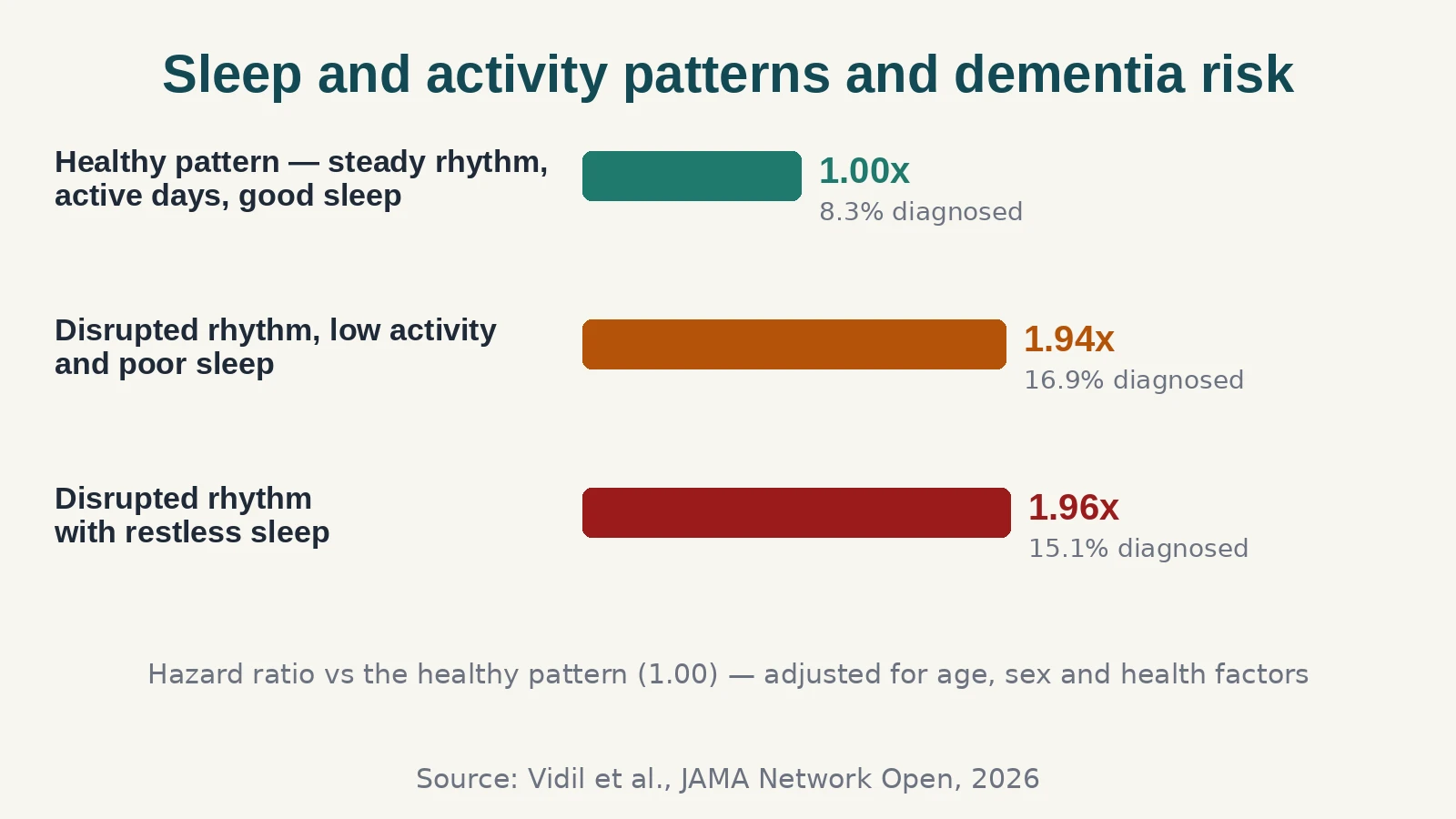
The two higher-risk groups were quite different. One group barely moved during the day and slept badly at night. The other was reasonably active in the daytime but tossed and turned through the night, with little clear difference between their active and resting periods. Both ended up with a similar, roughly doubled hazard — suggesting there is more than one route to a disrupted 24-hour cycle.
What happened to thinking skills over ten years?
Dementia diagnoses were only half the picture. On cognitive tests, the low-activity, poor-sleep group (profile 7) lost ground faster than the reference group — an extra 0.14 standardised units over ten years — and the most sedentary group (profile 9) faster still, by 0.28 units. An accompanying editorial in JAMA Network Open described those gaps as roughly equivalent to four and nine extra years of age-related decline. One nuance: the restless-sleep group scored lower at the start, but their rate of decline afterwards was not significantly faster.
Why did poor sleep on its own not raise the risk?
Perhaps the most surprising finding was what did not predict dementia. People who slept poorly but kept a strong daily rhythm and stayed active showed no significant rise in dementia hazard. Likewise, people with weak rhythms and little activity but relatively good sleep were not significantly worse off. It was the combination — disrupted rhythms plus inactivity or restless sleep — that carried the risk.
As the editorial put it, the same sleep problem can carry a very different outlook depending on the rest of the daily pattern. That fits with earlier evidence: Alzheimer’s Research UK notes that a study of more than 10,000 UK civil servants followed for 25 years found sleeping under six hours a night between the ages of 50 and 70 was linked to up to 30% higher dementia risk — yet experts consider about seven hours a night ideal, and what counts is the pattern over weeks and months, not a single bad night. A separate US study of 2,183 older adults, summarised by Gilmore Health, points the same way: each standard-deviation drop in the strength of the day–night activity contrast was linked to a 54% higher adjusted dementia hazard.
Could dementia be causing the sleep problems instead?
This is the biggest open question. Alzheimer’s disease can begin damaging the brain many years before symptoms are obvious enough for a diagnosis, and during that silent period brain changes could disturb sleep, movement and daily rhythms — so a broken sleep–wake pattern might be an early sign of dementia rather than a cause of it.
Several checks make that explanation less likely to account for everything. Excluding everyone diagnosed within the first five years, both associations stayed significant (hazard ratios 1.63 and 2.29). Excluding 702 people who already had mild cognitive impairment, the restless-sleep link held (1.79) while the low-activity, poor-sleep link weakened and lost significance. Adjusting for genetic risk and Alzheimer’s blood markers did not remove the associations either.
There are limits to keep in mind. The wrist sensors measured movement, not brain waves, so they could not diagnose underlying sleep disorders such as sleep apnoea, insomnia or restless legs syndrome, which may have explained some of the patterns. And the participants were mostly British former civil servants — a relatively healthy and homogeneous group — so the results may not apply in the same way to everyone. The study’s own conclusion is careful: further research is needed to test whether improving sleep–wake patterns can reduce dementia risk or delay its onset. No one has shown that yet.
Why does this matter now?
The World Health Organization reports that 57 million people were living with dementia worldwide in 2021, with nearly 10 million new cases every year; Alzheimer’s disease accounts for 60–70% of cases. Dementia is the fifth leading cause of death globally, and the WHO lists poor sleep and physical inactivity among the factors that raise risk. The NHS points out that by tackling the risk factors we can change, around four in ten cases could be prevented.
How can you look after your sleep and daily rhythm?
Nothing in this study proves that changing your routine will prevent dementia — it was not a trial of any treatment. But the habits that support a steady 24-hour rhythm are the ones health bodies already recommend for brain health:
- Keep regular hours. Going to bed and getting up at roughly the same time every day helps set the body’s internal clock, and Alzheimer’s Research UK lists this as one of its top sleep tips.
- Move during the day. The NHS recommends at least 150 minutes of moderate-intensity activity a week, such as brisk walking or cycling, plus strengthening exercises twice a week — and sitting less.
- Get morning light. The JAMA Network Open editorial highlights bright morning light, structured daytime activity and good sleep hygiene as the approaches most worth testing next.
- Wind down before bed. A short relaxing routine, dimming screens and avoiding alcohol and caffeine late in the day can help sleep settle.
- Stay socially and mentally engaged. The WHO lists staying socially and cognitively active among its recommended steps, alongside activity, a healthy weight and managing blood pressure, cholesterol and blood sugar.
The practical message is hopeful. A single bad night is not a verdict on your future brain health. What seemed to matter most was the shape of the whole day, repeated over months and years: active days, restful nights, and a clear, steady rhythm between the two.
When to see a doctor
Talk to a doctor if sleep problems persist for weeks, if you snore loudly or gasp during sleep, if you feel very sleepy during the day, or if you are worried about your memory or thinking. A doctor can check for treatable causes such as sleep apnoea, low mood or medication side effects. Do not try to diagnose yourself from a sleep tracker — these tools cannot tell you your personal dementia risk.
If memory problems come on suddenly, or someone becomes confused or very drowsy, seek urgent help. In an emergency call 911 (US), 999 (UK) or 112 (EU).
Frequently asked questions
Can poor sleep increase dementia risk?
It depends on the wider pattern. In this study, poor sleep alone was not linked to higher dementia risk when people kept strong daily rhythms and stayed active. Earlier research found sleeping under six hours a night between ages 50 and 70 was linked to up to 30% higher risk. What seems to matter most is the pattern over weeks and months, not a single bad night.
What sleep pattern was linked to the highest dementia risk?
Two patterns carried nearly double the hazard. One combined weak, fragmented daily rhythms with little physical activity and short, inefficient, broken sleep (hazard ratio 1.94; dementia in 16.9% of the group). The other combined weak day-night contrast with restless, agitated sleep (hazard ratio 1.96; dementia in 15.1%). The healthiest pattern saw dementia in 8.3%.
Does being active protect your brain if you sleep badly?
The study points that way, but it does not prove it. People who slept poorly yet kept strong daily rhythms and higher activity showed no significant rise in dementia hazard. The researchers did not test whether exercise offsets poor sleep, and the study was observational, so it cannot show that changing activity levels changes risk.
How many people took part in the study?
The study followed 3,973 British adults aged 60 and over from the Whitehall II cohort, with a median age of 68.4 years and 26% women. None had dementia when they wore wrist movement sensors for nine days in 2012-2013. Over a median 12.3 years of follow-up, 379 participants received a dementia diagnosis.
Can changing your sleep pattern prevent dementia?
That has not been shown. This was an observational study, so it cannot prove that improving sleep or daily rhythms prevents dementia — disrupted patterns could be an early sign of dementia rather than a cause. The authors say trials are needed to test whether sleep-wake interventions reduce risk or delay onset. Healthy sleep and activity habits are still recommended for general brain health.
When should I see a doctor about sleep or memory?
Talk to a doctor if sleep problems persist for weeks, if you snore loudly or gasp during sleep, if you feel very sleepy during the day, or if you are worried about your memory or thinking. A doctor can check for treatable causes such as sleep apnoea or medication side effects. Sudden confusion or memory problems need urgent help.
Sources
- JAMA Network Open: Vidil et al., Sleep-Wake Cycle Profiles and Incident Dementia and Cognitive Decline in Older Adults (2026) jamanetwork.com
- JAMA Network Open: Liguori, Unraveling the Role of Sleep-Wake Cycle Regularity in Dementia Risk Assessment (2026) jamanetwork.com
- Gilmore Health: Two Sleep and Activity Patterns Linked to Nearly Double the Dementia Hazard in 12-Year Study www.gilmorehealth.com
- NHS: Can dementia be prevented www.nhs.uk
- WHO: Dementia fact sheet www.who.int
- Alzheimer's Research UK: How does sleep affect dementia risk? www.alzheimersresearchuk.org

Try the tool
Not sure if it can wait?
Common causes and warning signs for 16 everyday symptoms.
Open the symptom guide