Napping and Dementia: What a 10-Year Study Found
Frequent daytime naps were linked to a 48% higher dementia risk in a 10-year study of nearly 1,000 older Americans — but planned, occasional naps showed no link at all.
- Written by
- Health Daily Advice
- Published
- Reading time
- 4 minutes
- Sources
- 6 cited

In this guide
Older adults who nap most days may face a higher risk of dementia, according to a 10-year study of nearly 1,000 Americans aged 65 and over. Frequent nappers had a 48% higher risk than people who rarely or never napped — but planned, occasional naps showed no link at all.
What the 10-year study found
The study, published in The Journals of Gerontology in October 2026, followed 995 US Medicare beneficiaries who were free of dementia in 2013 and tracked them for up to 10 years using the National Health and Aging Trends Study, a nationally representative survey of older Americans. Researchers looked at three features of napping: how often people napped, whether the naps were planned, and how long they lasted.
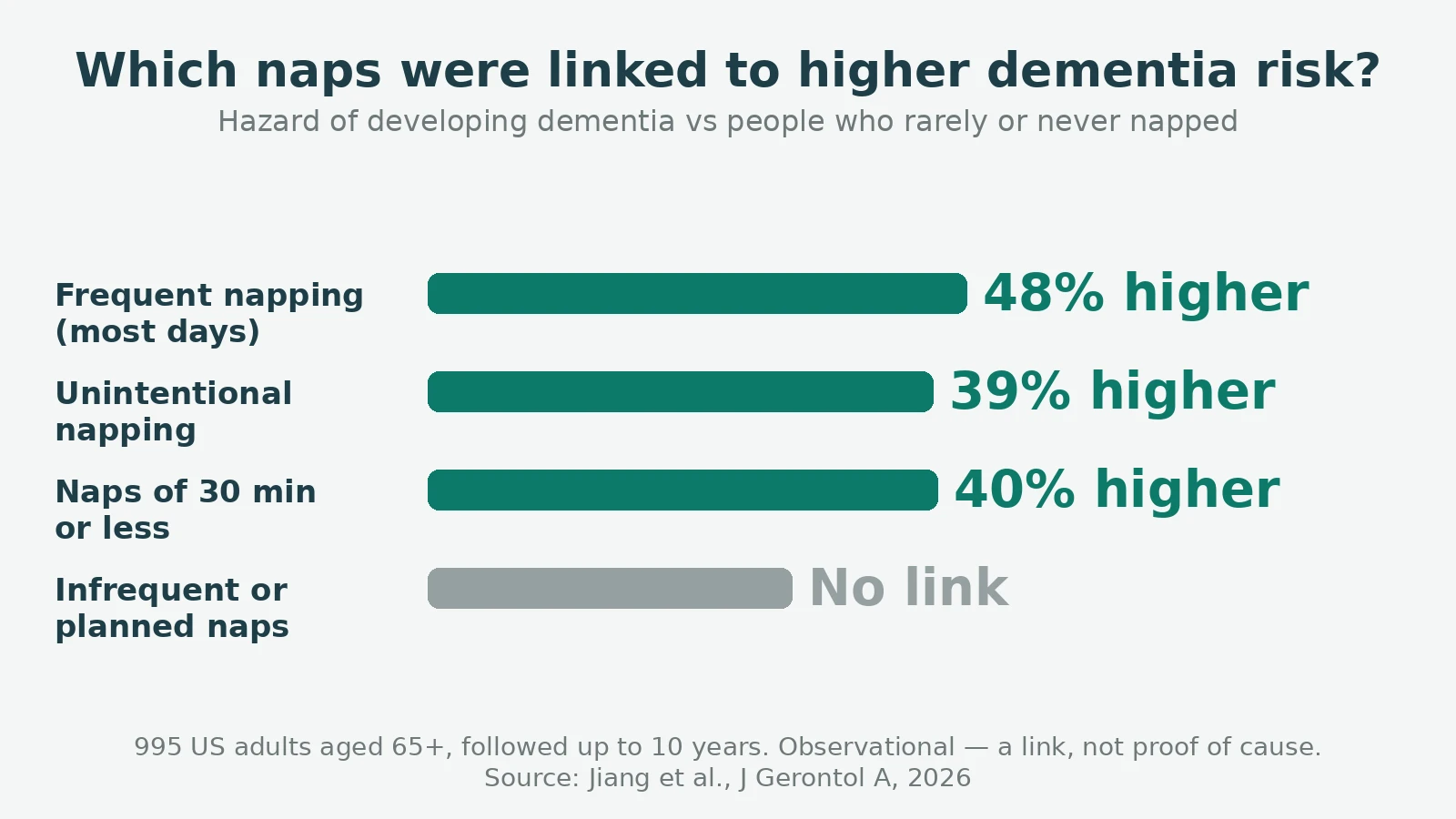
People who napped most days or every day had a 48% higher risk of developing dementia than those who rarely or never napped, even after accounting for age, health conditions and nighttime sleep. Napping for 30 minutes or less was linked to a 40% higher risk. But infrequent napping — some days only — showed no association.
Planned naps vs falling asleep without meaning to
The most striking distinction was intention. People who fell asleep without meaning to — dozing off in a chair, for example — had a 39% higher dementia risk. People who deliberately planned their naps showed no increased risk at all. The researchers say this makes sense: a planned nap is usually a habit or a way to catch up on sleep, while unintentional napping can be a sign of excessive daytime sleepiness, which itself can reflect changes in the brain.
Does napping really cause dementia?
The study cannot answer that — and the researchers are careful to say so. It was observational, which means it can show a link, not a cause. In fact, the relationship probably runs in both directions. As senior author Professor Adam Spira of Johns Hopkins put it, more frequent napping could be a marker of changes in the brain rather than a cause of them: the brain regions that keep us awake can start to degenerate early in dementia, which may itself make people nap more.
To test this, the team excluded dementia cases diagnosed within the first five years of follow-up. The links for frequent and unintentional napping stayed similar, which suggests napping patterns may genuinely precede a diagnosis rather than simply reflect it. Still, the authors stress that longer studies with objective measures of napping are needed.
What earlier research says
The picture has been mixed, which is why this study matters. A 2023 meta-analysis pooling 20 studies found napping was associated with dementia overall, and that naps longer than 30, 45 and 60 minutes a day were linked to a 35%, 41% and 40% higher risk of cognitive impairment respectively. A separate 12-year study of 2,751 older men, which measured naps with wrist monitors rather than asking people to recall them, found that naps of two hours or more a day were linked to a 66% higher risk of cognitive impairment. Other studies, though, have found no link — or even benefits from short naps — and differences in how naps were measured and in cultural attitudes to napping may explain the inconsistency.
Why this matters for dementia prevention
About 6.9 million older adults in the United States live with dementia, a number expected to roughly double by 2060, and there is still no cure. Researchers estimate that up to 45% of dementia cases worldwide might be prevented by addressing modifiable risk factors. If napping habits turn out to be one of them — or even just a useful early warning sign — they would be easy to spot. The study’s first author, Dr Kening Jiang, suggests that monitoring napping could serve as an early and accessible marker to help identify older adults at higher risk and guide prevention efforts.
How to nap more wisely
There is no need to give up naps on the basis of this study, and the researchers do not recommend it. But the findings point to a few sensible habits, echoed by the Alzheimer’s Association and Mayo Clinic. Keep naps short and planned rather than long and accidental. Protect your nighttime sleep with a regular routine — same bedtime and waking time, morning daylight, daily exercise and limited caffeine and alcohol. And avoid long afternoon naps, which can make it harder to fall asleep at night. If you find yourself dozing off without meaning to most days, that is worth mentioning to your doctor, especially if it is new.
When to see a doctor
Talk to your GP if daytime sleepiness is new, getting worse, or comes with memory problems, confusion, loud snoring or pauses in breathing during sleep, or difficulty staying awake during the day. A sudden change in napping habits can have many causes — poor nighttime sleep, sleep apnoea, depression, medication side effects or other health problems — and a doctor can check for treatable ones. If someone shows sudden confusion, slurred speech, face drooping or weakness on one side, seek emergency help. In an emergency call 911 (US), 999 (UK) or 112 (EU).
Frequently asked questions
Does napping cause dementia?
No study has shown that. This research found a link between frequent or unintentional napping and a higher dementia risk over 10 years, but it was observational, so it cannot prove cause and effect. Napping may instead be an early sign of brain changes that lead to dementia, because the brain regions that keep us awake can start to degenerate early in the disease.
How long a nap is linked to dementia risk?
In this study, naps of 30 minutes or less were linked to a 40% higher risk of dementia, while the link for longer naps weakened once nighttime sleep was taken into account. An earlier meta-analysis of 20 studies found naps over 30, 45 and 60 minutes a day were linked to a 35%, 41% and 40% higher risk of cognitive impairment. The evidence is still mixed.
Are short naps bad for your brain?
Not necessarily. Planned, occasional naps showed no link to higher dementia risk in this study — only frequent and unintentional napping did. Short planned naps can be refreshing and are a normal part of life for many people. The pattern to notice is needing to nap most days, or falling asleep without meaning to, especially if that is new.
Why would napping be linked to dementia?
The link probably runs in both directions. Poor nighttime sleep and conditions such as sleep apnoea can make people sleepy in the day, and napping can then disturb nighttime sleep. At the same time, early dementia can damage the brain regions that regulate wakefulness, making people doze off during the day. Researchers are still working out which comes first.
Should I stop napping?
There is no need to stop napping because of this study, and the researchers do not recommend it. Planned, occasional naps were not linked to higher risk. It is sensible to keep naps short and planned, protect your nighttime sleep with a regular routine, and talk to a doctor if you start dozing off without meaning to most days or notice memory problems.
Sources
- Johns Hopkins Bloomberg School of Public Health: Frequent, Unintended Napping Tied to Higher Dementia Risk publichealth.jhu.edu
- Jiang K, et al. Napping characteristics and incident dementia: results from the National Health and Aging Trends Study. J Gerontol A Biol Sci Med Sci. 2026;81(10):glag208 academic.oup.com
- Wu Fang, et al. Association between napping and cognitive impairment: a systematic review and meta-analysis. Sleep Med. 2023;111:146-159 pubmed.ncbi.nlm.nih.gov
- Alzheimer's Association: Treatments for Sleep Changes www.alz.org
- Leng Y, et al. Objective napping, cognitive decline and risk of cognitive impairment in older men. Alzheimers Dement. 2019;15(8):1039-1047 pmc.ncbi.nlm.nih.gov
- Mayo Clinic: Alzheimer's: Managing sleep problems www.mhsystem.org

Try the tool
Not sure if it can wait?
Common causes and warning signs for 16 everyday symptoms.
Open the symptom guide