HPV Viral Load and Cervical Cancer: Why the Trend Matters
A single HPV test tells you the virus is there. A new study suggests that how the amount of virus changes over time tells you far more — and could help doctors spot who needs closer follow-up.
- Written by
- Health Daily Advice
- Published
- Reading time
- 4 minutes
- Sources
- 7 cited

In this guide
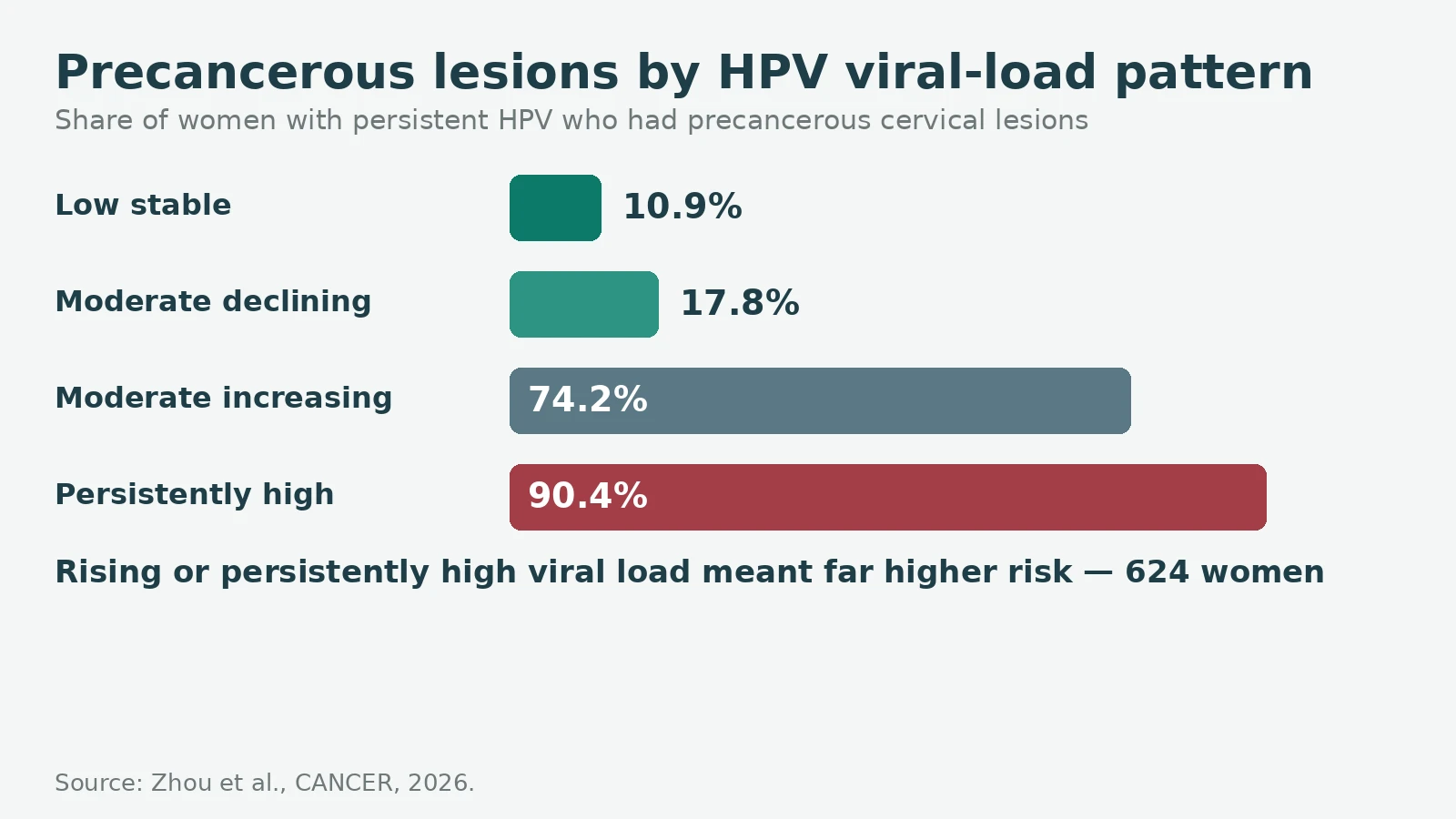
Possibly. In a study of 624 women with persistent HPV infection, precancerous cervical lesions were found in 90.4% of those whose viral load stayed high, and 74.2% of those whose levels were rising — compared with 10.9% when levels stayed low. Tracking how HPV levels change over time predicted risk far better than a single test.
What is HPV viral load?
HPV — human papillomavirus — is an extremely common virus passed on through sexual contact. Almost all cervical cancer cases (99%) are linked to infection with high-risk types of HPV, according to the World Health Organization.
Viral load is simply a measure of how much of the virus is present in a sample taken during a test. A higher viral load means more virus is present; a lower one means less. Most HPV infections cause no symptoms and clear on their own: nearly 90% are gone within one to two years. It is only when a high-risk infection persists that it can, over years, cause changes in the cells of the cervix that may eventually lead to cancer.
What the new study found
Researchers at Nanjing Medical University in China followed 624 women with persistent HPV infection, testing their viral load at roughly six-month intervals. They found four distinct patterns — and the differences in outcome were stark. The study was published in CANCER, a journal of the American Cancer Society, in November 2026.
| Viral-load pattern | Women | Precancerous lesions found |
|---|---|---|
| Low stable | 247 (39.6%) | 10.9% |
| Moderate declining | 118 (18.9%) | 17.8% |
| Moderate increasing | 186 (29.8%) | 74.2% |
| Persistently high | 73 (11.7%) | 90.4% |
Compared with the low stable group, the risk of precancerous lesions was about twice as high when levels were falling slowly, nearly 30 times as high when levels were rising, and 124 times as high when levels stayed persistently high. Women in the persistently high group were also far more likely to have high-grade cell changes, the kind most likely to progress if left untreated.
Why the trend matters more than a single test
Until now, doctors have mostly looked at a single viral-load reading. This study shows that two women with similar readings at one appointment can be heading in very different directions. As co-author Lina Zhang put it:
“Two women with similar HPV viral loads at one visit may have very different outcomes depending on how those levels change over time.”
Adding the trend over time made risk prediction far more accurate. On the study’s accuracy measure, the score rose from 0.71 using standard information alone to 0.89 once viral-load trends were included. The researchers hope this could lead to more personalised follow-up: closer surveillance for women whose levels are rising or staying high, and fewer unnecessary examinations for women whose levels are low and stable.
This was a single study in one hospital in China, and the approach is not yet part of routine screening anywhere. Larger studies in other populations will be needed before clinics change how they follow up persistent HPV.
What this means for cervical screening
Cervical screening exists precisely to catch cell changes before they become cancer. In England, the NHS Cervical Screening Programme invites women and people with a cervix aged 25 to 64 every five years. The sample is first tested for high-risk HPV; if HPV is found, the same sample is checked for abnormal cells.
If HPV is found but there are no abnormal cells, you are usually invited for another screening test in 12 months, to check whether your immune system has cleared the virus. If abnormal cells are found, you are referred for a closer look at the cervix, called a colposcopy. The HPV vaccine, offered in the UK since 2008, protects against the types that cause most cervical cancers — but vaccinated people should still attend screening, because the vaccine does not cover every type.
Worldwide, cervical cancer remains the fourth most common cancer in women: in 2022 an estimated 660,000 women were diagnosed and about 350,000 died. The WHO says effective vaccination and screening can prevent most cases, and has set targets to eliminate cervical cancer as a public health problem.
What happens if HPV is found?
Finding HPV does not mean you have cancer, and it does not mean you will develop it. Most infections clear without treatment, and slightly abnormal cells often go away on their own once the virus clears. What matters is follow-up: attend the appointments you are offered, and talk to your GP or the screening service if you are worried or unsure what your result means. They can explain your own result — this article cannot, because risk depends on the individual.
When to see a doctor
See a GP promptly if you notice bleeding after sex, bleeding between periods or after the menopause, new or different vaginal discharge, or lower tummy or back pain, or pain during sex. These are the symptoms the NHS lists as reasons to get checked, whether or not you are due for screening. Do not wait for your next screening invitation if you have symptoms.
In an emergency call 911 (US), 999 (UK) or 112 (EU)
Frequently asked questions
What does HPV viral load mean?
Viral load is a measure of how much human papillomavirus (HPV) is present in a sample taken during a test. A higher viral load means more of the virus is present; a lower one means less. It is not a diagnosis: it is one piece of information that, together with other results, helps doctors judge how likely cell changes are.
Does a high HPV viral load mean I have cancer?
No. A high or rising viral load means a higher likelihood of precancerous cell changes, not that cancer is present. In the study, precancerous lesions were found in 90.4% of women whose load stayed high — but those are changes that can be treated before cancer develops. Only further tests, such as colposcopy, can show what is actually happening.
Does HPV always cause cervical cancer?
No. HPV is extremely common, and nearly 90% of infections clear on their own within one to two years without causing any harm. Only a persistent infection with a high-risk type can, over many years, cause cell changes that may lead to cancer — which is why screening and follow-up matter, and why most people with HPV never develop cancer.
How often should I have cervical screening?
In England, women and people with a cervix aged 25 to 64 are invited for cervical screening every five years. If HPV is found but there are no abnormal cells, you are usually invited back in 12 months to check whether the virus has cleared. If abnormal cells are found, you are referred for colposcopy. Always attend the appointments you are offered.
Can the HPV vaccine prevent cervical cancer?
The vaccine protects against the high-risk HPV types that cause most cervical cancers, and it is a key part of prevention — the WHO wants 90% of girls vaccinated by age 15. But it does not protect against every type of HPV, so vaccinated people should still attend cervical screening when invited.
Sources
- Zhou Y, et al. Longitudinal Viral Load Trajectories Predict Cervical Lesion Risk in Women With Persistent HPV Infection: A Prospective Cohort Study. CANCER, 2026 doi.org
- Wiley: Are viral load trends a predictor of cervical cancer in women with persistent human papillomavirus infection? newsroom.wiley.com
- WHO: Cervical cancer www.who.int
- NHS Cervical Screening Administration Service: Patients csas.nhs.uk
- GOV.UK: Cervical screening: programme overview www.gov.uk
- Drugs.com (HealthDay): Trajectories of HPV Infection Can Predict Cervical Lesions www.drugs.com

Try the tool
When is your next period and fertile window?
Six cycles ahead from your last period date.
Open the calculator