What Is Egg Freezing? How It Works, Costs and Success Rates
Egg freezing lets you store younger eggs for later use — but age, cost and honest success rates matter more than the headlines suggest.
- Written by
- Health Daily Advice
- Published
- Reading time
- 7 minutes
- Sources
- 6 cited

In this guide
Egg freezing, also called oocyte cryopreservation, is a way of preserving fertility by collecting eggs from your ovaries, freezing them, and storing them for later use. It lets you keep eggs from a younger age so they can be thawed and used in fertility treatment in the future — but it improves your chances, it never guarantees a baby.
What is egg freezing?
Egg freezing is a form of fertility preservation. A woman is born with all the eggs she will ever have, and both the number and the quality of those eggs fall as she gets older. Freezing eggs while they are younger is an attempt to hold on to that fertility for later, as the Human Fertilisation and Embryology Authority (HFEA) explains.
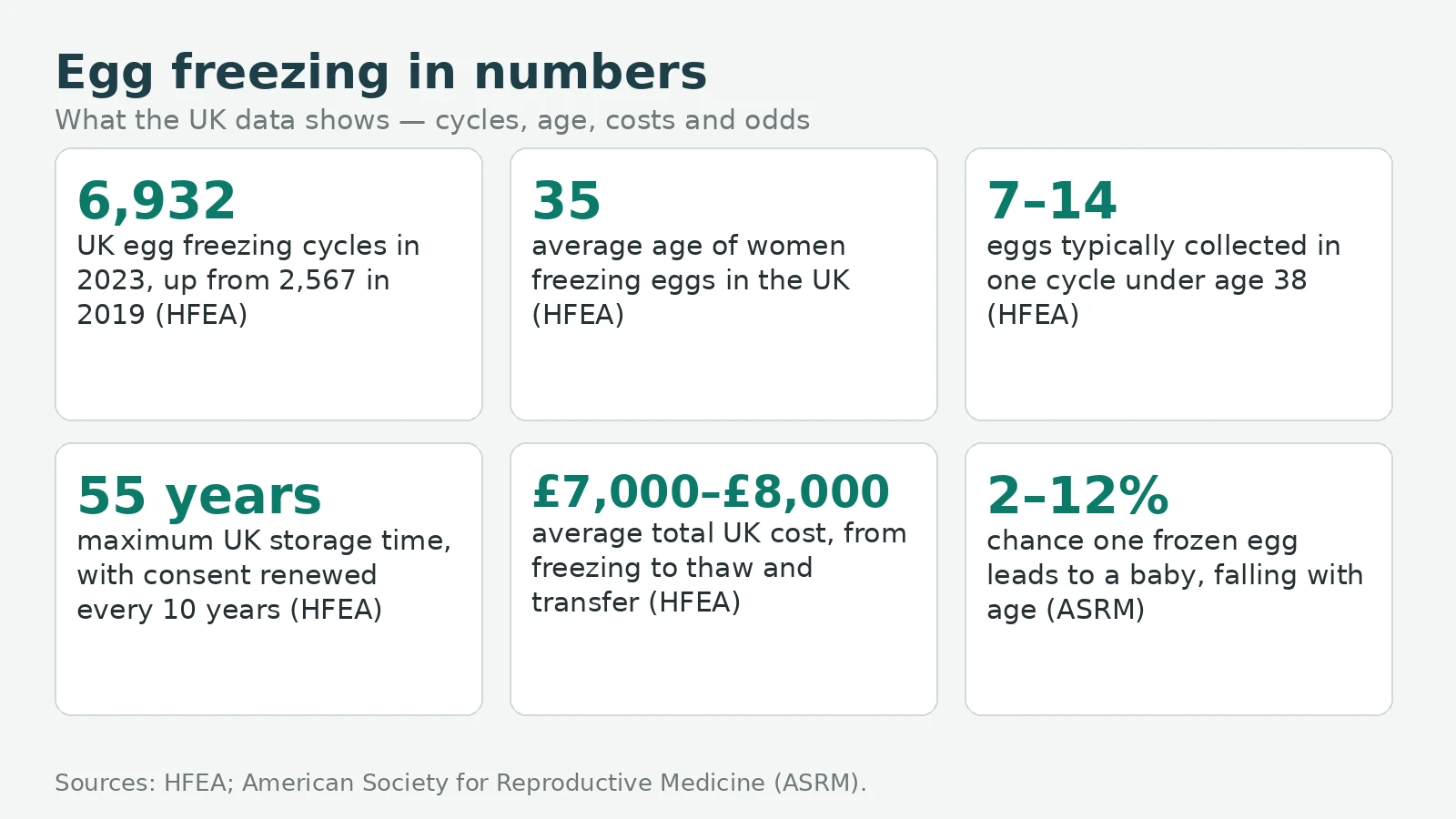
Interest has grown sharply. The HFEA recorded 6,932 egg freezing cycles in the UK in 2023, up from 2,567 in 2019, and the number of patients choosing to freeze their eggs rose by 44% between 2022 and 2024, according to the HFEA. Even so, it still made up only 7% of all UK treatment cycles in 2024 — it is not a promise of a future pregnancy, and it does not stop the clock entirely. What it offers is a better set of odds than using eggs collected at an older age.
How does egg freezing work?
Egg freezing follows the first half of an IVF cycle. The whole process usually takes around two to three weeks.
1. Assessment and screening
First come blood tests and an ultrasound scan to check your ovarian reserve — roughly, how many eggs you are likely to produce. Clinics also test for infectious diseases such as HIV and hepatitis, so affected samples can be stored separately. Talk to a doctor or fertility specialist about what your own results mean.
2. Ovarian stimulation
Normally, one egg matures each month. During stimulation you give yourself daily hormone injections for around 10 to 12 days to encourage several follicles — the small fluid-filled sacs in the ovaries that each hold an egg — to grow at the same time. From around day six, a second daily injection stops the eggs being released too early. Vaginal ultrasound scans every two to three days let the clinic watch the follicles grow and adjust your medication, as described in the NHS patient leaflet on egg freezing. A final “trigger” injection, taken about 36 hours before collection, matures the eggs.
3. Egg collection
Egg collection is a short procedure, usually lasting 10 to 30 minutes, done under sedation with pain relief. A doctor guides a fine needle through the wall of the vagina into the ovaries, using ultrasound, and drains each follicle to collect the eggs. You will need the whole day off work, and you must not drive for 24 hours afterwards. Some crampy, period-like pain and light bleeding for 24 to 72 hours afterwards is common.
4. Freezing and storage
Only mature eggs can be frozen, and not every egg collected will be mature. The suitable eggs are treated with a freezing solution called a cryoprotectant, then frozen extremely quickly. This ultra-fast method is called vitrification, and the HFEA notes it is more successful than the older slow-cooling method, because it stops damaging ice crystals forming inside the egg. The frozen eggs are stored in tanks of liquid nitrogen.
Why does your age matter so much?
Age at freezing is the single biggest factor in whether frozen eggs eventually lead to a baby. Eggs frozen in your twenties or early thirties are healthier than eggs frozen later: more survive the thaw, more fertilise, and more lead to a pregnancy. The American Society for Reproductive Medicine (ASRM) puts the chance that any one frozen egg will lead to a baby at only about 2% to 12%, falling with age. That is why the number of eggs matters.
The HFEA says most patients under 38 have around 7 to 14 eggs collected in a cycle. Fertility Network UK advises that it is preferable to freeze at least 15 eggs for a realistic chance of a live birth, and many people need more than one cycle to reach that number. Research quoted in the NHS leaflet found that, in women younger than 38 who started with 20 eggs, 75 out of 100 were likely to have at least one baby — but none from women who froze at 40 or over.
| Age when eggs are frozen | What the evidence says |
|---|---|
| 20s to early 30s | Best chances — ASRM says planned egg freezing typically works best at this age |
| Before 38 | Freezing is most likely to succeed; aim for at least 15 eggs, ideally more |
| At 38 | About 25 to 30 frozen eggs are needed for a reasonable chance of one child (ASRM) |
| Over 38 | Not commonly recommended; chances fall sharply and more cycles are usually needed |
How much does egg freezing cost?
The HFEA gives the following UK averages, and advises patients to ask for a fully itemised quote:
| Stage | Average UK cost (HFEA) |
|---|---|
| Collecting and freezing the eggs | About £3,350 |
| Medication | £500 to £1,500 |
| Storage per year | £125 to £350 |
| Thawing and transferring to the womb | About £2,500 |
| Whole process, freezing to thaw and transfer | £7,000 to £8,000 on average |
In the United States, one cycle costs around $16,000 on average — about $11,000 charged by the clinic and around $5,000 for medication, according to FertilityIQ data quoted by Fertility Days. The average patient does a second cycle, and more than 20% do a third.
On the NHS, funding depends on why you are freezing. People who need fertility preservation for medical reasons — most commonly before cancer treatment — can generally have it on the NHS, depending on where they live. Freezing for non-medical reasons, sometimes called social or elective freezing, is not NHS-funded. The HFEA estimates that at least 15% of egg freezing cycles between 2018 and 2022 were for medical reasons.
How long can eggs be stored?
In the UK, eggs can now be stored for up to 55 years from the date they were first placed in storage, under a law that changed on 1 July 2022 (before that, the limit was usually 10 years). The condition is that you must renew your consent to storage every 10 years. Keep your contact details up to date — if the clinic cannot reach you, or you do not renew, your eggs will be removed from storage and disposed of.
Who is egg freezing for?
Medical freezing is for people whose fertility is about to be affected by a health condition or its treatment — most often chemotherapy or radiotherapy for cancer. Elective freezing, sometimes called social freezing, is for people who are not ready for a child yet, or have not found the right partner, and want to keep the option open. It is also an option for Armed Forces personnel before deployment, and for trans people before hormone therapy or surgery.
Most recent growth has been elective: the average age at thawing was 40 in 2023. But far fewer people return to use their frozen eggs — only around 15% of people who stored eggs had come back to use them in one UK dataset.
What are the risks and side effects?
Egg freezing is mostly very safe, but the HFEA is blunt about the biggest risk: it might not work. The other main risks are:
- Ovarian hyperstimulation syndrome (OHSS). The fertility drugs can overstimulate the ovaries, causing swelling, pain and nausea and, in severe cases, fluid building up in the abdomen. An ASRM guideline puts moderate to severe OHSS at about 1% to 5% of IVF cycles, and the HFEA notes it can be potentially fatal in extreme cases.
- Problems during egg collection. The needle can cause bleeding, or very rarely puncture the bladder or bowel, and there is a small risk of infection. Serious complications are rare — about once in every 1,000 procedures.
- Side effects of the drugs. Bloating, mood changes, headaches, hot flushes and injection-site soreness are common, and usually settle once the cycle ends.
- Emotional and financial strain. The process is expensive, the outcome is uncertain, and the wait between freezing and using the eggs can last years.
What happens when you want to use your eggs?
When you are ready, the eggs are thawed and the ones that survived intact are fertilised — but not in the usual way. Freezing toughens the outer coating of the egg, so sperm may not be able to get in on its own. Instead, a single sperm is injected directly into each egg, a technique called ICSI (intracytoplasmic sperm injection), using your partner’s or a donor’s sperm. This is an extra cost unless you have NHS funding.
The fertilised eggs, now embryos, are grown in the laboratory for about five days. A maximum of two embryos are then transferred into the womb. One large US clinic study found that about 6.4% of warmed eggs became a live-born child.
When to see a doctor
Egg freezing is a big decision, and the right answer depends on your age, your health and your plans. Talk to a doctor or fertility specialist before you commit — ideally early, because the best results come from freezing sooner rather than later.
After a cycle, contact your clinic urgently for severe abdominal pain, rapid swelling, persistent vomiting, difficulty breathing, heavy bleeding or a fever.
In an emergency call 911 (US), 999 (UK) or 112 (EU)
Egg freezing has given many people real choices about when to start a family. But the HFEA’s warning is worth keeping in mind: do not think of it as an insurance policy. Ask the clinic for its own success rates for women your age, and get the full cost in writing.
Frequently asked questions
What is the best age to freeze your eggs?
ASRM says planned egg freezing works best in your twenties to early thirties, and is most likely to succeed when eggs are frozen before 38. The average age of women freezing eggs in the UK was 35 in 2023. After 38, success falls sharply and many more eggs are needed.
How much does egg freezing cost in the UK?
In the UK, the HFEA puts the average cost of collecting and freezing eggs at about £3,350, plus £500 to £1,500 for medication and £125 to £350 a year for storage. Thawing and transferring the eggs later costs about £2,500, bringing the whole process to £7,000 to £8,000 on average.
How long can frozen eggs be stored?
In the UK, eggs can be stored for up to 55 years from the date they were first placed in storage, under a law that changed in July 2022. You must renew your consent every 10 years, and your clinic will contact you before each renewal. If you do not renew, your eggs are removed from storage.
Does egg freezing guarantee a baby?
No. The HFEA is clear that egg freezing does not guarantee a baby. ASRM puts the chance that one frozen egg leads to a baby at about 2% to 12%, falling with age. Success depends on your age when you freeze and how many eggs you store — which is why clinics advise freezing at least 15 eggs.
What happens when I want to use my frozen eggs?
The eggs are thawed and the surviving ones are fertilised using ICSI, where a single sperm is injected into each egg, because freezing toughens the egg's outer coating. The embryos are grown for about five days, then a maximum of two are transferred into the womb. This is an extra cost unless you have NHS funding.
Is egg freezing available on the NHS?
The NHS generally funds egg freezing only for medical reasons, such as before cancer treatment, and availability depends on where you live. Freezing for non-medical reasons — sometimes called social or elective freezing — is not NHS-funded, so most people pay privately at a licensed clinic.
Sources
- HFEA: Egg freezing www.hfea.gov.uk
- HFEA: Egg freezing — a factsheet www.hfea.gov.uk
- Kingston and Richmond NHS Foundation Trust: Egg freezing www.kingstonandrichmond.nhs.uk
- Fertility Network UK: Fertility preservation fertilitynetworkuk.org
- Fertility Days: Egg Freezing Cost in the US (2026) www.fertilitydays.com

Try the tool
When is your next period and fertile window?
Six cycles ahead from your last period date.
Open the calculator