Forever Chemicals and Breast Cancer: What the NIH Study Found
Women with the highest blood levels of two 'forever chemicals' had a markedly higher rate of aggressive ER-negative breast cancer in a large NIH study. What the research found, what it does not prove, and how to cut exposure.
- Written by
- Health Daily Advice
- Published
- Reading time
- 7 minutes
- Sources
- 8 cited

In this guide
Women with the highest blood levels of two “forever chemicals”, PFOA and PFOS, had a markedly higher rate of oestrogen receptor-negative breast cancer than women with the lowest levels, according to a large US National Institutes of Health study published in November 2026. The link applied only to this aggressive tumour type, not to breast cancer overall.
What the NIH study found
The study, published in the Journal of Clinical Oncology, drew on the Sister Study, a long-running US research project led by the National Institute of Environmental Health Sciences. It enrolled 50,884 women aged 35 to 74 in the United States and Puerto Rico between 2003 and 2009. Every participant had a sister who had previously been diagnosed with breast cancer, and none had breast cancer themselves when they joined. For this analysis, researchers measured 17 PFAS chemicals in blood samples collected years before diagnosis, comparing 1,609 women who later developed breast cancer with 2,269 women who did not.
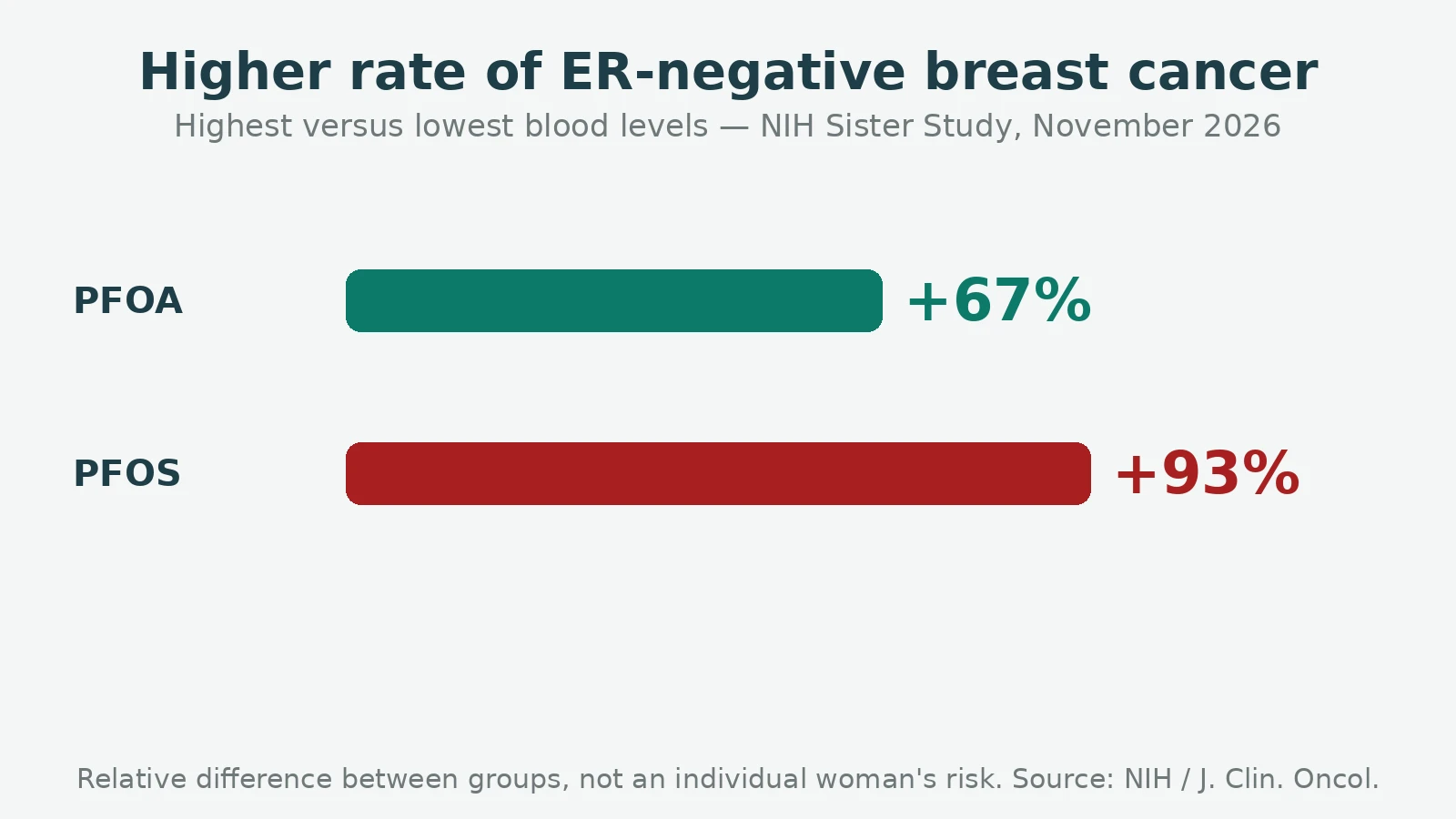
Two chemicals stood out. Women in the group with the highest blood levels of perfluorooctanoic acid (PFOA) had a 67% higher rate of oestrogen receptor-negative (ER-negative) breast cancer than women in the lowest group. For perfluorooctanesulfonic acid (PFOS), the rate was 93% higher — nearly twice as high. A separate meta-analysis of seven earlier prospective studies, which the researchers carried out to check the result, further supported the link for PFOA.
Crucially, the study found no clear association between either chemical and breast cancer risk overall. The link was specific to ER-negative tumours. The researchers also stressed that the percentages describe relative differences between groups, not an individual woman’s chance of developing breast cancer. As the study’s lead investigator, Dr Alexandra White of the NIH, put it, the findings show that certain legacy PFAS are associated with a higher risk of ER-negative breast cancer, “a more aggressive tumor type with few known risk factors”.
What are PFAS, PFOA and PFOS?
PFAS stands for per- and polyfluoroalkyl substances: a large family of thousands of man-made chemicals used in common consumer products. They are often called “forever chemicals” because they do not break down easily in the environment and can remain in the body for years. PFOA and PFOS are the two most extensively produced and studied members of the family, and both have been largely phased out and replaced with newer PFAS compounds.
Because of their widespread use and persistence, many PFAS are found in the blood of people and animals all over the world, and at low levels in food, water, air, fish and soil. The main route of exposure is swallowing contaminated food and water. According to the US Agency for Toxic Substances and Disease Registry (ATSDR), nearly all people in the United States have had some exposure to PFAS.
PFAS have been linked to other health effects too. The ATSDR notes sufficient evidence that they can raise cholesterol levels, slightly lower birth weight, and reduce the antibody response to some vaccines in children, and that PFOA is linked to kidney cancer. Until now, the evidence on breast cancer was inconclusive: the ATSDR’s review found no consistent evidence of an association, while the National Academies rated it as limited or suggestive. The new NIH study therefore strengthens evidence that was previously uncertain, rather than being the first hint of a link.
What ER-negative breast cancer means
Breast cancers are often described by whether their cells carry receptors for the hormone oestrogen. ER-negative tumours lack those receptors, so oestrogen cannot help their cells grow. Compared with cancers that respond to oestrogen, ER-negative breast cancers tend to be more aggressive and have worse outcomes, and scientists know less about what raises the risk of this type.
The difference also matters for treatment. Hormone therapy, such as tamoxifen, works by blocking oestrogen receptors, so it only helps when the cancer cells have those receptors. Cancers that do not express oestrogen or progesterone receptors are hormone receptor-negative and usually need chemotherapy, unless the cancer is very small. Some ER-negative tumours are also negative for the HER2 receptor, a combination known as triple-negative breast cancer, which is associated with a higher risk of the cancer spreading.
Breast cancer remains the most common cancer in women worldwide. The World Health Organization estimates that 2.4 million women were diagnosed in 2024 and 694,000 died of the disease that year. About 80% of breast cancers occur in women with no specific risk factors other than sex and age.
What the study does not prove
An association is not proof of cause. This was an observational study: it followed women over time and compared blood levels with later diagnoses, but it did not test how PFAS might cause cancer. The authors suggest the chemicals may act through non-hormonal pathways, such as changes in gene activity or the immune system, but they state clearly that the study did not test those explanations.
The study population also matters. Because every participant had a sister with breast cancer, the group was at higher-than-average risk from the start, so the results may not apply in exactly the same way to the general population. The researchers call for further investigation, including studies in groups with higher PFAS exposure and in groups more affected by ER-negative breast cancer. The International Agency for Research on Cancer has classified PFOA as carcinogenic to humans and PFOS as possibly carcinogenic, but that classification and this new study still leave open questions about newer replacement PFAS chemicals, which the study did not examine.
How to reduce PFAS exposure
Completely avoiding PFAS is unlikely, because they are present at low levels in some foods and in the environment. But the US Environmental Protection Agency (EPA) lists practical steps that can lower exposure, and the same advice is echoed by the ATSDR:
- Drinking water: ask your local water supplier whether it has tested for PFAS and what it is doing about them. If you are concerned, consider a home water filter certified to lower PFAS levels, or use an alternative water source for drinking, cooking and brushing teeth.
- Private wells: have the water tested regularly, and contact your state environmental or health agency for a list of certified laboratories.
- Fish: avoid eating fish from waterways affected by PFAS, and follow local fish consumption advisories.
- Products: if you have questions about products you use at home, the EPA suggests contacting the Consumer Product Safety Commission.
- Breastfeeding: PFAS can pass from a mother’s blood into breast milk, but based on current science the benefits of breastfeeding appear in most cases to outweigh the risks of PFAS exposure for infants. Mothers who are concerned should talk to their doctor.
If you are worried about your own exposure, the ATSDR advises talking to your doctor. There is no single test or treatment that applies to everyone, and a clinician can weigh your individual circumstances.
Breast cancer symptoms to know
Whatever your exposure, knowing the symptoms of breast cancer matters more than any single study. According to the NHS, the main symptoms in women are:
- a lump or swelling in your breast, chest or armpit
- a change in the skin of your breast, such as dimpling that looks like orange peel
- a change in the colour of the skin on your breast
- a change in the size or shape of one or both breasts
- nipple discharge when you are not pregnant or breastfeeding, which may contain blood
- a change in the shape or look of your nipple, such as it turning inwards, or a rash on it
You may have pain in your breast or armpit with these symptoms, but you can also have them without any pain — and breast pain on its own is not usually a symptom of breast cancer. Most breast lumps are not cancer, and the World Health Organization notes that cancerous lumps are more likely to be treated successfully when they are small and have not spread to nearby lymph nodes.
When to see a doctor
See a GP if you have a lump or swelling in your breast, chest or armpit, any change in your breasts or nipples that is not normal for you, or pain in your breast or armpit when other people in your family have had breast cancer or ovarian cancer. The NHS stresses that having these symptoms does not definitely mean you have breast cancer, but it is important to get checked: if the symptoms are caused by cancer, finding it early may mean it is easier to treat. It is also worth checking your breasts regularly so you know what is normal for you.
In an emergency call 911 (US), 999 (UK) or 112 (EU). If you notice a new breast change, do not wait for your next routine appointment — contact your GP promptly.
Frequently asked questions
Do forever chemicals cause breast cancer?
The new NIH study shows an association, not proof of cause. Women with the highest blood levels of PFOA and PFOS had higher rates of ER-negative breast cancer, but the study did not test how the chemicals might cause cancer. Earlier evidence was inconclusive, and researchers say more studies are needed before any causal claim can be made.
What are PFOA and PFOS?
PFOA and PFOS are two of the most studied PFAS, or 'forever chemicals'. They were widely used in consumer and industrial products and have been largely phased out, but they persist in the environment and in the body for years. Most people have been exposed to them, mainly through contaminated food and drinking water.
What is ER-negative breast cancer?
ER-negative breast cancer is a type whose cells lack receptors for the hormone oestrogen, so oestrogen cannot fuel their growth. These tumours tend to be more aggressive and have worse outcomes than oestrogen-sensitive cancers, and hormone therapy such as tamoxifen does not work on them, so treatment usually involves chemotherapy.
How can I reduce my exposure to PFAS?
Ask your water supplier whether it has tested for PFAS, and consider a home filter certified to lower PFAS levels if you are concerned. Avoid fish from PFAS-affected waterways and follow local fish advisories. Completely avoiding PFAS is unlikely, since they are present at low levels in food and the environment.
Does the study mean my personal risk is higher?
Not necessarily. The 67% and 93% figures are relative differences between the highest- and lowest-exposure groups in a higher-risk study population, not an individual's chance of developing breast cancer. Breast cancer risk depends on many factors, and about 80% of cases occur in women with no specific risk factors other than sex and age.
What are the symptoms of breast cancer?
The main symptoms are a lump or swelling in the breast, chest or armpit, changes in breast skin such as dimpling, changes in the size or shape of a breast, nipple discharge, or a nipple turning inwards. See a GP promptly if you notice any of these changes, even though most lumps turn out not to be cancer.
Sources
- NIH: Two 'forever chemicals' associated with higher risk of aggressive breast cancer in NIH analysis www.nih.gov
- Chang CJ, et al. Per- and Polyfluoroalkyl Substance Exposure and Breast Cancer Incidence in the Sister Study. Journal of Clinical Oncology doi.org
- US EPA: PFAS Explained www.epa.gov
- US EPA: Meaningful and Achievable Steps You Can Take to Reduce Your Risk www.epa.gov
- ATSDR/CDC: Health Effects: PFAS Information for Clinicians www.atsdr.cdc.gov
- WHO: Breast cancer fact sheet www.who.int
- NHS: Symptoms of breast cancer in women www.nhs.uk
- Cancer Research UK: Hormone therapy for breast cancer www.cancerresearchuk.org

Try the tool
When is your next period and fertile window?
Six cycles ahead from your last period date.
Open the calculator