What Causes Bleeding After Sex? Causes and When to See a Doctor
Bleeding after sex is usually caused by a harmless cervical change, an infection, vaginal dryness or a polyp — but it should always be checked. This guide covers the common causes, what happens at the doctor, and the red flags that need prompt care.
- Written by
- Health Daily Advice
- Published
- Reading time
- 8 minutes
- Sources
- 10 cited

In this guide
Bleeding after sex, known as postcoital bleeding, is usually caused by a harmless change on the cervix, an infection, vaginal dryness or a small growth called a polyp. It is often nothing serious, but because it can rarely be an early sign of cervical cancer, any bleeding after sex should be checked by a doctor.
What is postcoital bleeding?
Postcoital bleeding is spotting or bleeding during or after sex that is not part of your period. It can be a few drops of pink or brown blood, or a heavier bleed. It can happen once and never return, or it can keep happening. The blood usually comes from the cervix — the lower, narrow end of the womb — or from the lining of the vagina, both of which are delicate tissues that can bleed when touched.
It is worth knowing that bleeding and pain are different symptoms, even though they sometimes appear together. Pain during sex, known as dyspareunia, has its own causes and treatments, which we cover in our guide to painful sex in women. This article deals only with bleeding.
How common is bleeding after sex?
Bleeding after sex is a common complaint. A review of the research published in Obstetrics and Gynecology International found that it affects between 0.7% and 9.0% of menstruating women, with around 6% experiencing it in any given year. The same review found that in women who are still having periods, the bleeding clears up on its own in about half of cases within two years when no cause is found.
Those numbers are reassuring, but they do not mean the symptom can be ignored. The NHS advises that bleeding after sex is not usually serious, but should always be checked by a GP or sexual health clinic. A single episode is enough reason to book an appointment.
What causes bleeding after sex?
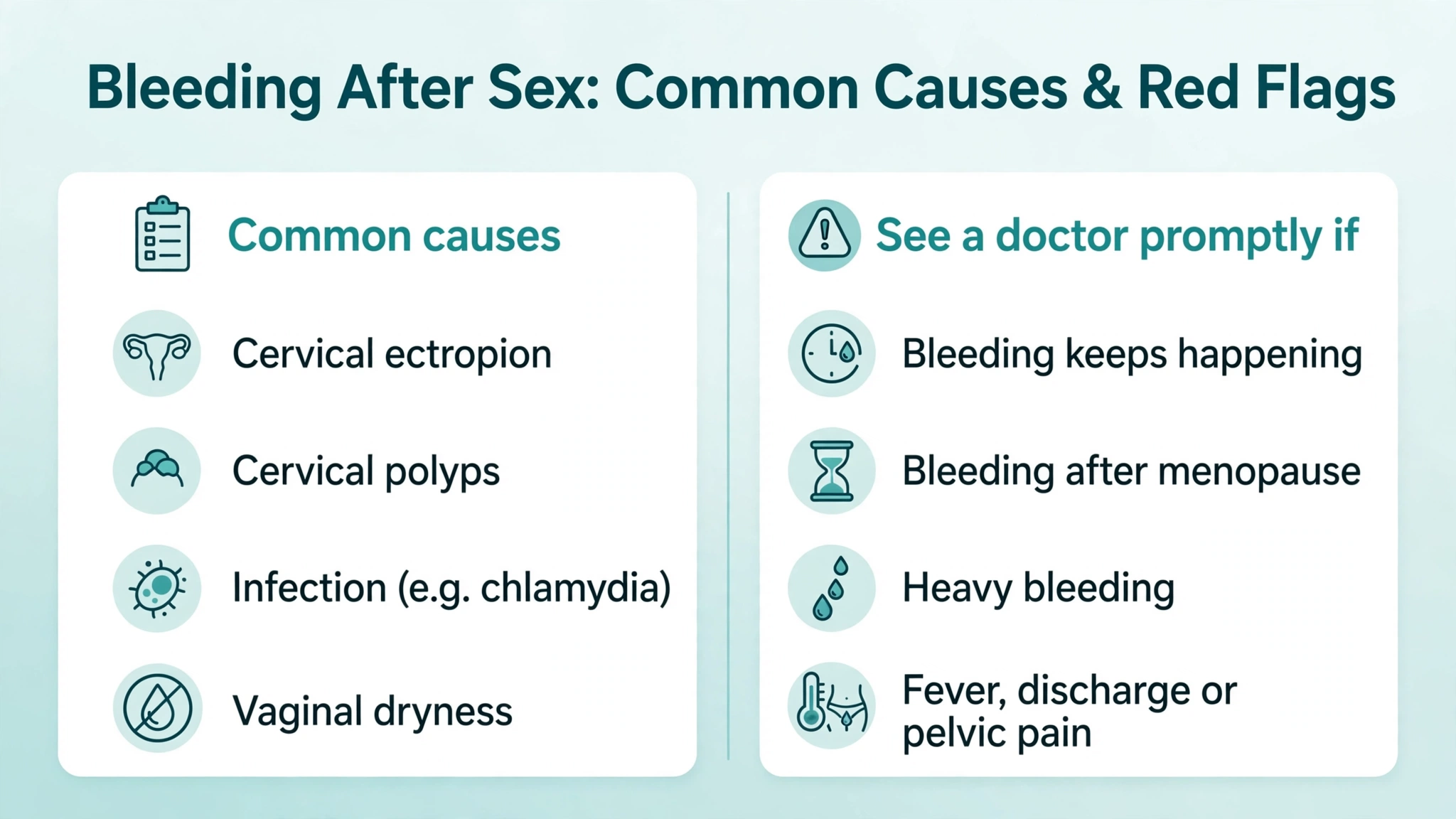
There are many possible causes, and in some cases a doctor never finds a clear one. The most common causes fall into a few groups.
Cervical ectropion
Cervical ectropion, sometimes called cervical erosion, is one of the most common causes. It happens when the soft cells that normally line the inside of the cervix grow on its outer surface. Those cells are delicate and bleed easily when touched, which is why sex can trigger spotting. Ectropion is not a disease and is not cancer. It is often seen in teenagers, in women taking the combined contraceptive pill, and in pregnancy, because the cervix is remodelling at those times. It usually needs no treatment, although a doctor may suggest treatment if the bleeding keeps happening.
Cervical polyps
Polyps are small, soft growths on the cervix. They are almost always non-cancerous, but because they are fragile they bleed easily during sex. Cervical polyps are found in about 4% of women seen in gynaecology clinics, most often in women in their 40s and 50s who have had children. A doctor can usually remove a polyp in a simple clinic procedure and send it for testing, which also stops the bleeding.
Infections and inflammation of the cervix
Inflammation of the cervix, known as cervicitis, is often caused by a sexually transmitted infection such as chlamydia or gonorrhoea, or by other infections including trichomoniasis and bacterial vaginosis. An infected cervix becomes swollen and fragile, so it bleeds on contact. Chlamydia is a particularly common culprit — and it often causes no other symptoms at all, which is why testing matters even when you feel well otherwise. Unusual discharge, burning when you pass urine, or pain low in the tummy can appear alongside the bleeding, but their absence does not rule an infection out.
An untreated infection can spread upwards to the womb, fallopian tubes and ovaries, a condition called pelvic inflammatory disease (PID), which can affect fertility. That is one more reason not to put off getting tested. If an infection is found, treatment usually involves antibiotics, and any recent partners may need testing too.
Vaginal dryness and thinning tissue
When the vaginal lining is dry or thin, friction during sex can cause small tears that bleed. Dryness is extremely common and has many causes: the menopause and perimenopause, breastfeeding, some medicines including hormonal contraceptives and antidepressants, and not enough arousal before sex. Cleveland Clinic notes that if dryness is severe enough, friction alone can cause bleeding after sex. In women after the menopause, the same problem is often called genitourinary syndrome of menopause — thinning, drying and inflammation of the vaginal walls as oestrogen levels fall.
Friction and small tears
Sometimes the cause is simply mechanical. Not enough lubrication or foreplay, vigorous sex, or a sex toy can cause small tears in the vaginal wall. These usually heal quickly on their own. If bleeding keeps happening, though, it is still worth getting checked rather than assuming friction is the whole story.
Hormonal contraception and other causes
Hormonal contraception can change bleeding patterns, and bleeding after sex can occasionally be part of that picture. An intrauterine device (IUD) that is not sitting correctly can also cause bleeding. Less common causes include fibroids or polyps inside the womb, endometriosis, pelvic organ prolapse, and genital sores caused by infections such as herpes or syphilis. Mayo Clinic also lists trauma, including sexual abuse, as a cause — if that is part of your story, tell your doctor, who can offer support and help you get the right care.
Could it be cancer?
This is the worry most people have, so it deserves a straight answer. Cervical cancer can cause bleeding after sex, and it is the most serious cause. About 11% of women with cervical cancer first notice bleeding after sex. But the reverse is not true: most people with bleeding after sex do not have cancer. Research summarised in the Tarney and Han review found cervical cancer in 3.0% to 5.5% of women investigated for postcoital bleeding, and precancerous cell changes in 6.8% to 17.8%. The risk is lower in countries with good cervical screening programmes, because screening catches abnormal cells before they become cancer. That is exactly why getting checked matters — and why keeping up with cervical screening (smear tests) is one of the best things you can do.
What about bleeding after sex in pregnancy?
Light spotting after sex can happen in pregnancy, often because the cervix is more sensitive and has a richer blood supply. Small amounts of spotting after sex with no other symptoms are listed by NHS guidance as something that can usually be monitored at home with a maternity pad — but any bleeding in pregnancy should still be mentioned to your midwife or GP, and you should hold off on sex until you have been checked. Call your maternity unit straight away if the bleeding is heavy, or if it comes with tummy pain, reduced baby movements, or if you have been told your placenta is low. Bleeding in pregnancy can also be an early sign of pregnancy itself: very light spotting can happen when a fertilised egg implants in the lining of the womb. If your period is late and you notice bleeding after sex, taking a pregnancy test is a sensible first step.
Bleeding after sex after the menopause
Any vaginal bleeding after the menopause needs prompt attention, whenever it happens — after sex, between periods, or at any other time. After the menopause, the most common causes are thinning and inflammation of the vaginal or womb lining, polyps, or a thickened womb lining, but bleeding after the menopause can also be a sign of womb cancer, which is why doctors take it seriously. In the UK, the NHS says a GP should refer you to a hospital or specialist clinic, where you should not have to wait more than two weeks to be seen. Do not wait to see whether it happens again.
How will a doctor investigate bleeding after sex?
Knowing what to expect can make the appointment much less daunting. A doctor or nurse will start by asking about your symptoms and medical history: when the bleeding happens, how heavy it is, whether you have bleeding between periods, any change in discharge, any pain, your contraception, and when you last had a cervical screening test. The NHS says tests may include a pregnancy test, a blood test, an STI test — usually a urine test or a swab — and an examination of your vagina and cervix.
Depending on what is found, you may be referred for further tests, such as an ultrasound scan, a colposcopy (a closer look at the cervix with a magnifying instrument), or a hysteroscopy (a look inside the womb). Cleveland Clinic adds that a Pap smear may be part of the assessment, helping your doctor decide whether other tests are needed. Treatment depends entirely on the cause: an infection is treated, a polyp can be removed, and dryness can be managed — your doctor will talk through the options with you.
What can help while you wait for your appointment?
There are a few sensible steps you can take before you are seen. Note when the bleeding happens, how much there is, and anything that goes with it — discharge, pain, fever, or a missed period. Avoid sex until you have been checked if the bleeding keeps happening, and avoid douching or scented vaginal products, which can irritate the tissue further. If dryness is part of the problem, using a lubricant and allowing more time for arousal may help, but do not treat that as a substitute for getting checked. And keep up with cervical screening: regular screening is how abnormal cells are found early, when they are easiest to deal with.
When to see a doctor
Book an appointment with your GP or a sexual health clinic if you notice bleeding during or after sex — even if it has only happened once, and even if it is only a small amount. Get help sooner, the same day, if the bleeding is heavy or keeps coming back, if it happens after the menopause, if you have unusual discharge, a fever, or pelvic pain, or if you could be pregnant and have bleeding with tummy pain. In an emergency call 911 (US), 999 (UK) or 112 (EU).
Bleeding after sex is unsettling, and worrying is natural. Most causes are benign and treatable — but only a check can tell you which cause is yours. A short appointment can rule out the serious causes, treat the common ones, and replace weeks of wondering with a clear answer.
Frequently asked questions
Why am I bleeding after sex?
The most common reasons are cervical ectropion, where delicate cells from inside the cervix sit on its surface and bleed when touched; an infection such as chlamydia; a cervical polyp; or vaginal dryness causing small tears. Hormonal contraception can also play a role. Rarely, it can be an early sign of cervical cancer, which is why any bleeding after sex should be checked by a doctor.
Is bleeding after sex normal?
Light spotting after sex is common and often turns out to be harmless — research puts it at 0.7% to 9.0% of menstruating women, and about half of cases clear up on their own within two years. But 'common' does not mean 'ignore it': the NHS advises that bleeding after sex should always be checked by a GP or sexual health clinic, because only an examination and tests can rule out infection or cervical changes.
Can bleeding after sex be a sign of cancer?
Yes, but rarely. About 11% of women with cervical cancer first notice bleeding after sex, and studies find cervical cancer in 3.0% to 5.5% of women investigated for this symptom. Most bleeding after sex is caused by benign conditions such as ectropion, polyps or infection. The reason to get checked promptly is that screening and early investigation catch abnormal cells before they become cancer.
What causes bleeding after sex in pregnancy?
In pregnancy the cervix is more sensitive and has a richer blood supply, so sex can cause light spotting — cervical changes are a recognised cause of bleeding in later pregnancy. Small amounts of spotting with no other symptoms can often be monitored at home, but any bleeding in pregnancy should still be mentioned to your midwife or GP. Call your maternity unit straight away if bleeding is heavy or comes with pain or reduced baby movements.
Should I see a doctor if I bleed once after sex?
Yes. The NHS advises seeing a GP or going to a sexual health clinic if you bleed after sex, even if it has only happened once and only a small amount. A single episode is usually nothing serious, but it is the only way to rule out infection, cervical changes or polyps. Get help the same day if bleeding is heavy, keeps happening, happens after the menopause, or comes with discharge, fever or pelvic pain.
What tests will a doctor do for bleeding after sex?
Your doctor will ask about your symptoms, medical history, contraception and last cervical screening, then usually examine your vagina and cervix. Tests may include a pregnancy test, a blood test and an STI test, usually a urine test or swab. If needed, you may be referred for an ultrasound, a colposcopy — a closer look at the cervix — or a hysteroscopy. Treatment depends on the cause found.
Sources
- NHS: Vaginal bleeding between periods or after sex www.nhs.uk
- Cleveland Clinic: Bleeding After Sex: Causes and Risk Factors health.clevelandclinic.org
- Mayo Clinic: Vaginal bleeding after sex www.mayoclinic.org
- Tarney & Han: Postcoital Bleeding: A Review on Etiology, Diagnosis, and Management pmc.ncbi.nlm.nih.gov
- NHS Healthier Together: Bleeding in pregnancy stw-healthiertogether.nhs.uk

Try the tool
When is your next period and fertile window?
Six cycles ahead from your last period date.
Open the calculator