Dementia Risk Factors Hit Women Harder, Study Finds
Women carry more dementia risk factors than men — and diabetes, hearing loss and high blood pressure hit their thinking harder. What the study found.
- Written by
- Health Daily Advice
- Published
- Reading time
- 7 minutes
- Sources
- 7 cited

In this guide
Women carry more dementia risk factors than men, and several of them — diabetes, hearing loss and high blood pressure — are linked to sharper drops in thinking skills in women. A US study of 17,182 adults, published in May 2026, found this pattern. It measured test scores, not dementia itself, so it shows an association, not a cause.
What the study found
Researchers at the University of California San Diego analysed data from the Health and Retirement Study, a nationally representative survey of US adults aged 50 and over that has run since 1992. This analysis used the 2008 wave: 17,182 people aged 40 and above, with a mean age of 69.2 years, 59.2% of them women.
The team looked at 13 modifiable risk factors for dementia — twelve from the Lancet Commission’s 2024 list, plus poor sleep. They asked two questions: which factors are more common in women, and which ones hit women’s thinking hardest?
On the first question, the answer surprised even the researchers. They had hypothesised that men would carry more risk factors. The opposite was true: women had a higher prevalence of seven of the thirteen, men of three. The figures from the study’s press release make the gap concrete:
| Risk factor | Women | Men |
|---|---|---|
| Depression | 17% | 9% |
| Physical inactivity | 48% | 42% |
| Sleep problems | 45% | 40% |
| Hearing loss | 50% | 64% |
| Diabetes | 21% | 24% |
| Heavy alcohol use | 12% | 22% |
| High blood pressure | about 6 in 10 | about 6 in 10 |
Women were also more likely to have raised cholesterol, poor vision and fewer years of education. Average body mass index and social isolation showed no difference between the sexes. High blood pressure was slightly more common in men aged 40 to 64, but significantly more common in women after 65.
The study was published on 19 May 2026 in the journal Biology of Sex Differences. It was written about again in November 2026, which is why it is in the news now — but the research itself is from May, and it is not, as some reports have suggested, a November study in a different journal.
The same risk factor, a bigger effect
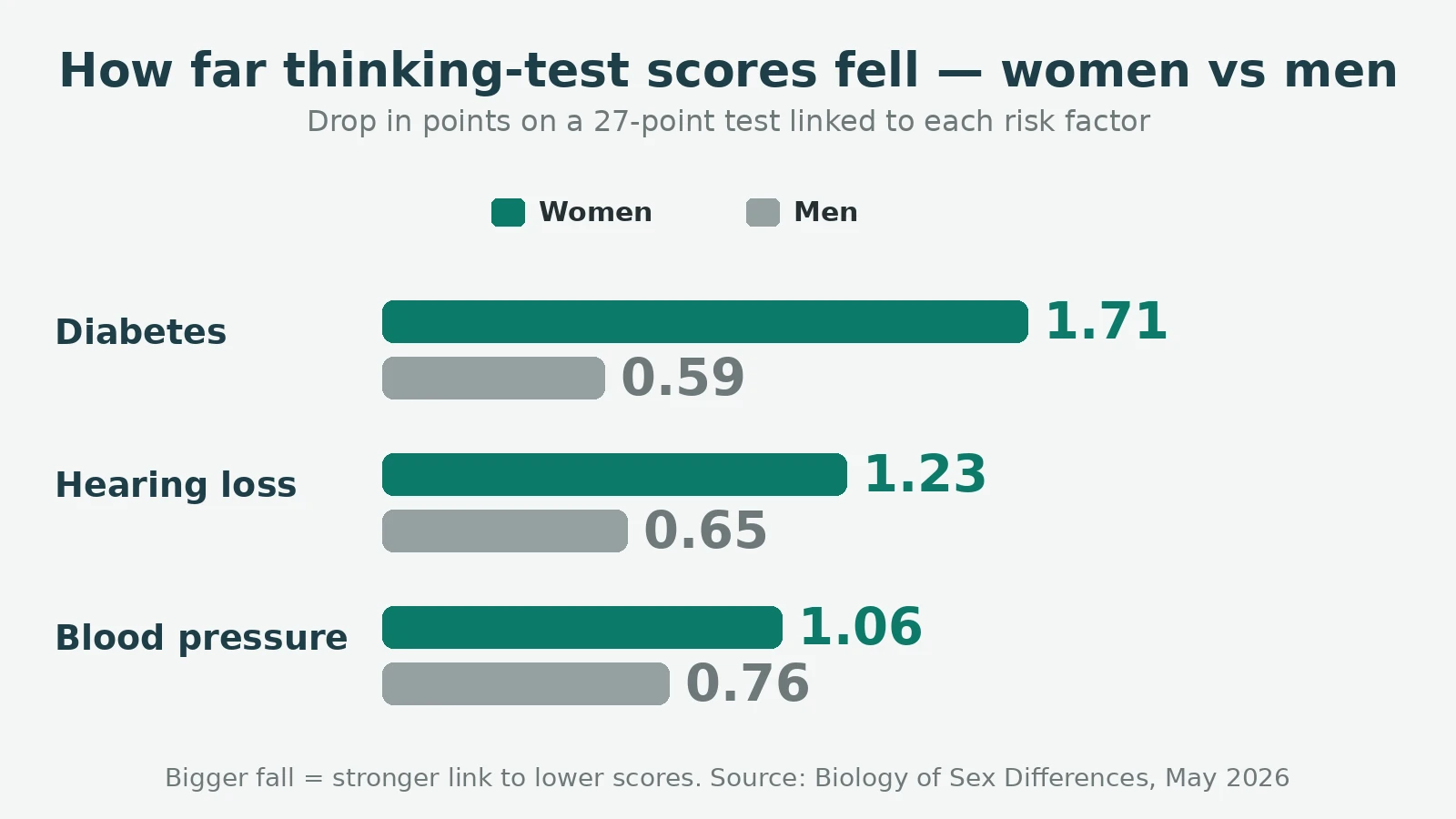
Prevalence was only half the story. The researchers also measured how strongly each factor was linked to performance on a 27-point telephone test of memory and thinking — the Telephone Interview for Cognitive Status, which tests word recall, subtraction and counting backwards. Three factors had a significantly larger negative effect on women’s scores than on men’s:
- Diabetes was linked to a 1.71-point lower score in women, against 0.59 points in men — the largest sex gap in the study.
- Hearing loss was linked to a 1.23-point lower score in women, against 0.65 in men.
- High blood pressure was linked to a 1.06-point lower score in women, against 0.76 in men.
That creates a counterintuitive picture: hearing loss and diabetes are more common in men, yet they appear to weigh more heavily on women’s thinking. Prevalence and impact are not the same thing — and that, the authors argue, is why prevention may need to be tailored, not just counted.
Body weight showed an age-dependent pattern. At ages 55 and 65, a higher body mass index was linked to worse thinking scores in women but slightly better scores in men; by age 75 the difference had disappeared. Each extra year of education was linked to better scores in both sexes, but more strongly in women. And each additional risk factor was linked to a steeper drop in women’s scores than in men’s — 0.70 points per extra factor, against 0.59.
One finding deserves care rather than a headline. Total cholesterol showed a small positive association with thinking scores in women, and no association in men. The authors flag it as an association, not a protective effect, and it should not be read as “high cholesterol is good for women’s brains”.
Why might this be?
The study does not answer that question — it was not designed to. It measured risk factors and test scores at a single point in time, so it cannot say what causes what. The authors offer tentative explanations in their discussion, and are careful to label them as such.
On high blood pressure, they note that women may be more prone to it because of pregnancy complications such as gestational hypertension, hormonal shifts associated with menopause, and a higher prevalence of small vessel disease in the brain — adding, in their own words, that “the mechanisms linking these events with increased hypertension risk are not well-understood”. On body weight, they suggest obesity and related metabolic conditions may exert greater harmful effects on women’s thinking “particularly during midlife and early older adulthood when hormonal and metabolic changes associated with the menopausal transition occur”.
It is worth being precise here. The word “oestrogen” does not appear anywhere in the study, and menopause, reproductive history and hormone therapy were not among the thirteen factors measured. No source supports recommending hormone therapy to protect against dementia. The press release is equally cautious: “Hormonal influences, genetic susceptibility and disparities in health care access may all play a role, but more work is needed to clarify how they interact over time.”
Lead author Dr Megan Fitzhugh framed the practical point: “Looking beyond which risk factors are most common, we found that some have a disproportionately larger impact on women’s cognition. This suggests that prevention efforts may be more effective if they are tailored not just to risk factor prevalence, but to how strongly each factor affects cognition in women versus men.”
What the study cannot prove
- It measured test scores, not dementia. The outcome was a single telephone cognitive test, not a dementia diagnosis and not change over time. A lower score is not dementia.
- It is a single snapshot. Risk factors and thinking were measured in the same 2008 wave, so the study cannot show the direction of effects. Depression and poor sleep, for example, can also be early symptoms of cognitive decline, not only causes.
- Much of the data was self-reported. Hearing loss, physical activity, smoking and sleep were reported by participants, sometimes from a single questionnaire item, with no clinical measurement.
- It is a US cohort from 2008. The findings may not generalise to other countries, ethnic groups or younger, present-day populations.
- The effects are modest in absolute terms. Diabetes was linked to about 1.7 points lower on a 27-point scale in women — a real association with test performance, not a percentage risk of dementia.
The background matters too. Of the roughly 7 million adults living with Alzheimer’s disease in the US, nearly two-thirds are women, and a US woman’s lifetime risk of Alzheimer’s dementia is about 20%, against about 10% for a man. The study notes that living longer does not fully explain that gap. Globally, the World Health Organization reports 57 million people were living with dementia in 2021, with nearly 10 million new cases every year — and women provide 70% of the hours of care for people living with dementia.
What helps — for everyone
There is no certain way to prevent dementia, as the NHS puts it — but there is good evidence that a healthy lifestyle can reduce the risk. The 2024 Lancet Commission estimated that 45% of future dementia could potentially be prevented if all fourteen modifiable risk factors were eliminated. That is a population-level estimate that assumes the factors are causal and can be fully removed; it is not a promise that any individual can cut their own risk by 45%.
The advice from the WHO, the NHS and the Alzheimer’s Society is the same for women and men, and it overlaps heavily with heart-health advice — “what’s good for your heart is also good for your brain”, in the NHS’s framing:
- Move more. At least 150 minutes of moderate-intensity activity a week, plus strengthening exercises at least twice a week.
- Look after blood pressure, cholesterol, blood sugar and weight. The NHS Health Check, free for people aged 40 to 74 every five years, can spot early signs of heart disease, diabetes, kidney disease and stroke.
- Drink within limits. No more than 14 units of alcohol a week, spread over three or more days — and stop smoking.
- Protect hearing and vision. Use hearing aids where needed and have an eye test at least every two years.
- Stay connected and mentally active, and seek help early for depression — the Alzheimer’s Society notes that people who have experienced depression have a higher risk of dementia later in life.
- Get enough sleep. Poor sleep, especially obstructive sleep apnoea, is linked to higher dementia risk.
The study authors single out midlife and early older adulthood as the window that matters most for women: “Women particularly may want to seek treatments or management for hearing loss, bouts of insomnia, hypertension, diabetes, and excess weight, particularly in midlife and early older adulthood.”
When to see a doctor
See a GP if you are worried about your memory or thinking, if low mood or depression is persisting, or if you notice hearing loss or worsening eyesight — all of these are worth checking and treating in their own right, whatever their link to dementia. Also see a doctor if your blood pressure, blood sugar or cholesterol have not been checked recently, or if you snore loudly and feel very sleepy during the day, which can be a sign of sleep apnoea.
Seek help urgently if confusion comes on suddenly, or if memory problems are rapidly getting worse, as sudden changes can have other causes that need prompt assessment.
In an emergency call 911 (US), 999 (UK) or 112 (EU)
Frequently asked questions
Do women get dementia more often than men?
Yes, in the figures the study cites. Of the roughly 7 million adults living with Alzheimer's disease in the US, nearly two-thirds are women, and a US woman's lifetime risk of Alzheimer's dementia is about 20%, against about 10% for a man. Living longer does not fully explain the gap. Worldwide, the WHO reports 57 million people were living with dementia in 2021.
Which dementia risk factors affect women most?
In this study, diabetes had the largest sex gap: it was linked to a 1.71-point drop in women's thinking scores, against 0.59 in men, on a 27-point test. Hearing loss (1.23 against 0.65) and high blood pressure (1.06 against 0.76) also showed larger effects in women. Depression was nearly twice as common in women, at 17% against 9%, and physical inactivity and sleep problems were also more common.
Does menopause cause the difference?
This study does not show that. Menopause was not one of the thirteen factors measured, and the word oestrogen does not appear in the paper at all. The authors mention hormonal shifts at menopause only as a tentative explanation for the blood pressure and weight findings, adding that the mechanisms are not well-understood. No source supports using hormone therapy to prevent dementia.
Can dementia be prevented?
There is no certain way to prevent all types of dementia, as the NHS puts it, but there is good evidence that a healthy lifestyle can reduce the risk. The 2024 Lancet Commission estimated that 45% of future dementia could potentially be prevented at population level by tackling all fourteen modifiable risk factors. That is a population estimate, not a promise for any individual.
What should women do in midlife to protect their brain?
The study authors say women may want to seek treatment or management for hearing loss, bouts of insomnia, high blood pressure, diabetes and excess weight, particularly in midlife and early older adulthood. The wider advice is the same for everyone: move more, keep blood pressure, cholesterol and blood sugar in check, drink within limits, don't smoke, and stay socially and mentally active.
Does the study prove these factors cause dementia?
No. It is a secondary analysis of survey data from one year, 2008, and it measured scores on a telephone test of memory and thinking, not dementia diagnoses. It shows that risk factors and lower scores travel together, and that some factors are linked to bigger score drops in women. It cannot show that a factor causes dementia, or that removing it would prevent it.
Sources
- Biology of Sex Differences — Fitzhugh & Pa. Sex differences in modifiable risk factors of dementia and their associations with cognition. Published 19 May 2026 link.springer.com
- WHO: Dementia fact sheet www.who.int
- mindbodygreen: Researchers Found Several Dementia Risk Factors Hit Women Harder www.mindbodygreen.com
- Newswise / UC San Diego: Sex Differences in Dementia Risks Reveal Stronger Cognitive Impacts in Women www.newswise.com
- NHS: Can dementia be prevented www.nhs.uk
- Alzheimer Europe: 2024 Lancet Commission underscores potential dementia risk reduction www.alzheimer-europe.org
- Alzheimer's Society: Dementia risk and prevention www.alzheimers.org.uk

Try the tool
When is your next period and fertile window?
Six cycles ahead from your last period date.
Open the calculator