Liquid BBL Risks: What a Liquid Brazilian Butt Lift Can Do
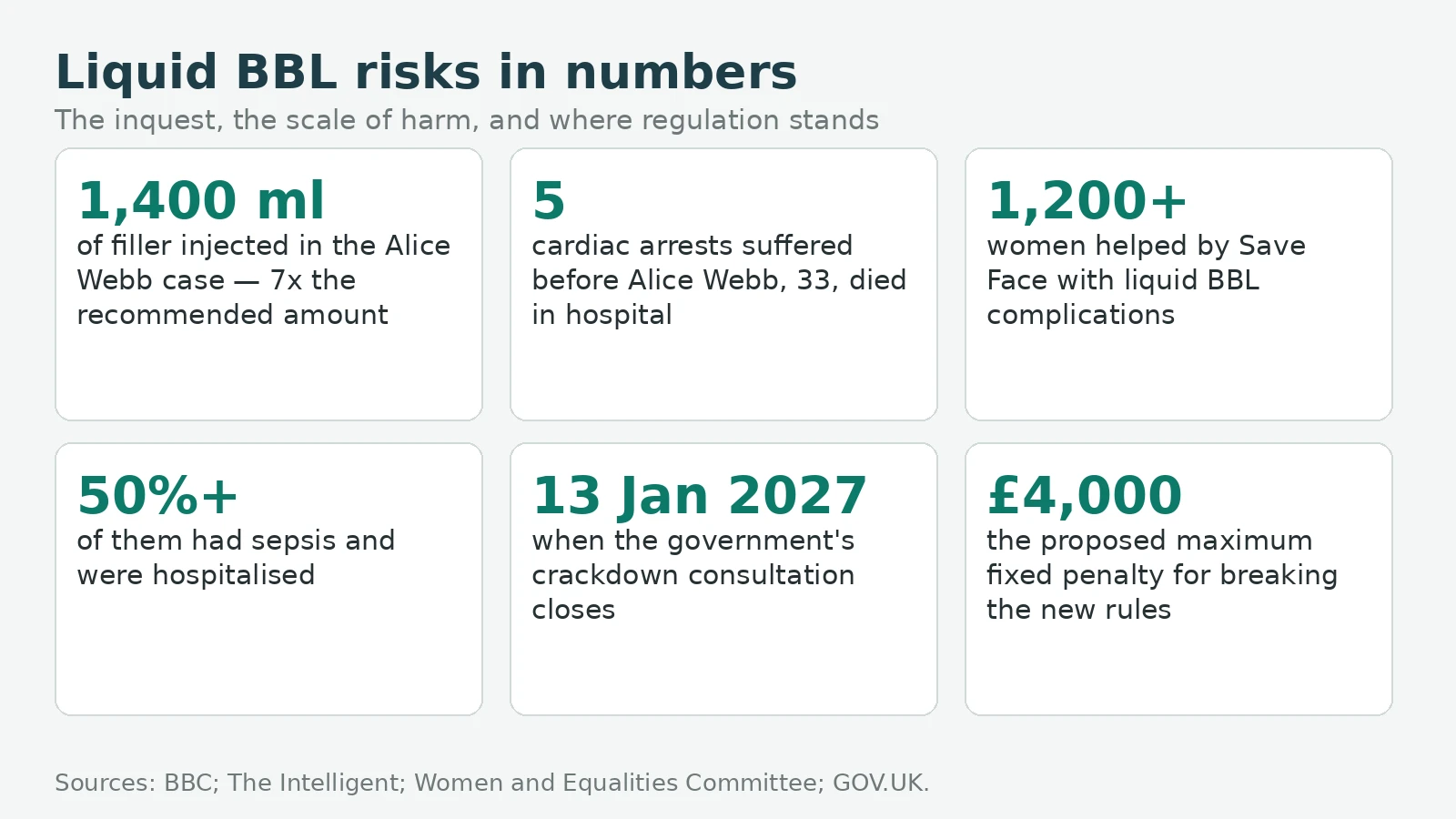
A liquid BBL injects dermal filler into the buttocks, and it can kill. Alice Webb, 33, died after 1,400ml was injected — seven times the recommended amount — and the coroner warns more deaths are likely without tighter regulation.
- Written by
- Health Daily Advice
- Published
- Reading time
- 6 minutes
- Sources
- 8 cited
In this guide
A liquid BBL injects dermal filler into the buttocks to add volume, and it carries serious risks including embolism, sepsis, tissue death and death. In September 2024, Alice Webb, 33, died after a practitioner injected 1,400 millilitres of filler — seven times the recommended amount. An inquest in November 2026 recorded accidental death.
Liquid BBL explained: filler, not fat transfer
A liquid Brazilian butt lift — also called a non-surgical BBL — is a procedure in which dermal filler, usually hyaluronic acid, is injected into the buttocks to add volume and shape. It is sometimes marketed as a quick, needle-only alternative to surgery, and it is often offered in beauty clinics, hotel rooms or private homes rather than medical settings.
It is not the same as a surgical BBL. A surgical Brazilian butt lift moves a person’s own fat from areas such as the tummy or thighs into the buttocks, in three stages: removing fat by liposuction, preparing it, and injecting it, usually over a couple of hours under general or local anaesthetic. In the UK it usually costs between £3,000 and £8,000, according to the NHS. Buttock implants are a third, separate option. The British Association of Aesthetic Plastic Surgeons (BAAPS) says liquid BBLs are invasive and surgical in nature, and should only be performed by specialist plastic surgeons in regulated medical clinics or hospitals.
What are the risks of a liquid BBL?
The buttock is high-risk anatomy: large veins run beneath the buttock muscles, and filler or fat that enters a blood vessel can travel to the heart and lungs and block blood vessels there. The specific risks of liquid BBLs reported by BAAPS include sepsis, tissue death (necrosis), infection and scarring, and the US Food and Drug Administration (FDA) warns that injectable body fillers can cause ongoing pain, scarring, permanent disfigurement, and — if the material migrates — embolism, stroke, infection and death.
Serious complications can appear immediately or develop weeks, months or even years later, according to the FDA. The FDA also warns that such injections are often carried out by unlicensed practitioners in non-clinical settings, sometimes using industrial-grade silicone falsely sold as an approved dermal filler, and it advises consumers never to get any type of filler as a “butt filler” or “breast filler”.
Surgical BBLs carry their own dangers. The NHS says BBL surgery has the highest death rate of all cosmetic procedures, mainly because injected fat can cause a pulmonary embolism — a blockage in a blood vessel in the lungs. Other risks include haematoma, fat necrosis, pneumothorax and thick, obvious scarring, and about half of transferred fat does not survive, so further surgery is often needed. BAAPS advised its members against carrying out BBL surgery in 2018 because of the death rate; its updated guidance says fat grafting is only acceptable when fat is injected into the layer just under the skin, never into muscle, and with ultrasound used during the operation to confirm placement.
The Alice Webb case: what the inquest heard
Alice Webb, 33, a mother of five from Wotton-under-Edge in Gloucestershire, received a liquid BBL on 23 September 2024 at a property in Gloucester. The procedure was carried out by beauty influencer Jordan Parke, who had no formal medical qualifications. She collapsed, suffered five cardiac arrests, and died in hospital the following day.
Parke injected 1,400 millilitres of hyaluronic acid filler — seven times the recommended amount. The post-mortem found filler in the fatty tissue and muscle of her buttock, beneath the muscle and along her sciatic nerve, and in her lungs, brain, heart, thyroid gland and kidney. The Home Office forensic pathologist gave the cause of death as “embolisation of hyaluronic acid from introduction into the buttocks” — the filler had entered her bloodstream when a blood vessel was damaged during the procedure.
After a three-day hearing at Gloucestershire Coroner’s Court, the jury on 20 November 2026 returned a conclusion of accidental death, saying Webb died from “complications arising from BBL procedure”. Her family said they were disappointed and believed it should have been unlawful killing. Senior coroner Katy Skerrett said she will issue a Prevention of Future Deaths report, saying she was “very satisfied there is significant risk of future deaths arising in similar circumstances” because of inadequate regulation in the aesthetics industry.
Parke had previously been issued with prohibition notices preventing him from performing BBLs in Dudley and Salford, but was able to keep working elsewhere. He died in February 2026 while under police investigation for gross negligence manslaughter in connection with Webb’s death; he was never charged.
How common are serious complications?
There is no reliable published figure for how common serious complications are specifically from liquid BBLs in the UK. The FDA says it does not know the true extent of injuries, because unlicensed practitioners do not report them. The clearest picture of the scale comes from the charity Save Face, which told Parliament’s Women and Equalities Committee it has helped over 1,200 women who had liquid BBL or liquid breast augmentation complications. Over half of those women had sepsis and were hospitalised, and a further 40% needed extensive corrective surgery and ongoing district nurse care.
That is a charity’s caseload of people seeking help, not a population rate, so it cannot be read as the risk for any one procedure. But it shows the harm is not rare or minor. Another woman who gave evidence to the committee, Sasha Dean, said her liquid BBL, performed by an unqualified practitioner in non-sterile conditions, led to septic shock and five days in a coma, and that she would like to see liquid BBLs banned.
What is being done about regulation?
Webb’s family, working with Save Face, are campaigning for “Alice’s law” and tighter regulation, including nationally recognised prohibition orders rather than local ones that practitioners can work around. Her sister April Palmer said: “We’d like to see tighter regulation, more protection.” Her former partner Ben Kingscote said the government has announced regulations “but they haven’t implemented them. They need to get on with it, get it done.”
On 21 October 2026 the government announced a “cosmetic cowboys crackdown” that would legally define fillers injected anywhere other than the face — including liquid BBLs — as cosmetic surgical procedures, meaning only doctors could perform them. High-risk procedures would be banned for under-18s, and breaching the rules would be a criminal offence, with unlimited fines or fixed penalties of up to £4,000. But this is a consultation, not yet law: it opened on 21 October 2026 and closes on 13 January 2027, with parliamentary scrutiny planned for spring 2027.
Parliament’s Women and Equalities Committee had already recommended in February 2026 that liquid BBLs be restricted to appropriately qualified medical professionals immediately; by September 2026 the government still had not responded, seven months on. In an open letter in August 2026, the Royal College of Surgeons of England, BAAPS, the British Association of Plastic, Reconstructive and Aesthetic Surgeons, the Joint Council for Cosmetic Practitioners and Save Face jointly warned that more than a decade after the 2013 Keogh Review called for reform, “nothing has changed” — and that any doctor registered with the General Medical Council can legally perform cosmetic surgery even if they are not a recognised specialist surgeon, which they called “unacceptable”.
Warning signs after a filler procedure
The FDA says to seek medical attention immediately if you develop difficulty breathing, chest pain, or signs of a stroke — sudden difficulty speaking, numbness or weakness in the face, arms or legs, difficulty walking, face drooping, severe headache, dizziness or confusion. The NHS advises that signs of possible infection after a fat-transfer procedure, such as increasing swelling, redness or pain, mean going back to the surgeon straight away.
Anyone considering any cosmetic procedure should check that the clinic is registered with the Care Quality Commission and that the surgeon is on the General Medical Council register — ideally the specialist register for plastic surgery — and ask about their training, complication numbers and follow-up arrangements, according to the NHS.
When to see a doctor
Get emergency help immediately for difficulty breathing, chest pain, face drooping, sudden weakness or numbness, difficulty speaking or walking, a severe headache, or confusion after any filler or cosmetic procedure — these can be signs of an embolism or stroke. See a doctor urgently for increasing swelling, redness or pain, fever, discharge from the injection site, or any filler that seems to have moved or changed shape. Complications can appear months or even years later, so do not assume a procedure that seemed fine at the time is safe for good.
In an emergency call 911 (US), 999 (UK) or 112 (EU). Concerns about a practitioner’s care in the UK can be raised with the Care Quality Commission or the General Medical Council.
Frequently asked questions
What is a liquid BBL?
A liquid BBL, or non-surgical Brazilian butt lift, injects dermal filler — usually hyaluronic acid — into the buttocks to add volume and shape. It is often marketed as a quick alternative to surgery and is frequently offered in beauty clinics, hotel rooms or private homes rather than medical settings. It is not the same as a surgical BBL, which moves your own fat from elsewhere in the body.
Is a liquid BBL safe?
No cosmetic procedure is risk-free, and liquid BBLs carry serious dangers. BAAPS says they are invasive and surgical in nature and should only be done by specialist plastic surgeons in regulated clinics. Reported risks include sepsis, tissue death, infection, scarring and embolism, which can cause stroke or death. The FDA warns consumers never to get filler as a 'butt filler', and says complications can appear months or years later.
What happened to Alice Webb?
Alice Webb, 33, a mother of five from Gloucestershire, died the day after a liquid BBL on 23 September 2024. The practitioner, who had no medical qualifications, injected 1,400ml of hyaluronic acid — seven times the recommended amount. Filler was found in her lungs, brain, heart, thyroid and kidney, and the cause of death was embolisation of hyaluronic acid. On 20 November 2026 an inquest jury recorded accidental death.
Are liquid BBLs legal in the UK?
Yes, for now. Liquid BBLs are not yet restricted to medical professionals in the UK. The government announced a crackdown on 21 October 2026 that would define them as cosmetic surgery, meaning only doctors could perform them — but it is only a consultation, closing 13 January 2027, with parliamentary scrutiny planned for spring 2027. It is not yet law.
What are the warning signs after a liquid BBL?
Seek emergency help immediately for difficulty breathing, chest pain, or stroke signs — sudden difficulty speaking, numbness or weakness in the face, arms or legs, difficulty walking, face drooping, severe headache, dizziness or confusion. See a doctor urgently for increasing swelling, redness or pain, fever, or discharge from the injection site. Complications can appear months or even years after the procedure.
What is the difference between a liquid BBL and a surgical BBL?
A surgical BBL moves your own fat from areas such as the tummy or thighs into the buttocks, using liposuction, and is done under anaesthetic in a medical setting. A liquid BBL injects dermal filler instead, with no fat transfer and usually no anaesthetic. Both carry serious risks: the NHS says BBL surgery has the highest death rate of all cosmetic procedures, mainly from fat causing a pulmonary embolism.
Sources
- BBC News: Mum's fatal BBL 'an accident' — but 'significant risk' of more deaths bbcinsight.pages.dev
- NHS: Surgical fat transfer www.nhs.uk
- FDA: FDA warns about illegal use of injectable silicone for body contouring www.fda.gov
- BAAPS: The BAAPS Calls For Urgent Regulation Of BBL Procedures baaps.org.uk
- GOV.UK: Cosmetic cowboys crackdown continues with new restrictions www.gov.uk
- House of Commons Women and Equalities Committee: Cosmetic procedures: follow-up publications.parliament.uk
- Tyla: Family of mum-of-five who died after botched BBL procedure make plea following inquest www.tyla.com
- The Intelligent: Coroner to issue preventing future deaths report after inquest into liquid BBL fatality theintelligent.co.uk

Try the tool
When is your next period and fertile window?
Six cycles ahead from your last period date.
Open the calculator