Testicular Cancer Symptoms: Signs Men Should Not Ignore
A painless lump is the most common first sign of testicular cancer, the most common cancer in young men — and one of the most treatable. Here are the symptoms to watch for, how to check, and when to see a doctor.
- Written by
- Health Daily Advice
- Published
- Reading time
- 8 minutes
- Sources
- 10 cited

In this guide
The most common early sign of testicular cancer is a painless lump or swelling in one testicle, sometimes with heaviness or a dull ache in the scrotum. It is the most common cancer in American men aged 15 to 35, but it is also highly treatable, with long-term survival above 90%.
What is testicular cancer?
Testicular cancer is a growth of cells that starts in the testicles, the two glands inside the scrotum that make sperm and the hormone testosterone. It is a different condition from prostate cancer, which affects the prostate gland. Testicular cancer usually affects only one testicle, although it can affect both, and it can develop at any age. Mayo Clinic notes that it happens most often between the ages of 15 and 45.
It is a rare cancer overall, but it is the one young men are most likely to face. In the UK, around 2,320 men are diagnosed every year, and the estimated lifetime risk of developing it is less than 1%, according to Cancer Research UK. The reassuring part of the picture is the outlook: the same figures show that 96.5% of men survive for 10 years or more after diagnosis.
What are the symptoms of testicular cancer?
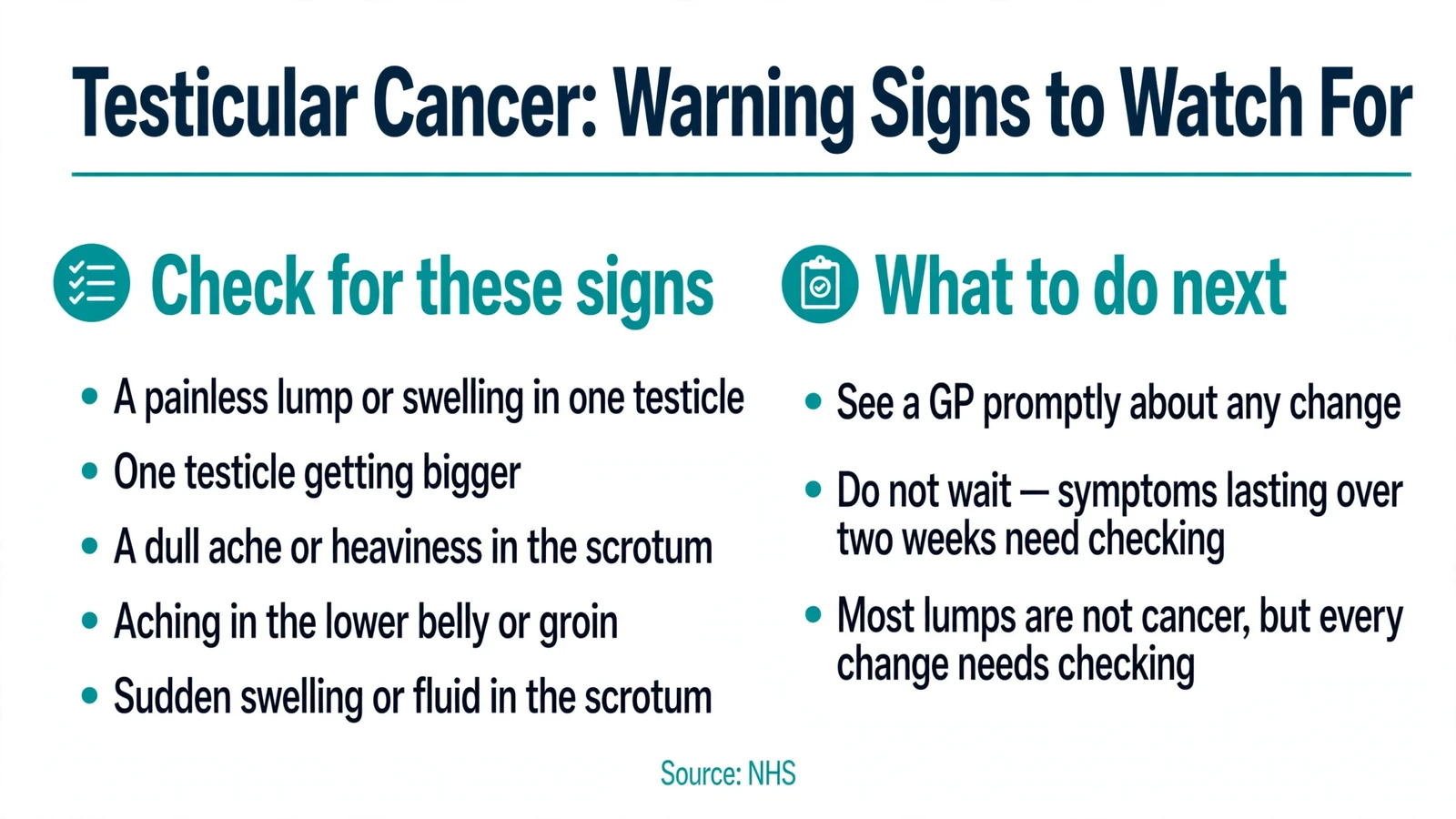
Most of the time, a lump on the testicle is the first symptom, or the testicle becomes swollen or larger than usual. The NHS lists these as the main symptoms to watch for:
- a lump or swelling in your testicle
- your testicle getting bigger
- an ache or pain in your testicle or scrotum, the skin that covers the testicles
- your scrotum feeling heavy, firm or hard
- sudden swelling in the scrotum
- a dull ache in your lower belly or groin
- enlargement or tenderness of the breast tissue
Other symptoms can include an ache or pain in your back or lower tummy, losing weight without trying, a cough, difficulty breathing or swallowing, and a sore or swollen chest. These later signs can appear if the cancer has spread beyond the testicle.
It is important to keep this in perspective. These symptoms are very common and can be caused by many different conditions, and having them does not definitely mean you have testicular cancer. The NHS makes the same point: most lumps and changes turn out to be something else, such as an injury, inflammation of the testicle or the tube behind it, or a harmless collection of fluid. But every new change deserves to be checked by a doctor, because finding cancer early may mean it is easier to treat.
What does testicular cancer feel like?
Often, it does not feel like much at all. Most testicular tumours cause no pain, which is one reason a lump can be easy to dismiss. The American Cancer Society explains that some tumours do cause pain, but most of the time they do not, and men may instead notice heaviness or aching in the lower belly or scrotum.
Cleveland Clinic describes the same pattern: a painless lump is the most common sign, sometimes with heaviness or pressure, swelling, or a dull ache. A sharp, stabbing pain is rare. Because the lump is usually painless, it is often found by chance, in the shower or while getting dressed, rather than because it hurts.
What are the symptoms if testicular cancer has spread?
Some testicular cancers cause no symptoms at all until they have spread outside the testicles. If the cancer reaches other parts of the body, the symptoms depend on where it has gone. The American Cancer Society lists low back pain from cancer that has spread to the lymph nodes behind the belly, shortness of breath, chest pain or a cough from spread to the lungs, belly pain from enlarged lymph nodes or spread to the liver, and headaches or confusion from spread to the brain.
The NHS adds unexplained weight loss, a persistent cough, difficulty breathing or swallowing, and a sore or swollen chest to the list of possible later symptoms. Cleveland Clinic also lists back pain, pain in the side or belly, chest pain, a cough or shortness of breath, and unexplained weight loss. None of these symptoms on their own proves cancer, but any of them alongside a testicular change should be checked promptly.
How common is testicular cancer, and who gets it?
Testicular cancer is uncommon compared with other cancers, yet it is the most common cancer in American males aged 15 to 35, according to Mayo Clinic. The average age at diagnosis is in the early thirties, and it can occur at any age, including in teenagers and in older men.
In the UK, Cancer Research UK records around 2,320 new cases each year and around 70 deaths a year, which underlines how treatable this cancer is. Mayo Clinic puts long-term survival at greater than 90%, even when the cancer has spread beyond the testicle, and several treatments, or a combination of them, are available. That is why doctors stress early detection so strongly: the earlier it is found, the simpler the treatment tends to be.
Who is most at risk of testicular cancer?
Doctors do not know exactly what causes most testicular cancers. It starts when changes in the DNA of testicle cells tell them to grow and multiply quickly, forming a tumour, but what triggers those changes is still unclear. Several factors are known to raise the risk:
- An undescended testicle. The testicles form in the belly during development and usually drop into the scrotum before birth. A testicle that never descended, known as cryptorchidism, raises the risk, and the risk stays higher even after surgery to move it down.
- Family history. If a father or brother has had testicular cancer, the risk is higher.
- Having had testicular cancer before. A previous tumour in one testicle raises the risk of cancer in the other one.
- Being a young adult. It can happen at any age, but it is most common in teenagers and young adults between 15 and 45.
- Being white. Testicular cancer is most common in white people, although it can affect men of any background.
- Other conditions. Cleveland Clinic also lists Klinefelter syndrome and low fertility or infertility as factors linked with higher risk.
There is no way to prevent testicular cancer, and getting it is not something you could have avoided. If you have one of these risk factors, it is worth being familiar with what is normal for you and mentioning the risk factor to your doctor at routine check-ups.
How do you check your testicles?
Knowing what is normal for you makes it much easier to notice a change. The NHS advises checking your testicles regularly so you learn their usual size, shape and feel. The best time to check is during or after a warm bath or shower, when the skin of the scrotum is relaxed.
The American Cancer Society describes the check in simple steps: examine each testicle separately, holding it between your thumbs and fingers with both hands and rolling it gently. Look and feel for any hard lumps or nodules, or any change in the size, shape or consistency of your testicles. It is normal for one testicle to be slightly larger than the other, and for one to hang lower. Each testicle also has a small coiled tube at the top of the back, called the epididymis, which can feel like a small bump and is not a lump to worry about.
A note of balance is worth making here. The American Cancer Society does not recommend regular self-exams for all men, because they have not been studied enough to show they reduce the death rate from this cancer, and even late-stage disease is likely to be cured. What it does advise is that men know the risk and see a doctor right away if they find a lump. Some doctors do recommend monthly checks after puberty, particularly for men with risk factors such as an undescended testicle or a family history. If you are unsure, talk to a doctor or pharmacist about what makes sense for you.
What happens when you see a doctor?
If you go to your GP with a lump or change, the doctor will ask about your symptoms and general health, then examine your testicles and the lymph nodes at the top of your legs. If the GP thinks your symptoms could be cancer, you may get an urgent referral for more tests or to see a specialist in hospital. That does not definitely mean you have cancer, but it means the cause will be found quickly.
An ultrasound scan is often the first test, because it can show whether a change is a harmless condition such as a fluid collection or a solid tumour. Blood tests may also check for tumour markers, proteins called AFP and hCG that many testicular cancers release. If there is a high concern that a lump is cancer, surgery to remove the testicle is usually recommended promptly, and the tissue is examined in a laboratory to confirm the type and extent of the disease.
How is testicular cancer treated?
Testicular cancer is highly treatable, even when it has spread to other parts of the body. Surgery to remove the affected testicle is the most common treatment. Before surgery, your doctor will usually discuss sperm banking, because you can still father a child with one testicle. Some men also choose a prosthesis to replace the removed testicle.
Depending on the type of cancer and how far it has spread, chemotherapy or radiotherapy may follow surgery, or be used instead. Radiotherapy is mainly used for one type, called seminoma. Cleveland Clinic notes that most testicular cancers do not come back, and those that do usually return within the first two or three years after treatment, which is why follow-up appointments are most frequent in that period.
When to see a doctor
See a GP promptly if you notice any of the following, and do not wait to see whether it goes away on its own:
- a lump or swelling on one or both of your testicles
- one or both of your testicles getting bigger
- your scrotum feeling heavy, firm or hard
- an ache or pain in your scrotum or one or both of your testicles
- any change in one or both of your testicles that is not normal for you
Mayo Clinic advises seeing a doctor if you notice pain, swelling or lumps in your testicles or groin area that last longer than two weeks. Embarrassment stops many men from going, but GPs see these symptoms every day and a quick check is the fastest route to peace of mind. If you are unsure whether a change matters, talk to a doctor or pharmacist rather than trying to work it out alone.
In an emergency call 911 (US), 999 (UK) or 112 (EU)
Frequently asked questions
What is the first sign of testicular cancer?
Most often, the first sign is a painless lump or swelling on one testicle, or the testicle becoming swollen or larger than usual. Some men notice heaviness or a dull ache in the scrotum or lower belly instead. A lump can be small, and because it usually does not hurt, it is often found by chance. Any new lump or change should be checked by a doctor promptly.
Is testicular cancer curable?
Yes, it is one of the most treatable cancers. Mayo Clinic puts long-term survival at greater than 90%, even when the cancer has spread beyond the testicle. In the UK, Cancer Research UK records that 96.5% of men survive for 10 years or more after diagnosis. Treatment usually starts with surgery to remove the affected testicle, sometimes followed by chemotherapy or radiotherapy.
How do I check my testicles for lumps?
Check during or after a warm bath or shower, when the scrotum is relaxed. Examine each testicle separately, rolling it gently between your thumbs and fingers, and feel for hard lumps or any change in size, shape or firmness. It is normal for one testicle to be slightly larger or to hang lower. The American Cancer Society advises seeing a doctor right away if you find a lump.
Is a lump on a testicle always cancer?
No. Most lumps and swellings are not cancer. They can be caused by injury, inflammation of the testicle or the tube behind it, or a harmless collection of fluid around the testicle. Even so, you cannot tell the cause by feel alone, and the NHS advises getting every new lump or change checked by a GP, because finding cancer early makes it easier to treat.
Who is most likely to get testicular cancer?
It most often affects teenagers and young adults between 15 and 45, and it is the most common cancer in American men aged 15 to 35. Risk is higher in men born with an undescended testicle, men with a father or brother who had the disease, and men who have had testicular cancer before. It is most common in white men, though it can affect men of any background.
When should I see a doctor about a testicle change?
See a GP promptly if you notice a lump or swelling, a testicle getting bigger, a scrotum that feels heavy, firm or hard, or any change that is not normal for you. Mayo Clinic advises seeing a doctor if pain, swelling or lumps last longer than two weeks. Do not wait to see whether it goes away. In an emergency call 911 (US), 999 (UK) or 112 (EU).
Sources
- NHS: Symptoms of testicular cancer www.nhs.uk
- Mayo Clinic: Testicular cancer — symptoms and causes www.mayoclinic.org
- Mayo Clinic Connect: What young men need to know about testicular cancer connect.mayoclinic.org
- Cancer Research UK: Testicular cancer statistics www.cancerresearchuk.org
- Cleveland Clinic: Testicular Cancer — Symptoms, Causes & Treatment my.clevelandclinic.org
- American Cancer Society: Early Detection, Diagnosis, and Staging of Testicular Cancer www.cancer.org

Try the tool
Not sure if it can wait?
Common causes and warning signs for 16 everyday symptoms.
Open the symptom guide