What Is Long COVID? Symptoms, Causes and Recovery
Long COVID can linger for months or years after the infection clears. Here is what it is, why breathing problems can persist, and what helps recovery.
- Written by
- Health Daily Advice
- Published
- Reading time
- 8 minutes
- Sources
- 11 cited

In this guide
Long COVID is the name for symptoms that continue or appear after a COVID-19 infection and last for at least 12 weeks. Fatigue, breathlessness, brain fog and muscle pain are the most common complaints. It can follow even a mild infection, and a 2026 study found half of patients still had breathing difficulties four years on.
What is long COVID?
Long COVID, also called post-COVID syndrome or post-COVID-19 condition, describes a wide range of health problems that linger after the acute infection has passed. The NHS defines it as symptoms of COVID-19 that last longer than 12 weeks, while the World Health Organization (WHO) describes symptoms that usually start within three months of the illness and last for at least two months, with no other explanation.
It is not one single illness. More than 200 different symptoms have been reported, and they can affect almost any part of the body, from the lungs and heart to the brain, gut and muscles. Symptoms often come and go, change over time, and can flare up after stress or physical activity.
Long COVID is far from rare. The WHO estimates that about 6 in every 100 people who catch COVID-19 go on to develop post-COVID-19 condition, and Cleveland Clinic puts the figure at roughly 5 to 10 per cent of people who have had the virus. With hundreds of millions of infections worldwide, that adds up to tens of millions of people living with lasting effects.
What are the symptoms of long COVID?
Symptoms vary a great deal from person to person, and most people do not experience all of them. The NHS lists extreme tiredness, shortness of breath, joint pain and aching muscles, and problems with memory and concentration — often called brain fog — as the most common.
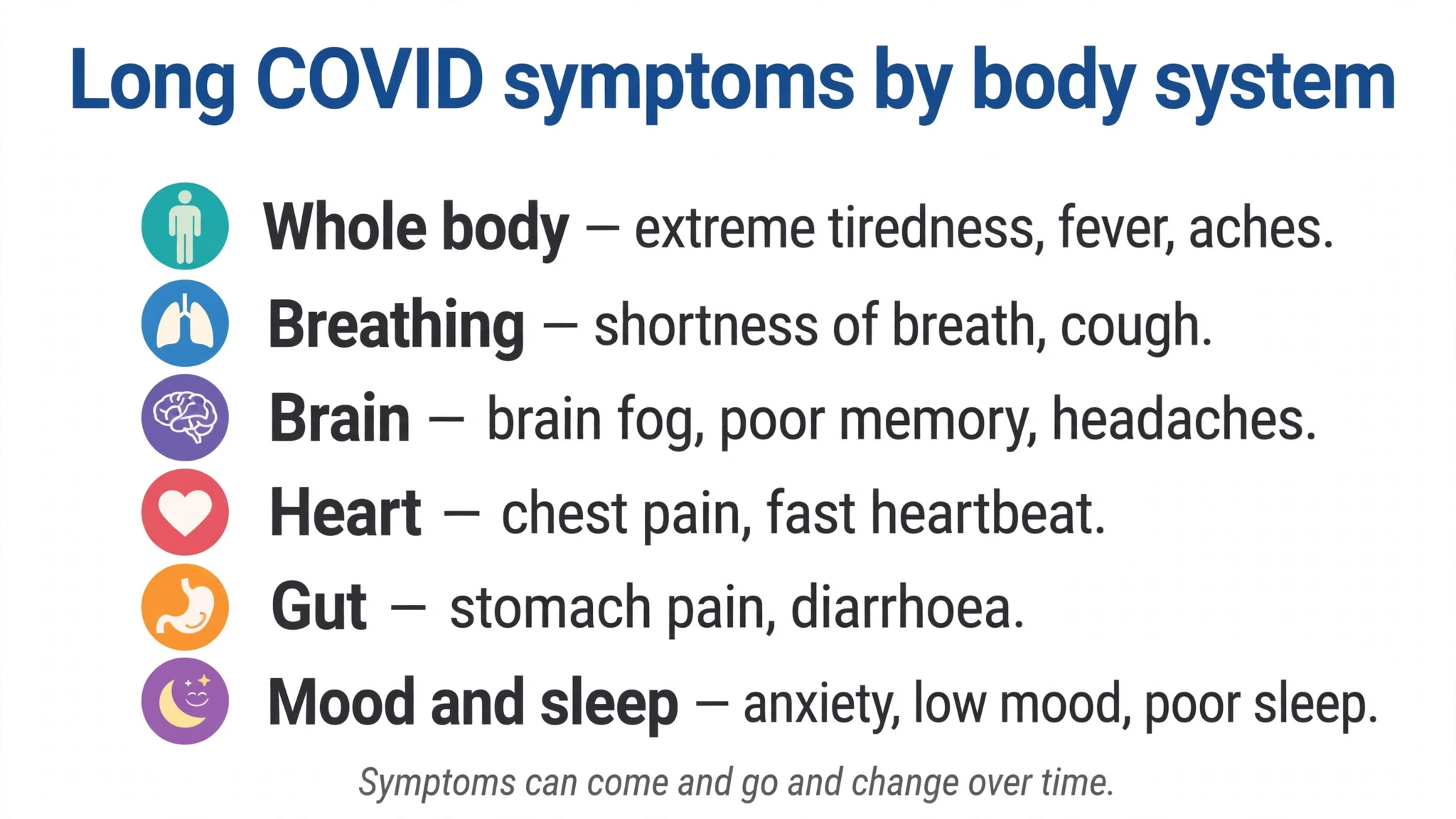
Other symptoms reported include a persistent cough, chest pain or tightness, heart palpitations, headaches, dizziness, difficulty sleeping, loss of taste or smell, stomach pain, diarrhoea, hair loss, skin rashes, pins and needles, anxiety and depression. Some people develop new symptoms weeks after they seemed to have recovered, and new health conditions — including heart disease, diabetes and kidney problems — are diagnosed more often than usual after COVID-19, according to the WHO.
One feature that sets long COVID apart is post-exertional malaise: symptoms that get noticeably worse after physical or mental effort, sometimes for days afterwards. Mayo Clinic specialists describe the fatigue as profound rather than ordinary tiredness — patients have said that a short walk with the dog can leave them needing to rest for hours.
Why are breathing problems still common four years on?
New research published in November 2026 shows just how long breathing difficulties can persist. In a study from Karolinska University Hospital in Stockholm, researchers followed 288 adults with long COVID for a median of 50 months — just over four years — after their original infection. Half of them, 143 people, reported symptoms suggesting dysfunctional breathing, meaning their breathing pattern itself had become disrupted, as measured by a score of 23 or more on the 16-item Nijmegen questionnaire.
Surprisingly, people who had not been admitted to hospital during their acute illness had about six times higher odds of reporting these breathing symptoms than those who had been hospitalised. The researchers also found that higher scores were linked to more severe breathlessness, a greater overall symptom burden, depressive symptoms and postural orthostatic tachycardia syndrome (PoTS), a condition that causes a racing heart on standing.
The study authors are careful about what the finding means: a high questionnaire score points to symptoms that suggest dysfunctional breathing, but it is not the same as a clinically confirmed diagnosis. Even so, they conclude that the burden of persistent breathing complaints four years after infection is substantial. The results were published in the journal Respiratory Research in November 2026.
What causes long COVID?
Scientists still cannot point to a single cause, and it is likely that several mechanisms are at work. The leading explanations, described by Cleveland Clinic and the WHO, include:
- Viral persistence: fragments of the SARS-CoV-2 virus may remain in the body long after the acute illness, keeping the immune system switched on.
- Immune overreaction: the immune system may keep driving inflammation in organs and tissues after the infection has cleared.
- Autoimmunity: the immune system may begin attacking the body’s own tissues, as it does in autoimmune conditions.
- Tiny blood clots: microscopic clots could reduce blood flow to the lungs, brain and other organs.
- Reactivation of dormant viruses: there is some evidence that COVID-19 can wake up viruses lying inactive in the body, such as Epstein-Barr virus, the virus that causes glandular fever.
Research is continuing, and different causes may explain different patterns of symptoms in different people. That is one reason there is no single test and no single treatment that works for everyone.
Who is most at risk of long COVID?
Anyone who catches COVID-19 can develop long COVID, including children, although it is most often seen in adults. The WHO lists higher risk among women, older adults, smokers, people who are overweight or obese, and people with pre-existing long-term health problems. Severe COVID-19 that needs hospital or intensive care, and repeated infections, also raise the risk.
Being unvaccinated increases the risk, according to the US Centers for Disease Control and Prevention (CDC), and each reinfection carries a fresh risk of developing the condition. The WHO notes that two doses of vaccine appear to lower the chance of long COVID.
Importantly, long COVID is not only a consequence of severe illness. At Mayo Clinic, three-quarters of the patients seen for long COVID had only a mild initial illness — they had not needed hospital care, emergency care or even a GP visit. Many cases occur in younger adults, and women are affected more often than men.
How is long COVID diagnosed?
There is no single test that can confirm long COVID. A doctor will usually make the diagnosis from your history — when you had COVID-19, which symptoms appeared and how long they have lasted — together with a physical examination. Tests such as blood tests, blood pressure and heart rate checks, and measuring oxygen levels in the blood may be used to look for other causes and to understand your symptoms better. Depending on your symptoms, you may also be referred for an electrocardiogram (ECG), a chest X-ray or other scans.
Because the symptoms overlap with many other conditions, your GP may suggest keeping a diary of what makes your symptoms better or worse. In the UK, people with persistent symptoms may be referred to a post-COVID service, where a team of different specialists works together.
What helps with long COVID recovery?
There is currently no cure for long COVID, but treatment can help ease symptoms and improve daily life. Care is tailored to the individual, because the pattern of symptoms differs so much from person to person. Support from the NHS may include:
- Advice on managing fatigue, including pacing — balancing activity with rest and avoiding the boom-and-bust cycle of overdoing it on good days.
- Physiotherapy and breathing exercises to help with breathlessness and muscle pain.
- Cognitive behavioural therapy (CBT) for anxiety, depression and fatigue.
- Cognitive rehabilitation — activities to improve memory, concentration and thinking.
- Help to improve your sense of smell, dietary advice, and tools such as apps to track symptoms.
- Referral to specialists, for example for heart, lung or sleep problems.
Simple self-care steps can help too. The NHS advises keeping regular sleep times, getting up and moving gently when you can — but stopping if symptoms appear — and talking to a GP and your employer if work is difficult. Do not restart exercise before talking to a GP or specialist, and talk to a doctor or pharmacist before taking any new medicine or supplement. Pulmonary rehabilitation, a structured programme of exercise and education, can help some people breathe better and manage breathlessness at home.
Recovery is often slow and uneven. Symptoms can improve, then flare again, which many patients find the hardest part. Support groups, whether local or online, and charities such as Long COVID SOS and Asthma and Lung UK can help with the emotional side of living with a long-term condition.
How long does long COVID last?
There is no fixed timeline, and the honest answer is that it differs for everyone. The WHO says symptoms generally improve over time, typically within four to nine months, but about 15 in every 100 people still have symptoms at 12 months, based on global estimates from 2022. Cleveland Clinic notes that most people with long COVID start to feel better within 12 to 18 months, though some have symptoms that affect daily life, work and relationships for many years.
The new 2026 Karolinska study is a reminder that for a minority, breathing problems can still be present more than four years after infection. At the same time, clinicians report that most people do improve gradually, especially with rehabilitation and symptom-by-symptom care. Getting help early is better — Mayo Clinic specialists advise contacting a doctor if symptoms are still present two or three weeks after recovering from COVID-19.
Can long COVID be prevented?
There is no guaranteed way to avoid long COVID, but risk can be reduced. The most important step is avoiding infection in the first place: good hand hygiene, ventilation and a well-fitting mask in crowded indoor settings all help. Vaccination also lowers the risk — the WHO reports that two doses appear to reduce the likelihood of developing post-COVID-19 condition. Because every new infection carries a fresh risk, and people can be reinfected many times, these measures stay relevant even years into the pandemic.
When to see a doctor
See a GP if you think you might have long COVID — for example, if fatigue, breathlessness, brain fog or other symptoms have lasted more than a few weeks after a COVID-19 infection, keep coming back, or are disrupting your daily life. Tell the doctor when you had COVID-19 and when your current symptoms began. If you already have a diagnosis, contact your GP or long COVID service if symptoms suddenly get worse or new symptoms appear.
Get urgent help straight away if you have severe or worsening breathlessness, chest pain that is severe or will not go away, confusion, persistent dizziness, severe muscle pain or weakness, or you cannot wake up or stay awake. In an emergency call 911 (US), 999 (UK) or 112 (EU).
Frequently asked questions
What is long COVID?
Long COVID, also called post-COVID syndrome, is the name for symptoms that continue or appear after a COVID-19 infection and last for at least 12 weeks. The WHO describes symptoms that usually start within three months of the illness and last at least two months. Fatigue, breathlessness, brain fog and muscle pain are the most common complaints, and more than 200 symptoms have been reported.
How long does long COVID last?
It varies from person to person. The WHO says symptoms generally improve over four to nine months, but about 15 in every 100 people still have symptoms at 12 months. Cleveland Clinic notes most people start to feel better within 12 to 18 months. A 2026 Swedish study found half of patients still had breathing symptoms more than four years after infection, though recovery is often slow and uneven.
What are the most common long COVID symptoms?
The NHS lists extreme tiredness, shortness of breath, joint pain and aching muscles, and problems with memory and concentration, known as brain fog, as the most common symptoms. Other frequent complaints include a persistent cough, chest pain, heart palpitations, headaches, poor sleep, loss of taste or smell, stomach pain, anxiety and depression. Symptoms can come and go and flare up after exertion.
Can long COVID happen after a mild infection?
Yes. Long COVID can follow even a mild or asymptomatic infection. At Mayo Clinic, three-quarters of the patients seen for long COVID had only a mild initial illness and had not needed hospital or emergency care. Women are affected more often than men, and many cases occur in younger adults. Severe illness, repeated infections and being unvaccinated all raise the risk further.
Is there a cure for long COVID?
There is currently no cure, and no single treatment works for everyone because symptoms differ so much. Care focuses on easing symptoms: pacing and fatigue management, breathing exercises and physiotherapy, cognitive behavioural therapy, help with memory and concentration, and referral to specialists. The NHS says treatment can help manage symptoms, and most people improve gradually over time.
Can long COVID be prevented?
There is no guaranteed way to prevent it, but risk can be reduced. Avoiding infection helps, through hand hygiene, ventilation and a well-fitting mask in crowded indoor settings. The WHO reports that two doses of COVID-19 vaccine appear to reduce the likelihood of developing post-COVID-19 condition. Because each reinfection carries a fresh risk, these measures remain important.
Sources
- NHS: Long COVID www.nhs.uk
- WHO: Post COVID-19 condition (long COVID) www.who.int
- Cleveland Clinic: Long COVID my.clevelandclinic.org
- Mayo Clinic News Network: Learning more about long-haul COVID-19 newsnetwork.mayoclinic.org
- Hallberg C, et al. Predictors and prevalence of symptoms suggestive of dysfunctional breathing four years after COVID-19. Respiratory Research, 2026 pmc.ncbi.nlm.nih.gov
- CDC: Long COVID or Post-COVID Conditions archive.cdc.gov

Try the tool
Not sure if it can wait?
Common causes and warning signs for 16 everyday symptoms.
Open the symptom guide