Is Creatine Safe? Benefits, Side Effects and Who Should Avoid It
Creatine use among US college students nearly doubled in five years. Here is what decades of research actually say about its safety, side effects and who should steer clear.
- Written by
- Health Daily Advice
- Published
- Reading time
- 5 minutes
- Sources
- 8 cited

In this guide
For most healthy adults, creatine is considered safe at the doses usually studied — 3 to 5 grams a day — and it is one of the most researched supplements in sports nutrition. Mild side effects such as stomach upset, cramps and water-weight gain are the most common complaints. People with kidney disease should talk to a doctor first.
Why everyone is asking now
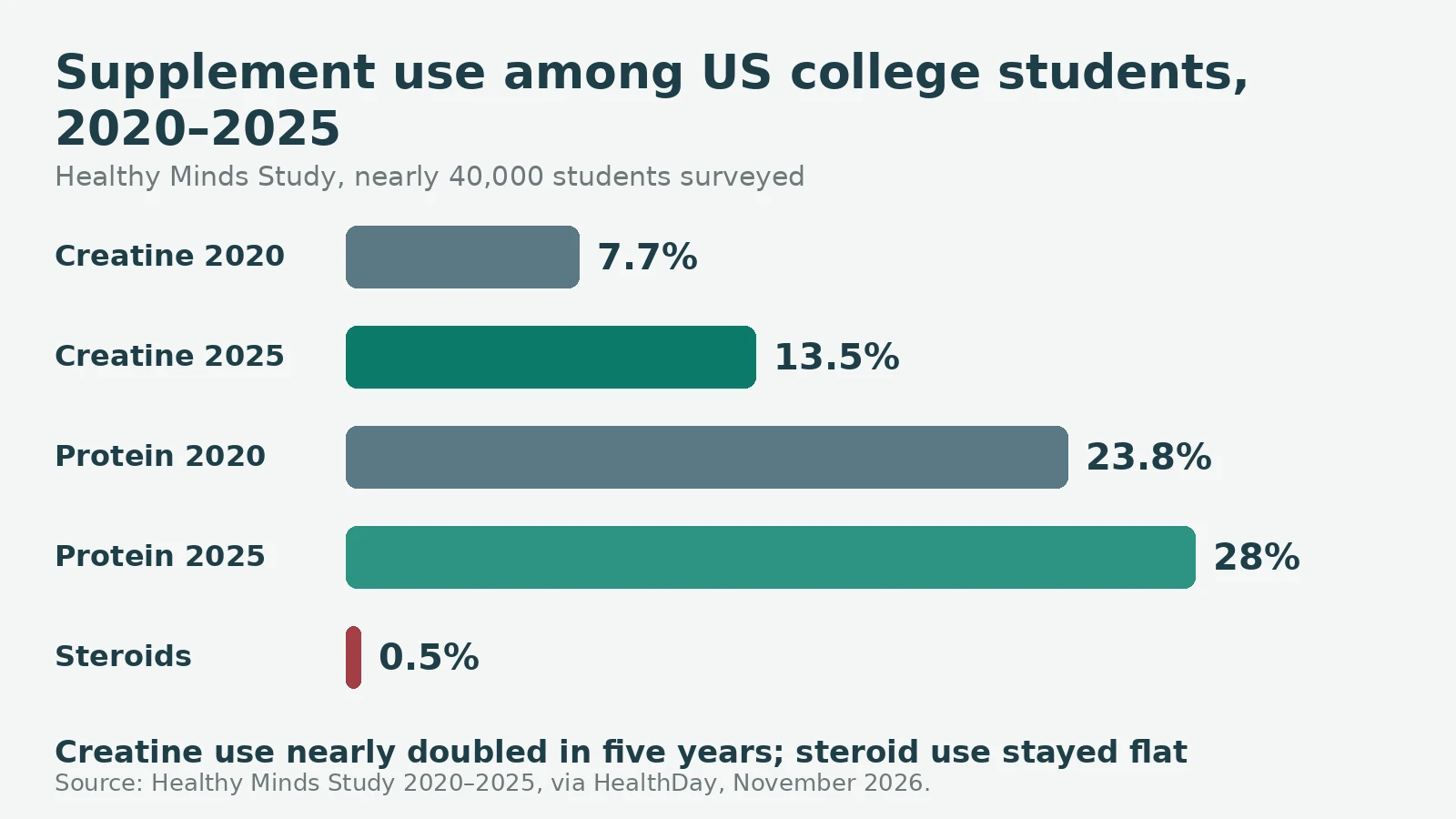
Creatine has gone from a gym supplement to a campus staple. A new study of the Healthy Minds Study, an annual survey of US college students, found that creatine use nearly doubled in five years: 7.7% of students reported using it in 2020, and 13.5% did by 2025. The study looked at responses from nearly 40,000 students, and men were four times more likely to be taking it than women.
Protein supplements rose too, from 23.8% to 28% over the same period, while use of far riskier anabolic steroids stayed flat at 0.5%. Study lead author Kyle Ganson, of the University of Toronto, points to social media pressure on young men to build muscle — including “looksmaxxing” trends — as a likely driver. The study appears in the February issue of the journal Performance Enhancement & Health.
What is creatine?
Creatine is a compound your body makes from three amino acids, and you also get it from food — mainly red meat and seafood. About 95% of the creatine in your body sits in skeletal muscle, with smaller amounts in the brain. A typical diet provides about 1 to 2 grams a day, and the body replaces about 1 to 3 grams a day to keep its stores topped up.
Inside muscle cells, creatine helps recycle ATP, the energy currency muscles use for short, hard efforts. That is why it is marketed for strength and power: it helps muscles produce quick energy during repeated bursts of high-intensity exercise, such as lifting weights or sprinting.
What does the evidence say it does?
The Mayo Clinic’s summary of the research is measured. Creatine, combined with resistance training, can lead to greater gains in muscle strength, muscle size and athletic performance. The US National Library of Medicine rates it as possibly effective for athletic performance, muscle strength and age-related muscle loss (sarcopenia), where it seems to work best alongside exercise. Early research also hints at memory and thinking benefits, especially in older adults, but the evidence there is still thin.
Vegetarians may see more benefit than most: because they eat little or no meat, their muscle creatine stores start lower, and supplementation raises them further. People with already-high stores tend to gain less.
Is creatine safe?
For healthy adults, the short answer from the research is yes — at the doses usually studied. The Mayo Clinic calls creatine “generally safe” and says the evidence suggests it is safe when taken as directed, with studies supporting use for up to five years at recommended doses. The International Society of Sports Nutrition’s position stand goes further: short- and long-term supplementation, up to 30 grams a day for five years, was safe and well tolerated in healthy people.
MedlinePlus, run by the US National Library of Medicine, lists the doses that have been safely used in studies: up to 25 grams a day for up to 14 days, lower doses of 4 to 5 grams a day for up to 18 months, and up to 10 grams a day for up to five years. A 2011 safety review found no change in liver or kidney function in healthy people taking creatine for several months, young and old alike.
That safety record comes with a condition: the doses matter, and so does the person taking it. Anyone considering a supplement should talk to a doctor or pharmacist first — especially with a medical condition or another medicine in the picture.
What are the side effects?
The most common complaints are mild. Higher doses can cause stomach cramps, nausea or diarrhea. Some people notice headaches in the first weeks. And creatine draws water into muscle cells, so the scale often jumps by about 3 to 5 pounds at the start — water weight, not fat.
A few persistent myths deserve clearing up. Creatine does not dehydrate you: the University of Rochester’s dietitians note that while it draws water into muscle cells, it does not increase the body’s overall fluid needs. One small study found a slight rise in DHT, a hormone linked to some hair loss, but no other study has found a connection with hair loss. And there is no need to “load” with high doses for a week or to cycle on and off: a steady daily amount saturates muscles in about three to four weeks.
The kidney question
This is the worry people raise most, and the evidence is reassuring for healthy kidneys. The Mayo Clinic notes that older reports suggested creatine might worsen kidney function in people who already had kidney conditions, but studies in healthy people have found no harm to kidney function at recommended doses. A 2011 review reached the same conclusion: liver and kidney markers did not change in healthy volunteers over several months.
Two cautions matter. First, creatine can raise blood creatinine levels without damaging the kidneys, which can make a kidney blood test look worse than it is — worth mentioning to your doctor before testing. Second, MedlinePlus warns that creatine might make existing kidney disease worse, so people with kidney disease should talk to a healthcare professional before using it. A 2011 safety review advises the same for people with diabetes, high blood pressure or reduced kidney function.
Who should be careful?
MedlinePlus lists the groups who should pause and ask first: people with kidney disease; people with bipolar disorder, because creatine might make mania worse; and anyone who is pregnant or breastfeeding, where there is not enough reliable information to judge safety. For children, small doses have been used safely in studies for a few months, but a parent should still talk to a doctor first. Caffeine may also blunt creatine’s effects, according to the Mayo Clinic, so heavy coffee drinkers may get less from it.
Using it safely: what the research says
If you and your doctor decide a supplement is worth trying, the research points to a few practical rules. Creatine monohydrate is the form with the most evidence behind it; other forms have not been shown to work better. The amount used in most studies is 3 to 5 grams a day, and consistency matters more than timing. And because supplement quality varies, the University of Rochester advises choosing products with third-party testing — look for NSF Certified for Sport, Informed Choice or USP on the label.
When to see a doctor
Talk to a doctor or pharmacist before starting creatine if you have kidney disease, diabetes, high blood pressure, bipolar disorder, or take other medicines. Get checked promptly if you develop persistent stomach pain, vomiting, diarrhea that will not settle, swelling, very dark urine or much less urine than usual.
In an emergency call 911 (US), 999 (UK) or 112 (EU).
The bottom line
Creatine is one of the most studied supplements in sports nutrition, and for healthy adults at the doses used in research, the safety record is strong. The most likely downsides are a few pounds of water weight and an unsettled stomach. The people who need to be careful are those with kidney problems or other medical conditions — for them, the first step is a conversation with a doctor, not a tub of powder.
Frequently asked questions
Is creatine safe for your kidneys?
For healthy kidneys, the evidence says yes at the doses usually studied. The Mayo Clinic notes that studies in healthy people found no harm to kidney function at recommended doses, and a 2011 review found no change in liver or kidney markers over several months. People who already have kidney disease should talk to a doctor first, as creatine might make it worse.
How much creatine is safe to take a day?
Most studies use 3 to 5 grams a day, and that is the amount the Mayo Clinic, the University of Rochester and the International Society of Sports Nutrition describe as the usual dose. Higher doses have been used safely in short studies — up to 25 grams a day for two weeks — but more is not better. Ask a doctor or pharmacist what fits your health.
Does creatine cause hair loss?
There is no good evidence that it does. One small study found a slight rise in DHT, a hormone linked to some hair loss, and the finding was widely repeated online. No other study has found a connection between creatine and hair loss, and the University of Rochester calls the claim a misconception. A rise in DHT can also follow harder training itself.
Is creatine safe for teenagers?
Short-term use appears safe in studies: MedlinePlus notes that 3 to 5 grams a day for two to six months has been taken safely by children aged 5 to 18. But teenagers are also the group most exposed to social media pressure to bulk up, and supplements are not tested the way medicines are. A parent should talk to a doctor before a teenager starts.
Does creatine cause weight gain?
It often adds a few pounds at first, but that is water, not fat. Creatine draws water into muscle cells, and the University of Rochester puts the usual early gain at about 3 to 5 pounds. The gain levels off once muscles are saturated, usually within three to four weeks. It is the most commonly reported side effect, and it is temporary.
Do you need to load creatine or cycle it?
No. A loading phase of high doses for a week and cycling on and off are both unnecessary, according to the University of Rochester. A steady daily amount saturates the muscles in about three to four weeks, and long-term use at the usual dose has not been shown to cause problems. Consistency matters more than timing or loading.
Sources
- Mayo Clinic: Creatine www.mayoclinic.org
- MedicineNet / HealthDay: Use Of Muscle-Building Creatine Nearly Doubles Among College Students (26 Nov 2026) www.medicinenet.com
- MedlinePlus (US National Library of Medicine): Creatine medlineplus.gov
- University of Rochester Medicine: What is Creatine and Should I Take it? www.urmc.rochester.edu
- Kreider RB et al. International Society of Sports Nutrition position stand: Safety and efficacy of creatine supplementation in exercise, sport, and medicine. J Int Soc Sports Nutr, 2017 doi.org
- Kim HJ et al. Studies on the safety of creatine supplementation. Amino Acids, 2011 pubmed.ncbi.nlm.nih.gov

Try the tool
Not sure if it can wait?
Common causes and warning signs for 16 everyday symptoms.
Open the symptom guide