AI Breast Cancer Screening: Inside the NHS EDITH Trial
The NHS has begun the world's largest AI breast screening trial, EDITH, with nearly 700,000 women. How it works, what it could change, and what it has not proven yet.
- Written by
- Health Daily Advice
- Published
- Reading time
- 6 minutes
- Sources
- 6 cited
In this guide
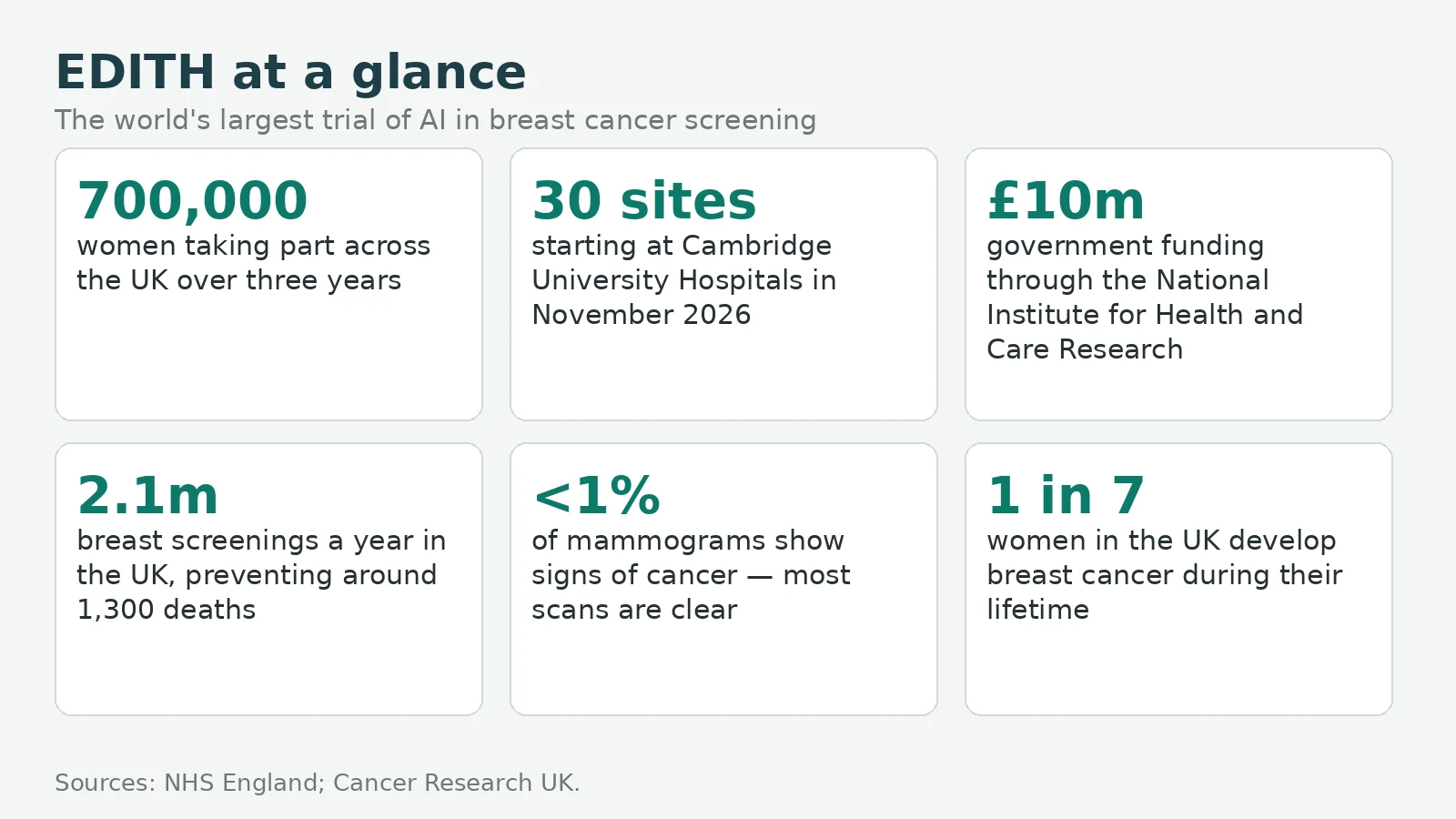
The NHS has begun inviting women to the world’s largest trial of AI in breast cancer screening. Nearly 700,000 women will take part in EDITH over three years, testing whether artificial intelligence can help specialists spot cancers earlier and review mammograms faster. Every scan will still be checked by a human specialist.
What is EDITH?
EDITH stands for Early Detection using Information Technology in Health. It is a £10 million trial funded by the government through the National Institute for Health and Care Research (NIHR), and it is the largest study of its kind anywhere in the world. Recruitment began on 23 November 2026 at Cambridge University Hospitals, with 29 further screening sites across the UK due to join over the coming months.
The trial is led by the University of Warwick, the University of Cambridge and Cambridge University Hospitals NHS Foundation Trust, working closely with NHS England and the UK National Screening Committee. Its two chief investigators are Professor Sian Taylor-Phillips of the University of Warwick and Professor Fiona Gilbert of the University of Cambridge.
The question EDITH sets out to answer is a practical one: can an AI-assisted tool help specialists review mammograms more efficiently, while keeping the same safety and quality women expect from NHS screening? Four AI systems were tested rigorously for accuracy before the trial, and several commercial systems from different makers will be evaluated during it.
How will the trial work?
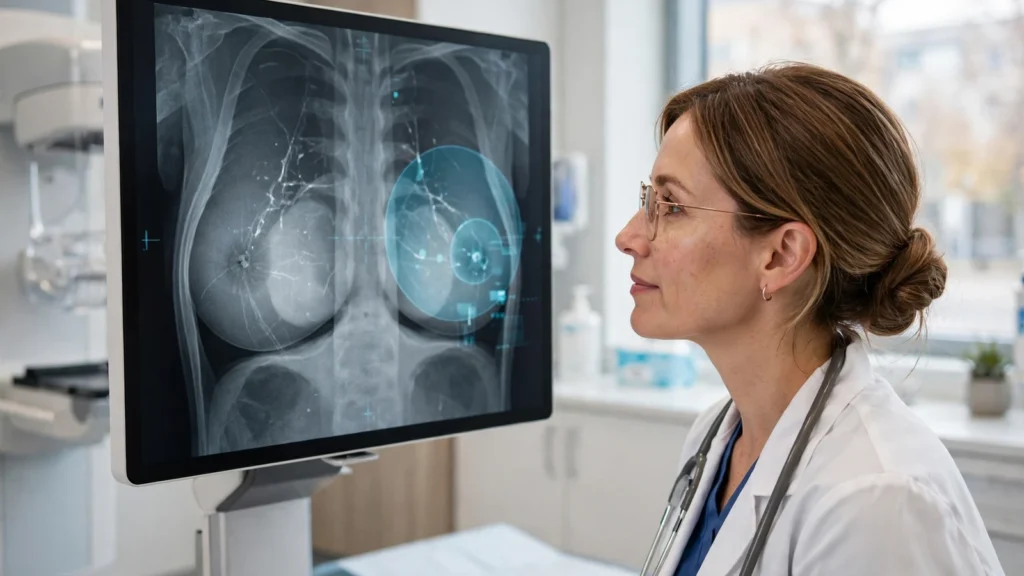
Women taking part will be put into one of three groups. In the first group, screening carries on exactly as it does today, with two NHS specialists reviewing each mammogram. In the second, an AI tool acts as a first filter, sorting scans by how likely they are to show cancer. In the third, the AI works alongside a single specialist reader, flagging areas of the image where cancer might have been missed.
There are safeguards built in. If the human reader and the AI disagree — or if the AI flags a very high likelihood of cancer — the scan goes to standard NHS arbitration, where a third specialist or a panel of experts makes the final call. All clinical decisions during the trial remain with NHS staff, and the NHS says it will only change how screening works if the evidence shows the new approach is as safe and effective as the care women receive now.
For women invited to screening, nothing about the appointment itself changes. The mammogram is taken in the usual way, at a local clinic, GP practice, hospital or mobile screening van. The invitation letter includes details about the trial and how to opt out for anyone who does not want to take part.
How does breast screening work today?
Breast screening uses an X-ray test called a mammogram, which can spot cancers when they are too small to see or feel. In England, women aged 50 to their 71st birthday are invited for screening every three years, with the first invitation arriving within three years of their 50th birthday. Women over 71 are no longer invited automatically but can still ask for screening every three years.
Around 2.1 million women have breast screening in the UK each year, and the programme helps prevent around 1,300 deaths a year. Each mammogram is currently reviewed by two specialist radiologists, and fewer than 1% of mammograms show signs of cancer — which means specialists spend a great deal of time carefully checking images that turn out to be clear.
Breast cancer is the most common cancer in the UK. Cancer Research UK says around 59,400 people are diagnosed every year — more than 160 a day — and 1 in 7 women will develop breast cancer during their lifetime. About a third of breast cancers in England are found through screening, most of them at an early stage, when treatment has the best chance of working.
Why is the NHS testing AI?
The short answer is pressure on people. Reviewing millions of mammograms takes a large specialist workforce, and that workforce is stretched. The Royal College of Radiologists says more than a fifth of the breast radiology workforce is due to retire by 2030, while the workforce has grown by only 2% a year on average over the past five years. Its president, Dr Stephen Harden, welcomed the trial but warned it is not a quick fix for the long waits many patients already face for scan results.
If AI can safely take on part of the reading workload, specialists could spend more of their time on diagnosis and caring for people with cancer, rather than on the large majority of scans that show nothing wrong. The NHS says that, if the trial succeeds, it could free up hundreds of radiologists and other specialists across the country, help cut waiting lists and save more lives.
The trial is also a test of trust. Health Secretary Yvette Cooper has said AI has huge potential but needs proper safeguards, and the trial’s leaders stress that the technology is being used transparently, with human specialists keeping the final say on every scan.
What does it mean for women invited to screening?
If you are invited for breast screening over the next three years, your letter may include information about EDITH. Taking part is optional, and you can opt out. Whether or not you take part, your appointment will be the same, and your mammogram will be reviewed by at least one specialist.
The trial does not change the most important advice about screening: go when you are invited. Screening finds cancers before symptoms appear, and finding cancer early makes treatment more likely to succeed. One woman from Cambridgeshire, aged 70, had early-stage breast cancer found by a routine mammogram in October 2025 despite having no symptoms at all; after surgery and radiotherapy she is doing well, and she credits the routine invitation with saving her life.
What the trial has not proven yet
It is important to be clear about what EDITH is and is not. It has not yet shown that AI improves cancer detection, shortens waiting times or saves additional lives. That is precisely what the trial is designed to find out, over three years and across 30 sites. Smaller studies and early pilots have been promising, but a large, careful trial is how the NHS decides whether a new way of working is genuinely safe and effective.
The trial is also testing whether the benefits hold up in real clinics, not just in research settings, and whether the approach is good value for money. Results will be published in scientific journals and shared with the government and screening services before any decision is made about using AI in the national programme.
When to see a doctor
Do not wait for a screening invitation if you notice a change in your breasts. See your GP promptly if you find a lump or an area of thickened tissue, or if your breasts look or feel different from what is normal for you. The same applies to nipple changes, discharge, or skin changes such as dimpling or redness. Most breast changes are not cancer, but only a proper assessment can tell.
Also speak to your GP if you have a strong family history of breast cancer, or if you are under 50 and worried about your risk — you may be eligible for screening earlier or for other checks.
In an emergency call 911 (US), 999 (UK) or 112 (EU). Breast symptoms themselves are rarely an emergency, but seek urgent help for any sudden, severe illness or new symptom that worries you.
Frequently asked questions
What is the EDITH trial?
EDITH stands for Early Detection using Information Technology in Health. It is an NHS trial testing whether artificial intelligence can help specialists review breast screening mammograms more efficiently and spot cancers earlier. Nearly 700,000 women at 30 UK sites will take part over three years, in a £10 million study funded through the National Institute for Health and Care Research.
Will AI replace radiologists in breast screening?
No. Every mammogram in the trial is still reviewed by at least one human specialist, and all clinical decisions remain with NHS staff. The AI tool assists readers by flagging areas where cancer might have been missed. If the human reader and the AI disagree, the scan goes to standard NHS arbitration by a third specialist or expert panel.
How many women are taking part in EDITH?
Nearly 700,000 women attending routine NHS breast screening will take part over three years, at 30 screening sites across the UK. Recruitment began on 23 November 2026 at Cambridge University Hospitals, with further sites joining over the coming months. Women are invited as part of their normal screening appointments.
Do I have to take part in the EDITH trial?
No, taking part is optional. Your invitation letter will include details about the trial and how to opt out if you do not want to take part. Whether or not you take part, your screening appointment is exactly the same, and your mammogram will still be reviewed by at least one specialist.
Who is invited for NHS breast screening?
In England, women aged 50 to their 71st birthday are invited for breast screening every three years, with the first invitation within three years of their 50th birthday. Women over 71 are no longer invited automatically but can still ask for screening every three years by contacting their local screening unit.
Does breast screening find all cancers?
No screening test is perfect, and mammograms can miss some cancers. That is why it matters to know what is normal for you and to see your GP promptly about any lump, thickened tissue, nipple change or change in how your breasts look or feel. Do not wait for your next screening invitation if you notice a symptom.
Sources
- NHS England: First women join world-leading AI-assisted NHS breast screening trial (23 Nov 2026) www.england.nhs.uk
- Royal College of Radiologists: 'Real potential but not a quick fix' — RCR responds to EDITH (23 Nov 2026) www.rcr.ac.uk
- Cambridge University Hospitals: Cambridge co-leading world's largest trial to use AI to help detect breast cancers earlier www.myscience.uk
- pharmaphorum: UK launches world's largest trial of AI in breast cancer (23 Nov 2026) pharmaphorum.com
- Cancer Research UK: Breast cancer www.cancerresearchuk.org
- NHS England: Screening and earlier diagnosis www.england.nhs.uk

Try the tool
When is your next period and fertile window?
Six cycles ahead from your last period date.
Open the calculator