Paxlovid Cuts Long COVID Risk by 12% in High-Risk Adults
A study of nearly 500,000 people found Paxlovid taken within five days of COVID-19 cut long COVID risk by 12% in high-risk adults — and lowered hospital admissions and deaths too.
- Written by
- Health Daily Advice
- Published
- Reading time
- 5 minutes
- Sources
- 9 cited

In this guide
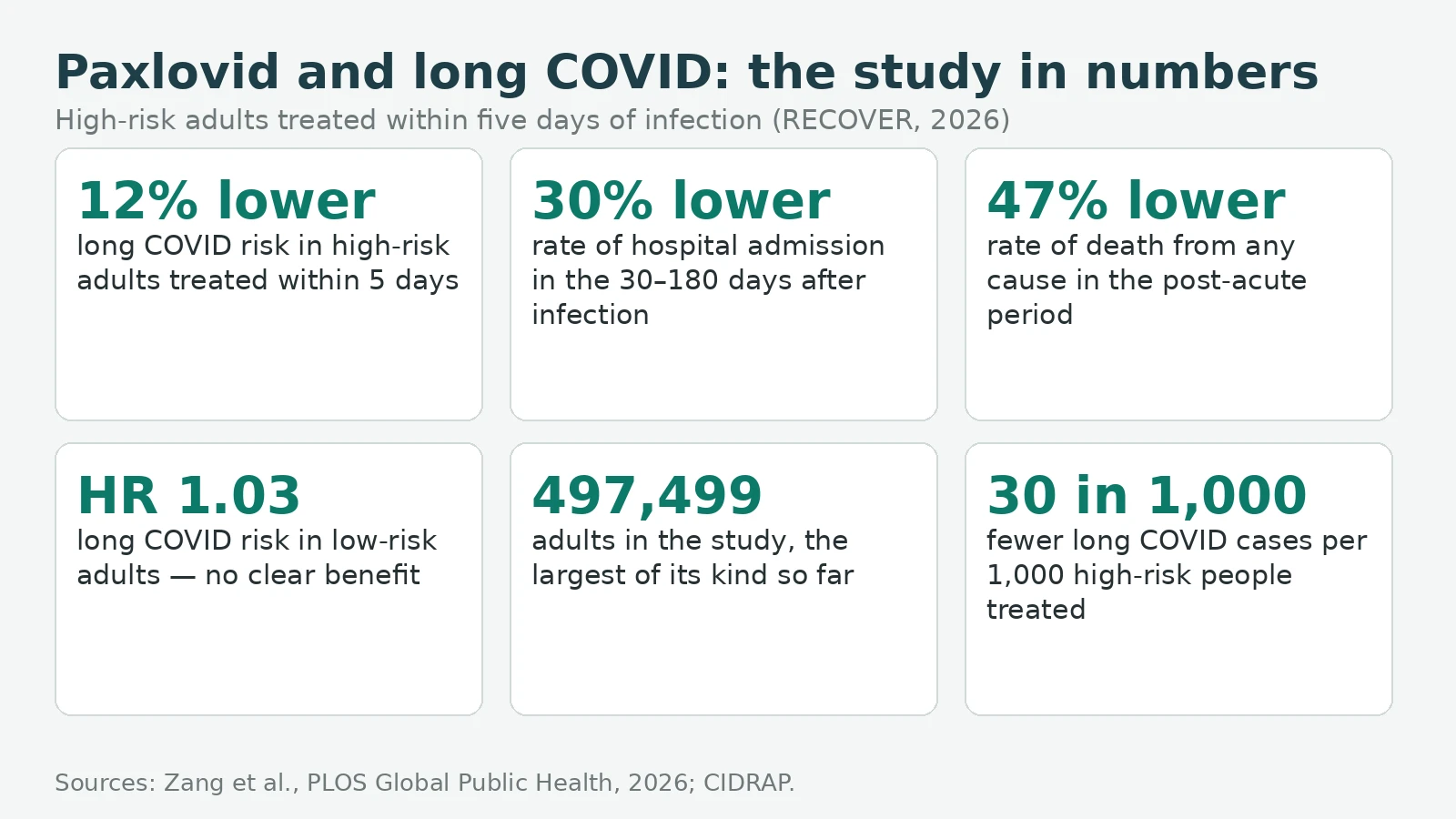
A large US study of nearly 500,000 people found that high-risk adults who took Paxlovid within five days of catching COVID-19 were 12% less likely to develop long COVID than similar people who went untreated. The same group also had lower rates of hospital admission and death in the following six months. Low-risk adults saw no clear benefit.
What the new study found
Researchers from Weill Cornell Medicine and the US National Institutes of Health RECOVER programme analysed electronic health records from 497,499 adults who tested positive for COVID-19 between March 2022 and February 2023. The study was published in PLOS Global Public Health in October 2026, and it is the largest observational study yet to look at whether Paxlovid can help prevent long COVID.
Among people with at least one risk factor for severe COVID-19, 159,659 took at least one dose of Paxlovid within five days of infection and 272,048 received no COVID-19 treatment. Compared with the untreated group, those who took Paxlovid had:
- A 12% lower risk of long COVID — about 30 fewer cases per 1,000 people.
- A 30% lower rate of hospital admission in the 30 to 180 days after infection — about 24 fewer admissions per 1,000 people.
- A 47% lower rate of death from any cause in the same period — about two fewer deaths per 1,000 people.
People who took Paxlovid were also less likely to develop a range of later health problems, including cognitive problems, sleep problems, joint pain, fatigue, breathlessness and changes in smell and taste.
Who benefited — and who did not
The benefit was limited to people at higher risk of severe COVID-19. That group included people aged 50 and over and people with underlying conditions such as diabetes, heart disease, chronic lung or kidney disease, a weakened immune system or obesity — the same factors that make severe COVID-19 more likely.
For people without any documented risk factor, the picture was different. Their long COVID risk was essentially unchanged whether or not they took Paxlovid, and the researchers described the result as inconclusive. That fits with a recent clinical trial that found no significant benefit from Paxlovid in low-risk patients.
It is worth keeping the size of the benefit in proportion. A 12% lower risk is a relative figure: in absolute terms it worked out at roughly three fewer cases of long COVID for every 100 high-risk people treated. That is a real effect across a population, but it is not a guarantee for any one person.
What is long COVID?
Long COVID, also called post COVID-19 condition, is the name for symptoms that continue or appear after the initial infection. According to the World Health Organization, symptoms usually start within three months of the infection and last at least two months. About 6 in every 100 people who catch COVID-19 develop the condition, and more than 200 different symptoms have been reported.
The most common are fatigue, breathlessness, muscle or joint pain, difficulty thinking or concentrating — often called “brain fog” — impaired sleep, headaches and changes in taste or smell. Symptoms can be mild or severely disabling, and they can affect someone’s ability to work and carry out daily activities. Around 15 in 100 people still have symptoms at 12 months, based on global estimates from 2022.
There is still no approved treatment specifically for long COVID. Care is individual and focused on the symptoms, which is why the question of whether an early antiviral can reduce the risk matters.
What Paxlovid is and who can get it
Paxlovid is the brand name for nirmatrelvir plus ritonavir, an oral antiviral. The US Food and Drug Administration approved it in May 2023 for mild-to-moderate COVID-19 in adults at high risk of progressing to severe disease. In its main trial, it cut COVID-related hospital admission or death by 86% when started within five days of symptoms.
In England and Wales, the National Institute for Health and Care Excellence recommends Paxlovid for an estimated 5.3 million people at increased risk who do not need oxygen for COVID-19, including people aged 85 and over, people on the organ transplant waiting list, and people with certain cancers, liver or kidney disease. The key point in every country is timing: treatment has to start within five days of symptoms beginning, so eligible people are advised to test as soon as symptoms appear and contact their GP, NHS 111 or hospital specialist straight away.
Paxlovid can interact with many other medicines, so a prescriber has to review everything a patient takes first. Its most common side effects are an altered sense of taste and diarrhoea.
What the study could not prove
This was an observational study, not a randomised trial, so it shows a link rather than proof. People were not assigned Paxlovid by chance, and other differences between the treated and untreated groups could help explain the findings, even though the researchers adjusted for a wide range of factors including age, other illnesses, body weight and vaccination status.
The researchers also could not check whether people actually took Paxlovid as prescribed, and they only counted new diagnoses after infection — they did not measure whether existing conditions got worse. Earlier research on Paxlovid and long COVID has been mixed: a large veterans’ study found a bigger reduction in risk, while another large analysis found almost no difference. That is why the authors describe their results as an association, and why they call for further studies, including trials, to confirm them.
What this means for you
If you are in a high-risk group and you test positive for COVID-19, contact your doctor, GP or pharmacist promptly — the five-day window is short, and waiting can mean missing it. Ask whether an antiviral is suitable for you, and mention every medicine you take, including over-the-counter and herbal products, because of the interaction checks.
If you are younger and otherwise healthy, this study gives no reason to seek Paxlovid to prevent long COVID. Vaccination also helps: the WHO notes that receiving two doses of vaccine appears to reduce the likelihood of developing long COVID. And if you already have long COVID symptoms, talk to your doctor about them — the Mayo Clinic advises keeping a note of when symptoms started, what makes them worse and how they affect your daily life, so your healthcare professional can plan your care.
When to see a doctor
Contact your doctor or GP promptly if you test positive for COVID-19 and you are in a high-risk group, or if symptoms such as breathlessness, chest pain or confusion develop. If long COVID symptoms — fatigue, breathlessness, brain fog, joint pain or sleep problems — are still present weeks after your infection, or they are getting worse or interfering with work and daily life, ask for an appointment rather than waiting them out.
Get emergency help straight away for severe breathlessness, persistent chest pain or pressure, new confusion, inability to stay awake, or lips or face turning blue or grey. In an emergency call 911 (US), 999 (UK) or 112 (EU).
Frequently asked questions
Does Paxlovid prevent long COVID?
For high-risk adults, it appears to lower the odds. In a study of nearly 500,000 people, those who took Paxlovid within five days of infection had a 12% lower risk of long COVID than similar untreated people. It is not a guarantee, and low-risk adults saw no clear benefit. Paxlovid is an antiviral for acute COVID-19, not a treatment for long COVID itself.
Who counts as high risk for Paxlovid?
Paxlovid is for adults at increased risk of severe COVID-19, including people aged 50 and over and those with conditions such as diabetes, heart disease, chronic lung or kidney disease, a weakened immune system or obesity. In England and Wales, NICE recommends it for an estimated 5.3 million people. Whether it suits you is a decision for your doctor or pharmacist.
How soon after infection must Paxlovid be started?
Within five days of symptoms beginning — that is the window used in the study and in the drug's approval. Because the window is short, eligible people are advised to test as soon as symptoms appear and contact their GP, NHS 111 or hospital specialist straight away. Starting later has not been shown to give the same benefit.
What are the symptoms of long COVID?
More than 200 symptoms have been reported. The most common are fatigue, breathlessness, muscle or joint pain, difficulty thinking or concentrating, impaired sleep, headaches and changes in taste or smell. Symptoms usually start within three months of infection and last at least two months, and about 15 in 100 people still have them at 12 months.
Is there a treatment for long COVID?
No treatment is approved specifically for long COVID. Care is individual and focused on relieving symptoms, and may involve rehabilitation and support from different specialists. If your symptoms are still present weeks after infection, or they are getting worse, talk to your doctor rather than waiting them out.
What are the side effects of Paxlovid?
The most common side effects are an altered sense of taste and diarrhoea, according to the FDA. Paxlovid can also interact with many other medicines, which is why prescribers review everything you take before deciding it is suitable. Tell your doctor or pharmacist about all medicines, supplements and herbal products you use.
Sources
- Zang C et al. Real-world effectiveness of Paxlovid in protecting Long COVID for outpatient adult patients. PLOS Global Public Health, 2026 journals.plos.org
- CIDRAP: Paxlovid tied to 12% lower risk of long COVID in high-risk adults www.cidrap.umn.edu
- WHO: Post COVID-19 condition (long COVID) www.who.int
- Mayo Clinic: Long COVID: Lasting effects of COVID-19 www.mayoclinic.org
- FDA: FDA Approves First Oral Antiviral for Treatment of COVID-19 in Adults www.fda.gov
- NICE: People at risk of severe COVID-19 to have access to antiviral Paxlovid www.nice.org.uk

Try the tool
Not sure if it can wait?
Common causes and warning signs for 16 everyday symptoms.
Open the symptom guide