Bird Flu Death in Washington: First Linked to Dairy Cattle
A dairy worker in Washington has died after catching H5N1 bird flu from infected cattle — the first such death anywhere. Here is what happened, what the symptoms look like and who needs to take care.
- Written by
- Health Daily Advice
- Published
- Reading time
- 5 minutes
- Sources
- 9 cited
In this guide
A dairy worker in Yakima County, Washington, has died after catching H5N1 bird flu from infected cattle — the first death reported anywhere following exposure to dairy cows. Two other workers in the county also caught the virus but had mild illness. The World Health Organization says the risk to the general public remains low.
What happened in Washington?
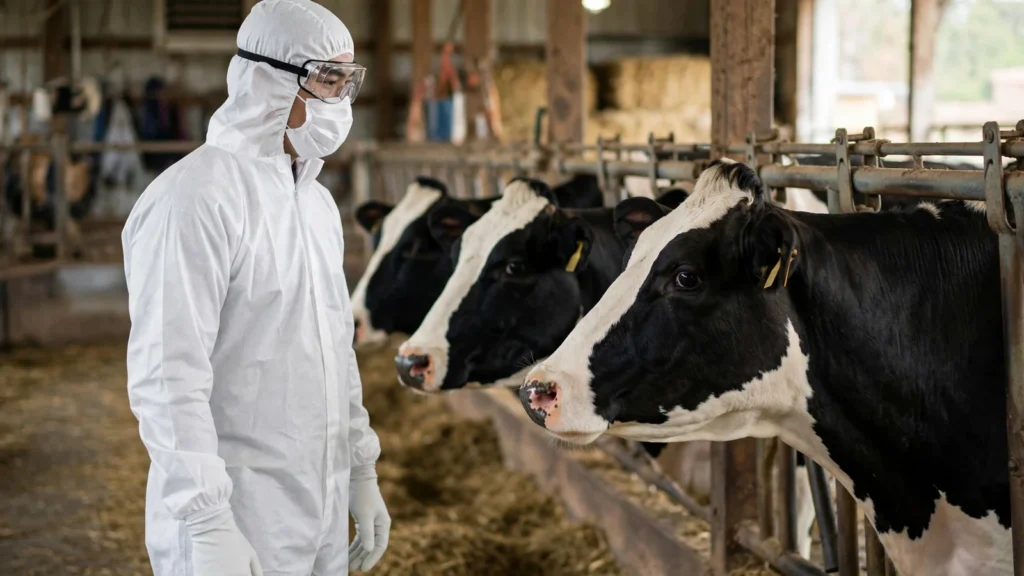
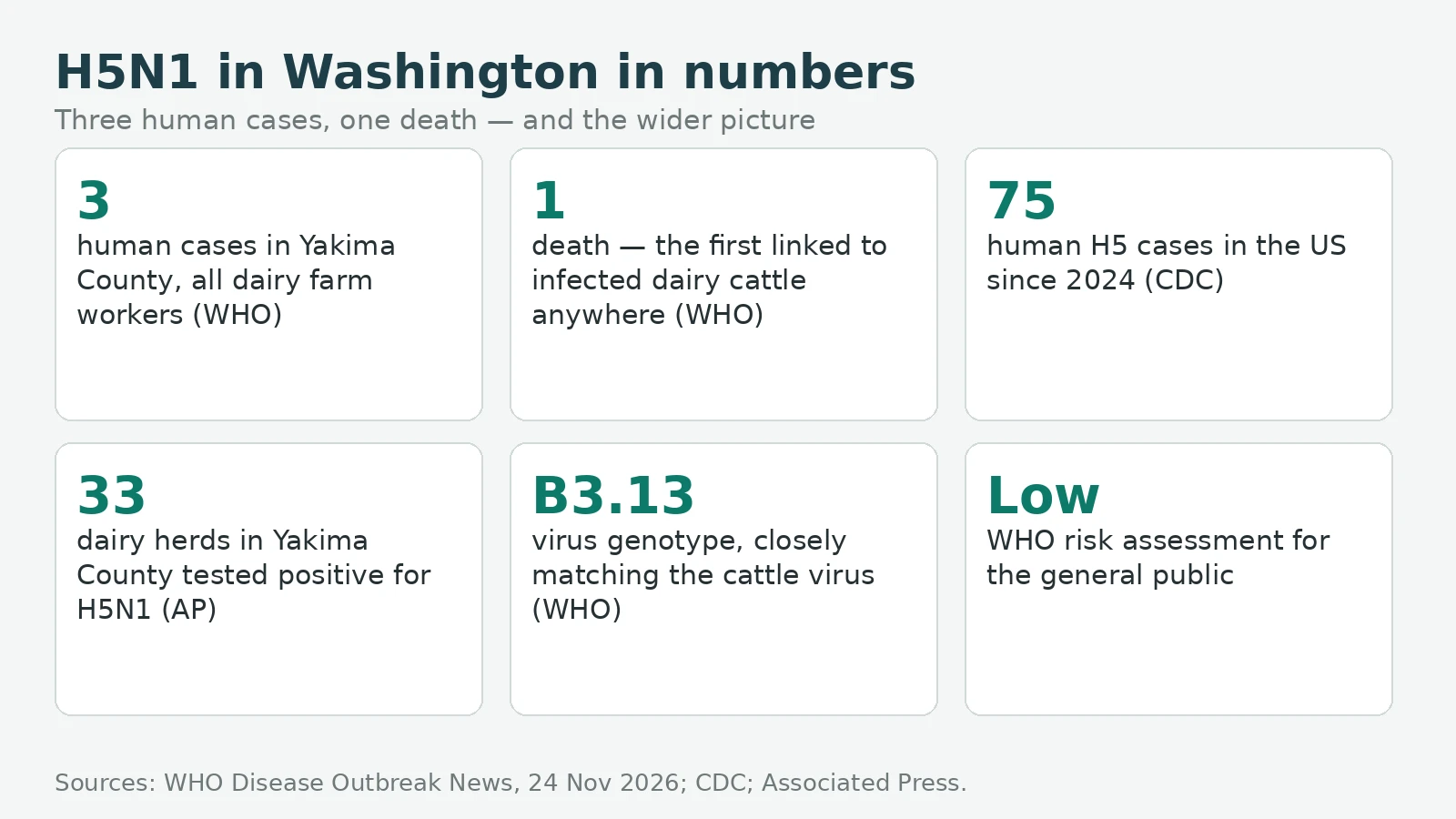
Between 16 October and 4 November 2026, the United States notified the World Health Organization (WHO) of three laboratory-confirmed human infections with influenza A(H5) virus in Yakima County, Washington. All three were adults who worked on dairy cattle farms in the county, where highly pathogenic avian influenza A(H5N1) had recently been detected in dairy cattle.
The first case fell ill on 5 October with eye irritation, a runny nose, muscle aches and a headache, and was offered the antiviral oseltamivir. The person was not hospitalised. The third case developed conjunctivitis — red, irritated eyes — and also did not need hospital care.
The second case was different. That person, who had underlying health conditions, developed respiratory symptoms in the week ending 24 October, was admitted to hospital with severe illness and died on 1 November. Genetic testing confirmed the virus as influenza A(H5N1), closely matching the virus found in the county’s dairy herds.
Why this death is a first
This is the first death reported anywhere in the world following exposure to infected dairy cattle, according to the WHO. It is also the first bird flu death in the United States in 2026 and the third in the country since February 2024, when H5N1 first jumped into dairy cattle.
The two earlier US deaths were different in kind. The first, in Louisiana in January 2025, was an elderly person exposed to a backyard flock. The second, in Washington in November 2025, involved a rarer version of the virus called H5N5. This latest death was caused by H5N1, the strain now circulating widely in wild birds, poultry and cattle.
As of 20 November 2026, 75 human cases of influenza A(H5) have been reported in the United States since 2024, according to the CDC. Most have been mild. County officials said 33 dairy herds in Yakima County had recently tested positive for H5N1, and the US Department of Agriculture said the virus most likely arrived from Idaho through the movement of cattle.
The virus in all three human cases belonged to genotype B3.13, the same type circulating in the county’s dairy cattle — evidence that the infections came from the animals, not from other people.
Bird flu symptoms in people
Bird flu in people can range from mild eye irritation to severe, life-threatening illness. According to the CDC, eye redness and irritation has been the most common symptom among recent US cases.
Mild symptoms can include a mild fever, cough, sore throat, a runny or blocked nose, muscle aches, headache and tiredness. Less commonly, people have diarrhoea, nausea or vomiting. The NHS says symptoms usually start around four to six days after contact with an infected bird, while the CDC notes that eye symptoms can appear one to two days after exposure and breathing symptoms about three days after, though the range is two to seven days.
Severe illness is less common but serious. It can bring a high fever, shortness of breath, confusion, seizures and complications including pneumonia, respiratory failure, kidney injury and inflammation of the brain. Some people who catch the virus have no symptoms at all.
For more on the virus in general, see our guide to bird flu in humans.
How bird flu spreads
People usually catch bird flu through direct contact with infected animals or with environments contaminated by them — for example, handling sick or dead birds, or working with infected cattle. The virus has been found in the milk of infected cows, which is why health authorities advise against drinking raw milk.
Importantly, there is no evidence of human-to-human transmission in the Washington cases. The WHO says sustained spread between people has not been detected anywhere in the world, and contacts of the three cases are being monitored for symptoms.
Seasonal flu is a different virus, and the two should not be confused. Our guide to flu symptoms explains how ordinary flu usually presents.
Who is most at risk
The risk is concentrated in people who work closely with animals that may be infected: dairy and poultry farm workers, people who handle sick or dead birds, and vets and wildlife workers. The WHO assesses the risk to the general public as low, and the risk for people with occupational exposure as low to moderate.
Workers who may be exposed should wear appropriate protective equipment — gloves, eye protection, a mask and coveralls — and follow their employer’s infection-control measures. The CDC recommends that people exposed to infected animals be monitored for symptoms for up to 10 days after their last exposure, and tested if they develop breathing symptoms or eye irritation.
How to protect yourself
- Avoid unprotected contact with sick or dead animals, and with surfaces that may be contaminated by them.
- Do not drink raw or unpasteurised milk, or eat raw milk products. Pasteurised milk and milk products are safe, according to the WHO.
- Cook eggs, poultry and other poultry products thoroughly, and handle them safely during food preparation.
- Wash your hands with soap and water after handling birds or animals, and after touching surfaces that could carry bird saliva or droppings.
- If you travel where bird flu is circulating, avoid live animal markets and poultry farms.
Antiviral medicines such as oseltamivir can treat bird flu, and the WHO says they work best when started as soon as possible, ideally within 48 hours of symptoms beginning. There is no human vaccine against H5N1 readily available, and existing seasonal flu vaccines are unlikely to protect against it.
When to see a doctor
Get medical advice promptly if you develop flu-like symptoms or red, irritated eyes within 10 days of contact with sick or dead birds, infected cattle or a contaminated environment. Tell the clinician about the animal contact, so you can be tested. Do not wait to see if it passes: early antiviral treatment works best.
Seek urgent care straight away for severe difficulty breathing, confusion or a seizure. In an emergency call 911 (US), 999 (UK) or 112 (EU).
Frequently asked questions
How did the Washington dairy worker die of bird flu?
The person worked on a dairy farm in Yakima County, Washington, where H5N1 had been found in cattle, and had underlying health conditions. They developed severe respiratory illness, were hospitalised and died on 1 November 2026. It is the first death reported anywhere following exposure to infected dairy cattle, and the first US bird flu death of 2026.
Can you catch bird flu from milk?
There is no evidence that pasteurised milk spreads bird flu — the WHO says pasteurised milk and milk products are safe to drink. Raw or unpasteurised milk from infected cows can carry the virus, so health authorities advise against drinking it. Cooking and pasteurisation kill the virus, and eggs and poultry should also be cooked thoroughly.
What are the symptoms of bird flu in people?
Eye redness and irritation has been the most common symptom in recent US cases. Other mild symptoms include fever, cough, sore throat, a runny nose, muscle aches, headache and tiredness. Severe illness can bring breathlessness, confusion and seizures, with complications such as pneumonia. Symptoms usually start two to seven days after exposure, with eye symptoms sometimes appearing within a day or two.
Is bird flu spreading between people?
There is no evidence of human-to-human transmission in the Washington cases, and the WHO says sustained spread between people has not been detected anywhere. All three cases caught the virus from infected dairy cattle. Close contacts of the cases are being monitored for symptoms, and health authorities say the risk to the general public remains low.
Who is most at risk from bird flu?
People who work closely with animals that may be infected are most at risk — dairy and poultry farm workers, vets, wildlife workers and people who handle sick or dead birds. The WHO rates their risk as low to moderate, and the risk to the general public as low. Workers should wear gloves, eye protection, a mask and coveralls, and be monitored for symptoms for 10 days after exposure.
Is there a vaccine for bird flu?
There is no vaccine against H5N1 bird flu readily available for people, and the WHO says existing seasonal flu vaccines are unlikely to protect against it. Candidate vaccine viruses have been selected for pandemic preparedness, but they are not in general use. Antiviral medicines such as oseltamivir can treat the illness, and they work best when started within 48 hours of symptoms beginning.
Sources
- WHO: Influenza A(H5N1) – United States of America (Disease Outbreak News, 24 Nov 2026) www.who.int
- CDC: A(H5) Bird Flu: Current Situation www.cdc.gov
- NHS: Bird flu www.nhs.uk
- CDC: Signs and Symptoms of Bird Flu in People www.cdc.gov
- STAT (Associated Press): Bird flu: Washington state resident dies after exposure to infected cattle, 2 Nov 2026 www.statnews.com
- Becker's Hospital Review: Washington state reports 3 human bird flu cases, 1 death tied to dairy cattle, 24 Nov 2026 www.beckershospitalreview.com

Try the tool
Not sure if it can wait?
Common causes and warning signs for 16 everyday symptoms.
Open the symptom guide