Screen Time at Ages 1 and 6 Linked to Weaker Memory Later
It may not just be how much screen time children get, but when. A study tracking 502 children found ages 1 and 6 were sensitive periods for later learning and memory.
- Written by
- Health Daily Advice
- Published
- Reading time
- 5 minutes
- Sources
- 6 cited

In this guide
A study tracking 502 children from age 1 to 8 found more screen time at ages 1 and 6 was linked to lower school results at 9 and weaker working memory at 10 and a half. Screen time at ages 2 and 3 showed no such link. The study shows an association, not proof that screens cause the difference.
What the study found
Researchers from Inserm in France and the National University of Singapore followed 502 children in the Growing Up in Singapore Towards healthy Outcomes (GUSTO) birth cohort. Parents reported how much time their child spent watching screens at ages 1, 1.5, 2, 3, 6 and 8. Trained psychologists later tested the children’s school results at age 9 and their working memory at age 10 and a half.
Two ages stood out. More screen viewing at age 1 was linked to lower school results at age 9 — each extra hour a day was tied to 1.47 fewer standard points — and to weaker working memory at 10 and a half. The same pattern appeared at age 6, when children typically start formal school. Between those ages, at 2 and 3, screen time showed no significant link with later results once family background and other factors were taken into account.
“The effect sizes we saw at age 1 were the largest among all time points we examined,” the authors said. “That suggests early infancy may be a window of heightened sensitivity, when the developing brain is particularly vulnerable to the displacement of learning interactions by screen time.” The study was published in the World Journal of Pediatrics in 2026 and highlighted by ScienceDaily on 26 November 2026.
Why ages 1 and 6?
The researchers’ explanation is about what screens replace. In the first year of life, the brain is forming connections at a rate it will never match again, and hours spent watching a screen can crowd out the back-and-forth moments with a caregiver — talking, singing, playing — that teach a baby how the world works. Age 6 is a different kind of turning point: children start formal school and are suddenly asked to sit still, pay attention, follow instructions and hold information in mind for long stretches.
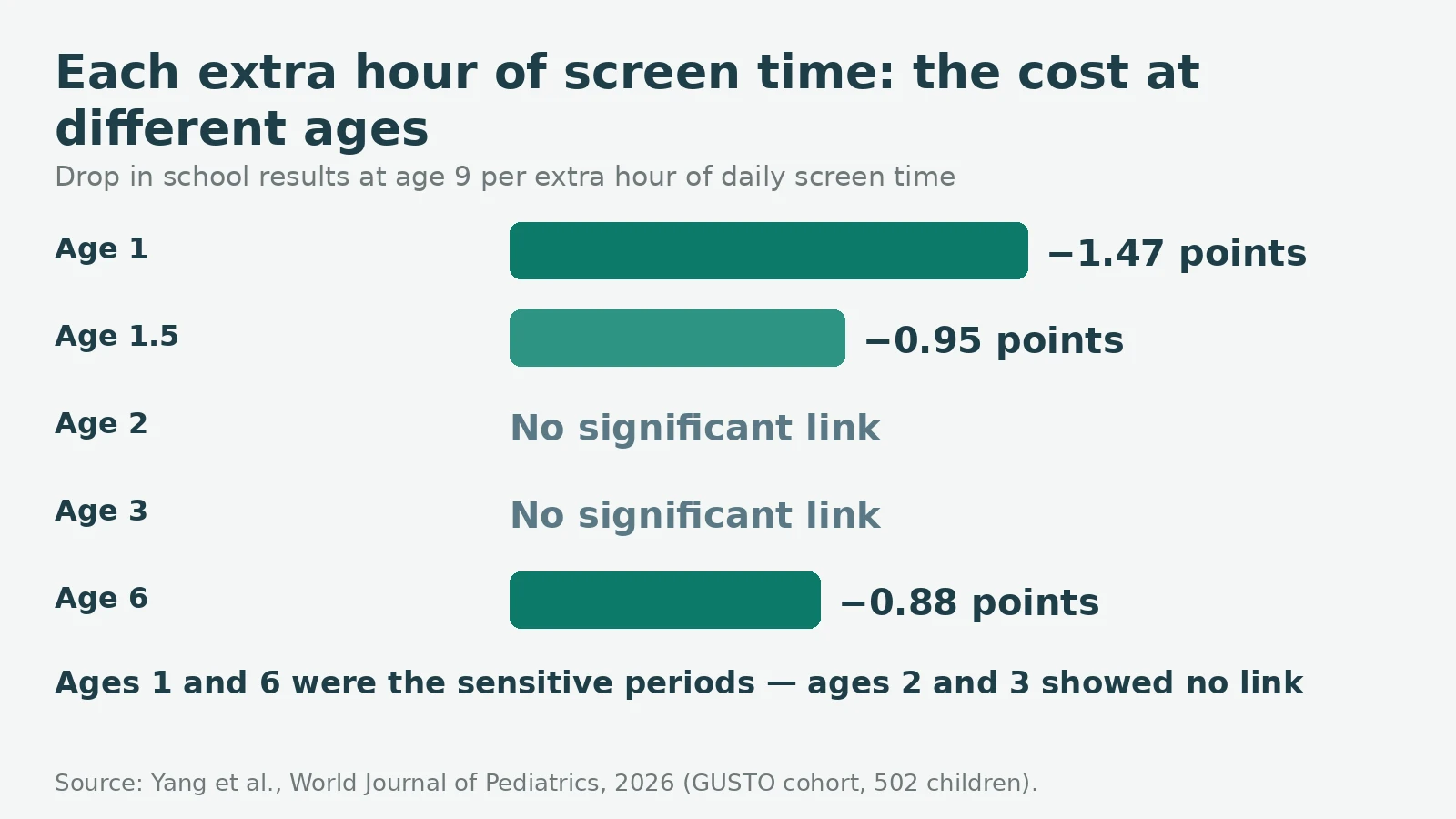
The amounts involved were not small. Average screen time in the study rose from 2.1 hours a day at age 1 to 3 hours a day by age 8 — far above the limits health bodies recommend for young children. Total screen time across childhood was also linked to poorer school results, but the timing mattered most: the single strongest effects came from screen viewing in early infancy.
How much screen time is too much?
Health bodies agree on the broad shape of the advice, even if the exact numbers differ a little. The table below brings together the main guidance for young children.
| Age | Recommended screen time | Source |
|---|---|---|
| Under 1 year | None (except video calls with family) | WHO; American Academy of Pediatrics |
| Age 1 | None recommended | WHO |
| Ages 2–4 | No more than 1 hour a day; less is better | WHO |
| Ages 2–5 | Less than 1 hour a day of good-quality shows, watched together | American Academy of Pediatrics |
| School-age children | No more than 2 hours a day; keep screens out of bedrooms at night | NHS |
The UK government’s Best Start in Life guidance for under-5s gives similar advice: avoid screens under age 2 apart from shared activities such as video calls with family, and keep it to no more than an hour a day for ages 2 to 5. It also notes that 90% of brain growth happens before the age of 5.
What is working memory?
Working memory is the brain’s ability to temporarily hold and use information — the skill a child needs to follow instructions, solve maths problems, understand sentences and keep track of information while completing a task. It is one of the building blocks of learning, and it is what the study measured at age 10 and a half using a letter-and-number sequencing task.
The link the researchers found was specific: more screen time at ages 1 and 6 was tied to weaker working memory years later, while total screen time across childhood was linked to school results but not to working memory. That pattern — the timing mattering more than the total — is what makes this study different from earlier research that simply counted hours.
What parents can do
No single study should make parents panic about a tablet, and the researchers stress that their findings show an association, not proof of cause. But the guidance from the WHO, the American Academy of Pediatrics and the NHS points in the same direction, and small changes help most at the two sensitive ages:
- Keep the first year screen-free. The WHO says screen time is not recommended for babies under 1, and the American Academy of Pediatrics advises avoiding screens before 18 months other than video calls with family.
- Watch together. For toddlers and pre-schoolers, sit with your child, choose slow-paced shows with simple stories, and talk about what you are seeing. Watching together is always better than leaving a child alone with a screen.
- Make bedrooms and mealtimes screen-free. Keep devices out of bedrooms at night and switch them off at least an hour before bedtime, as screens can disrupt sleep.
- Swap, don’t just ban. Replace screen time with reading, storytelling, singing, puzzles and active play — the activities the WHO says matter most for development.
- Watch your own use. Children copy what adults do, so limiting your own screen use around your child helps more than rules alone.
- Don’t use screens to soothe. Try not to hand a phone or tablet to a child to calm them when they are upset — young children are still learning how to handle their feelings.
- Set a family plan. The American Academy of Pediatrics offers a Family Media Plan tool to help families agree household media rules together.
What the study could not prove
The study was observational, so it cannot prove that screen time caused the poorer results — it can only show that the two moved together. Screen time was reported by parents from memory, and parents tend to under-report. The study also did not distinguish between types of screen content, so it cannot say whether educational shows differ from fast-paced videos, or whether watching with a parent changes the picture. The children were all from Singapore, so the findings may not apply in exactly the same way elsewhere. Future studies, the authors say, should look at content quality, device type and whether parents watch alongside their children.
When to see a doctor
Talk to your GP or health visitor if you are worried about your child’s development — for example, if their speech seems delayed, they struggle to concentrate or follow instructions, or their sleep is regularly disturbed. These can have many causes, and a professional can help work out what is going on. If your child is very withdrawn, not meeting developmental milestones, or you are worried about their eyesight or hearing, ask for advice sooner rather than later.
In an emergency call 911 (US), 999 (UK) or 112 (EU).
Frequently asked questions
At what age is screen time most harmful for children?
In this study, ages 1 and 6 stood out. More screen time at age 1 was linked to the biggest drop in later school results and working memory, and the link reappeared at age 6, when children start formal school. Screen time at ages 2 and 3 showed no significant link with later outcomes. The researchers say infancy and school entry may be sensitive periods for the developing brain.
How much screen time should a 1-year-old have?
None, according to the World Health Organization, which says screen time is not recommended for children under 1 and for 1-year-olds. The American Academy of Pediatrics advises avoiding screens before 18 months other than video calls with family. Instead, the WHO recommends reading and storytelling with a caregiver, active play and plenty of good-quality sleep.
Does screen time affect children's memory?
This study found a link with one kind of memory: working memory, the brain's ability to hold and use information while learning. Children who had more screen time at ages 1 and 6 scored worse on working memory tests at age 10 and a half. The study shows an association, not proof that screens cause the difference, and it did not find a link for screen time at ages 2 and 3.
How does working memory help children learn?
Working memory is the brain's ability to temporarily hold and use information. It lets a child follow instructions, solve maths problems, understand sentences and keep track of information while completing a task. Because it underpins so much everyday learning, researchers test it as a measure of how a child's thinking is developing.
How can I reduce my child's screen time?
Keep bedrooms and mealtimes screen-free, switch devices off at least an hour before bedtime, and swap screen time for reading, storytelling, puzzles and active play. Watch together when your child does use a screen, and choose slow-paced shows. Children copy adults, so limiting your own screen use around your child helps, and try not to use a phone to calm an upset child.
Sources
- ScienceDaily: Scientists identify two ages when children may be most vulnerable to screen time sciencedaily.com
- Yang et al. Screen viewing time from age 1 to 8 years and subsequent academic performance and working memory. World Journal of Pediatrics, 2026 link.springer.com
- WHO: To grow up healthy, children need to sit less and play more www.who.int
- KidsHealth: Media Use Guidelines for Parents (American Academy of Pediatrics guidance) kidshealth.org
- NHS: Advice for parents of healthy-weight children www.nhs.uk
- Howden Medical Centre (NHS GP practice): A guide to screen time www.howdenmedicalcentre.nhs.uk

Try the tool
Not sure if it can wait?
Common causes and warning signs for 16 everyday symptoms.
Open the symptom guide