What Is DMAA? The Banned Stimulant Behind the Pre-Workout Recall
A pre-workout powder sold nationwide since 2023 has been recalled after FDA lab tests found a banned stimulant that was never listed on the label. Here is what DMAA is, why it is dangerous, and what to do if you have the tub.
- Written by
- Health Daily Advice
- Published
- Reading time
- 7 minutes
- Sources
- 6 cited
In this guide
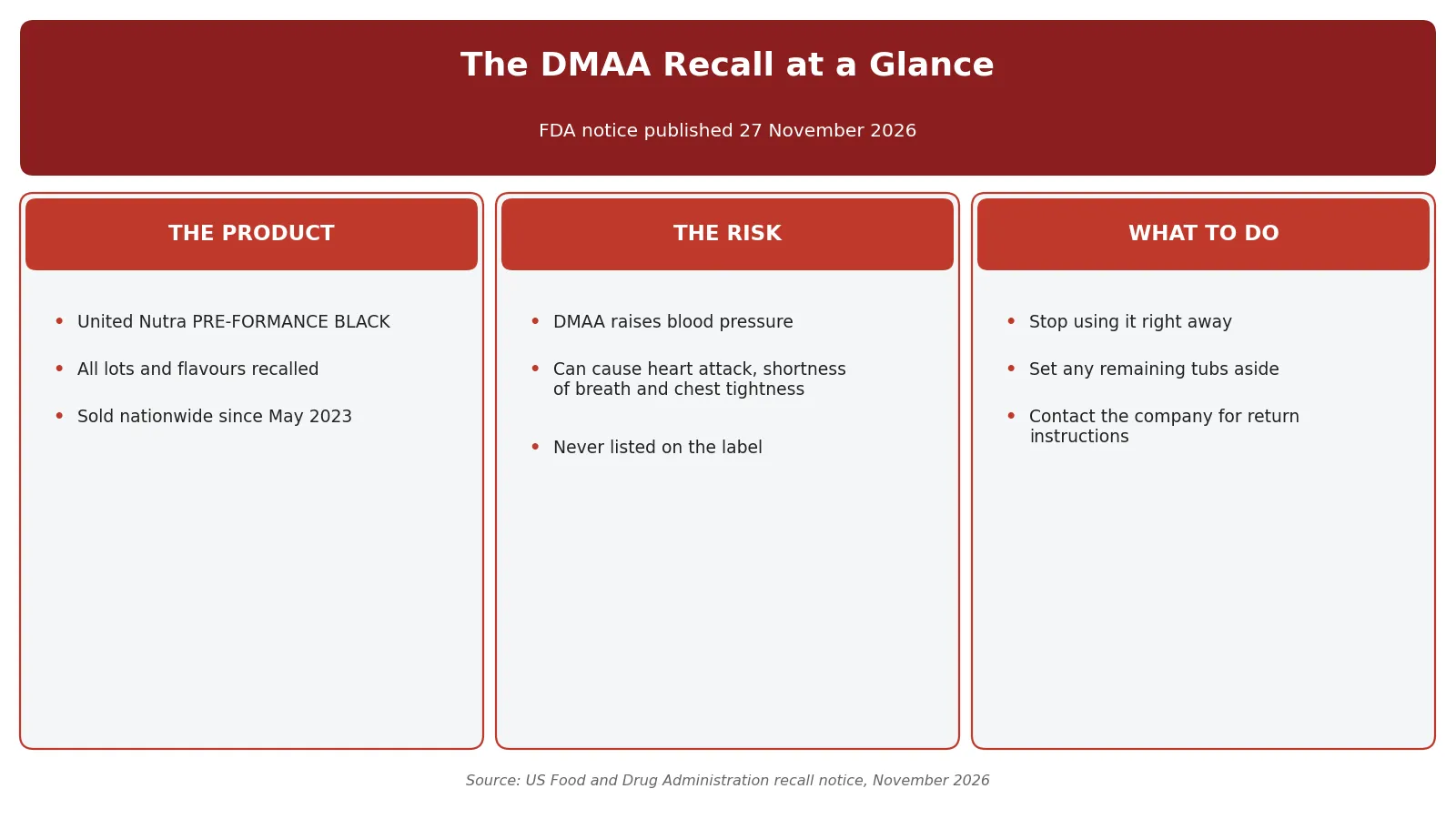
DMAA, short for dimethylamylamine, is a stimulant that the FDA says has no legal place in dietary supplements. It was found undeclared in United Nutra PRE-FORMANCE BLACK pre-workout powder, prompting a recall posted by the FDA on November 27, 2026. DMAA narrows blood vessels and raises blood pressure, which can lead to heart attack, shortness of breath, and chest tightness.
What happened? The PRE-FORMANCE BLACK recall
On November 25, 2026, Advanced Nutritional Supplements LLC of Harrisburg, Pennsylvania, announced a nationwide recall of every lot and flavor of United Nutra PRE-FORMANCE BLACK, a powdered pre-workout supplement. The FDA published the recall notice two days later, on November 27, 2026. The trigger was laboratory testing by the FDA, which found undeclared DMAA — specifically 1,4-dimethylamylamine — in the powder. The ingredient was not part of the formula the company had specified to its third-party manufacturer, and it was not listed anywhere on the label.
The product had been sold across the United States through the company’s website, AdvancedSupps.com, and its physical store in Harrisburg since May 6, 2023. It comes in black plastic tubs holding 25 servings (390 grams), with black and silver labeling. Three flavors were named in the recall notice, and the lot number is printed on the bottom of each tub:
| Flavor | UPC | Lot number |
|---|---|---|
| Razz Lemonade | 845215988602 | 48B891 |
| Blackberry Lime | 845215988701 | 29007H |
| Fruit Smoothie | 725272730843 | 55R40 |
Because the recall covers all lots and flavors, the company says the notice applies to every PRE-FORMANCE BLACK container, whatever the flavor or lot number. At the time the recall was published, the company said it had received no reports of adverse events linked to the product. The company is contacting customers by email, has posted a public notice on its website, and is asking buyers to complete a recall response form even if they no longer have the product.
What is DMAA?
DMAA is a lab-made stimulant related to amphetamine. It was first developed in the 1940s and sold for a time as an inhaled nasal decongestant under the brand name Forthane. That medical use ended decades ago, and the FDA says no medical use of DMAA is recognized today.
The name DMAA covers more than one closely related compound. The form discussed most often is 1,3-dimethylamylamine, also called methylhexanamine or geranamine. The form found in PRE-FORMANCE BLACK is 1,4-dimethylamylamine. Both are DMAA, and both are treated the same way by regulators.
DMAA reappeared in the 2000s as an ingredient in pre-workout powders and weight-loss products. Sellers often described it as a natural stimulant from geranium plants, sometimes listing “geranium extract” or Pelargonium graveolens extract on the label. The FDA says it is not aware of any reliable science showing that DMAA occurs naturally in plants.
DMAA has been illegal as a dietary supplement ingredient in the United States since 2013. The FDA began sending warning letters to companies selling DMAA products in 2012, and in 2013 it detained two well-known DMAA products, OxyElite Pro and Jack3d, after the maker initially refused to comply. Those products, worth more than $8 million at retail, were eventually destroyed. A federal court ruled in 2017 that DMAA-containing products were adulterated, an appeals court affirmed that ruling in 2019, and the Supreme Court declined to review the case in 2020.
Why is DMAA put in pre-workout?
Pre-workout powders are blends of several ingredients meant to be taken 30 to 60 minutes before training, and they are marketed as a way to boost energy, focus, and performance. DMAA appeals to makers of these products because it is a strong stimulant: it mimics the body’s fight-or-flight chemicals, sharpening focus and creating a surge of energy and urgency that some lifters describe as a “buzz.” It also suppresses appetite, which is why it turned up in weight-loss products too.
That same stimulant kick is the problem. DMAA tightens blood vessels and pushes blood pressure up, and the effect is stronger when it is combined with other stimulants such as caffeine — a combination that is common in pre-workout formulas. The Department of Defense’s Operation Supplement Safety program notes that there is limited scientific research on DMAA’s safety, yet products containing it have been linked to serious harm.
What are the health risks of DMAA?
DMAA is a vasoconstrictor, meaning it narrows blood vessels and arteries. That narrowing raises blood pressure and puts extra strain on the heart. According to the FDA, using DMAA can lead to cardiovascular problems including heart attack, shortness of breath, and tightening of the chest. The agency also warns that it can cause arrhythmias (irregular heartbeats) and seizures, along with other neurological and psychological effects.
The risks are not only theoretical. The Department of Defense program reports that products containing DMAA have been linked to liver injury, cardiac arrest, stroke, brain hemorrhage, and death following physical exertion. The recall notice for PRE-FORMANCE BLACK adds that people with underlying cardiovascular conditions may be particularly susceptible.
Several things make DMAA especially risky in a pre-workout. It is often taken right before intense exercise, when the heart is already working hard. It is frequently stacked with caffeine and other stimulants, which compounds the effect on blood pressure and heart rate. And when it is undeclared — as in this recall — the person taking it has no idea it is there, so they cannot weigh the risk, check it against a heart condition, or tell a doctor what they took if something goes wrong.
How can you tell if a supplement contains DMAA?
Start with the Supplement Facts label. DMAA can appear under many names, and the FDA lists these as the ones to watch for:
- 1,3-DMAA, 1,3-dimethylamylamine, or 1,3-dimethylpentylamine
- 1,4-DMAA or 1,4-dimethylamylamine (the form found in this recall)
- Dimethylamylamine, methylhexanamine, methylhexanenamine, or geranamine
- 2-amino-4-methylhexane, 4-methyl-2-hexanamine, or 4-methyl-2-hexylamine
- Geranium extract or Pelargonium graveolens extract, which may indicate DMAA is present
The catch is that a label is only as honest as the company behind it. In this recall, DMAA was not on the label at all — only FDA laboratory testing found it. That is why the FDA warns that it cannot test every supplement on the market, and why buyers should be cautious about products that promise extreme energy or rapid results. One practical safeguard is to look for a third-party testing seal from organizations such as NSF, Informed Sport, or the Banned Substances Control Group, which test supplements for contaminants and banned substances.
This is not the first warning about this product
The November recall is the second time the FDA has flagged PRE-FORMANCE BLACK in 2026. On June 24, 2026, the agency issued a public notification advising consumers not to buy or use the product after its laboratory analysis confirmed it contained 1,4-dimethylamylamine that was not listed on the label. The recall five months later suggests the problem was not resolved.
DMAA keeps surfacing in other products too. In October 2026, Leader Formulas recalled its RAPTURE pre-workout nationwide after FDA testing found 1,3-DMAA in it, and in April 2026 the FDA warned consumers against Addall XR Shot and Addall XL capsules, which contained undeclared 1,4-DMAA. The pattern is a reminder that a banned ingredient can keep reappearing in new products, sometimes without ever appearing on a label.
What should you do if you have the recalled product?
If you bought or received United Nutra PRE-FORMANCE BLACK, the company’s instructions are clear:
- Stop using it immediately.
- Set aside any remaining containers. Do not consume, sell, or give away the powder.
- Contact Advanced Nutritional Supplements for return instructions — by phone at (717) 553-0500, Monday through Friday, 9 a.m. to 7 p.m. Eastern, or by email at info@advancedsupps.com.
- Complete and return the recall response form on the company’s website, even if you no longer have the product.
- Tell anyone you may have shared the product with so they can stop using it too.
If you have felt unwell after using the product, talk to a doctor or pharmacist, and mention DMAA by name so they know what was in it. You can also report the problem to the FDA through its MedWatch program, which collects reports of side effects and quality problems with medicines and supplements.
Choosing a safer pre-workout
Not every pre-workout carries this kind of risk, but the category deserves a careful look before you buy. Research by Mayo Clinic sports medicine researchers found that the average pre-workout supplement contains around 18 ingredients, and that some of them can pose health risks, especially in large amounts. In a survey of 872 people who used pre-workout supplements, 14% said they took two or more servings at a time, and more than half said they had experienced side effects such as skin reactions, heart irregularities, and nausea.
A few habits help. Read the full ingredient list rather than trusting the front of the tub, and be wary of “proprietary blends” that hide how much of each ingredient is inside. Check for a third-party testing seal. Do not double-scoop or mix a pre-workout with energy drinks, since that stacks stimulants. And if you play competitive sport, remember that even a trace of DMAA can lead to a failed drug test — it is banned by the World Anti-Doping Agency and is on the Department of Defense’s prohibited ingredients list for service members. If you are unsure whether a product is safe for you, talk to a doctor or pharmacist before using it.
When to see a doctor
Get medical advice promptly if you used the recalled pre-workout and then felt unwell — especially if you noticed chest pain or tightness, shortness of breath, a racing or irregular heartbeat, dizziness, fainting, or a severe headache. These symptoms can signal a serious heart problem, and they should not be waited out. If you have a heart condition, high blood pressure, or another long-term health problem, talk to a doctor or pharmacist before using any stimulant-containing supplement.
In an emergency call 911 (US), 999 (UK) or 112 (EU)
Frequently asked questions
What is DMAA?
DMAA is a lab-made stimulant related to amphetamine. It was once sold as a nasal decongestant, but that use ended decades ago and the FDA recognizes no medical use for it today. Since 2013 it has been illegal as a dietary supplement ingredient in the United States. It is sometimes sold as methylhexanamine, geranamine, or geranium extract.
Why was PRE-FORMANCE BLACK recalled?
FDA laboratory testing found undeclared DMAA (1,4-dimethylamylamine) in the pre-workout powder. The ingredient was not in the formula the company specified and was not listed on the label. Because DMAA can raise blood pressure and cause serious heart problems, the company recalled all lots and flavors nationwide on November 25, 2026, and the FDA published the notice on November 27.
Is DMAA illegal?
Yes, as a dietary supplement ingredient in the United States. The FDA declared in 2013 that DMAA is not a lawful dietary ingredient and considers products containing it adulterated. Courts upheld that position in 2017 and 2019, and the Supreme Court declined to review the case in 2020. It is also banned in competitive sport and for US service members.
What should I do if I used the recalled pre-workout?
Stop using it right away and set any remaining containers aside. Contact Advanced Nutritional Supplements at (717) 553-0500 or info@advancedsupps.com for return instructions, and complete the recall response form on the company's website. If you felt unwell after using it, talk to a doctor or pharmacist, and report the problem to the FDA through MedWatch.
How can I tell if a supplement contains DMAA?
Check the Supplement Facts label for DMAA and its other names: 1,3- or 1,4-dimethylamylamine, methylhexanamine, geranamine, and geranium or Pelargonium graveolens extract. But a label is not a guarantee — in this recall, DMAA was not listed at all and only FDA lab testing found it. Look for a third-party testing seal from NSF, Informed Sport, or BSCG.
Can DMAA cause a failed drug test?
Yes. DMAA is a banned substance under the World Anti-Doping Agency's rules and is on the Department of Defense's prohibited ingredients list for service members. Mayo Clinic researchers warn that even trace amounts of DMAA or other banned substances in a supplement can lead to a failed drug test, so competitive athletes should be especially careful about pre-workout products.
Sources
- FDA: Recalls, Market Withdrawals, & Safety Alerts (Nov 27, 2026 entry: Advanced Nutritional Supplements LLC, PRE-FORMANCE BLACK) www.fda.gov
- Advanced Nutritional Supplements LLC: URGENT: Product Recall – United Nutra Pre-Formance Black advancedsupps.com
- FDA: PRE-FORMANCE BLACK may be harmful due to hidden ingredient www.fda.gov
- FDA: DMAA in Products Marketed as Dietary Supplements www.fda.gov
- Mayo Clinic Press: Preworkout supplements: What's safe? What should you avoid? mcpress.mayoclinic.org
- Operation Supplement Safety (DoD): DMAA: A Prohibited Stimulant www.opss.org

Try the tool
Not sure if it can wait?
Common causes and warning signs for 16 everyday symptoms.
Open the symptom guide