US Measles Cases Pass 6,000: What the New Study Found
The US has recorded 6,039 measles cases in 2026, more than double last year's total, with nine deaths. A new JAMA study links school vaccine exemptions to local outbreaks.
- Written by
- Health Daily Advice
- Published
- Reading time
- 5 minutes
- Sources
- 7 cited
In this guide
The United States has recorded 6,039 confirmed measles cases in 2026, more than double the 2,289 cases in all of 2025, with nine deaths. A new study links higher school vaccine exemption rates to a greater chance of local outbreaks, even where average vaccination coverage looks adequate.
Measles was declared eliminated in the US in 2000. This year the country lost that status, and the case count keeps climbing. The new research, published in JAMA Network Open on 24 November 2026, may help explain why outbreaks are flaring in some counties and not others.
How bad is the 2026 measles surge?
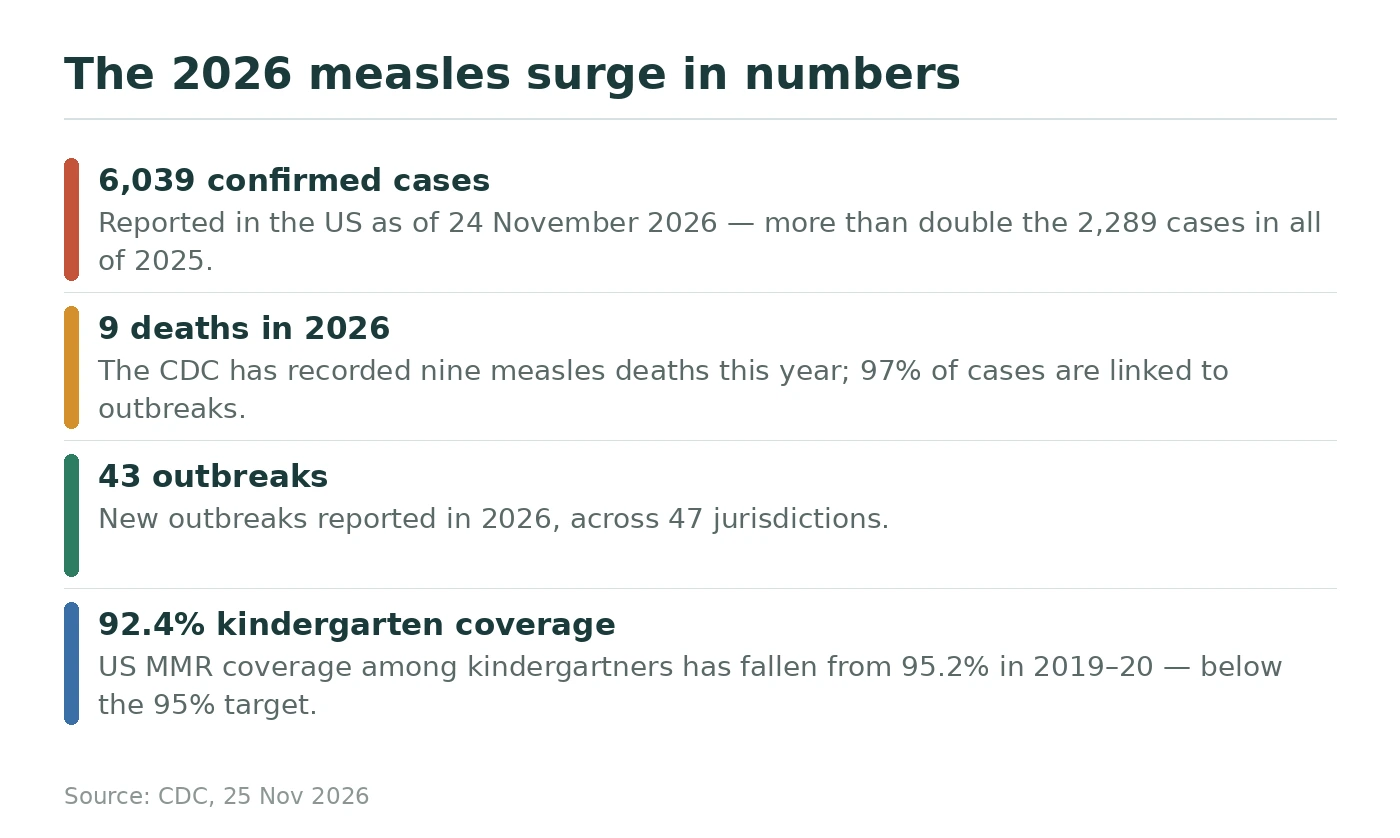
As of 24 November 2026, the CDC had recorded 6,039 confirmed measles cases in the US in 2026, reported by 47 jurisdictions, plus 18 cases among international visitors. Almost all of them — 97%, or 5,829 cases — are linked to outbreaks, and 43 new outbreaks have been reported this year. Nine people have died.
The scale is stark against recent years: 2,289 cases were recorded in all of 2025, and just 285 in 2024. Before the measles vaccine was introduced, the CDC estimates that around 48,000 people were hospitalised and 400 to 500 people died in the US each year. The Pan American Health Organization withdrew the US elimination status in 2026 after the same strain of virus circulated continuously for at least 12 months — a story covered in our earlier article, US Loses Measles Elimination Status.
Behind the national total sits a quieter shift: vaccination coverage among US kindergartners has fallen from 95.2% in the 2019–20 school year to 92.4% in 2025–26, leaving around 280,000 kindergartners at risk, according to the CDC. At least 95% coverage with two doses is needed to stop measles spreading in a community — and national averages can hide much lower coverage in particular towns and schools.
What did the new exemptions study find?
The study, published in JAMA Network Open on 24 November 2026, was led by researchers at the University of Washington and George Washington University. They analysed 1,914 counties across 30 states, covering about 237 million people — nearly three-quarters of the US population — and compared school-entry nonmedical exemption rates with measles cases in 2025.
The headline finding: each one-percentage-point increase in a county’s nonmedical exemption rate was associated with 16% higher odds of that county reporting at least three measles cases (odds ratio 1.16). The link held even after accounting for the county’s average MMR coverage — and average coverage on its own showed no independent link with outbreaks. In other words, a county can look well protected on average while still containing clusters of unvaccinated children where measles can take hold.
The average nonmedical exemption rate across the counties studied was 4.6%, and average kindergarten MMR coverage was 91.1%. Only 66 counties (3.4%) met the study’s outbreak threshold of three or more cases — but those counties are where the risk concentrates. The authors are careful about the limits: this was a county-level study, so it cannot prove that exemptions caused individual cases, and three cases in a county do not necessarily mean one connected outbreak. What exemption data may do, they suggest, is help health officials spot schools and communities that need closer checks and better preparation.
What are the symptoms of measles?
Measles usually starts 10 to 12 days after catching the infection, though it can take up to 21 days. According to the NHS, it begins with cold-like symptoms: a high temperature, a runny or blocked nose, sneezing, a cough and red, sore, watery eyes. Small white spots may appear inside the cheeks and on the back of the lips a few days later.
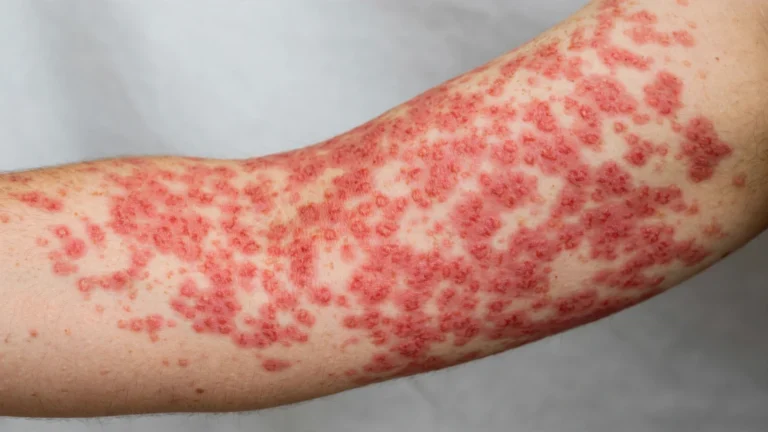
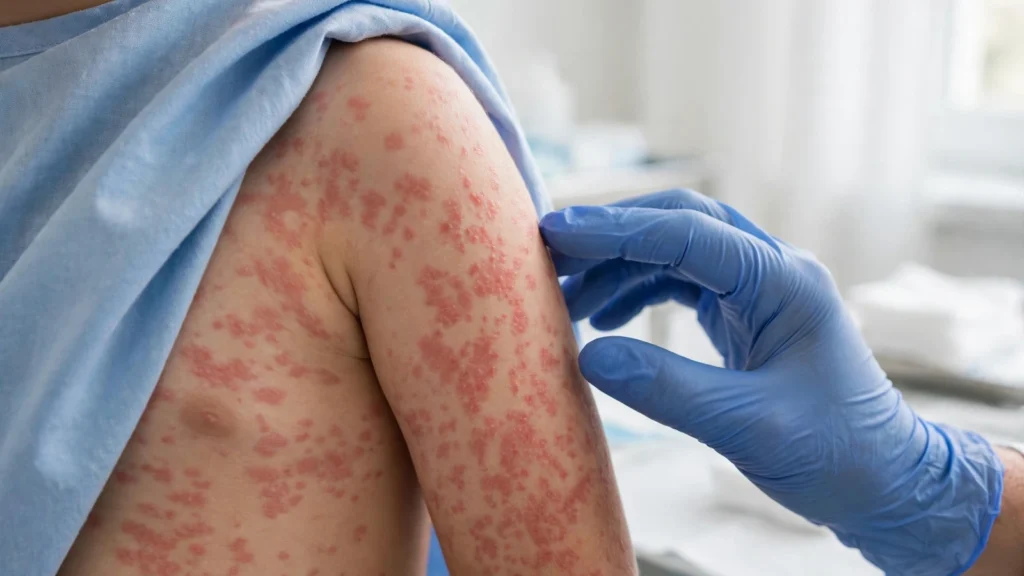
A rash usually appears two to four days after the cold-like symptoms started. It begins on the face and behind the ears before spreading to the rest of the body, forming blotchy red or brown patches that are not usually itchy. Measles usually starts to get better in about a week, but it can become serious — around one in 15 people become seriously unwell, according to the UK Health Security Agency.
How serious is measles?
Measles can spread to the lungs or brain and cause pneumonia, meningitis, blindness and seizures. These problems are rare, but babies and people with weakened immune systems are most at risk. Measles in pregnancy can cause miscarriage, stillbirth or premature birth. Globally, the WHO estimates that around 72,000 people — mostly children under five — died of measles in 2025, even though a safe and cheap vaccine exists. Vaccination has averted more than 60 million deaths since 2000.
You can spread measles from around four days before the rash appears until four days after it appears, and the virus spreads through the air when an infected person breathes, coughs or sneezes. The NHS advises staying off nursery, school or work for at least four days from when the rash first appears, and avoiding close contact with babies, pregnant women and people with weakened immune systems.
How well does the MMR vaccine protect?
Very well. Two doses of the MMR vaccine are about 97% effective at preventing measles, and one dose is about 93% effective, according to the CDC. The vaccine also protects against mumps and rubella, and it has been in use for about 60 years.
In the UK, children are offered two doses of the MMRV or MMR vaccine, and adults who missed their doses can catch up free on the NHS — it is never too late. In the US, the CDC advises talking to a healthcare provider about vaccination, especially if you are planning to travel. If you are unsure whether you or your child have had two doses, check your vaccination record or ask your GP or healthcare provider. Pregnant women and people with weakened immune systems should not have the MMR vaccine, so they should seek medical advice instead.
When to see a doctor
Ask for an urgent GP appointment or call NHS 111 (in the UK) if you think you or your child may have measles, if your child is under one and has been in contact with someone with measles, or if you are pregnant or have a weakened immune system and have been in close contact with a case. Call your GP surgery before going in, as they may arrange for you to be seen separately so you do not spread the infection. In the US, call your healthcare provider or local health department for advice.
Call 999 or go to A&E if you or your child has measles and has a seizure, severe difficulty breathing, cannot stay awake, suddenly becomes confused, or has a rash that does not fade when you press a glass against it. Do not drive to A&E — ask someone to drive you or call 999 for an ambulance. In an emergency call 911 (US), 999 (UK) or 112 (EU).
Frequently asked questions
How many measles cases are there in the US in 2026?
The CDC reported 6,039 confirmed cases as of 24 November 2026, across 47 jurisdictions, with nine deaths. That is more than double the 2,289 cases recorded in all of 2025 and far above the 285 cases in 2024. Almost all cases — 97% — are linked to outbreaks, and 43 new outbreaks have been reported this year.
What did the new study find about vaccine exemptions?
Researchers analysed 1,914 counties in 30 states and found that each one-percentage-point rise in school-entry nonmedical exemption rates was linked to 16% higher odds of a county reporting at least three measles cases. The link held even after accounting for average MMR coverage, suggesting pockets of unvaccinated children matter more than county-wide averages.
What are the symptoms of measles?
Measles usually starts 10 to 12 days after infection with cold-like symptoms: a high temperature, runny nose, sneezing, a cough and red, sore, watery eyes. Small white spots may appear inside the mouth, and a blotchy rash follows a few days later, starting on the face and behind the ears before spreading over the body.
How effective is the MMR vaccine?
Two doses of the MMR vaccine are about 97% effective at preventing measles, and one dose is about 93% effective, according to the CDC. In the UK, children are offered two doses, and adults who missed them can catch up free on the NHS. Checking your vaccination status is the simplest step if you are unsure.
How long is measles infectious for?
You can spread measles from around four days before the rash appears until four days after it appears. The NHS advises staying off nursery, school or work for at least four days from when the rash first appears, and avoiding close contact with babies, pregnant women and people with weakened immune systems.
Can adults get measles?
Yes. Anyone who has not had measles or two doses of the MMR vaccine can catch it, and complications are more likely in babies, teenagers, adults and people with weakened immune systems. Measles can cause pneumonia, meningitis, blindness and seizures, and in pregnancy it can lead to miscarriage or premature birth.
Sources
- CDC: Measles Cases and Outbreaks www.cdc.gov
- Ahmed HM, Kayani R, Yang YT. School-entry nonmedical vaccine exemptions and county-level measles outbreaks. JAMA Network Open, 24 Nov 2026 jamanetwork.com
- NHS: Measles www.nhs.uk
- UK Health Security Agency: Measles factsheet www.gov.uk
- WHO: Measles deaths down 88% since 2000, but cases surge www.who.int

Try the tool
Not sure if it can wait?
Common causes and warning signs for 16 everyday symptoms.
Open the symptom guide