Can a Blood Test Predict a Heart Attack 30 Years Early?
A major new study found blood pressure, cholesterol and blood proteins began to differ up to 30 years before a first heart attack or stroke — but no single test can predict one person's future.
- Written by
- Health Daily Advice
- Published
- Reading time
- 8 minutes
- Sources
- 11 cited

In this guide
No — not as a personal fortune-teller. A large new study found that blood pressure, cholesterol and certain blood proteins began to differ up to 30 years before a first heart attack or stroke. The differences show up in group averages, not in a single test that can predict one person’s future.
It followed more than 110,000 adults for decades. But it does not give doctors a crystal ball, and it does not mean everyone should rush out for extra blood tests.
What did the new study actually find?
The study, “Cardiovascular Risk Factors and Biomarkers in the Decades Prior to a Cardiovascular Event”, was published in JAMA Network Open on 23 November 2026. It was led by Marie de Bakker, with senior author Dorien M. Kimenai of the Usher Institute at the University of Edinburgh, and funded by the British Heart Foundation.
The researchers pooled four long-running cohort studies — the Cardiovascular Health Study, the Trøndelag Health Study (HUNT) in Norway, the Multi-Ethnic Study of Atherosclerosis (MESA) in the United States, and Whitehall II in the UK — covering 1985 to 2019. Together they followed 113,612 adults with no history of heart attack or stroke across 316,719 study visits, for a median of 18.9 years.
Over that time, a first cardiovascular event — nonfatal heart attack, nonfatal stroke or cardiovascular death — occurred in 8,025 women (13.5%) and 8,892 men (16.4%). Working backwards, they found the two groups had already drifted apart three decades beforehand.
As Dr Kimenai put it: “Modifiable risk factors begin to diverge 30 years before a cardiovascular event occurs. This highlights a great opportunity to develop early prevention strategies throughout the life course.” Professor Bryan Williams, the British Heart Foundation’s chief scientific and medical officer, added: “For the vast majority of people, heart attacks and strokes are completely preventable… That could lead to a simple blood pressure reading, or proteins in the blood, being used to forewarn people of their future cardiovascular risk.” MedicalXpress reported the findings on 23 November 2026.
How far back do the warning signs go?
Not every marker moved at the same time — some differences were visible 30 years ahead, others only in the final decade.
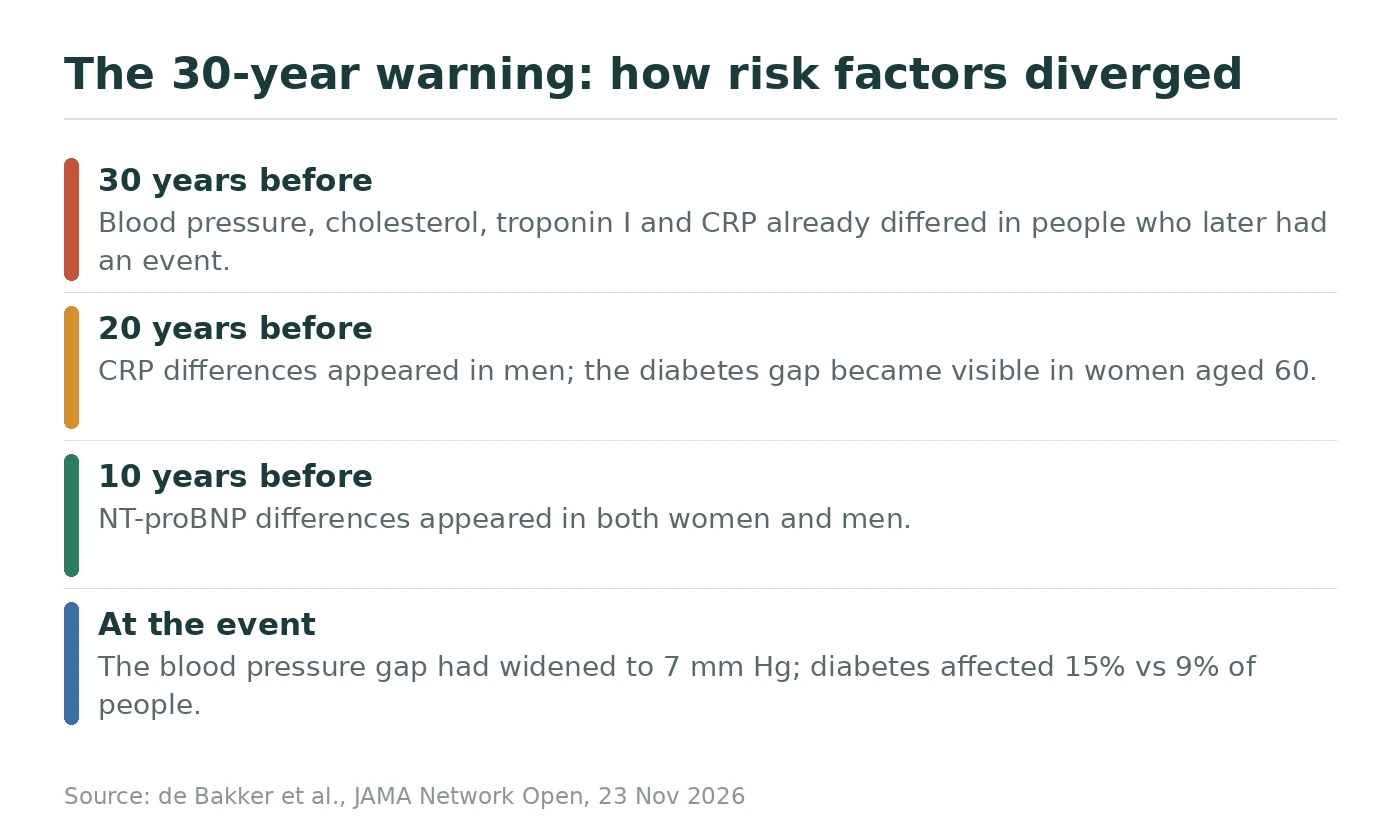
Blood pressure was among the earliest signals: among women who later had an event, average systolic blood pressure — the top number — was 121 mm Hg versus 117 mm Hg in women who stayed event-free, three decades beforehand. That 4 mm Hg gap widened to 7 mm Hg (137 versus 130) by the time of the event, with a similar pattern in men.
A few millimetres of mercury sounds trivial, but small differences add up: a meta-analysis of 38 randomised trials (186,988 participants) found major cardiovascular event risk rises by around 10% for every 5 mm Hg increase in systolic blood pressure.
Cholesterol followed a similar long arc. People who later had an event had higher total cholesterol, lower HDL cholesterol — often called “good” cholesterol — lower physical activity and lower kidney function as early as three decades beforehand.
The blood proteins were more staggered. Troponin I, a protein released when heart muscle is damaged, already differed three decades before the event in both sexes. CRP, a marker of inflammation, differed three decades beforehand in women but only two decades beforehand in men. NT-proBNP, a protein linked to strain on the heart, was the latecomer: its levels only began to differ about a decade before the event.
Diabetes showed yet another pattern, depending on age. In women who were 60 at the time of their event, the gap in diabetes prevalence was visible as early as 20 years beforehand, peaking at a 7% gap at the event itself. In women who were 80 at the event, the gap appeared only about five years beforehand. At the event, diabetes affected 15.3% versus 9.3% of women (15.2% versus 9.0% in men), and smoking was far more common: 16.6% versus 3.6% in women, 14.7% versus 2.7% in men.
The sexes differed too: at age 20, average systolic blood pressure was 110 mm Hg in women versus 123 mm Hg in men, but women’s readings rose more steeply and overtook men’s at a mean age of 66.
What do these blood markers actually measure?
Troponin, CRP and NT-proBNP may sound unfamiliar, but each is used in everyday medicine. What is new is the suggestion that their levels may start shifting decades before trouble arrives.
Troponin
Troponin is a protein in heart muscle cells that leaks into the blood when the muscle is damaged, as in a heart attack. Its most common use today is to confirm or rule out a heart attack, mainly in emergency departments. After a heart attack, levels usually rise sharply within 3 to 12 hours and peak about 24 hours later, according to the Cleveland Clinic.
In this study, troponin I levels were already slightly higher in people who would later have an event — three decades before it happened. That does not mean a troponin test can predict a heart attack 30 years ahead: it is a diagnostic test for suspected heart damage, not a screening test.
CRP (C-reactive protein)
CRP is a protein made by the liver, and its level rises with inflammation anywhere in the body. A high-sensitivity version, hs-CRP, “can help show the risk of getting coronary artery disease”, according to the Mayo Clinic. Below 2.0 mg/L suggests lower risk of heart disease; at or above 2.0 mg/L, higher risk. Because a passing infection can throw off one reading, risk is usually judged from the average of two tests taken two weeks apart.
The Mayo Clinic is clear, though, that “an hs-CRP test isn’t for everyone”. It is most useful at intermediate risk — a 10% to 20% chance of a heart attack within the next 10 years — where the result might change a treatment decision. In the new study, CRP differences appeared 30 years before an event in women and 20 years before in men.
NT-proBNP
NT-proBNP is a protein made by the heart and blood vessels. As the Mayo Clinic explains, “in heart failure, the level of this protein goes up”, and the test is used to help diagnose heart failure. In this study it was the last of the three proteins to diverge, with differences appearing only about a decade before the event — suggesting it reflects strain on the heart as disease gets closer, rather than an early warning.
Why this study matters — and what it does not prove
Cardiovascular disease is the UK’s biggest single health challenge: according to the British Heart Foundation, it causes over a quarter of all deaths — around 170,000 each year, or one every three minutes. More than 8 million people live with it, and around 1.4 million people alive in the UK today have survived a heart attack.
But the study has real limits. It compared average trajectories of groups; it did not build a risk score, and it did not test whether acting earlier changes outcomes. As Science Times reported, the findings “do not establish a single blood test that can predict an individual’s future with certainty”. Elevated levels alone cannot predict one person’s future risk, and they do not justify routine screening for everyone. The study is also observational: it shows risk factors diverged long before events, not that the divergence caused them.
What the study does offer is a new way of thinking about timing. Heart disease is often treated as a problem of later life. This research suggests the story starts far earlier — in your thirties and forties, when blood pressure and cholesterol are already quietly setting their course. That is not a reason for alarm at 35 — it is a reason to know your numbers early.
What does this mean for you now?
The practical message is simple: the checks that already exist are the ones that matter. Professor Williams put it this way: “we can all find out our risk of cardiovascular disease, for example by ‘knowing your numbers’ and getting your blood pressure and cholesterol checked, or having a free NHS health checkup with your general practitioner in midlife for those living in England.”
The NHS Health Check is free for people in England aged 40 to 74 without a pre-existing condition, offered every five years. It takes 20 to 30 minutes, and includes blood pressure and cholesterol tests (and possibly a blood sugar test), plus questions about family history, smoking, alcohol and physical activity. You leave with a cardiovascular risk score for the next 10 years — low, moderate or high — and advice on what to do about it.
Beyond that, the everyday habits that protect the heart — not smoking, staying active, eating well, keeping weight healthy and drinking within limits — matter across the whole of adult life.
Should you ask your GP for these blood tests?
For most people, no — not as routine screening. The study “does not establish a new standard of care or recommend that everyone undergo routine testing for CRP, cardiac troponins, or NT-proBNP”, as Science Times noted. Troponin and NT-proBNP are diagnostic tests, used when a doctor suspects a heart attack or heart failure.
There are exceptions. An hs-CRP test may be useful if you are at intermediate cardiovascular risk and the result would change a treatment decision — something to discuss with your GP, not to order yourself. If you already have high blood pressure, high cholesterol or diabetes, regular monitoring through your GP is part of standard care.
The more useful question is simpler: when was your blood pressure last checked, and what is your cardiovascular risk over the next 10 years? Those are the numbers that guide real decisions — and, on this study’s evidence, the numbers worth tracking for decades.
When to see a doctor
Speak to your GP if your blood pressure or cholesterol has not been checked in the last few years, if you are aged 40 to 74 and have never had an NHS Health Check, or if early heart disease or stroke runs in your family. Also book an appointment for chest pain or tightness, unusual breathlessness, pain spreading to the arm, jaw or back, or sudden weakness or numbness on one side of the body.
Call 999 immediately if you or someone near you shows signs of a heart attack or stroke — crushing chest pain, sudden severe breathlessness, or sudden weakness, numbness or difficulty speaking. Do not drive yourself to hospital. In an emergency call 911 (US), 999 (UK) or 112 (EU).
Frequently asked questions
Can a blood test predict a heart attack 30 years in advance?
No. The study found that blood pressure, cholesterol and blood proteins differed on average between groups up to 30 years before a first heart attack or stroke. It did not build a test that predicts one person's future, and elevated levels alone cannot tell you whether you personally will have an event.
What did the JAMA Network Open study actually find?
Researchers followed 113,612 adults for a median of 18.9 years and found that blood pressure, cholesterol, troponin I and CRP already differed up to 30 years before a first heart attack or stroke, while NT-proBNP differences appeared only about a decade beforehand.
What is troponin and why does it matter?
Troponin is a protein in heart muscle cells that leaks into the blood when the muscle is damaged. It is mainly used in emergency departments to confirm or rule out a heart attack. In the study, troponin I levels already differed three decades before an event, but it is a diagnostic test, not a screening test.
What does a high CRP level mean?
CRP is a protein made by the liver that rises with inflammation. A high-sensitivity CRP test can help show the risk of coronary artery disease: below 2.0 mg/L suggests lower risk and at or above 2.0 mg/L suggests higher risk. It is most useful for people at intermediate cardiovascular risk.
Should I ask my GP for troponin, CRP or NT-proBNP tests?
For most people, no. The study does not recommend routine testing of these markers for everyone. Troponin and NT-proBNP are diagnostic tests for suspected heart attacks or heart failure. The most useful step is knowing your blood pressure and cholesterol, or having a free NHS Health Check if you are aged 40 to 74 in England.
What is an NHS Health Check?
It is a free check for people in England aged 40 to 74 without a pre-existing condition, offered every five years. It takes 20 to 30 minutes, includes blood pressure and cholesterol tests plus questions about lifestyle and family history, and gives a cardiovascular risk score for the next 10 years.
Sources
- JAMA Network Open: Cardiovascular Risk Factors and Biomarkers in the Decades Prior to a Cardiovascular Event jamanetwork.com
- MedicalXpress: Risk factors for heart attack, stroke emerge up to 30 years before events medicalxpress.com
- Science Times: Blood Tests Could Help Predict Heart Attack, Stroke Risk 30 Years Ahead www.sciencetimes.com
- Cleveland Clinic: Troponin Test my.clevelandclinic.org
- Mayo Clinic: C-reactive protein test www.mayoclinic.org
- Mayo Clinic: Heart failure diagnosis and treatment www.mayoclinic.org
- NHS: NHS Health Check www.nhs.uk
- British Heart Foundation: Facts and figures www.bhf.org.uk

Try the tool
Not sure if it can wait?
Common causes and warning signs for 16 everyday symptoms.
Open the symptom guide