Iowa Lead Azide Detonation: Lead Risks and What We Know
The Army blew up 9,500 lb of unstable lead azide in Iowa. Air monitors found no lead, but the soil results are still to come. Here is what happened, why lead matters and what people nearby should do.
- Written by
- Health Daily Advice
- Published
- Reading time
- 5 minutes
- Sources
- 8 cited
In this guide
On the morning of 25 November 2026, the US Army detonated about 9,500 pounds of degraded lead azide at an ammunition plant near Middletown, Iowa. Air monitors run by the Environmental Protection Agency detected no airborne lead, and officials issued an all-clear the same evening. Soil and surface tests are still under way, so the picture is not yet known.
What happened in Iowa?
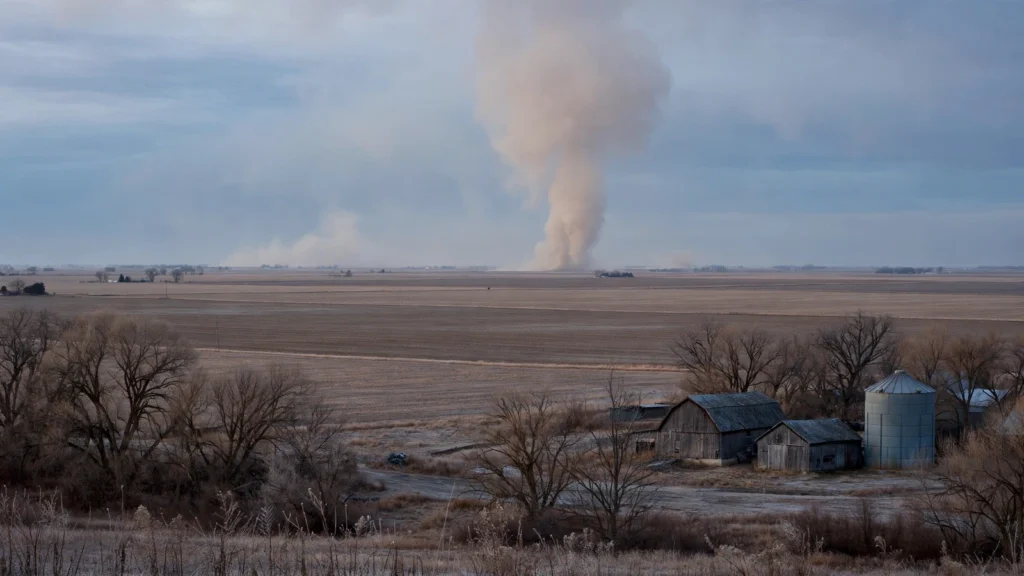
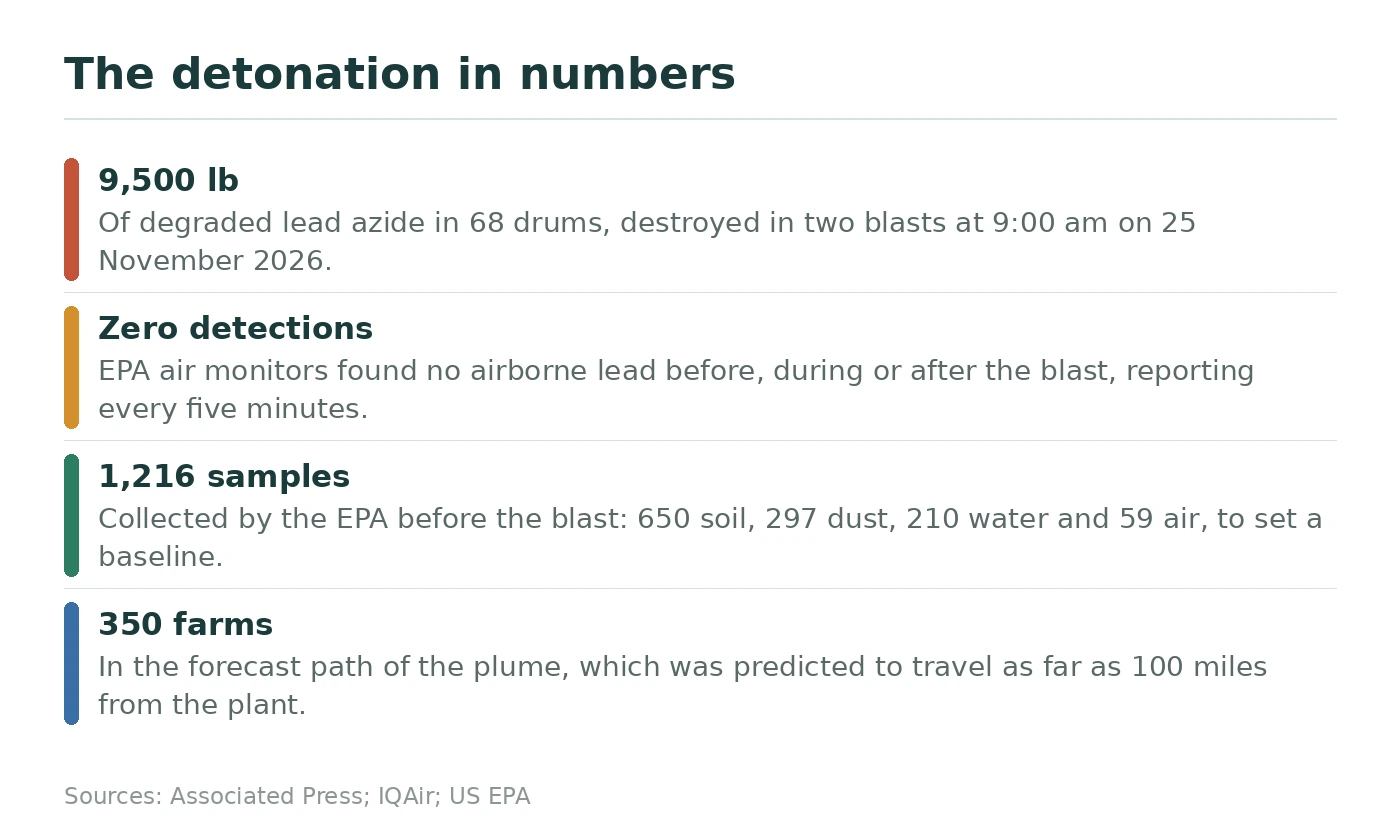
At 9:00 am local time on Wednesday 25 November 2026, the US Army carried out two controlled detonations at the Iowa Army Ammunition Plant in Middletown, about 10 miles from the Mississippi River. The blasts destroyed the nation’s entire stockpile of lead azide — 68 drums holding around 9,500 pounds (4,300 kg) of the chemical — which had been stored at the plant since at least the 1980s.
Two loud booms were heard for miles, and white plumes rose hundreds of feet before quickly clearing. To limit the spread of dust, the Army surrounded the bunkers with two-storey sand barriers, soaked the ground with water, and sprayed foam and gel designed to capture particles. The blast was directed south and south-west, away from populated areas, and winds carried any dust away from Burlington, a city of just under 25,000 people on the Mississippi.
What is lead azide, and why did it have to go?
Lead azide is a primary explosive — a chemical used to set off other explosives in munitions — and it has been used for that purpose since the First World War. It is dangerous to handle because, once it crystallises, it becomes highly sensitive to shock, friction and cold.
That is what happened in Iowa. The drums were kept in a bath of ethanol and water meant to keep the chemical stable, but the liquid had evaporated, and the lead azide had recrystallised. An inspection in March 2026 found the stockpile deteriorating, and a further inspection in April found 58 of the 68 drums affected. The Army concluded the material could detonate on its own at any time, and that nobody could safely approach or move it. After a chemical-neutralisation contract was cancelled over safety concerns and a court cleared the plan, the Army decided a controlled detonation was the safest way to remove the hazard — a decision environmental groups had challenged in court, arguing for more safeguards and more time.
What did the air monitoring show?
The early results were reassuring. The Environmental Protection Agency (EPA) said all of its air monitors reported zero detections of airborne lead before, during and after the blast, with readings taken every five minutes. Army maps showed the same, and no effects were reported in neighbouring Illinois. The Army announced an all-clear just after 6:30 pm local time, about nine hours after the detonation, and mobile alerts told residents it was safe to resume normal activities.
Before the blast, the EPA had collected 1,216 samples — 650 soil, 297 dust, 210 water and 59 air — to establish a baseline, and deployed about 300 staff and contractors to the area. Iowa’s governor had declared a disaster emergency for Des Moines, Lee and Van Buren counties, residents within 5 miles were advised to consider evacuating, and those 5 to 20 miles away were told to stay indoors with windows closed. About 350 farms lay in the forecast path of the plume.
Why “no lead detected” is not the final answer
Air monitors only measure what passes the sensor at a given place and time. They cannot show whether lead dust settled on soil, roofs, playgrounds or window sills — and settled dust is one of the main ways children are exposed to lead. That is why the soil and surface results matter more than the air readings, and they have not yet been released. Laboratory analysis of those samples is expected to take days to weeks.
Before the blast, the lead-dust plume was predicted to travel as far as 100 miles from the plant. One chemist estimated that around 7,000 pounds of lead could be released, and the Army estimated surface lead levels of 100 micrograms per square foot or higher in places. Independent researchers from the Universities of Iowa and Nebraska are running their own air and soil monitoring alongside the federal testing.
Experts have urged caution in the meantime. Andrew Whelton, an environmental engineering professor at Purdue University, called the EPA’s air data promising but stressed that samples need laboratory testing before anyone can judge the health risk, and that different communities may need different advice depending on how far they are from the plant and whether they were downwind.
How does lead affect health?
Lead is a toxic metal with no known safe level of exposure. The CDC states that no safe blood lead level in children has been identified: even low levels are associated with developmental delays, difficulty learning and behavioural problems, and the effects can be permanent. Children under six are most at risk because their brains are still developing, they absorb more of the lead they swallow than adults do, and they often put hands, toys and soil in their mouths.
In adults, lead exposure is linked to high blood pressure, kidney damage and anaemia. NHS inform lists the symptoms of lead poisoning in children as irritability and fatigue, loss of appetite and weight loss, abdominal pain, vomiting, constipation, hearing loss and developmental delay. In adults, symptoms can include abdominal pain, constipation, joint and muscle pain, headaches, numbness or tingling in the hands and feet, fatigue and memory loss. Many children with raised lead levels have no obvious symptoms at all, which is why testing matters.
The CDC uses a blood lead reference value of 3.5 micrograms per decilitre to identify children with higher levels than most, and estimates that about 500,000 children in the United States sit at or above that value. A blood lead test is the only way to tell whether a person has been exposed.
What should people near Middletown do now?
Officials have advised residents to follow instructions from the Army, FEMA and local authorities on returning to evacuated areas. Practical steps recommended by health agencies include wet-cleaning surfaces children touch, such as play equipment, toys, railings and window sills; washing cars parked outdoors; removing shoes at the door; and washing hands often, especially before eating and after children play outside.
People who are concerned about exposure — particularly parents of children under six and pregnant women — should speak to their doctor about whether a blood lead test is appropriate. Residents should not collect soil samples or disturb soil near the plant until officials declare the area clear, and livestock owners who believe animals were harmed can file claims with the Army.
When to see a doctor
Speak to a doctor promptly if you or your child were near the detonation area and develop symptoms such as persistent abdominal pain, vomiting, constipation, unusual tiredness, headaches or hearing changes — or if you are pregnant and think you may have been exposed. Mention the possible lead exposure so the doctor can decide whether a blood lead test is needed. Do not wait for symptoms to appear if you are worried: many children with raised lead levels feel entirely well, and a blood test is the only way to check.
In an emergency call 911 (US), 999 (UK) or 112 (EU).
Frequently asked questions
What is lead azide?
Lead azide is a primary explosive, a chemical used to set off other explosives in munitions, and it has been used for that purpose since the First World War. It becomes highly sensitive to shock, friction and cold once it crystallises. The Iowa stockpile had deteriorated after its stabilising bath of ethanol and water evaporated, which is why the Army decided it could no longer be stored or moved safely.
Was any lead detected in the air after the Iowa detonation?
No. The EPA said all of its air monitors reported zero detections of airborne lead before, during and after the blast, with readings taken every five minutes, and Army maps showed the same. An all-clear was issued about nine hours after the detonation. But air monitors cannot show whether lead dust settled on soil or surfaces, and those laboratory results are still pending.
How does lead exposure affect children?
Children under six are most at risk because their brains are still developing and they absorb more lead than adults. The CDC says no safe blood lead level in children has been identified: even low levels are linked to developmental delays, difficulty learning and behaviour problems, and the effects can be permanent. Symptoms can include irritability, fatigue, loss of appetite, abdominal pain, vomiting, constipation and hearing loss.
What should people near Middletown do now?
Follow instructions from the Army, FEMA and local authorities on returning to evacuated areas. Wet-clean surfaces children touch, such as toys, railings and window sills, wash cars parked outdoors, remove shoes at the door and wash hands often. Parents of children under six and pregnant women who are concerned should speak to their doctor about a blood lead test.
How is lead exposure tested?
A blood lead test is the only way to tell whether a person has been exposed to lead. Parents can talk to their doctor about whether a test is needed for their child, and doctors can recommend follow-up care based on the result. The CDC uses a reference value of 3.5 micrograms per decilitre to identify children with higher levels than most, and about 500,000 US children sit at or above it.
Sources
- IQAir: Iowa lead azide detonation: What to know about air quality risks www.iqair.com
- Associated Press: Army calls detonation of bomb chemicals in Iowa a success after earlier fears of a toxic plume gmg-wjxt-prod.cdn.arcpublishing.com
- CDC: About Childhood Lead Poisoning Prevention www.cdc.gov
- NHS inform: Lead poisoning www.nhsinform.scot
- GOV.UK: Lead: information for the public www.gov.uk
- Wikipedia: Iowa lead azide detonation en.wikipedia.org

Try the tool
Not sure if it can wait?
Common causes and warning signs for 16 everyday symptoms.
Open the symptom guide